Futexes and memory ordering
This chapter covers
- The futex: a wait queue in the kernel, keyed by the address of a word in your memory
- A mutex with three states that enters the kernel only to sleep and to wake
- Why the kernel checks the word before it puts a thread to sleep
- Counting the system calls a mutex makes, and comparing it with
std::sync::Mutex - Store buffers, and the reordering they allow even on x86
- Two litmus tests run a million times: store buffering, and message passing
Chapter 16 built a spin lock from one atomic flag. A thread that found the lock taken kept the CPU busy until the lock came free. That is a good trade for a lock held for a few nanoseconds. It is a poor one for a lock held while a thread writes a file. Such a lock has to put the waiting thread to sleep and wake it later. Only the kernel can do that.
This chapter builds such a lock on the Linux futex system call, the same design std::sync::Mutex uses
on Linux. Then it looks under the orderings chapter 16 used. It runs two classic litmus tests a million times each, and counts how often the hardware reorders memory operations.
26.1 Sleeping on a word
A futex, a fast user-space mutex, is a wait queue in the kernel, keyed by an address. The word at that address lives in your program’s memory, and the kernel never interprets it. A futex has two operations:
futex_wait(addr, expected): if the 32-bit word ataddrstill holdsexpected, put this thread to sleep on the queue foraddr. If it holds anything else, return at once.futex_wake(addr, n): wake up tonthreads sleeping on the queue foraddr.
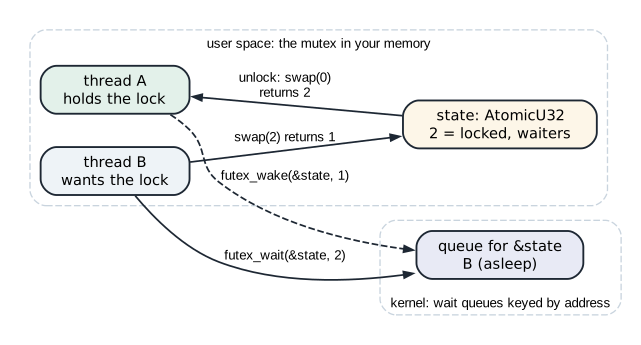
The lock state stays in an atomic in user space (figure 26.1). Taking a free lock is one compare-exchange
on that word, with no system call. Only a thread that has to wait calls futex_wait, and only an unlock that may have a sleeper to wake calls futex_wake.
26.1.1 Why the kernel checks the word
futex_wait checks the word and queues the thread as one step, under a kernel lock. Without the check,
this sequence would lose a wake-up:
- Thread B reads the lock word and sees it held. B decides to sleep.
- Thread A unlocks and calls
futex_wake. No thread is on the queue yet, so the wake does nothing. - B enters the queue and sleeps. Nobody will wake it.
With the check, step 3 finds that the word no longer holds the value B saw, and futex_wait returns at
once. B then tries the lock again. This is the lost wake-up problem, and it is the reason Condvar in
chapter 16 takes the mutex as an argument.
26.2 A mutex with three states
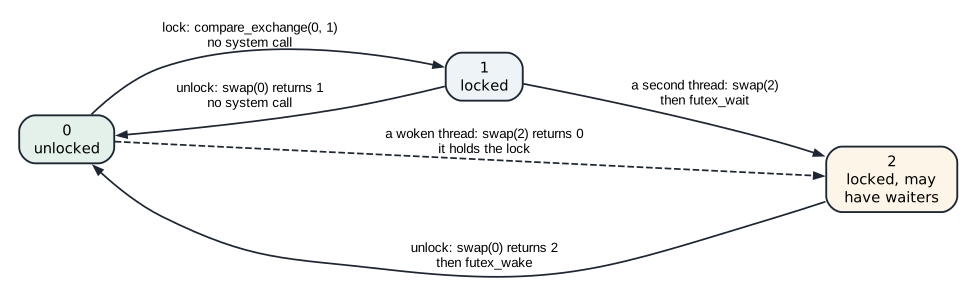
The lock word has three values (figure 26.2):
- 0, unlocked.
- 1, locked, and no thread is waiting.
- 2, locked, and some thread may be asleep in
futex_wait.
The third state exists so that unlock knows whether to call futex_wake. Unlocking from 1 costs one
atomic instruction. Unlocking from 2 also costs a system call.
26.2.1 The system calls
libc has no wrapper for futex, so the program calls it through syscall, which takes a system call’s
number and its arguments:
unsafe extern "C" {
    fn syscall(number: c_long, ...) -> c_long;
}

// The futex call, as the kernel defines its arguments:
// syscall(SYS_futex, uaddr: *const u32, op: c_int, val: u32, timeout: *const timespec)
//   FUTEX_WAIT: sleep if *uaddr == val, until woken or until the timeout (null: none)
//   FUTEX_WAKE: wake up to val threads sleeping on uaddr; timeout is unused
The two wrappers:
#[cfg(target_os = "linux")]
mod linux {
    use std::{
        cell::UnsafeCell,
        ops::{Deref, DerefMut},
        sync::atomic::{
            AtomicU32,
            AtomicU64,
            Ordering::{Acquire, Relaxed, Release},
        },
    };

    const UNLOCKED: u32 = 0;
    const LOCKED: u32 = 1;
    const CONTENDED: u32 = 2;

    /// Sleep while `word` holds `expected`. The kernel checks the value and
    /// queues the thread as one step, so a wake that happens first is not lost.
    fn futex_wait(word: &AtomicU32, expected: u32) {
        // SAFETY: `word` is a valid, aligned u32 for the whole call, and a null
        // timeout means wait without a time limit.
        unsafe {
            libc::syscall(
                libc::SYS_futex,
                word.as_ptr(),
                libc::FUTEX_WAIT | libc::FUTEX_PRIVATE_FLAG,
                expected,
                std::ptr::null::<libc::timespec>(),
            );
        }
    }

    /// Wake one thread sleeping on `word`, if there is one.
    fn futex_wake_one(word: &AtomicU32) {
        // SAFETY: `word` is a valid, aligned u32 for the whole call.
        unsafe {
            libc::syscall(
                libc::SYS_futex,
                word.as_ptr(),
                libc::FUTEX_WAKE | libc::FUTEX_PRIVATE_FLAG,
                1,
            );
        }
    }
    // ...
}
FUTEX_PRIVATE_FLAG tells the kernel that only this process uses the word. The kernel can then key the queue by the virtual address alone. A word shared between processes needs the physical page, which costs more to find. AtomicU32::as_ptr gives the address of the atomic’s value. The return value is ignored. futex_wait returns early for several reasons, a signal among them, and the caller checks the word again anyway.
26.2.2 lock and unlock
The type holds the word, two counters for this chapter’s measurements, and the protected value:
mod linux {
    // ...
    /// A mutual-exclusion lock that sleeps in the kernel while it waits.
    pub struct FutexMutex<T> {
        state: AtomicU32,
        waits: AtomicU64,
        wakes: AtomicU64,
        value: UnsafeCell<T>,
    }

    // SAFETY: the lock gives one thread at a time access to `value`, so sharing
    // the mutex is safe whenever `T` may move between threads.
    unsafe impl<T: Send> Sync for FutexMutex<T> {}

    impl<T> FutexMutex<T> {
        pub const fn new(value: T) -> Self {
            Self {
                state: AtomicU32::new(UNLOCKED),
                waits: AtomicU64::new(0),
                wakes: AtomicU64::new(0),
                value: UnsafeCell::new(value),
            }
        }
        // ...
}
As with the spin lock in chapter 16, the unsafe impl Sync promises that the lock hands out value to one
thread at a time. lock returns a Guard, which section 26.2.2 shows below: it gives access to the value,
and unlocks when it is dropped. lock tries the uncontended path first:
mod linux {
    // ...
    impl<T> FutexMutex<T> {
        // ...
        pub fn lock(&self) -> Guard<'_, T> {
            if self
                .state
                .compare_exchange(UNLOCKED, LOCKED, Acquire, Relaxed)
                .is_err()
            {
                self.lock_contended();
            }
            Guard { mutex: self }
        }

        /// The slow path: mark the lock contended, and sleep until it is free.
        fn lock_contended(&self) {
            while self.state.swap(CONTENDED, Acquire) != UNLOCKED {
                self.waits.fetch_add(1, Relaxed);
                futex_wait(&self.state, CONTENDED);
            }
        }

        fn unlock(&self) {
            if self.state.swap(UNLOCKED, Release) == CONTENDED {
                self.wakes.fetch_add(1, Relaxed);
                futex_wake_one(&self.state);
            }
        }
        // ...
    }
    // ...
}
compare_exchange(UNLOCKED, LOCKED, Acquire, Relaxed) takes a free lock in one instruction. If it fails,
lock_contended swaps in 2 and looks at the old value. An old value of 0 means the lock was free, and this
thread now holds it. Any other value means the lock is held. The thread sleeps while the word is still 2,
then tries again.
A thread that takes the lock in lock_contended leaves the word at 2, even if no other thread waits. It
cannot know whether others are asleep, so it assumes they are. The cost is a futex_wake call that may find
nobody to wake.
unlock swaps in 0 with Release, which publishes the writes made under the lock, as in section 16.4.3.
The old value says whether to wake a sleeper.
The guard is the same as the spin lock’s:
mod linux {
    // ...
    /// Access to the value while the lock is held. Unlocks when dropped.
    pub struct Guard<'a, T> {
        mutex: &'a FutexMutex<T>,
    }

    impl<T> Deref for Guard<'_, T> {
        type Target = T;

        fn deref(&self) -> &T {
            // SAFETY: the guard exists only while this thread holds the lock.
            unsafe { &*self.mutex.value.get() }
        }
    }

    impl<T> DerefMut for Guard<'_, T> {
        fn deref_mut(&mut self) -> &mut T {
            // SAFETY: as in `deref`, and `&mut self` makes this the only borrow.
            unsafe { &mut *self.mutex.value.get() }
        }
    }

    impl<T> Drop for Guard<'_, T> {
        fn drop(&mut self) {
            self.mutex.unlock();
        }
    }
}
Animation 26.1 follows two threads through the three states, and then shows the lost wake-up.
futex_wait keeps a wake-up from being lost.26.2.3 Measured
main adds 1 to a counter a million times under each lock: with one thread, then split across two and four
threads. It runs in a Linux container with two CPUs:
$ cargo run --release --bin futex_mutex
threads     total    waits    wakes     futex ms       std ms
      1   1000000        0        0         30.8         25.1
      2   1000000    23712    59752         64.4         56.2
      4   1000000    28006    71826         71.0         56.1
With one thread, a million increments made no system calls, at about 30 ns each. With
two threads, about 2.4% of the locks slept. There were 2.5 times as many wakes as waits. Most wakes came
from a thread that had taken the lock in lock_contended, left the word at 2, and woke an empty queue.
std::sync::Mutex uses the same three states, and was faster with contention. Before it sleeps, it spins
for up to 100 rounds, reading the word. A lock held for a few nanoseconds is often free again within those
rounds, so the waiter avoids two system calls. The timings vary between runs by 10% or more on this
container. In one of three runs, std with four threads took 214 ms. The counts of waits and wakes are the
steadier measurement.
26.3 What the hardware reorders
Section 16.2.3 said that Relaxed promises nothing about other memory, and that SeqCst gives one order
all threads agree on. This section shows a reordering that real hardware performs, and the ordering that
forbids it.
26.3.1 Store buffers
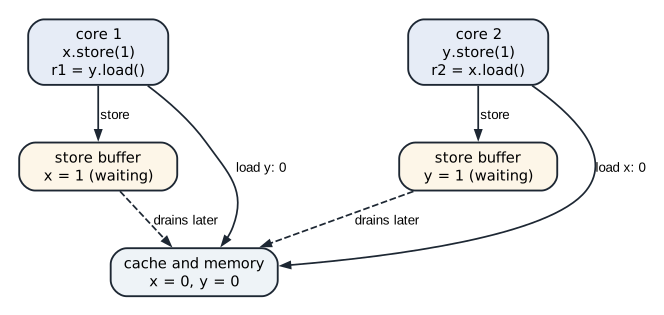
A store to memory is slow for a core: the cache line may have to be fetched from another core first. So each core puts its stores in a store buffer and goes on running. The buffer drains to the cache in the background. The core’s own loads check its buffer, so a thread always sees its own stores. Other cores see a store only after it drains.
A load that comes after a store can therefore complete before the store is visible to anyone else. Figure 26.3 shows two cores each doing that at once. Both loads read the old value, 0, from memory, while both stores still sit in the buffers.
Animation 26.2 runs one round of this, then the same round with SeqCst.
Relaxed, both loads run while both stores are still buffered. A SeqCst store drains the buffer first, so the later load of the other thread sees it.x86 processors keep a strong ordering, called total store order. They never reorder two stores, or two
loads, and this store-then-load case is the one reordering they allow. ARM processors, including Apple’s
M-series and AWS Graviton, also reorder stores with stores and loads with loads. The compiler may reorder
Relaxed operations too, on any processor.
26.3.2 The litmus tests
A litmus test is two short threads and a question about the results. Each test here runs a million rounds. Every round uses fresh atomics, so no round needs a reset, and both threads meet before each round so their operations overlap:
use std::{
    sync::atomic::{
        AtomicU32,
        AtomicUsize,
        Ordering::{self, Acquire, Relaxed, Release, SeqCst},
    },
    thread,
};

const ROUNDS: usize = 1_000_000;

/// A fresh, zeroed atomic for every round, so no round needs a reset.
fn zeroed(rounds: usize) -> Vec<AtomicU32> {
    (0..rounds)
        .map(|_| AtomicU32::new(0))
        .collect()
}

/// Wait until both threads have reached `round`. Keeps the two threads on the
/// same round, so their operations overlap in time.
fn meet(arrived: &AtomicUsize, round: usize) {
    arrived.fetch_add(1, SeqCst);
    while arrived.load(SeqCst) < 2 * (round + 1) {
        std::hint::spin_loop();
    }
}
meet is a spin barrier on one counter. Each thread adds 1 and waits until both have arrived for this round.
Store buffering is figure 26.3 as code. The question is whether both loads can read 0:
/// Store buffering. Thread 1 stores x and loads y; thread 2 stores y and loads
/// x. Returns the rounds in which both loads read 0.
fn store_buffering(store: Ordering, load: Ordering) -> usize {
    let (x, y) = (zeroed(ROUNDS), zeroed(ROUNDS));
    let (r1, r2) = (zeroed(ROUNDS), zeroed(ROUNDS));
    let arrived = AtomicUsize::new(0);

    thread::scope(|scope| {
        scope.spawn(|| {
            for i in 0..ROUNDS {
                meet(&arrived, i);
                x[i].store(1, store);
                r1[i].store(y[i].load(load), Relaxed);
            }
        });
        scope.spawn(|| {
            for i in 0..ROUNDS {
                meet(&arrived, i);
                y[i].store(1, store);
                r2[i].store(x[i].load(load), Relaxed);
            }
        });
    });

    (0..ROUNDS)
        .filter(|&i| r1[i].load(Relaxed) == 0 && r2[i].load(Relaxed) == 0)
        .count()
}
Message passing writes data, then sets a flag. The question is whether the reader can see the flag set and the data still 0:
/// Message passing. Thread 1 writes data, then sets a flag; thread 2 reads the
/// flag, then the data. Returns the rounds in which thread 2 saw the flag set
/// but the data still 0.
fn message_passing(store: Ordering, load: Ordering) -> usize {
    let (data, flag) = (zeroed(ROUNDS), zeroed(ROUNDS));
    let (seen_flag, seen_data) = (zeroed(ROUNDS), zeroed(ROUNDS));
    let arrived = AtomicUsize::new(0);

    thread::scope(|scope| {
        scope.spawn(|| {
            for i in 0..ROUNDS {
                meet(&arrived, i);
                data[i].store(42, Relaxed);
                flag[i].store(1, store);
            }
        });
        scope.spawn(|| {
            for i in 0..ROUNDS {
                meet(&arrived, i);
                seen_flag[i].store(flag[i].load(load), Relaxed);
                seen_data[i].store(data[i].load(Relaxed), Relaxed);
            }
        });
    });

    (0..ROUNDS)
        .filter(|&i| seen_flag[i].load(Relaxed) == 1 && seen_data[i].load(Relaxed) == 0)
        .count()
}
Message passing is the pattern behind every lock and every queue: the flag says the data is ready. Its
Release store and Acquire load are the pair from section 16.4.3.
The run on an Intel x86 laptop:
$ cargo run --release --bin litmus
store buffering, 1000000 rounds: both loads read 0
  Relaxed               14472
  Release / Acquire     15019
  SeqCst                    0

message passing, 1000000 rounds: flag read as 1, data read as 0
  Relaxed                   0
  Release / Acquire         0
  SeqCst                    0
The Linux container on the same machine found 6,342 and 5,045 rounds for store buffering, and the same zeros elsewhere. The results say three things:
- Store buffering happens. About 1.5% of rounds read 0 twice with
Relaxed.ReleaseandAcquiredid not prevent it. They order a thread’s earlier operations before a release store, and later operations after an acquire load. Neither stops a store from being passed by a later load. SeqCstforbids it. On x86, aSeqCststore compiles to anxchginstruction, which waits for the store buffer to drain. EverySeqCstoperation then fits one global order, and in any such order one of the stores comes first, so one load sees 1.- Message passing did not fail, even with
Relaxed. On x86 the hardware does not reorder the two stores or the two loads. TheRelaxedversion is still wrong. On ARM the same test fails in some rounds, and the compiler may reorder theRelaxedoperations on any processor. A test that passes on x86 does not show that the orderings are right.
26.4 The complete programs
Listing 26.1 A mutex on the futex system call. src/bin/futex_mutex.rs
//! A mutex built on the futex system call.
//!
//! The lock is one 32-bit word with three states: 0 unlocked, 1 locked, and
//! 2 locked with threads that may be asleep waiting for it. Taking a free lock
//! and releasing a lock nobody waits for are single atomic instructions. Only a
//! thread that has to wait, and an unlock that has to wake it, enter the kernel.
//!
//! Linux only. Run with: cargo run --release --bin futex_mutex

#[cfg(target_os = "linux")]
mod linux {
    use std::{
        cell::UnsafeCell,
        ops::{Deref, DerefMut},
        sync::atomic::{
            AtomicU32,
            AtomicU64,
            Ordering::{Acquire, Relaxed, Release},
        },
    };

    const UNLOCKED: u32 = 0;
    const LOCKED: u32 = 1;
    const CONTENDED: u32 = 2;

    /// Sleep while `word` holds `expected`. The kernel checks the value and
    /// queues the thread as one step, so a wake that happens first is not lost.
    fn futex_wait(word: &AtomicU32, expected: u32) {
        // SAFETY: `word` is a valid, aligned u32 for the whole call, and a null
        // timeout means wait without a time limit.
        unsafe {
            libc::syscall(
                libc::SYS_futex,
                word.as_ptr(),
                libc::FUTEX_WAIT | libc::FUTEX_PRIVATE_FLAG,
                expected,
                std::ptr::null::<libc::timespec>(),
            );
        }
    }

    /// Wake one thread sleeping on `word`, if there is one.
    fn futex_wake_one(word: &AtomicU32) {
        // SAFETY: `word` is a valid, aligned u32 for the whole call.
        unsafe {
            libc::syscall(
                libc::SYS_futex,
                word.as_ptr(),
                libc::FUTEX_WAKE | libc::FUTEX_PRIVATE_FLAG,
                1,
            );
        }
    }

    /// A mutual-exclusion lock that sleeps in the kernel while it waits.
    pub struct FutexMutex<T> {
        state: AtomicU32,
        waits: AtomicU64,
        wakes: AtomicU64,
        value: UnsafeCell<T>,
    }

    // SAFETY: the lock gives one thread at a time access to `value`, so sharing
    // the mutex is safe whenever `T` may move between threads.
    unsafe impl<T: Send> Sync for FutexMutex<T> {}

    impl<T> FutexMutex<T> {
        pub const fn new(value: T) -> Self {
            Self {
                state: AtomicU32::new(UNLOCKED),
                waits: AtomicU64::new(0),
                wakes: AtomicU64::new(0),
                value: UnsafeCell::new(value),
            }
        }

        pub fn lock(&self) -> Guard<'_, T> {
            if self
                .state
                .compare_exchange(UNLOCKED, LOCKED, Acquire, Relaxed)
                .is_err()
            {
                self.lock_contended();
            }
            Guard { mutex: self }
        }

        /// The slow path: mark the lock contended, and sleep until it is free.
        fn lock_contended(&self) {
            while self.state.swap(CONTENDED, Acquire) != UNLOCKED {
                self.waits.fetch_add(1, Relaxed);
                futex_wait(&self.state, CONTENDED);
            }
        }

        fn unlock(&self) {
            if self.state.swap(UNLOCKED, Release) == CONTENDED {
                self.wakes.fetch_add(1, Relaxed);
                futex_wake_one(&self.state);
            }
        }

        /// The number of `futex` wait and wake calls this mutex has made.
        pub fn syscalls(&self) -> (u64, u64) {
            (self.waits.load(Relaxed), self.wakes.load(Relaxed))
        }

        pub fn into_inner(self) -> T {
            self.value.into_inner()
        }
    }

    /// Access to the value while the lock is held. Unlocks when dropped.
    pub struct Guard<'a, T> {
        mutex: &'a FutexMutex<T>,
    }

    impl<T> Deref for Guard<'_, T> {
        type Target = T;

        fn deref(&self) -> &T {
            // SAFETY: the guard exists only while this thread holds the lock.
            unsafe { &*self.mutex.value.get() }
        }
    }

    impl<T> DerefMut for Guard<'_, T> {
        fn deref_mut(&mut self) -> &mut T {
            // SAFETY: as in `deref`, and `&mut self` makes this the only borrow.
            unsafe { &mut *self.mutex.value.get() }
        }
    }

    impl<T> Drop for Guard<'_, T> {
        fn drop(&mut self) {
            self.mutex.unlock();
        }
    }
}

#[cfg(target_os = "linux")]
fn main() {
    use std::{
        sync::Mutex,
        thread,
        time::{Duration, Instant},
    };

    use linux::FutexMutex;

    const INCREMENTS: u64 = 1_000_000;

    /// Run `add` INCREMENTS times in total, split across `threads`.
    fn timed(threads: u64, add: &(dyn Fn() + Sync)) -> Duration {
        let start = Instant::now();
        thread::scope(|scope| {
            for _ in 0..threads {
                scope.spawn(|| (0..INCREMENTS / threads).for_each(|_| add()));
            }
        });
        start.elapsed()
    }

    // One untimed pass of each, so neither pays for a cold start in the table.
    let warm = FutexMutex::new(0u64);
    timed(1, &|| *warm.lock() += 1);
    let warm = Mutex::new(0u64);
    timed(1, &|| *warm.lock().unwrap() += 1);

    println!(
        "{:>7} {:>9} {:>8} {:>8} {:>12} {:>12}",
        "threads", "total", "waits", "wakes", "futex ms", "std ms"
    );
    for threads in [1, 2, 4] {
        let futex = FutexMutex::new(0u64);
        let futex_time = timed(threads, &|| *futex.lock() += 1);
        let (waits, wakes) = futex.syscalls();

        let std = Mutex::new(0u64);
        let std_time = timed(threads, &|| *std.lock().unwrap() += 1);
        assert_eq!(std.into_inner().unwrap(), INCREMENTS);

        println!(
            "{threads:>7} {:>9} {waits:>8} {wakes:>8} {:>12.1} {:>12.1}",
            futex.into_inner(),
            futex_time.as_secs_f64() * 1000.0,
            std_time.as_secs_f64() * 1000.0
        );
    }
}

#[cfg(not(target_os = "linux"))]
fn main() {
    eprintln!("futex_mutex uses the Linux futex system call; run it on Linux");
}

#[cfg(all(test, target_os = "linux"))]
mod tests {
    use std::thread;

    use super::linux::FutexMutex;

    #[test]
    fn an_uncontended_lock_makes_no_system_calls() {
        let mutex = FutexMutex::new(0);
        for _ in 0..1000 {
            *mutex.lock() += 1;
        }
        assert_eq!(mutex.syscalls(), (0, 0));
        assert_eq!(mutex.into_inner(), 1000);
    }

    #[test]
    fn contended_increments_are_not_lost() {
        let mutex = FutexMutex::new(0);
        thread::scope(|scope| {
            for _ in 0..8 {
                scope.spawn(|| {
                    for _ in 0..10_000 {
                        *mutex.lock() += 1;
                    }
                });
            }
        });
        assert_eq!(mutex.into_inner(), 80_000);
    }
}
Listing 26.2 Store buffering and message passing, a million rounds each. src/bin/litmus.rs
//! Memory-ordering litmus tests, run many times on real hardware.
//!
//! A litmus test is two short threads and a question: can this combination
//! of results happen? Each test runs a million rounds and counts the rounds
//! that ended with the result in question.
//!
//! Run with: cargo run --release --bin litmus

use std::{
    sync::atomic::{
        AtomicU32,
        AtomicUsize,
        Ordering::{self, Acquire, Relaxed, Release, SeqCst},
    },
    thread,
};

const ROUNDS: usize = 1_000_000;

/// A fresh, zeroed atomic for every round, so no round needs a reset.
fn zeroed(rounds: usize) -> Vec<AtomicU32> {
    (0..rounds)
        .map(|_| AtomicU32::new(0))
        .collect()
}

/// Wait until both threads have reached `round`. Keeps the two threads on the
/// same round, so their operations overlap in time.
fn meet(arrived: &AtomicUsize, round: usize) {
    arrived.fetch_add(1, SeqCst);
    while arrived.load(SeqCst) < 2 * (round + 1) {
        std::hint::spin_loop();
    }
}

/// Store buffering. Thread 1 stores x and loads y; thread 2 stores y and loads
/// x. Returns the rounds in which both loads read 0.
fn store_buffering(store: Ordering, load: Ordering) -> usize {
    let (x, y) = (zeroed(ROUNDS), zeroed(ROUNDS));
    let (r1, r2) = (zeroed(ROUNDS), zeroed(ROUNDS));
    let arrived = AtomicUsize::new(0);

    thread::scope(|scope| {
        scope.spawn(|| {
            for i in 0..ROUNDS {
                meet(&arrived, i);
                x[i].store(1, store);
                r1[i].store(y[i].load(load), Relaxed);
            }
        });
        scope.spawn(|| {
            for i in 0..ROUNDS {
                meet(&arrived, i);
                y[i].store(1, store);
                r2[i].store(x[i].load(load), Relaxed);
            }
        });
    });

    (0..ROUNDS)
        .filter(|&i| r1[i].load(Relaxed) == 0 && r2[i].load(Relaxed) == 0)
        .count()
}

/// Message passing. Thread 1 writes data, then sets a flag; thread 2 reads the
/// flag, then the data. Returns the rounds in which thread 2 saw the flag set
/// but the data still 0.
fn message_passing(store: Ordering, load: Ordering) -> usize {
    let (data, flag) = (zeroed(ROUNDS), zeroed(ROUNDS));
    let (seen_flag, seen_data) = (zeroed(ROUNDS), zeroed(ROUNDS));
    let arrived = AtomicUsize::new(0);

    thread::scope(|scope| {
        scope.spawn(|| {
            for i in 0..ROUNDS {
                meet(&arrived, i);
                data[i].store(42, Relaxed);
                flag[i].store(1, store);
            }
        });
        scope.spawn(|| {
            for i in 0..ROUNDS {
                meet(&arrived, i);
                seen_flag[i].store(flag[i].load(load), Relaxed);
                seen_data[i].store(data[i].load(Relaxed), Relaxed);
            }
        });
    });

    (0..ROUNDS)
        .filter(|&i| seen_flag[i].load(Relaxed) == 1 && seen_data[i].load(Relaxed) == 0)
        .count()
}

fn main() {
    let orderings = [
        ("Relaxed", Relaxed, Relaxed),
        ("Release / Acquire", Release, Acquire),
        ("SeqCst", SeqCst, SeqCst),
    ];

    println!("store buffering, {ROUNDS} rounds: both loads read 0");
    for (name, store, load) in orderings {
        println!("  {name:<18} {:>8}", store_buffering(store, load));
    }

    println!("\nmessage passing, {ROUNDS} rounds: flag read as 1, data read as 0");
    for (name, store, load) in orderings {
        println!("  {name:<18} {:>8}", message_passing(store, load));
    }
}

#[cfg(test)]
mod tests {
    use super::*;

    #[test]
    fn seq_cst_forbids_both_loads_reading_zero() {
        assert_eq!(store_buffering(SeqCst, SeqCst), 0);
    }

    #[test]
    fn release_acquire_forbids_a_flag_without_its_data() {
        assert_eq!(message_passing(Release, Acquire), 0);
    }
}
26.5 Questions that come up
“Why not always spin, or always sleep?”
Spinning wastes a CPU for as long as the wait lasts. Sleeping costs two system calls and a context switch,
a few microseconds. A short spin followed by a sleep handles both short and long holds, which is what
std::sync::Mutex does.
“What is priority inversion, and does a futex help?”
A low-priority thread holds a lock that a high-priority thread waits for. Meanwhile a medium-priority thread keeps the low one off the CPU. Linux has priority-inheritance futexes, FUTEX_LOCK_PI, which raise the
holder’s priority while a higher-priority thread waits.
“Can a futex be shared between processes?”
Yes. Put the word in memory both processes map, such as a MAP_SHARED mapping from section 23.2, and leave
out FUTEX_PRIVATE_FLAG. The kernel then keys the queue by the physical page.
“When is Relaxed correct?”
When no other memory depends on the value: a statistics counter, or a unique id from fetch_add. Once a
value says that other data is ready, it needs Release and Acquire.
“When is SeqCst needed?”
When correctness depends on a single order of operations on different variables, as in store buffering.
Dekker’s mutual-exclusion algorithm is the classic case. Most code built from locks, channels, and
Release/Acquire pairs does not need it.
Summary
- A futex is a kernel wait queue keyed by the address of a word in user memory.
futex_waitsleeps only if the word still holds the expected value, which prevents a lost wake-up. - A three-state mutex takes and releases an uncontended lock with one atomic instruction each. It enters the kernel only to sleep or to wake a sleeper.
- One thread made a million increments under the lock with no system calls. Under contention, the conservative state 2 made more wakes than waits.
std::sync::Mutexspins briefly before sleeping, which saved system calls in this test.- A store buffer lets a later load complete before an earlier store is visible. x86 allows this one reordering. ARM allows more.
- Store buffering read 0 twice in about 1.5% of a million rounds with
RelaxedorRelease/Acquire, and never withSeqCst. Message passing never failed on x86, which does not makeRelaxedcorrect there.
Chapter 27 starts Part 9, production networking. It follows a TCP connection through its close. It covers the states after FIN, the length of TIME_WAIT, and the CLOSE_WAIT sockets a leaking server piles up.
Exercises
- Add a spin to
lock_contended: up to 100 relaxed loads of the word, stopping early when it reads 0, before the firstswap. Compare the waits, wakes, and times with the table in section 26.2.3. - Hold the lock for 50 microseconds inside each increment, with a busy loop, and run four threads. Compare
the futex mutex with chapter 16’s spin lock in total time and in CPU time (
/usr/bin/time -v). - Remove the
expectedcheck by passing a value the word never holds, such as 7, tofutex_wait. Explain why the program now burns CPU instead of sleeping. - Change the message-passing test to
Relaxedfor both and build it foraarch64(or run it on an ARM machine). Count the failing rounds. - Add the “load buffering” test: thread 1 loads x then stores y = 1, and thread 2 loads y then stores
x = 1. Can both loads read 1? Run it with
Relaxedon x86 and explain the result.