TLS and mutual TLS
This chapter covers
- What TLS adds to a TCP connection: secrecy, integrity, and proof of who the server is
- Certificates, certificate authorities, and the three checks a client makes
- The TLS 1.3 handshake, and the records it puts on the wire, read byte by byte
- A client and server on
rustls, with certificates made at startup byrcgen - The errors a client reports for a wrong name and for an unknown authority
- Mutual TLS, where the server checks a certificate from the client
The connections in chapters 20 to 27 sent their bytes as they were. Every router between the two machines could read them, and could change them without either side noticing. TLS, Transport Layer Security, runs on top of TCP and fixes three things. The bytes are encrypted, so others cannot read them. Each record carries a tag, so a changed byte is detected. And the server proves who it is with a certificate, so the client knows it is not talking to an impostor.
This chapter runs TLS with the rustls crate. The program, tls_mtls, makes its own certificate authority
and certificates when it starts, runs five connections over loopback, and prints what each side reports.
28.1 Certificates and trust
TLS identifies a server with public-key cryptography. A key pair is two numbers: a private key that the owner keeps secret, and a public key that anyone may have. A signature made with the private key can be checked with the public key. Only the holder of the private key can make a signature that checks out.
A certificate is a signed statement: “this public key belongs to localhost, from this date to that
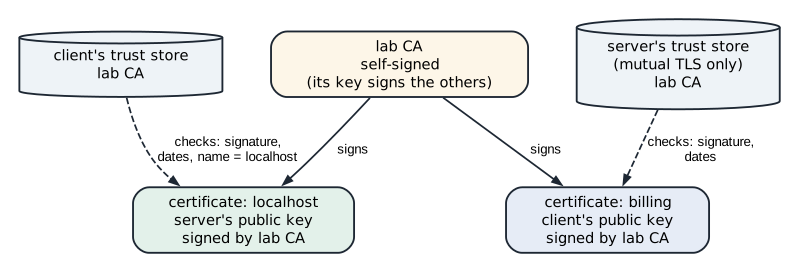
date”. The signer is a certificate authority (CA). A client keeps a trust store, a list of CA
certificates it accepts. When a server presents its certificate, the client makes three checks (figure 28.1):
- The signature. The certificate is signed by a CA in the trust store, possibly through intermediate certificates that the server also sends.
- The dates. The current time is inside the certificate’s validity period.
- The name. One of the names in the certificate matches the name the client connected to.
A certificate is public, so anyone can present one. During the handshake, the server also signs data from that handshake with its private key. That signature proves the server holds the key that matches the certificate.
On the public internet, trust stores hold a few hundred commercial CAs, and browsers ship them. Inside a company, services often trust a private CA of their own, as this program does.
28.1.1 Making the certificates
rcgen creates key pairs and certificates in memory. Pki makes a CA, then has it sign one certificate
for the server and one for the client:
use std::{
    io::{self, Read, Write},
    net::{TcpListener, TcpStream},
    sync::{Arc, Mutex},
    thread,
};

use rcgen::{BasicConstraints, CertificateParams, DnType, IsCa, KeyPair};
use rustls::{
    ClientConfig,
    ClientConnection,
    RootCertStore,
    ServerConfig,
    ServerConnection,
    StreamOwned,
    crypto::{CryptoProvider, ring},
    pki_types::{CertificateDer, PrivateKeyDer, PrivatePkcs8KeyDer, ServerName},
    server::WebPkiClientVerifier,
};

type Error = Box<dyn std::error::Error + Send + Sync>;

/// A certificate and the private key that goes with it.
struct Identity {
    cert: CertificateDer<'static>,
    key: PrivatePkcs8KeyDer<'static>,
}

impl Identity {
    fn key(&self) -> PrivateKeyDer<'static> {
        PrivateKeyDer::Pkcs8(self.key.clone_key())
    }
}

/// A certificate authority, and certificates it signed for a server and a client.
struct Pki {
    ca: CertificateDer<'static>,
    server: Identity,
    client: Identity,
}

impl Pki {
    fn new() -> Result<Self, Error> {
        let ca_key = KeyPair::generate()?;
        let mut ca_params = CertificateParams::new(Vec::<String>::new())?;
        ca_params.is_ca = IsCa::Ca(BasicConstraints::Unconstrained);
        ca_params
            .distinguished_name
            .push(DnType::CommonName, "lab CA");
        let ca = ca_params.self_signed(&ca_key)?;

        let issue = |name: &str| -> Result<Identity, Error> {
            let key = KeyPair::generate()?;
            let mut params = CertificateParams::new(vec![name.to_string()])?;
            params
                .distinguished_name
                .push(DnType::CommonName, name);
            let cert = params.signed_by(&key, &ca, &ca_key)?;
            Ok(Identity {
                cert: cert.der().clone(),
                key: PrivatePkcs8KeyDer::from(key.serialize_der()),
            })
        };
        let server = issue("localhost")?;
        let client = issue("billing")?;
        Ok(Self {
            ca: ca.der().clone(),
            server,
            client,
        })
    }

    /// A trust store holding only this CA.
    fn roots(&self) -> Result<RootCertStore, Error> {
        let mut roots = RootCertStore::empty();
        roots.add(self.ca.clone())?;
        Ok(roots)
    }
}
IsCa::Ca marks the first certificate as one that may sign others. self_signed signs it with its own key. A CA at the top of a chain vouches for itself. A client trusts it only if it is in the trust store.
CertificateParams::new takes the names the certificate covers. signed_by signs the new certificate’s
public key with the CA’s key. The private keys never leave the process. roots builds a trust store that
holds only this CA.
28.2 The TLS 1.3 handshake
Before any application bytes move, the two sides run a handshake. In TLS 1.3 it takes one round trip:
| Step | From | Messages | Encrypted |
|---|---|---|---|
| 1 | client | ClientHello: cipher suites, a key share, and the server’s name (SNI) | no |
| 2 | server | ServerHello: the chosen suite and the server’s key share | no |
| 3 | server | Certificate, CertificateVerify (the signature), Finished | yes |
| 4 | client | Finished | yes |
After step 2, each side combines its own secret with the other’s key share, and both get the same keys. Anyone watching the wire cannot compute them. This is an elliptic-curve Diffie-Hellman exchange. Everything after
ServerHello is encrypted with those keys, including the server’s certificate. The client checks the
certificate and the signature in step 3 before it sends step 4. The client’s first application bytes can
travel with its Finished.
TLS sends everything in records. Each record starts with a 5-byte header: a content type (22 for handshake, 23 for application data), a version, and a 2-byte length.
28.2.1 Watching the wire
To see the records, the client’s socket is wrapped in Tap, which keeps a copy of every byte written.
records walks the copy, one header at a time:
/// A TCP stream that keeps a copy of every byte it sends.
struct Tap {
    stream: TcpStream,
    sent: Arc<Mutex<Vec<u8>>>,
}

impl Read for Tap {
    fn read(&mut self, buffer: &mut [u8]) -> io::Result<usize> {
        self.stream.read(buffer)
    }
}

impl Write for Tap {
    fn write(&mut self, buffer: &[u8]) -> io::Result<usize> {
        let written = self.stream.write(buffer)?;
        self.sent
            .lock()
            .expect("tap lock")
            .extend_from_slice(&buffer[..written]);
        Ok(written)
    }

    fn flush(&mut self) -> io::Result<()> {
        self.stream.flush()
    }
}

/// The TLS records in a byte stream, as (content type, length) pairs.
fn records(mut bytes: &[u8]) -> Vec<(&'static str, usize)> {
    let mut found = Vec::new();
    while let [kind, _, _, high, low, rest @ ..] = bytes {
        let length = usize::from(*high) << 8 | usize::from(*low);
        let name = match kind {
            20 => "change_cipher_spec",
            21 => "alert",
            22 => "handshake",
            23 => "application_data",
            _ => "unknown",
        };
        found.push((name, length));
        bytes = rest.get(length..).unwrap_or_default();
    }
    found
}
The slice pattern [kind, _, _, high, low, rest @ ..] matches only while at least five bytes remain, and
names the parts of the header. rest.get(length..) skips the record’s body, and returns None if the body
is cut short, which ends the loop.
28.2.2 A client and a server
rustls keeps TLS separate from I/O. A ClientConnection or ServerConnection holds the TLS state, and
StreamOwned joins it to any type that implements Read and Write. The handshake runs inside the first
read or write.
The configurations are built in steps. Both name the crypto provider, ring, explicitly. The server gives
its certificate and key, and the client gives its trust store:
fn main() -> Result<(), Error> {
    let pki = Pki::new()?;
    let server_only = || -> Result<ServerConfig, Error> {
        Ok(ServerConfig::builder_with_provider(provider())
            .with_safe_default_protocol_versions()?
            .with_no_client_auth()
            .with_single_cert(vec![pki.server.cert.clone()], pki.server.key())?)
    };
    let client_trusting = |roots: RootCertStore| -> Result<ClientConfig, Error> {
        Ok(ClientConfig::builder_with_provider(provider())
            .with_safe_default_protocol_versions()?
            .with_root_certificates(roots)
            .with_no_client_auth())
    };
    // ...
}
with_safe_default_protocol_versions allows TLS 1.3 and 1.2. with_no_client_auth means the server asks
for no client certificate, and the client offers none.
The server accepts one connection and answers one message in capitals:
/// Accept one connection, and answer one message in capitals. Returns what
/// the server learned about the client, or the error that ended the handshake.
fn serve_once(listener: TcpListener, config: Arc<ServerConfig>) -> thread::JoinHandle<String> {
    thread::spawn(move || {
        let outcome = || -> Result<String, Error> {
            let (stream, _) = listener.accept()?;
            let mut tls = StreamOwned::new(ServerConnection::new(config)?, stream);
            let mut message = [0; 64];
            let read = tls.read(&mut message)?;
            tls.write_all(&message[..read].to_ascii_uppercase())?;
            tls.conn.send_close_notify();
            tls.flush()?;
            Ok(match tls.conn.peer_certificates() {
                Some(chain) => format!("client presented {} verified certificate", chain.len()),
                None => "client presented no certificate".to_string(),
            })
        };
        outcome().unwrap_or_else(|error| format!("handshake failed: {error}"))
    })
}
send_close_notify queues a closing alert, which tells the client that the stream ended on purpose. TLS
needs it because an attacker can cut a TCP connection at any point. Without the alert, the client could not
tell a complete reply from a truncated one, and rustls reports that case as an error.
The client connects through the tap, sends hello over tls, and reads the reply:
/// What one client connection saw.
struct Session {
    version: String,
    suite: String,
    reply: String,
    sent: Vec<u8>,
}

/// Connect to `listener` with `config`, expecting the server to be `name`,
/// send one message, and read the reply.
fn connect(listener: &TcpListener, config: ClientConfig, name: &str) -> Result<Session, Error> {
    let sent = Arc::new(Mutex::new(Vec::new()));
    let tap = Tap {
        stream: TcpStream::connect(listener.local_addr()?)?,
        sent: Arc::clone(&sent),
    };
    let name = ServerName::try_from(name.to_string())?;
    let mut tls = StreamOwned::new(ClientConnection::new(Arc::new(config), name)?, tap);

    tls.write_all(b"hello over tls")?;
    let mut reply = String::new();
    tls.read_to_string(&mut reply)?;

    Ok(Session {
        version: format!(
            "{:?}",
            tls.conn
                .protocol_version()
                .ok_or("no version")?
        ),
        suite: format!(
            "{:?}",
            tls.conn
                .negotiated_cipher_suite()
                .ok_or("no suite")?
                .suite()
        ),
        reply,
        sent: sent.lock().expect("tap lock").clone(),
    })
}
ServerName is the name the client expects. rustls sends it as SNI in the ClientHello, and checks the
server’s certificate against it.
Animation 28.1 follows this connection, then the mutual TLS connections of section 28.4.
ServerHello is encrypted. In mutual TLS the server asks for a certificate, and refuses a client without one.main runs the scenes. The first is the plain case:
1. The client checks the server's certificate
  client: TLSv1_3 TLS13_AES_256_GCM_SHA384, reply "HELLO OVER TLS"
  client sent records: [("handshake", 231), ("change_cipher_spec", 1), ("application_data", 69), ("application_data", 31)]
  "hello" readable on the wire: false
  server: client presented no certificate
The client sent four records:
handshake, 231 bytes: theClientHello, the only record the client sent in the clear.change_cipher_spec, 1 byte: a record TLS 1.3 does not use. It is sent so that old middleboxes, which expect TLS 1.2, let the connection through.application_data, 69 bytes: the client’sFinished. In TLS 1.3, encrypted handshake messages are labeled as application data, so an observer cannot tell them apart.application_data, 31 bytes: the 14 bytes ofhello over tls, plus 1 byte for the real content type and a 16-byte tag that detects any change.

The plaintext appears nowhere in what the client sent.
28.3 When the check fails
The second and third scenes break one of the client’s checks each:
2. The client expects a different name
  client: invalid peer certificate: certificate not valid for name "billing.example"; certificate is only valid for DnsName("localhost")
  server: handshake failed: unexpected end of file

3. The client does not trust the CA
  client: invalid peer certificate: UnknownIssuer
  server: handshake failed: unexpected end of file
In both cases the client stopped in step 3 of the handshake and closed the connection, so the server saw the stream end. The certificate was valid in both. The client rejected it because it named a different server, or because nothing in the trust store had signed it.
These checks are the whole of TLS’s protection against an impostor. Encryption to an unchecked server is
encryption to whoever answered. rustls has no flag to turn the checks off. A program that wants to skip
them must write its own ServerCertVerifier, under a module named danger.
28.4 Mutual TLS
In plain TLS, only the server proves who it is. The client is anonymous at the TLS level, and proves itself,
if at all, with a password or token inside the encrypted stream. In mutual TLS (mTLS), the server asks
for a certificate in the handshake. The client sends one, with its own CertificateVerify signature. Each
side then knows which key the other holds.
Services inside one company use mutual TLS to authenticate each other. The certificate’s name becomes the
caller’s identity, and the server can then authorize by it: requests from billing may read invoices,
for example.
The server adds a client certificate verifier that trusts the same CA:
fn main() -> Result<(), Error> {
    // ...
    let verifier =
        WebPkiClientVerifier::builder_with_provider(Arc::new(pki.roots()?), provider()).build()?;
    let mutual = || -> Result<ServerConfig, Error> {
        Ok(ServerConfig::builder_with_provider(provider())
            .with_safe_default_protocol_versions()?
            .with_client_cert_verifier(verifier.clone())
            .with_single_cert(vec![pki.server.cert.clone()], pki.server.key())?)
    };

    println!("\n4. Mutual TLS, client without a certificate");
    run(mutual()?, client_trusting(pki.roots()?)?, "localhost")?;

    println!("\n5. Mutual TLS, client with the billing certificate");
    let client = ClientConfig::builder_with_provider(provider())
        .with_safe_default_protocol_versions()?
        .with_root_certificates(pki.roots()?)
        .with_client_auth_cert(vec![pki.client.cert.clone()], pki.client.key())?;
    run(mutual()?, client, "localhost")
}
4. Mutual TLS, client without a certificate
client: received fatal alert: CertificateRequired
server: handshake failed: peer sent no certificates
5. Mutual TLS, client with the billing certificate
client: TLSv1_3 TLS13_AES_256_GCM_SHA384, reply "HELLO OVER TLS"
client sent records: [("handshake", 231), ("change_cipher_spec", 1), ("application_data", 481), ("application_data", 31)]
"hello" readable on the wire: false
server: client presented 1 verified certificate
The client without a certificate got a fatal alert, CertificateRequired, and the server reported why.
With the certificate, the client’s encrypted handshake record grew from 69 to 481 bytes. The extra 412
bytes carry the client’s certificate and its signature.
Certificates expire, and a service that uses mutual TLS has to replace them before they do. Production systems issue certificates that last hours or days, and rotate them automatically. A leaked key is then useful only until its certificate expires.
28.4.1 What TLS costs
- A round trip. A new connection waits for TCP’s handshake and then for TLS’s, two round trips before the first request. Across regions that is 100 ms or more. Session resumption lets a client that has connected before skip the certificate exchange. A connection pool (chapter 29) avoids the handshake for most requests.
- CPU. The key exchange and the signatures cost tens to hundreds of microseconds per handshake. The symmetric encryption of the data afterwards runs at gigabytes per second on modern CPUs.
- Copies.
rustlsencrypts in user space, so a TLS server cannot usesendfileto send a file without copying it, as section 23.3.2 explained.
28.5 The complete program
Listing 28.1 TLS and mutual TLS with rustls, on certificates made by rcgen. src/bin/tls_mtls.rs
//! TLS with rustls: a client that checks the server's certificate, the errors
//! it reports when the check fails, and mutual TLS, where the server checks a
//! certificate from the client as well.
//!
//! The certificates are made at startup with rcgen: one certificate authority,
//! a server certificate for "localhost", and a client certificate for a
//! service called "billing". Nothing secret is stored on disk.
//!
//! Run with: cargo run --bin tls_mtls
use std::{
io::{self, Read, Write},
net::{TcpListener, TcpStream},
sync::{Arc, Mutex},
thread,
};
use rcgen::{BasicConstraints, CertificateParams, DnType, IsCa, KeyPair};
use rustls::{
ClientConfig,
ClientConnection,
RootCertStore,
ServerConfig,
ServerConnection,
StreamOwned,
crypto::{CryptoProvider, ring},
pki_types::{CertificateDer, PrivateKeyDer, PrivatePkcs8KeyDer, ServerName},
server::WebPkiClientVerifier,
};
type Error = Box<dyn std::error::Error + Send + Sync>;
/// A certificate and the private key that goes with it.
struct Identity {
cert: CertificateDer<'static>,
key: PrivatePkcs8KeyDer<'static>,
}
impl Identity {
fn key(&self) -> PrivateKeyDer<'static> {
PrivateKeyDer::Pkcs8(self.key.clone_key())
}
}
/// A certificate authority, and certificates it signed for a server and a client.
struct Pki {
ca: CertificateDer<'static>,
server: Identity,
client: Identity,
}
impl Pki {
fn new() -> Result<Self, Error> {
let ca_key = KeyPair::generate()?;
let mut ca_params = CertificateParams::new(Vec::<String>::new())?;
ca_params.is_ca = IsCa::Ca(BasicConstraints::Unconstrained);
ca_params
.distinguished_name
.push(DnType::CommonName, "lab CA");
let ca = ca_params.self_signed(&ca_key)?;
let issue = |name: &str| -> Result<Identity, Error> {
let key = KeyPair::generate()?;
let mut params = CertificateParams::new(vec![name.to_string()])?;
params
.distinguished_name
.push(DnType::CommonName, name);
let cert = params.signed_by(&key, &ca, &ca_key)?;
Ok(Identity {
cert: cert.der().clone(),
key: PrivatePkcs8KeyDer::from(key.serialize_der()),
})
};
let server = issue("localhost")?;
let client = issue("billing")?;
Ok(Self {
ca: ca.der().clone(),
server,
client,
})
}
/// A trust store holding only this CA.
fn roots(&self) -> Result<RootCertStore, Error> {
let mut roots = RootCertStore::empty();
roots.add(self.ca.clone())?;
Ok(roots)
}
}
/// The ring crypto provider, named explicitly so the program does not depend
/// on which provider other crates enable.
fn provider() -> Arc<CryptoProvider> {
Arc::new(ring::default_provider())
}
/// A TCP stream that keeps a copy of every byte it sends.
struct Tap {
stream: TcpStream,
sent: Arc<Mutex<Vec<u8>>>,
}
impl Read for Tap {
fn read(&mut self, buffer: &mut [u8]) -> io::Result<usize> {
self.stream.read(buffer)
}
}
impl Write for Tap {
fn write(&mut self, buffer: &[u8]) -> io::Result<usize> {
let written = self.stream.write(buffer)?;
self.sent
.lock()
.expect("tap lock")
.extend_from_slice(&buffer[..written]);
Ok(written)
}
fn flush(&mut self) -> io::Result<()> {
self.stream.flush()
}
}
/// The TLS records in a byte stream, as (content type, length) pairs.
fn records(mut bytes: &[u8]) -> Vec<(&'static str, usize)> {
let mut found = Vec::new();
while let [kind, _, _, high, low, rest @ ..] = bytes {
let length = usize::from(*high) << 8 | usize::from(*low);
let name = match kind {
20 => "change_cipher_spec",
21 => "alert",
22 => "handshake",
23 => "application_data",
_ => "unknown",
};
found.push((name, length));
bytes = rest.get(length..).unwrap_or_default();
}
found
}
/// Accept one connection, and answer one message in capitals. Returns what
/// the server learned about the client, or the error that ended the handshake.
fn serve_once(listener: TcpListener, config: Arc<ServerConfig>) -> thread::JoinHandle<String> {
thread::spawn(move || {
let outcome = || -> Result<String, Error> {
let (stream, _) = listener.accept()?;
let mut tls = StreamOwned::new(ServerConnection::new(config)?, stream);
let mut message = [0; 64];
let read = tls.read(&mut message)?;
tls.write_all(&message[..read].to_ascii_uppercase())?;
tls.conn.send_close_notify();
tls.flush()?;
Ok(match tls.conn.peer_certificates() {
Some(chain) => format!("client presented {} verified certificate", chain.len()),
None => "client presented no certificate".to_string(),
})
};
outcome().unwrap_or_else(|error| format!("handshake failed: {error}"))
})
}
/// What one client connection saw.
struct Session {
version: String,
suite: String,
reply: String,
sent: Vec<u8>,
}
/// Connect to `listener` with `config`, expecting the server to be `name`,
/// send one message, and read the reply.
fn connect(listener: &TcpListener, config: ClientConfig, name: &str) -> Result<Session, Error> {
let sent = Arc::new(Mutex::new(Vec::new()));
let tap = Tap {
stream: TcpStream::connect(listener.local_addr()?)?,
sent: Arc::clone(&sent),
};
let name = ServerName::try_from(name.to_string())?;
let mut tls = StreamOwned::new(ClientConnection::new(Arc::new(config), name)?, tap);
tls.write_all(b"hello over tls")?;
let mut reply = String::new();
tls.read_to_string(&mut reply)?;
Ok(Session {
version: format!(
"{:?}",
tls.conn
.protocol_version()
.ok_or("no version")?
),
suite: format!(
"{:?}",
tls.conn
.negotiated_cipher_suite()
.ok_or("no suite")?
.suite()
),
reply,
sent: sent.lock().expect("tap lock").clone(),
})
}
/// Run one client against one server, and print what each side reported.
fn run(server: ServerConfig, client: ClientConfig, name: &str) -> Result<(), Error> {
let listener = TcpListener::bind("127.0.0.1:0")?;
let server = serve_once(listener.try_clone()?, Arc::new(server));
match connect(&listener, client, name) {
Ok(session) => {
println!(
" client: {} {}, reply {:?}",
session.version, session.suite, session.reply
);
println!(" client sent records: {:?}", records(&session.sent));
let visible = session
.sent
.windows(5)
.any(|window| window == b"hello");
println!(" \"hello\" readable on the wire: {visible}");
}
Err(error) => println!(" client: {error}"),
}
println!(" server: {}", server.join().expect("server thread"));
Ok(())
}
fn main() -> Result<(), Error> {
let pki = Pki::new()?;
let server_only = || -> Result<ServerConfig, Error> {
Ok(ServerConfig::builder_with_provider(provider())
.with_safe_default_protocol_versions()?
.with_no_client_auth()
.with_single_cert(vec![pki.server.cert.clone()], pki.server.key())?)
};
let client_trusting = |roots: RootCertStore| -> Result<ClientConfig, Error> {
Ok(ClientConfig::builder_with_provider(provider())
.with_safe_default_protocol_versions()?
.with_root_certificates(roots)
.with_no_client_auth())
};
println!("1. The client checks the server's certificate");
run(server_only()?, client_trusting(pki.roots()?)?, "localhost")?;
println!("\n2. The client expects a different name");
run(
server_only()?,
client_trusting(pki.roots()?)?,
"billing.example",
)?;
println!("\n3. The client does not trust the CA");
run(
server_only()?,
client_trusting(RootCertStore::empty())?,
"localhost",
)?;
let verifier =
WebPkiClientVerifier::builder_with_provider(Arc::new(pki.roots()?), provider()).build()?;
let mutual = || -> Result<ServerConfig, Error> {
Ok(ServerConfig::builder_with_provider(provider())
.with_safe_default_protocol_versions()?
.with_client_cert_verifier(verifier.clone())
.with_single_cert(vec![pki.server.cert.clone()], pki.server.key())?)
};
println!("\n4. Mutual TLS, client without a certificate");
run(mutual()?, client_trusting(pki.roots()?)?, "localhost")?;
println!("\n5. Mutual TLS, client with the billing certificate");
let client = ClientConfig::builder_with_provider(provider())
.with_safe_default_protocol_versions()?
.with_root_certificates(pki.roots()?)
.with_client_auth_cert(vec![pki.client.cert.clone()], pki.client.key())?;
run(mutual()?, client, "localhost")
}
#[cfg(test)]
mod tests {
use super::*;
#[test]
fn records_are_split_by_their_length_field() {
let bytes = [22, 3, 1, 0, 2, 0xAA, 0xBB, 23, 3, 3, 0, 1, 0xCC];
assert_eq!(records(&bytes), [("handshake", 2), ("application_data", 1)]);
}
#[test]
fn a_trusted_server_answers() {
let pki = Pki::new().expect("pki");
let server = ServerConfig::builder_with_provider(provider())
.with_safe_default_protocol_versions()
.unwrap()
.with_no_client_auth()
.with_single_cert(vec![pki.server.cert.clone()], pki.server.key())
.unwrap();
let client = ClientConfig::builder_with_provider(provider())
.with_safe_default_protocol_versions()
.unwrap()
.with_root_certificates(pki.roots().unwrap())
.with_no_client_auth();
let listener = TcpListener::bind("127.0.0.1:0").unwrap();
let handle = serve_once(listener.try_clone().unwrap(), Arc::new(server));
let session = connect(&listener, client, "localhost").expect("session");
assert_eq!(session.reply, "HELLO OVER TLS");
handle.join().unwrap();
}
}$ cargo run --bin tls_mtls
1. The client checks the server's certificate
client: TLSv1_3 TLS13_AES_256_GCM_SHA384, reply "HELLO OVER TLS"
client sent records: [("handshake", 231), ("change_cipher_spec", 1), ("application_data", 69), ("application_data", 31)]
"hello" readable on the wire: false
server: client presented no certificate
2. The client expects a different name
client: invalid peer certificate: certificate not valid for name "billing.example"; certificate is only valid for DnsName("localhost")
server: handshake failed: unexpected end of file
3. The client does not trust the CA
client: invalid peer certificate: UnknownIssuer
server: handshake failed: unexpected end of file
4. Mutual TLS, client without a certificate
  client: received fatal alert: CertificateRequired
  server: handshake failed: peer sent no certificates

5. Mutual TLS, client with the billing certificate
  client: TLSv1_3 TLS13_AES_256_GCM_SHA384, reply "HELLO OVER TLS"
  client sent records: [("handshake", 231), ("change_cipher_spec", 1), ("application_data", 481), ("application_data", 31)]
  "hello" readable on the wire: false
  server: client presented 1 verified certificate
28.6 Questions that come up
“What does SNI do, and is it encrypted?”
SNI, Server Name Indication, carries the host name in the ClientHello. One IP address can then serve certificates for many names. It is sent in the clear. Encrypted Client Hello (ECH) hides it, where both
sides support it.
“Where should TLS end in a system?” At a load balancer, the bytes are plaintext between the balancer and the servers behind it. That is acceptable on a trusted network. Mutual TLS between services keeps them encrypted and authenticated all the way.
“A client fails with UnknownIssuer against a server that works in a browser. Why?”
Usually the server sends only its own certificate, without the intermediate that links it to a root. A
browser may have the intermediate cached, and a fresh client does not. The server should send the full chain.
“What does 0-RTT mean?” A client resuming an earlier session can send application data in its first flight, before the handshake completes. An attacker can replay that data, so it is only safe for requests that are idempotent, in the sense of chapter 19.
“How does a server revoke a client’s certificate before it expires?”
With a revocation list that the verifier checks, which WebPkiClientVerifier accepts. Short-lived
certificates often replace revocation: the certificate is not renewed, and it expires within hours.
Summary
- TLS adds encryption, tamper detection, and server authentication on top of TCP.
- A certificate binds a name to a public key, signed by a CA. A client checks the signature chain to its trust store, the dates, and the name.
- The
CertificateVerifysignature proves that the server holds the certificate’s private key. - TLS 1.3 sets up keys in one round trip and encrypts everything after
ServerHello. On the wire, only theClientHellowas readable, and the 14-byte message became a 31-byte record. - A wrong name and an unknown CA both fail in the handshake, before any application data moves.
- Mutual TLS has the client present a certificate too. Without one, the server ended the handshake with
CertificateRequired. - TLS costs a round trip and some CPU per new connection, which connection reuse avoids.
Chapter 29 builds that reuse: a client connection pool. It bounds the number of connections, takes each one back when its user is done, and drops connections idle for too long.
Exercises
- Print the length of the server’s certificate and of the client’s. Compare with the 412 extra bytes in the mutual TLS record, and account for the rest.
- Make the server certificate valid for both
localhostandapi.internalwithCertificateParams::new, and connect with each name. - Set the server certificate’s
not_afterto yesterday withrcgen’sdate_time_ymd, and record the client’s error. - Issue the server certificate from an intermediate CA signed by the root, and have the server send only its own certificate. Then send the chain. What does the client report in each case?
- Restrict the server to TLS 1.2 with
with_protocol_versions(&[&rustls::version::TLS12]). Compare the records the client sends with the TLS 1.3 run.