TCP Sockets
A socket is the endpoint of a network connection, held by a process as a file
descriptor. Behind the descriptor the kernel keeps the state of the connection: who the
peer is, a buffer of data waiting to be sent, and a buffer of data received and not yet
read. read and write work on a connected socket as they do on a pipe, and the same
descriptor can be registered with epoll.
In this chapter, we will learn what the kernel does for a TCP connection between the
calls a program makes. We will first measure a connection on the loopback interface with
sockfacts. Then we will write sockmodel, a model of the receiving side: the table
that finds the socket for an arriving packet, the accept queue of a listener, and the
receive buffer that limits the sender.
This chapter covers
- the layers between a
writeand the network - the segments of a connection: the handshake, sequence numbers, and acknowledgements
- the calls that set up a connection:
listen,connectandaccept - the kernel structures:
struct sockandstruct tcp_sock - what identifies a connection, and how many connections share a port
- the accept queue and its backlog
- TCP as a stream of bytes without message boundaries
- the send buffer, the receive buffer, and the window that stops a fast sender
- how the end of a stream and a closed peer are reported
- how to inspect the connections of a running system with
ss
From write to the network
A network carries packets: blocks of at most about 1500 bytes on Ethernet, each delivered independently, and each of which may be lost, duplicated or delivered out of order. A program wants something else: a stream of bytes that arrives complete and in order. The kernel’s network stack builds the second from the first, in layers.
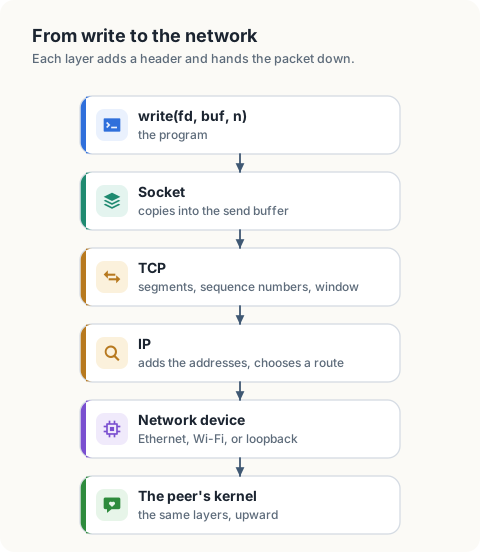
write and the network.| Layer | Adds | Responsible for |
|---|---|---|
| Socket | nothing | the descriptor, the buffers, and blocking |
| TCP | a header with 2 ports, a sequence number, an acknowledgement number and a window | reliability, order, and flow control between 2 programs |
| IP | a header with 2 IP addresses | delivering a packet to the right machine |
| Device | a frame for the medium | moving the packet to the next machine |
An IP address names a machine, and a port is a 16-bit number that names a program on it. The loopback device, with the address 127.0.0.1, delivers packets to the same machine without any hardware, and the programs of this chapter use it.
The segments of a connection
TCP makes an unreliable network reliable by numbering. Every byte of a stream has a sequence number. Each packet of TCP, called a segment, says which bytes it carries. The receiver answers with an acknowledgement: the number of the next byte it expects, which confirms everything before it. The sender keeps each byte until it is acknowledged, and sends it again if no acknowledgement arrives in time. Out-of-order segments are put in order by their numbers, and duplicates are recognised and dropped.
An example with small numbers shows the whole mechanism. The client sends hello, 5
bytes, and its stream is currently at byte 1001.
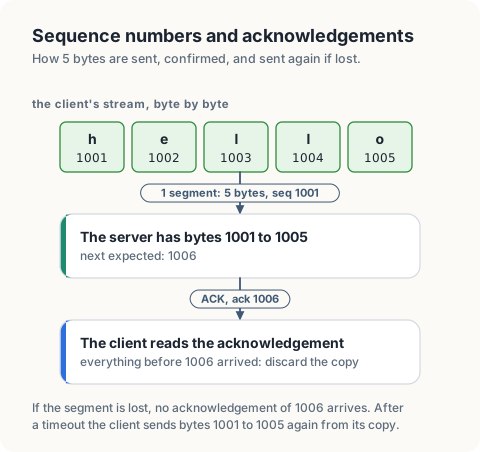
The acknowledgement is a single number, and it confirms a whole range. This keeps the protocol simple: the receiver always says “the next byte I need is this one”, and whatever went wrong, the sender knows where to continue.
Before any data, the 2 sides have to agree on their starting sequence numbers. This is
the handshake, 3 segments marked with the flags SYN and ACK.
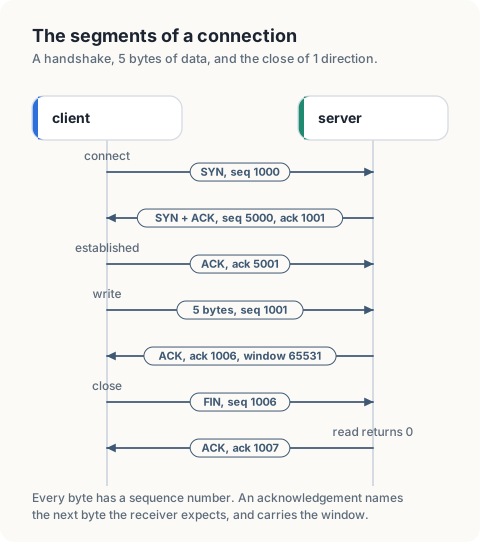
SYN: the client proposes its starting number, 1000.SYNandACK: the server acknowledges it with 1001 and proposes its own, 5000.ACK: the client acknowledges 5001. Both sides now know both numbers, and the connection is established.- The client sends 5 bytes, numbered 1001 to 1005.
- The server acknowledges 1006 and reports its window, the space left in its receive buffer.
FIN: the client has nothing more to send. This closes its direction of the stream.- The server acknowledges. Its program’s next
readreturns 0. The server can still send, until it sends aFINof its own.
All of this is done by the kernels. The programs call connect, write, read and
close, and do not see a segment.
Setting up a connection
TCP gives 2 programs a reliable stream of bytes in each direction. A server and a client reach that state through different calls.
| Call | Made by | Effect |
|---|---|---|
socket | both | creates an unconnected socket and returns a descriptor |
bind | server | gives the socket a local address and port |
listen | server | marks the socket as a listener and sets the length of its accept queue |
connect | client | exchanges 3 packets with the server’s kernel, the handshake, and returns when the connection is established |
accept | server | returns a new descriptor for an established connection |
The handshake is carried out by the server’s kernel. The server program takes no part in
it. An established connection waits in the accept queue of the listener until the
program calls accept.
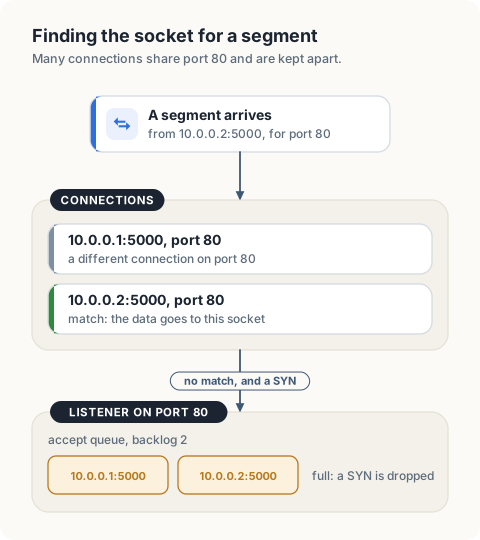
A connection is identified by 4 values: the local address, the local port, the remote
address and the remote port. A listener and all the connections accepted from it have
the same local port. An arriving packet, called a segment in TCP, is matched against
the 4 values of the existing connections. A segment that matches none and asks to open a
connection, a SYN, is given to the listener on its port.
The kernel’s structures
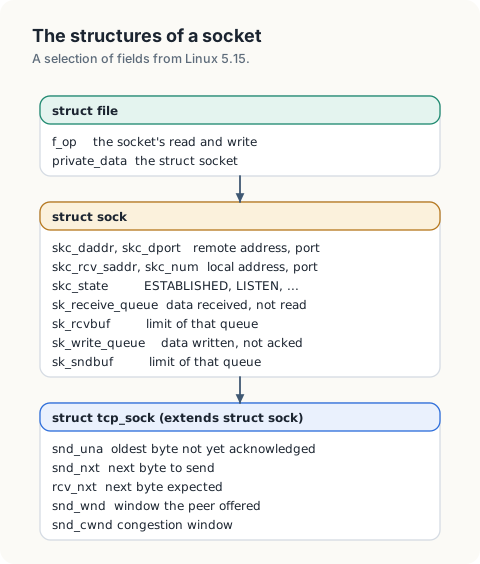
Behind a socket descriptor is a struct file (chapter 2)
whose function table is the socket’s, and behind that a struct sock. For TCP the
struct sock is the first part of a larger struct tcp_sock. These are fields from
include/net/sock.h and include/linux/tcp.h of Linux 5.15.
struct sock_common {
        __be32 skc_daddr;                      /* remote IP address */
        __be32 skc_rcv_saddr;                  /* local IP address */
        __be16 skc_dport;                      /* remote port */
        __u16 skc_num;                         /* local port */
        volatile unsigned char skc_state;      /* TCP_LISTEN, TCP_ESTABLISHED, ... */
        /* ... */
};

struct sock {
        struct sock_common __sk_common;
        struct sk_buff_head sk_receive_queue;  /* segments received, not yet read */
        int sk_rcvbuf;                         /* limit of the receive queue, bytes */
        struct sk_buff_head sk_write_queue;    /* data written, not yet acknowledged */
        int sk_sndbuf;                         /* limit of the write queue, bytes */
        u32 sk_ack_backlog;                    /* connections waiting for accept */
        u32 sk_max_ack_backlog;                /* the backlog given to listen */
        /* ... */
};

struct tcp_sock {
        u32 rcv_nxt;                           /* next byte we expect to receive */
        u32 snd_nxt;                           /* next byte we will send */
        u32 snd_una;                           /* oldest byte sent and not acknowledged */
        u32 snd_wnd;                           /* the window the peer offered */
        u32 snd_cwnd;                          /* congestion window */
        /* ... */
};
| Field | Meaning |
|---|---|
skc_daddr, skc_dport, skc_rcv_saddr, skc_num | The 4 values that identify the connection. |
skc_state | The state of the connection, shown by ss as LISTEN, ESTAB and others. |
sk_receive_queue, sk_rcvbuf | The receive buffer and its limit. read takes from this queue. |
sk_write_queue, sk_sndbuf | The send buffer and its limit. write adds to this queue and blocks when the limit is reached. |
snd_una, snd_nxt | The bytes between them have been sent and are waiting for an acknowledgement. |
rcv_nxt | The acknowledgement number this side sends. |
snd_wnd | The peer’s window: this side sends no byte beyond snd_una + snd_wnd. |
snd_cwnd | A second limit that TCP computes itself, to avoid overloading the network between the machines. |
The ss command prints these fields for the sockets of a system. Here a server listens
on port 9099 and a client has connected to it over loopback:
$ ss -tln 'sport = :9099'
State  Recv-Q Send-Q Local Address:Port Peer Address:Port
LISTEN 0      1          127.0.0.1:9099      0.0.0.0:*
$ ss -tn 'sport = :9099 or dport = :9099'
State Recv-Q Send-Q Local Address:Port  Peer Address:Port
ESTAB 0      0          127.0.0.1:9099     127.0.0.1:51252
ESTAB 0      0          127.0.0.1:51252    127.0.0.1:9099
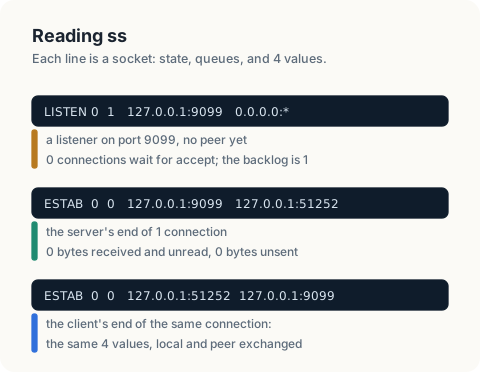
The first command shows the listener. For a listener, Send-Q is the backlog, 1 here,
and Recv-Q is the number of connections waiting for accept. The second shows the
connection 2 times, because both ends are on this machine: the server’s socket with
local port 9099, and the client’s with the port 51252 that the kernel chose for it. The
4 values of one line are the 4 values of the other, exchanged.
Measuring a connection
sockfacts makes its connections over the loopback address 127.0.0.1, with both ends in
the same process. The Go version calls the socket system calls through
golang.org/x/sys/unix. The Rust version uses std::net and the nix crate with the
socket feature for socket options.
$ cargo new sockfacts
$ cargo add -p sockfacts nix --features socket
listen binds to port 0, which asks the kernel for any free port.
 Listing 10.1 The imports of
sockfacts, in Go. code/go/sockfacts/main.go
import (
	"errors"
	"fmt"
	"log"

	"golang.org/x/sys/unix"
)
 Listing 10.2 The imports of
sockfacts, in Rust. code/rust/sockfacts/src/main.rs
use std::io::{self, Read, Write};
use std::net::{TcpListener, TcpStream};
use std::os::fd::AsRawFd;

use nix::errno::Errno;
use nix::sys::socket::{setsockopt, sockopt};
Listing 10.3 A listener and a client on the loopback interface, in Go. code/go/sockfacts/main.go
// listen returns a TCP socket that listens on a free port of 127.0.0.1, and
// its address.
func listen() (int, *unix.SockaddrInet4, error) {
	listener, err := unix.Socket(unix.AF_INET, unix.SOCK_STREAM|unix.SOCK_CLOEXEC, 0)

	if err != nil {
		return 0, nil, err
	}

	if err := unix.Bind(listener, &unix.SockaddrInet4{Addr: [4]byte{127, 0, 0, 1}}); err != nil {
		return 0, nil, err
	}

	if err := unix.Listen(listener, 16); err != nil {
		return 0, nil, err
	}

	address, err := unix.Getsockname(listener)

	if err != nil {
		return 0, nil, err
	}

	return listener, address.(*unix.SockaddrInet4), nil
}

// connect returns a TCP socket connected to an address.
func connect(address *unix.SockaddrInet4) (int, error) {
	client, err := unix.Socket(unix.AF_INET, unix.SOCK_STREAM|unix.SOCK_CLOEXEC, 0)

	if err != nil {
		return 0, err
	}

	return client, unix.Connect(client, address)
}

// name returns the symbolic name of a system call error, such as EPIPE.
func name(err error) string {
	var errno unix.Errno

	if errors.As(err, &errno) {
		return unix.ErrnoName(errno)
	}

	return fmt.Sprint(err)
}

// port returns the port of an address.
func port(address unix.Sockaddr, err error) int {
	if inet, ok := address.(*unix.SockaddrInet4); ok && err == nil {
		return inet.Port
	}

	return 0
}
Listing 10.4 A listener and a client on the loopback interface, in Rust. code/rust/sockfacts/src/main.rs
/// Returns a TCP socket that listens on a free port of 127.0.0.1.
fn listen() -> io::Result<TcpListener> {
    TcpListener::bind("127.0.0.1:0")
}

/// Returns a TCP socket connected to the address of a listener.
fn connect(listener: &TcpListener) -> io::Result<TcpStream> {
    TcpStream::connect(listener.local_addr()?)
}

/// Returns the symbolic name of a system call error, such as `EPIPE`.
fn name(error: &io::Error) -> String {
    match error.raw_os_error() {
        Some(code) => format!("{:?}", Errno::from_raw(code)),
        None => error.to_string(),
    }
}
establish calls connect before the server has called accept. Then it accepts and
compares the addresses of the ends.
Listing 10.5 Connecting before accept, and the ports of both ends, in Go. code/go/sockfacts/main.go
// establish connects before the server calls accept, and compares the
// addresses of both ends.
func establish() error {
	listener, address, err := listen()

	if err != nil {
		return err
	}

	defer unix.Close(listener)

	client, err := connect(address)
	fmt.Printf("connect before the server calls accept: succeeded %v\n", err == nil)

	if err != nil {
		return err
	}

	defer unix.Close(client)

	server, _, err := unix.Accept(listener)

	if err != nil {
		return err
	}

	defer unix.Close(server)

	fmt.Printf("accept returns a new descriptor: %v, on the listener's port: %v\n",
		server != listener, port(unix.Getsockname(server)) == address.Port)
	fmt.Printf("the client's local port is the server's peer port: %v\n",
		port(unix.Getsockname(client)) == port(unix.Getpeername(server)))

	return stream(client, server)
}
Listing 10.6 Connecting before accept, and the ports of both ends, in Rust. code/rust/sockfacts/src/main.rs
/// Connects before the server calls accept, and compares the addresses of
/// both ends.
fn establish() -> io::Result<()> {
    let listener = listen()?;

    let client = connect(&listener);
    println!(
        "connect before the server calls accept: succeeded {}",
        client.is_ok()
    );

    let client = client?;
    let (server, _) = listener.accept()?;

    println!(
        "accept returns a new descriptor: {}, on the listener's port: {}",
        server.as_raw_fd() != listener.as_raw_fd(),
        server.local_addr()?.port() == listener.local_addr()?.port()
    );
    println!(
        "the client's local port is the server's peer port: {}",
        client.local_addr()?.port() == server.peer_addr()?.port()
    );

    stream(client, server)
}
stream sends ab and cd with separate calls to write, and the server reads 3
bytes and then 1. After that the client closes its socket. The server reads again, and
then writes until a write fails.
Listing 10.7 A stream of bytes, and the end of the stream, in Go. code/go/sockfacts/main.go
// readFull reads until buf is full.
func readFull(fd int, buf []byte) error {
	for filled := 0; filled < len(buf); {
		n, err := unix.Read(fd, buf[filled:])

		if err != nil {
			return err
		}

		if n == 0 {
			return errors.New("the stream ended early")
		}

		filled += n
	}

	return nil
}

// stream writes "ab" and "cd" with 2 calls and reads 3 bytes and then 1.
// Then the client closes, and the server reads and writes again.
func stream(client, server int) error {
	for _, part := range []string{"ab", "cd"} {
		if _, err := unix.Write(client, []byte(part)); err != nil {
			return err
		}
	}

	first, second := make([]byte, 3), make([]byte, 1)

	if err := readFull(server, first); err != nil {
		return err
	}

	if err := readFull(server, second); err != nil {
		return err
	}

	fmt.Printf("writes of \"ab\" and \"cd\", reads of 3 bytes and 1 byte: %q and %q\n", first, second)

	unix.Close(client)

	n, err := unix.Read(server, first)

	if err != nil {
		return err
	}

	fmt.Printf("the client closed: read returns %d\n", n)

	for err == nil {
		_, err = unix.Write(server, []byte("x"))
	}

	fmt.Printf("writes to the closed peer: the first is accepted, a later one fails with %s\n", name(err))

	return nil
}
Listing 10.8 A stream of bytes, and the end of the stream, in Rust. code/rust/sockfacts/src/main.rs
/// Writes "ab" and "cd" with 2 calls and reads 3 bytes and then 1. Then the
/// client closes, and the server reads and writes again.
fn stream(mut client: TcpStream, mut server: TcpStream) -> io::Result<()> {
    for part in ["ab", "cd"] {
        client.write_all(part.as_bytes())?;
    }

    let (mut first, mut second) = ([0u8; 3], [0u8; 1]);

    server.read_exact(&mut first)?;
    server.read_exact(&mut second)?;

    println!(
        "writes of \"ab\" and \"cd\", reads of 3 bytes and 1 byte: {:?} and {:?}",
        String::from_utf8_lossy(&first),
        String::from_utf8_lossy(&second)
    );

    drop(client);

    let n = server.read(&mut first)?;
    println!("the client closed: read returns {n}");

    let error = loop {
        if let Err(error) = server.write(b"x") {
            break error;
        }
    };

    println!(
        "writes to the closed peer: the first is accepted, a later one fails with {}",
        name(&error)
    );

    Ok(())
}
flow reduces the buffers of a connection, so that the numbers are small, and writes to
the client socket in non-blocking mode until the kernel refuses a write. The server does
not read during that time. Then the server reads everything, and the client tries again.
Listing 10.9 A sender whose peer does not read, in Go. code/go/sockfacts/main.go
// fill writes blocks to a non-blocking socket until the kernel refuses one
// and returns the number of bytes accepted.
func fill(fd int) (int, error) {
	block := make([]byte, 1024)
	total := 0

	for {
		n, err := unix.Write(fd, block)

		if errors.Is(err, unix.EAGAIN) {
			return total, nil
		}

		if err != nil {
			return total, err
		}

		total += n
	}
}

// flow gives a connection small buffers, fills it while the server does not
// read, lets the server read everything, and fills it again.
func flow() error {
	listener, address, err := listen()

	if err != nil {
		return err
	}

	defer unix.Close(listener)

	if err := unix.SetsockoptInt(listener, unix.SOL_SOCKET, unix.SO_RCVBUF, 4096); err != nil {
		return err
	}

	client, err := connect(address)

	if err != nil {
		return err
	}

	defer unix.Close(client)

	if err := unix.SetsockoptInt(client, unix.SOL_SOCKET, unix.SO_SNDBUF, 4096); err != nil {
		return err
	}

	server, _, err := unix.Accept(listener)

	if err != nil {
		return err
	}

	defer unix.Close(server)

	if err := unix.SetNonblock(client, true); err != nil {
		return err
	}

	sent, err := fill(client)

	if err != nil {
		return err
	}

	fmt.Printf("the server does not read: the client is stopped after %d bytes\n", sent)

	if err := readFull(server, make([]byte, sent)); err != nil {
		return err
	}

	again, err := fill(client)

	if err != nil {
		return err
	}

	fmt.Printf("the server has read everything: the client can write again: %v\n", again > 0)

	return nil
}
Listing 10.10 A sender whose peer does not read, in Rust. code/rust/sockfacts/src/main.rs
/// Writes blocks to a non-blocking socket until the kernel refuses one and
/// returns the number of bytes accepted.
fn fill(mut stream: &TcpStream) -> io::Result<usize> {
    let block = [0u8; 1024];
    let mut total = 0;

    loop {
        match stream.write(&block) {
            Ok(n) => total += n,
            Err(error) if error.kind() == io::ErrorKind::WouldBlock => return Ok(total),
            Err(error) => return Err(error),
        }
    }
}

/// Gives a connection small buffers, fills it while the server does not read,
/// lets the server read everything, and fills it again.
fn flow() -> io::Result<()> {
    let listener = listen()?;
    setsockopt(&listener, sockopt::RcvBuf, &4096)?;

    let client = connect(&listener)?;
    setsockopt(&client, sockopt::SndBuf, &4096)?;

    let (mut server, _) = listener.accept()?;

    client.set_nonblocking(true)?;

    let sent = fill(&client)?;
    println!("the server does not read: the client is stopped after {sent} bytes");

    server.read_exact(&mut vec![0u8; sent])?;

    let again = fill(&client)?;
    println!(
        "the server has read everything: the client can write again: {}",
        again > 0
    );

    Ok(())
}
connect before the server calls accept: succeeded true
accept returns a new descriptor: true, on the listener's port: true
the client's local port is the server's peer port: true
writes of "ab" and "cd", reads of 3 bytes and 1 byte: "abc" and "d"
the client closed: read returns 0
writes to the closed peer: the first is accepted, a later one fails with EPIPE
the server does not read: the client is stopped after 7168 bytes
the server has read everything: the client can write again: true
| Output | Conclusion |
|---|---|
connect succeeds before accept | The kernel completes the handshake. The connection waits in the accept queue. |
| a new descriptor on the listener’s port | accept creates a socket for the connection. The listener stays open for further connections. |
| client’s local port is the server’s peer port | Both ends hold the same 4 values, each from its own side. |
abc and d | TCP delivers bytes in order and keeps no record of where a write ended. |
| read returns 0 | The end of the peer’s stream is reported as on a pipe. |
a later write fails with EPIPE | The first write after the close is accepted locally. The peer’s kernel answers it with a reset, and the following write fails. |
| stopped after 7168 bytes | Both buffers are full. A blocking write would be suspended here. |
| can write again after the server has read | Space in the receive buffer lets the sender continue. |
Row 4 has a practical consequence. A protocol built on TCP has to mark the
boundaries of its messages itself, with a length before each message or with a
delimiter such as a newline, and a reader has to be prepared to receive part of a
message or several messages in a single read.
TCP keeps no message boundaries. A read can return half a message, or 2 messages at once.
Buffers and the window
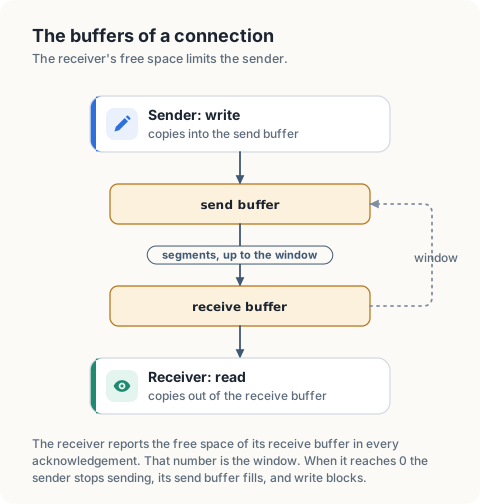
A write on a socket copies the data into the socket’s send buffer and returns. The
kernel transmits from that buffer and keeps each byte until the peer has acknowledged
it. On the other side, arriving data is placed in the receive buffer until the program
reads it.
The 2 buffers are connected by the window. With every acknowledgement, the receiver
reports how much free space its receive buffer has, and the sender transmits no more
than that. When the receiving program stops reading, the receive buffer fills, the
window becomes 0, the sender’s kernel stops transmitting, the send buffer fills, and
write blocks. This is the flow control of a pipe, extended across a network. The 7168
bytes of the measurement are the contents of both buffers at that point.
Low-level design: sockmodel
| Type | Fields | Meaning |
|---|---|---|
endpoint | address, port | one side of a connection |
key | remote, port | identifies a connection: the remote endpoint and the local port |
socket | received, capacity, finished | the receive buffer; whether the sender has ended its stream |
listener | backlog, queue | the accept queue and its maximum length |
stack | listeners, connections | listeners by port; connections by key |
| Operation | Behaviour |
|---|---|
receive(segment) | delivers to the matching connection; gives a SYN to the listener; otherwise answers with a reset |
deliver(segment) | appends data up to the window; records a FIN |
accept(port) | removes the oldest connection from the accept queue |
read(n) | removes bytes from the receive buffer; reports the end of the stream |
Modelling the receiving side
The model covers the receiving half of TCP and omits transmission, acknowledgements and retransmission.
Listing 10.11 The imports of sockmodel, in Go. code/go/sockmodel/main.go
import "fmt"
Listing 10.12 The imports of sockmodel, in Rust. code/rust/sockmodel/src/main.rs
use std::collections::{HashMap, VecDeque};
use std::fmt;
Listing 10.13 Endpoints, sockets, listeners and segments, in Go. code/go/sockmodel/main.go
// An endpoint is an IP address and a port.
type endpoint struct {
	address string
	port    int
}

func (e endpoint) String() string {
	return fmt.Sprintf("%s:%d", e.address, e.port)
}

// A socket is one established connection: the bytes received and not yet
// read, the size of the receive buffer, and whether the sender has finished.
type socket struct {
	received []byte
	capacity int
	finished bool
}

// window is the free space of the receive buffer: the number of bytes the
// sender may still send.
func (s *socket) window() int {
	return s.capacity - len(s.received)
}

// A key identifies a connection on this machine: the remote endpoint and the
// local port. With the local address, which the model leaves out, it forms
// the 4 values that identify a TCP connection.
type key struct {
	remote endpoint
	port   int
}

// A listener accepts connections on a port. queue holds the connections that
// are established and have not been returned by accept.
type listener struct {
	backlog int
	queue   []key
}

// A stack is the TCP state of a machine.
type stack struct {
	listeners   map[int]*listener
	connections map[key]*socket
	bufferSize  int
}

// A segment is a packet of TCP. syn opens a connection and fin ends the
// sender's stream.
type segment struct {
	from     endpoint
	port     int
	syn, fin bool
	data     string
}
Listing 10.14 Endpoints, sockets, listeners and segments, in Rust. code/rust/sockmodel/src/main.rs
/// An IP address and a port.
#[derive(Clone, Copy, PartialEq, Eq, Hash)]
struct Endpoint {
    address: &'static str,
    port: u16,
}

impl fmt::Display for Endpoint {
    fn fmt(&self, f: &mut fmt::Formatter<'_>) -> fmt::Result {
        write!(f, "{}:{}", self.address, self.port)
    }
}

/// One established connection: the bytes received and not yet read, the size
/// of the receive buffer, and whether the sender has finished.
struct Socket {
    received: VecDeque<u8>,
    capacity: usize,
    finished: bool,
}

impl Socket {
    /// The free space of the receive buffer: the number of bytes the sender
    /// may still send.
    fn window(&self) -> usize {
        self.capacity - self.received.len()
    }
}

/// Identifies a connection on this machine: the remote endpoint and the local
/// port. With the local address, which the model leaves out, it forms the 4
/// values that identify a TCP connection.
#[derive(Clone, Copy, PartialEq, Eq, Hash)]
struct Key {
    remote: Endpoint,
    port: u16,
}

/// Accepts connections on a port. `queue` holds the connections that are
/// established and have not been returned by accept.
struct Listener {
    backlog: usize,
    queue: VecDeque<Key>,
}

/// The TCP state of a machine.
struct Stack {
    listeners: HashMap<u16, Listener>,
    connections: HashMap<Key, Socket>,
    buffer_size: usize,
}

/// A packet of TCP. `syn` opens a connection and `fin` ends the sender's
/// stream.
#[derive(Default)]
struct Segment {
    syn: bool,
    fin: bool,
    data: &'static str,
}
receive is the lookup of figure 10.4. The table of connections is consulted first,
which is why data for an established connection reaches its own socket while a listener
exists on the same port. A SYN for a full accept queue is dropped without an answer.
The client’s kernel sends it again after a timeout, which gives the server time to call
accept.
Listing 10.15 Finding the socket for a segment, in Go. code/go/sockmodel/main.go
// receive handles an arriving segment and describes the result. A segment
// belongs to the connection with its remote endpoint and local port. Only
// when no such connection exists, and the segment is a SYN, is the listener
// on the port consulted.
func (st *stack) receive(seg segment) string {
	id := key{remote: seg.from, port: seg.port}

	if s, ok := st.connections[id]; ok {
		return s.deliver(seg)
	}

	if !seg.syn {
		return "reset, no connection"
	}

	l, ok := st.listeners[seg.port]

	if !ok {
		return "reset, no listener on the port"
	}

	if len(l.queue) == l.backlog {
		return "dropped, the accept queue is full"
	}

	st.connections[id] = &socket{capacity: st.bufferSize}
	l.queue = append(l.queue, id)

	return fmt.Sprintf("established, accept queue %d", len(l.queue))
}

// deliver puts the data of a segment into the receive buffer, up to the
// window, and records a FIN.
func (s *socket) deliver(seg segment) string {
	if seg.fin {
		s.finished = true

		return "the sender's stream has ended"
	}

	accepted := min(len(seg.data), s.window())
	s.received = append(s.received, seg.data[:accepted]...)

	return fmt.Sprintf("accepted %d, window %d", accepted, s.window())
}
Listing 10.16 Finding the socket for a segment, in Rust. code/rust/sockmodel/src/main.rs
impl Stack {
    /// Handles a segment that arrives from `from` for local port `port`, and
    /// describes the result. A segment belongs to the connection with its
    /// remote endpoint and local port. Only when no such connection exists,
    /// and the segment is a SYN, is the listener on the port consulted.
    fn receive(&mut self, from: Endpoint, port: u16, segment: &Segment) -> String {
        let id = Key { remote: from, port };

        if let Some(socket) = self.connections.get_mut(&id) {
            return socket.deliver(segment);
        }

        if !segment.syn {
            return "reset, no connection".into();
        }

        let Some(listener) = self.listeners.get_mut(&port) else {
            return "reset, no listener on the port".into();
        };

        if listener.queue.len() == listener.backlog {
            return "dropped, the accept queue is full".into();
        }

        let socket = Socket {
            received: VecDeque::new(),
            capacity: self.buffer_size,
            finished: false,
        };

        self.connections.insert(id, socket);
        listener.queue.push_back(id);

        format!("established, accept queue {}", listener.queue.len())
    }
}

impl Socket {
    /// Puts the data of a segment into the receive buffer, up to the window,
    /// and records a FIN.
    fn deliver(&mut self, segment: &Segment) -> String {
        if segment.fin {
            self.finished = true;

            return "the sender's stream has ended".into();
        }

        let accepted = segment.data.len().min(self.window());
        self.received.extend(&segment.data.as_bytes()[..accepted]);

        format!("accepted {accepted}, window {}", self.window())
    }
}
deliver accepts data up to the window. window is the free space of the receive
buffer, the value a real receiver reports to the sender.
accept takes connections in the order they were established. read returns the end
of the stream only when the buffer is empty and the FIN, the segment that ends the
sender’s stream, has arrived, so data that was sent before a close is not lost.
Listing 10.17 Accepting a connection, and reading from it, in Go. code/go/sockmodel/main.go
// accept removes the oldest connection from the accept queue of a port.
func (st *stack) accept(port int) (key, bool) {
	l, ok := st.listeners[port]

	if !ok || len(l.queue) == 0 {
		return key{}, false
	}

	id := l.queue[0]
	l.queue = l.queue[1:]

	return id, true
}

// read removes up to n bytes from the receive buffer. It returns 0 bytes
// with ended set when the buffer is empty and a FIN has arrived.
func (s *socket) read(n int) (data string, ended bool) {
	n = min(n, len(s.received))
	data, s.received = string(s.received[:n]), s.received[n:]

	return data, n == 0 && s.finished
}
Listing 10.18 Accepting a connection, and reading from it, in Rust. code/rust/sockmodel/src/main.rs
impl Stack {
    /// Removes the oldest connection from the accept queue of a port.
    fn accept(&mut self, port: u16) -> Option<Key> {
        self.listeners.get_mut(&port)?.queue.pop_front()
    }
}

impl Socket {
    /// Removes up to `n` bytes from the receive buffer. It returns 0 bytes
    /// with the second value set when the buffer is empty and a FIN has
    /// arrived.
    fn read(&mut self, n: usize) -> (String, bool) {
        let n = n.min(self.received.len());
        let data: Vec<u8> = self.received.drain(..n).collect();

        (
            String::from_utf8_lossy(&data).into_owned(),
            n == 0 && self.finished,
        )
    }
}
Listing 10.19 The trace, in Go. code/go/sockmodel/main.go
func main() {
	st := &stack{
		listeners:   map[int]*listener{80: {backlog: 2}},
		connections: map[key]*socket{},
		bufferSize:  8,
	}

	a, b, c := endpoint{"10.0.0.1", 5000}, endpoint{"10.0.0.2", 5000}, endpoint{"10.0.0.3", 5000}

	for _, seg := range []segment{{from: a, port: 80, syn: true}, {from: b, port: 80, syn: true},
		{from: c, port: 80, syn: true}, {from: c, port: 81, syn: true}} {
		fmt.Printf("SYN from %s to port %d: %s\n", seg.from, seg.port, st.receive(seg))
	}

	if id, ok := st.accept(80); ok {
		fmt.Printf("accept on port 80: the connection from %s\n", id.remote)
	}

	for _, from := range []endpoint{b, a, b, c} {
		fmt.Printf("5 bytes from %s to port 80: %s\n", from, st.receive(segment{from: from, port: 80, data: "hello"}))
	}

	conn, ok := st.connections[key{remote: b, port: 80}]

	if !ok {
		return
	}

	data, ended := conn.read(4)
	fmt.Printf("read of 4 bytes on the connection from %s: %q, window %d\n", b, data, conn.window())

	fmt.Printf("FIN from %s: %s\n", b, st.receive(segment{from: b, port: 80, fin: true}))

	data, ended = conn.read(16)
	fmt.Printf("read: %q, stream ended %v\n", data, ended)

	data, ended = conn.read(16)
	fmt.Printf("read: %q, stream ended %v\n", data, ended)
}
Listing 10.20 The trace, in Rust. code/rust/sockmodel/src/main.rs
fn endpoint(address: &'static str) -> Endpoint {
    Endpoint {
        address,
        port: 5000,
    }
}

fn main() {
    let listener = Listener {
        backlog: 2,
        queue: VecDeque::new(),
    };

    let mut stack = Stack {
        listeners: HashMap::from([(80, listener)]),
        connections: HashMap::new(),
        buffer_size: 8,
    };

    let (a, b, c) = (
        endpoint("10.0.0.1"),
        endpoint("10.0.0.2"),
        endpoint("10.0.0.3"),
    );

    let syn = Segment {
        syn: true,
        ..Segment::default()
    };

    for (from, port) in [(a, 80), (b, 80), (c, 80), (c, 81)] {
        let result = stack.receive(from, port, &syn);
        println!("SYN from {from} to port {port}: {result}");
    }

    if let Some(id) = stack.accept(80) {
        println!("accept on port 80: the connection from {}", id.remote);
    }

    let hello = Segment {
        data: "hello",
        ..Segment::default()
    };

    for from in [b, a, b, c] {
        let result = stack.receive(from, 80, &hello);
        println!("5 bytes from {from} to port 80: {result}");
    }

    let id = Key {
        remote: b,
        port: 80,
    };

    if let Some(socket) = stack.connections.get_mut(&id) {
        let (data, _) = socket.read(4);
        println!(
            "read of 4 bytes on the connection from {b}: {data:?}, window {}",
            socket.window()
        );
    }

    let fin = Segment {
        fin: true,
        ..Segment::default()
    };

    println!("FIN from {b}: {}", stack.receive(b, 80, &fin));

    if let Some(socket) = stack.connections.get_mut(&id) {
        for _ in 0..2 {
            let (data, ended) = socket.read(16);
            println!("read: {data:?}, stream ended {ended}");
        }
    }
}
SYN from 10.0.0.1:5000 to port 80: established, accept queue 1
SYN from 10.0.0.2:5000 to port 80: established, accept queue 2
SYN from 10.0.0.3:5000 to port 80: dropped, the accept queue is full
SYN from 10.0.0.3:5000 to port 81: reset, no listener on the port
accept on port 80: the connection from 10.0.0.1:5000
5 bytes from 10.0.0.2:5000 to port 80: accepted 5, window 3
5 bytes from 10.0.0.1:5000 to port 80: accepted 5, window 3
5 bytes from 10.0.0.2:5000 to port 80: accepted 3, window 0
5 bytes from 10.0.0.3:5000 to port 80: reset, no connection
read of 4 bytes on the connection from 10.0.0.2:5000: "hell", window 4
FIN from 10.0.0.2:5000: the sender's stream has ended
read: "ohel", stream ended false
read: "", stream ended true
| Line | What it shows |
|---|---|
| lines 1 and 2 | Connections are established and queued without a call to accept. |
dropped, the accept queue is full | The backlog of 2 is reached. |
reset, no listener on the port | A SYN for a port without a listener is refused. A client sees this as ECONNREFUSED. |
accept on port 80 | The oldest connection is returned. |
5 bytes from 10.0.0.2 and from 10.0.0.1 | Both connections use local port 80, and each segment reaches its own socket. |
accepted 3, window 0 | The receive buffer of 8 bytes is full. A real sender would have sent only 3 bytes, having been told the window. |
reset, no connection | The SYN of 10.0.0.3 was dropped, so no connection exists for its data. |
the reads after the FIN | The buffered bytes are returned first. The end of the stream follows. |
Correspondence with the kernel source. __inet_lookup_established and
__inet_lookup_listener in net/ipv4/inet_hashtables.c are the 2 lookups of receive.
A connected socket is struct tcp_sock, with the receive buffer in sk_receive_queue
and its limit in sk_rcvbuf. tcp_select_window computes the window, and
tcp_data_queue in net/ipv4/tcp_input.c queues arriving data. The accept queue is
icsk_accept_queue, limited by the backlog given to listen and by
/proc/sys/net/core/somaxconn, which is 4096 on this machine.
Inspecting sockets on a live system
| Command | Shows |
|---|---|
ss -tln | the listening TCP sockets, with their backlog |
ss -tn | the established connections, with the bytes waiting in each queue |
ss -tni | per connection: the congestion window, the round-trip time, and the window |
ss -tnp | the process that owns each socket |
cat /proc/sys/net/core/somaxconn | the largest backlog listen may set: 4096 here |
cat /proc/sys/net/ipv4/tcp_rmem | the minimum, initial and maximum size of a receive buffer |
Recv-Q on an established connection is data that has arrived and that the program has
not read. A value that stays high means the program is slow to read, and the sender is
being held back by the window.
The complete programs
Listing 10.21 The complete sockfacts, in Go. code/go/sockfacts/main.go
// Command sockfacts measures TCP sockets on the loopback interface: when a
// connection is established, what identifies it, how written bytes arrive,
// what stops a writer whose peer does not read, and how each side learns
// that the other has closed.
//
// Run it from code/go with:
//
//	go run ./sockfacts
package main

import (
	"errors"
	"fmt"
	"log"

	"golang.org/x/sys/unix"
)


// listen returns a TCP socket that listens on a free port of 127.0.0.1, and
// its address.
func listen() (int, *unix.SockaddrInet4, error) {
	listener, err := unix.Socket(unix.AF_INET, unix.SOCK_STREAM|unix.SOCK_CLOEXEC, 0)

	if err != nil {
		return 0, nil, err
	}

	if err := unix.Bind(listener, &unix.SockaddrInet4{Addr: [4]byte{127, 0, 0, 1}}); err != nil {
		return 0, nil, err
	}

	if err := unix.Listen(listener, 16); err != nil {
		return 0, nil, err
	}

	address, err := unix.Getsockname(listener)

	if err != nil {
		return 0, nil, err
	}

	return listener, address.(*unix.SockaddrInet4), nil
}

// connect returns a TCP socket connected to an address.
func connect(address *unix.SockaddrInet4) (int, error) {
	client, err := unix.Socket(unix.AF_INET, unix.SOCK_STREAM|unix.SOCK_CLOEXEC, 0)

	if err != nil {
		return 0, err
	}

	return client, unix.Connect(client, address)
}

// name returns the symbolic name of a system call error, such as EPIPE.
func name(err error) string {
	var errno unix.Errno

	if errors.As(err, &errno) {
		return unix.ErrnoName(errno)
	}

	return fmt.Sprint(err)
}

// port returns the port of an address.
func port(address unix.Sockaddr, err error) int {
	if inet, ok := address.(*unix.SockaddrInet4); ok && err == nil {
		return inet.Port
	}

	return 0
}


// establish connects before the server calls accept, and compares the
// addresses of both ends.
func establish() error {
	listener, address, err := listen()

	if err != nil {
		return err
	}

	defer unix.Close(listener)

	client, err := connect(address)
	fmt.Printf("connect before the server calls accept: succeeded %v\n", err == nil)

	if err != nil {
		return err
	}

	defer unix.Close(client)

	server, _, err := unix.Accept(listener)

	if err != nil {
		return err
	}

	defer unix.Close(server)

	fmt.Printf("accept returns a new descriptor: %v, on the listener's port: %v\n",
		server != listener, port(unix.Getsockname(server)) == address.Port)
	fmt.Printf("the client's local port is the server's peer port: %v\n",
		port(unix.Getsockname(client)) == port(unix.Getpeername(server)))

	return stream(client, server)
}


// readFull reads until buf is full.
func readFull(fd int, buf []byte) error {
	for filled := 0; filled < len(buf); {
		n, err := unix.Read(fd, buf[filled:])

		if err != nil {
			return err
		}

		if n == 0 {
			return errors.New("the stream ended early")
		}

		filled += n
	}

	return nil
}

// stream writes "ab" and "cd" with 2 calls and reads 3 bytes and then 1.
// Then the client closes, and the server reads and writes again.
func stream(client, server int) error {
	for _, part := range []string{"ab", "cd"} {
		if _, err := unix.Write(client, []byte(part)); err != nil {
			return err
		}
	}

	first, second := make([]byte, 3), make([]byte, 1)

	if err := readFull(server, first); err != nil {
		return err
	}

	if err := readFull(server, second); err != nil {
		return err
	}

	fmt.Printf("writes of \"ab\" and \"cd\", reads of 3 bytes and 1 byte: %q and %q\n", first, second)

	unix.Close(client)

	n, err := unix.Read(server, first)

	if err != nil {
		return err
	}

	fmt.Printf("the client closed: read returns %d\n", n)

	for err == nil {
		_, err = unix.Write(server, []byte("x"))
	}

	fmt.Printf("writes to the closed peer: the first is accepted, a later one fails with %s\n", name(err))

	return nil
}


// fill writes blocks to a non-blocking socket until the kernel refuses one
// and returns the number of bytes accepted.
func fill(fd int) (int, error) {
	block := make([]byte, 1024)
	total := 0

	for {
		n, err := unix.Write(fd, block)

		if errors.Is(err, unix.EAGAIN) {
			return total, nil
		}

		if err != nil {
			return total, err
		}

		total += n
	}
}

// flow gives a connection small buffers, fills it while the server does not
// read, lets the server read everything, and fills it again.
func flow() error {
	listener, address, err := listen()

	if err != nil {
		return err
	}

	defer unix.Close(listener)

	if err := unix.SetsockoptInt(listener, unix.SOL_SOCKET, unix.SO_RCVBUF, 4096); err != nil {
		return err
	}

	client, err := connect(address)

	if err != nil {
		return err
	}

	defer unix.Close(client)

	if err := unix.SetsockoptInt(client, unix.SOL_SOCKET, unix.SO_SNDBUF, 4096); err != nil {
		return err
	}

	server, _, err := unix.Accept(listener)

	if err != nil {
		return err
	}

	defer unix.Close(server)

	if err := unix.SetNonblock(client, true); err != nil {
		return err
	}

	sent, err := fill(client)

	if err != nil {
		return err
	}

	fmt.Printf("the server does not read: the client is stopped after %d bytes\n", sent)

	if err := readFull(server, make([]byte, sent)); err != nil {
		return err
	}

	again, err := fill(client)

	if err != nil {
		return err
	}

	fmt.Printf("the server has read everything: the client can write again: %v\n", again > 0)

	return nil
}


func main() {
	for _, experiment := range []func() error{establish, flow} {
		if err := experiment(); err != nil {
			log.Fatal(err)
		}
	}
}
 Listing 10.22 The complete
sockfacts, in Rust. code/rust/sockfacts/src/main.rs
//! Measures TCP sockets on the loopback interface: when a connection is
//! established, what identifies it, how written bytes arrive, what stops a
//! writer whose peer does not read, and how each side learns that the other
//! has closed.
//!
//! Run it from code/rust with:
//!
//! ```text
//! cargo run -p sockfacts
//! ```

use std::io::{self, Read, Write};
use std::net::{TcpListener, TcpStream};
use std::os::fd::AsRawFd;

use nix::errno::Errno;
use nix::sys::socket::{setsockopt, sockopt};

/// Returns a TCP socket that listens on a free port of 127.0.0.1.
fn listen() -> io::Result<TcpListener> {
    TcpListener::bind("127.0.0.1:0")
}

/// Returns a TCP socket connected to the address of a listener.
fn connect(listener: &TcpListener) -> io::Result<TcpStream> {
    TcpStream::connect(listener.local_addr()?)
}

/// Returns the symbolic name of a system call error, such as `EPIPE`.
fn name(error: &io::Error) -> String {
    match error.raw_os_error() {
        Some(code) => format!("{:?}", Errno::from_raw(code)),
        None => error.to_string(),
    }
}

/// Connects before the server calls accept, and compares the addresses of
/// both ends.
fn establish() -> io::Result<()> {
    let listener = listen()?;

    let client = connect(&listener);
    println!(
        "connect before the server calls accept: succeeded {}",
        client.is_ok()
    );

    let client = client?;
    let (server, _) = listener.accept()?;

    println!(
        "accept returns a new descriptor: {}, on the listener's port: {}",
        server.as_raw_fd() != listener.as_raw_fd(),
        server.local_addr()?.port() == listener.local_addr()?.port()
    );
    println!(
        "the client's local port is the server's peer port: {}",
        client.local_addr()?.port() == server.peer_addr()?.port()
    );

    stream(client, server)
}

/// Writes "ab" and "cd" with 2 calls and reads 3 bytes and then 1. Then the
/// client closes, and the server reads and writes again.
fn stream(mut client: TcpStream, mut server: TcpStream) -> io::Result<()> {
    for part in ["ab", "cd"] {
        client.write_all(part.as_bytes())?;
    }

    let (mut first, mut second) = ([0u8; 3], [0u8; 1]);

    server.read_exact(&mut first)?;
    server.read_exact(&mut second)?;

    println!(
        "writes of \"ab\" and \"cd\", reads of 3 bytes and 1 byte: {:?} and {:?}",
        String::from_utf8_lossy(&first),
        String::from_utf8_lossy(&second)
    );

    drop(client);

    let n = server.read(&mut first)?;
    println!("the client closed: read returns {n}");

    let error = loop {
        if let Err(error) = server.write(b"x") {
            break error;
        }
    };

    println!(
        "writes to the closed peer: the first is accepted, a later one fails with {}",
        name(&error)
    );

    Ok(())
}

/// Writes blocks to a non-blocking socket until the kernel refuses one and
/// returns the number of bytes accepted.
fn fill(mut stream: &TcpStream) -> io::Result<usize> {
    let block = [0u8; 1024];
    let mut total = 0;

    loop {
        match stream.write(&block) {
            Ok(n) => total += n,
            Err(error) if error.kind() == io::ErrorKind::WouldBlock => return Ok(total),
            Err(error) => return Err(error),
        }
    }
}

/// Gives a connection small buffers, fills it while the server does not read,
/// lets the server read everything, and fills it again.
fn flow() -> io::Result<()> {
    let listener = listen()?;
    setsockopt(&listener, sockopt::RcvBuf, &4096)?;

    let client = connect(&listener)?;
    setsockopt(&client, sockopt::SndBuf, &4096)?;

    let (mut server, _) = listener.accept()?;

    client.set_nonblocking(true)?;

    let sent = fill(&client)?;
    println!("the server does not read: the client is stopped after {sent} bytes");

    server.read_exact(&mut vec![0u8; sent])?;

    let again = fill(&client)?;
    println!(
        "the server has read everything: the client can write again: {}",
        again > 0
    );

    Ok(())
}

fn main() -> io::Result<()> {
    establish()?;
    flow()
}
Listing 10.23 The complete sockmodel, in Go. code/go/sockmodel/main.go
// Command sockmodel models the receiving side of TCP in the kernel: a table
// of connections keyed by addresses and ports, listeners with an accept
// queue of limited length, and a receive buffer whose free space is the
// window offered to the sender.
//
// Run it from code/go with:
//
//	go run ./sockmodel
package main

import "fmt"


// An endpoint is an IP address and a port.
type endpoint struct {
	address string
	port    int
}

func (e endpoint) String() string {
	return fmt.Sprintf("%s:%d", e.address, e.port)
}

// A socket is one established connection: the bytes received and not yet
// read, the size of the receive buffer, and whether the sender has finished.
type socket struct {
	received []byte
	capacity int
	finished bool
}

// window is the free space of the receive buffer: the number of bytes the
// sender may still send.
func (s *socket) window() int {
	return s.capacity - len(s.received)
}

// A key identifies a connection on this machine: the remote endpoint and the
// local port. With the local address, which the model leaves out, it forms
// the 4 values that identify a TCP connection.
type key struct {
	remote endpoint
	port   int
}

// A listener accepts connections on a port. queue holds the connections that
// are established and have not been returned by accept.
type listener struct {
	backlog int
	queue   []key
}

// A stack is the TCP state of a machine.
type stack struct {
	listeners   map[int]*listener
	connections map[key]*socket
	bufferSize  int
}

// A segment is a packet of TCP. syn opens a connection and fin ends the
// sender's stream.
type segment struct {
	from     endpoint
	port     int
	syn, fin bool
	data     string
}


// receive handles an arriving segment and describes the result. A segment
// belongs to the connection with its remote endpoint and local port. Only
// when no such connection exists, and the segment is a SYN, is the listener
// on the port consulted.
func (st *stack) receive(seg segment) string {
	id := key{remote: seg.from, port: seg.port}

	if s, ok := st.connections[id]; ok {
		return s.deliver(seg)
	}

	if !seg.syn {
		return "reset, no connection"
	}

	l, ok := st.listeners[seg.port]

	if !ok {
		return "reset, no listener on the port"
	}

	if len(l.queue) == l.backlog {
		return "dropped, the accept queue is full"
	}

	st.connections[id] = &socket{capacity: st.bufferSize}
	l.queue = append(l.queue, id)

	return fmt.Sprintf("established, accept queue %d", len(l.queue))
}

// deliver puts the data of a segment into the receive buffer, up to the
// window, and records a FIN.
func (s *socket) deliver(seg segment) string {
	if seg.fin {
		s.finished = true

		return "the sender's stream has ended"
	}

	accepted := min(len(seg.data), s.window())
	s.received = append(s.received, seg.data[:accepted]...)

	return fmt.Sprintf("accepted %d, window %d", accepted, s.window())
}


// accept removes the oldest connection from the accept queue of a port.
func (st *stack) accept(port int) (key, bool) {
	l, ok := st.listeners[port]

	if !ok || len(l.queue) == 0 {
		return key{}, false
	}

	id := l.queue[0]
	l.queue = l.queue[1:]

	return id, true
}

// read removes up to n bytes from the receive buffer. It returns 0 bytes
// with ended set when the buffer is empty and a FIN has arrived.
func (s *socket) read(n int) (data string, ended bool) {
	n = min(n, len(s.received))
	data, s.received = string(s.received[:n]), s.received[n:]

	return data, n == 0 && s.finished
}


func main() {
	st := &stack{
		listeners:   map[int]*listener{80: {backlog: 2}},
		connections: map[key]*socket{},
		bufferSize:  8,
	}

	a, b, c := endpoint{"10.0.0.1", 5000}, endpoint{"10.0.0.2", 5000}, endpoint{"10.0.0.3", 5000}

	for _, seg := range []segment{{from: a, port: 80, syn: true}, {from: b, port: 80, syn: true},
		{from: c, port: 80, syn: true}, {from: c, port: 81, syn: true}} {
		fmt.Printf("SYN from %s to port %d: %s\n", seg.from, seg.port, st.receive(seg))
	}

	if id, ok := st.accept(80); ok {
		fmt.Printf("accept on port 80: the connection from %s\n", id.remote)
	}

	for _, from := range []endpoint{b, a, b, c} {
		fmt.Printf("5 bytes from %s to port 80: %s\n", from, st.receive(segment{from: from, port: 80, data: "hello"}))
	}

	conn, ok := st.connections[key{remote: b, port: 80}]

	if !ok {
		return
	}

	data, ended := conn.read(4)
	fmt.Printf("read of 4 bytes on the connection from %s: %q, window %d\n", b, data, conn.window())

	fmt.Printf("FIN from %s: %s\n", b, st.receive(segment{from: b, port: 80, fin: true}))

	data, ended = conn.read(16)
	fmt.Printf("read: %q, stream ended %v\n", data, ended)

	data, ended = conn.read(16)
	fmt.Printf("read: %q, stream ended %v\n", data, ended)
}
Listing 10.24 The complete sockmodel, in Rust. code/rust/sockmodel/src/main.rs
//! Models the receiving side of TCP in the kernel: a table of connections
//! keyed by addresses and ports, listeners with an accept queue of limited
//! length, and a receive buffer whose free space is the window offered to the
//! sender.
//!
//! Run it from code/rust with:
//!
//! ```text
//! cargo run -p sockmodel
//! ```

use std::collections::{HashMap, VecDeque};
use std::fmt;

/// An IP address and a port.
#[derive(Clone, Copy, PartialEq, Eq, Hash)]
struct Endpoint {
    address: &'static str,
    port: u16,
}

impl fmt::Display for Endpoint {
    fn fmt(&self, f: &mut fmt::Formatter<'_>) -> fmt::Result {
        write!(f, "{}:{}", self.address, self.port)
    }
}

/// One established connection: the bytes received and not yet read, the size
/// of the receive buffer, and whether the sender has finished.
struct Socket {
    received: VecDeque<u8>,
    capacity: usize,
    finished: bool,
}

impl Socket {
    /// The free space of the receive buffer: the number of bytes the sender
    /// may still send.
    fn window(&self) -> usize {
        self.capacity - self.received.len()
    }
}

/// Identifies a connection on this machine: the remote endpoint and the local
/// port. With the local address, which the model leaves out, it forms the 4
/// values that identify a TCP connection.
#[derive(Clone, Copy, PartialEq, Eq, Hash)]
struct Key {
    remote: Endpoint,
    port: u16,
}

/// Accepts connections on a port. `queue` holds the connections that are
/// established and have not been returned by accept.
struct Listener {
    backlog: usize,
    queue: VecDeque<Key>,
}

/// The TCP state of a machine.
struct Stack {
    listeners: HashMap<u16, Listener>,
    connections: HashMap<Key, Socket>,
    buffer_size: usize,
}

/// A packet of TCP. `syn` opens a connection and `fin` ends the sender's
/// stream.
#[derive(Default)]
struct Segment {
    syn: bool,
    fin: bool,
    data: &'static str,
}

impl Stack {
    /// Handles a segment that arrives from `from` for local port `port`, and
    /// describes the result. A segment belongs to the connection with its
    /// remote endpoint and local port. Only when no such connection exists,
    /// and the segment is a SYN, is the listener on the port consulted.
    fn receive(&mut self, from: Endpoint, port: u16, segment: &Segment) -> String {
        let id = Key { remote: from, port };

        if let Some(socket) = self.connections.get_mut(&id) {
            return socket.deliver(segment);
        }

        if !segment.syn {
            return "reset, no connection".into();
        }

        let Some(listener) = self.listeners.get_mut(&port) else {
            return "reset, no listener on the port".into();
        };

        if listener.queue.len() == listener.backlog {
            return "dropped, the accept queue is full".into();
        }

        let socket = Socket {
            received: VecDeque::new(),
            capacity: self.buffer_size,
            finished: false,
        };

        self.connections.insert(id, socket);
        listener.queue.push_back(id);

        format!("established, accept queue {}", listener.queue.len())
    }
}

impl Socket {
    /// Puts the data of a segment into the receive buffer, up to the window,
    /// and records a FIN.
    fn deliver(&mut self, segment: &Segment) -> String {
        if segment.fin {
            self.finished = true;

            return "the sender's stream has ended".into();
        }

        let accepted = segment.data.len().min(self.window());
        self.received.extend(&segment.data.as_bytes()[..accepted]);

        format!("accepted {accepted}, window {}", self.window())
    }
}

impl Stack {
    /// Removes the oldest connection from the accept queue of a port.
    fn accept(&mut self, port: u16) -> Option<Key> {
        self.listeners.get_mut(&port)?.queue.pop_front()
    }
}

impl Socket {
    /// Removes up to `n` bytes from the receive buffer. It returns 0 bytes
    /// with the second value set when the buffer is empty and a FIN has
    /// arrived.
    fn read(&mut self, n: usize) -> (String, bool) {
        let n = n.min(self.received.len());
        let data: Vec<u8> = self.received.drain(..n).collect();

        (
            String::from_utf8_lossy(&data).into_owned(),
            n == 0 && self.finished,
        )
    }
}

fn endpoint(address: &'static str) -> Endpoint {
    Endpoint {
        address,
        port: 5000,
    }
}

fn main() {
    let listener = Listener {
        backlog: 2,
        queue: VecDeque::new(),
    };

    let mut stack = Stack {
        listeners: HashMap::from([(80, listener)]),
        connections: HashMap::new(),
        buffer_size: 8,
    };

    let (a, b, c) = (
        endpoint("10.0.0.1"),
        endpoint("10.0.0.2"),
        endpoint("10.0.0.3"),
    );

    let syn = Segment {
        syn: true,
        ..Segment::default()
    };

    for (from, port) in [(a, 80), (b, 80), (c, 80), (c, 81)] {
        let result = stack.receive(from, port, &syn);
        println!("SYN from {from} to port {port}: {result}");
    }

    if let Some(id) = stack.accept(80) {
        println!("accept on port 80: the connection from {}", id.remote);
    }

    let hello = Segment {
        data: "hello",
        ..Segment::default()
    };

    for from in [b, a, b, c] {
        let result = stack.receive(from, 80, &hello);
        println!("5 bytes from {from} to port 80: {result}");
    }

    let id = Key {
        remote: b,
        port: 80,
    };

    if let Some(socket) = stack.connections.get_mut(&id) {
        let (data, _) = socket.read(4);
        println!(
            "read of 4 bytes on the connection from {b}: {data:?}, window {}",
            socket.window()
        );
    }

    let fin = Segment {
        fin: true,
        ..Segment::default()
    };

    println!("FIN from {b}: {}", stack.receive(b, 80, &fin));

    if let Some(socket) = stack.connections.get_mut(&id) {
        for _ in 0..2 {
            let (data, ended) = socket.read(16);
            println!("read: {data:?}, stream ended {ended}");
        }
    }
}
Summary
- A socket is a descriptor for the endpoint of a connection. The kernel keeps a send buffer and a receive buffer behind it.
- The kernel completes the handshake of a connection and queues it on the listener.
acceptreturns a new descriptor for a queued connection. - A connection is identified by local address, local port, remote address and remote port. Connections accepted from a listener share its port.
- TCP is a stream of bytes. The boundaries of
writecalls are not preserved. - The receiver reports the free space of its receive buffer as the window, and the sender transmits no more than that. A receiver that does not read stops the sender.
- A closed peer is reported by a
readthat returns 0. Writing to it fails withEPIPEafter the peer’s kernel has answered with a reset.
References
tcp(7),socket(7)andlisten(2), Linux manual pages: https://man7.org/linux/man-pages/man7/tcp.7.html- W. R. Stevens, B. Fenner, A. M. Rudoff, UNIX Network Programming, Volume 1, 3rd edition, Addison-Wesley, 2003.
- RFC 9293, Transmission Control Protocol (TCP): https://www.rfc-editor.org/rfc/rfc9293
net/ipv4/tcp_input.candnet/ipv4/inet_hashtables.c, Linux 5.15: https://elixir.bootlin.com/linux/v5.15/source/net/ipv4/tcp_input.c