Building a Container
A container is an ordinary process that runs with a restricted view of the system and with limits on what it may use. The kernel has no object called a container. A container runtime builds one from the mechanisms of the previous chapters: namespaces for the view, a root file system for the files, and a control group for the limits.
In this chapter, we will write box, a program that starts a shell in a container. It
needs no privileges and no container software. We will build it in stages: the control
group, the creation of the first process in new namespaces, the root file system, and
the final exec.
This chapter covers
- the parts of a container and the kernel mechanism behind each
- starting a process directly inside a control group
- assembling a root file system from a tmpfs and bind mounts
pivot_root: replacing the root directory of a mount namespace- why
/prochas to be mounted again inside the container - what happens to the other processes of a container when its first process ends
- what the container sees: its mounts, its network, its capabilities
- what a container image is, and how
docker runreaches the calls of this chapter
The parts
| Part | Mechanism | Covered in |
|---|---|---|
| its own process numbers | PID namespace | chapter 11 |
| its own host name | UTS namespace | chapter 11 |
| user 0 inside, an ordinary user outside | user namespace | chapter 11 |
| its own mounted file systems | mount namespace | this chapter |
| its own network interfaces | network namespace | chapter 11 |
| its own root directory | pivot_root | this chapter |
| limits on processes and memory | control group | chapter 12 |
| a first process that runs a program | clone and exec | chapter 3 |
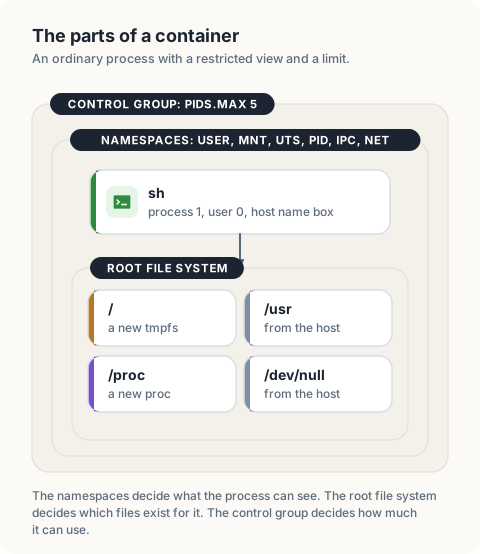
box builds.A mount namespace holds the list of mounted file systems that its processes see. A
process in a new mount namespace starts with a copy of its parent’s list and can then
mount and unmount without any effect outside. box uses that freedom to assemble a
directory tree for the container and to make it the root.
A real container image supplies a complete root file system, with its own programs and
libraries. box has no image. It borrows the program directories of the host, which
keeps the example self-contained, and exposes nothing else: the home directories,
/etc and /tmp of the host do not exist inside.
Mounts and the root directory
A mount attaches a file system at a directory, the mount point. The files of the
file system then appear below that directory. What a process sees at / is the mount at
the top of its mount namespace, and a path such as /usr/bin/ls is resolved by walking
down from there, crossing into another file system at each mount point.
box needs 3 kinds of mount, all made with the mount system call.
| Kind | Call | Effect |
|---|---|---|
| a new file system | mount("tmpfs", dir, "tmpfs", ...) | an empty file system held in memory appears at dir |
| a bind mount | mount("/usr", dir, NULL, MS_BIND, ...) | the existing directory /usr also appears at dir; the files are the same files |
| a change of propagation | mount(NULL, "/", NULL, MS_REC | MS_PRIVATE, ...) | mounts made from now on are not copied to other mount namespaces |
The root directory is changed with pivot_root, in 3 steps.
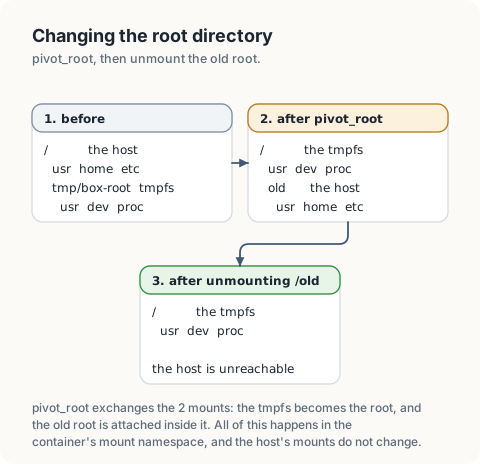
pivot_root exchanges the root with a prepared directory, and the old root is then unmounted.An older call, chroot, also changes what a process sees as /. It changes only the
starting point of path lookup and leaves the host’s file system mounted, and a process
with privilege can get out of it. pivot_root followed by the unmount removes the
host’s tree from the mount namespace altogether, which is why container runtimes use it.
Setting up
box uses golang.org/x/sys/unix in Go and the nix crate with 5 features in Rust.
$ cargo new box
$ cargo add -p box nix --features fs,hostname,mount,sched,user
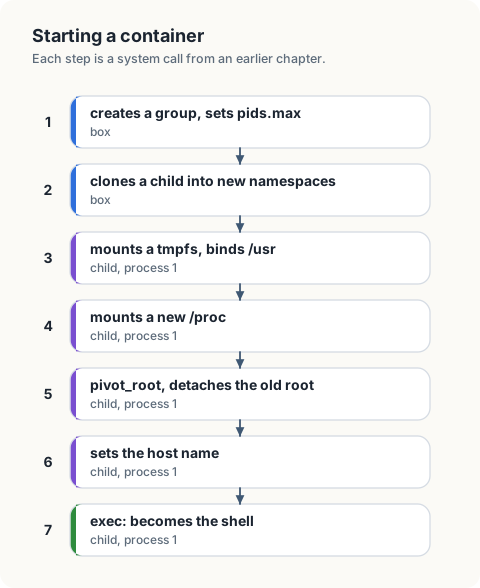
box. Steps 3 to 7 run inside the new namespaces.Low-level design: box
| Function | Runs in | Behaviour |
|---|---|---|
createGroup(pidsMax) | the parent | creates a control group and sets its limit |
launch(group, root, script) | the parent | starts the first process of the container in new namespaces and in the group |
buildRoot(root) | process 1 | mounts a tmpfs on root and populates it |
enterRoot(root) | process 1 | makes root the root directory and detaches the host’s tree |
initialize(root, script) | process 1 | builds and enters the root, sets the host name, executes the shell |
The control group
createGroup is the code of chapter 12: it finds the nearest group that passes on the
pids controller and creates a directory below it. The group is created before the
container, so that the first process of the container can start inside it.
 Listing 13.1 The imports of
box, in Go. code/go/box/main.go
import (
	"bufio"
	"errors"
	"fmt"
	"log"
	"os"
	"os/exec"
	"path/filepath"
	"strings"
	"syscall"
	"time"

	"golang.org/x/sys/unix"
)
 Listing 13.2 The imports of
box, in Rust. code/rust/box/src/main.rs
use std::env;
use std::fs;
use std::io;
use std::os::unix::fs::symlink;
use std::os::unix::process::CommandExt;
use std::path::{Path, PathBuf};
use std::process::{self, Command};
use std::thread;
use std::time::Duration;

use nix::mount::{MntFlags, MsFlags, mount, umount2};
use nix::sched::{CloneFlags, unshare};
use nix::unistd::{chdir, getgid, gethostname, getuid, pivot_root, sethostname};
Listing 13.3 Creating the control group of the container, in Go. code/go/box/main.go
// createGroup makes a control group for the container below the nearest
// group that passes the pids controller to its children, and sets pids.max.
func createGroup(pidsMax int) (string, error) {
	line, err := os.ReadFile("/proc/self/cgroup")

	if err != nil {
		return "", err
	}

	_, path, _ := strings.Cut(strings.TrimSpace(string(line)), "::")

	for dir := filepath.Join("/sys/fs/cgroup", path); dir != "/sys/fs/cgroup"; dir = filepath.Dir(dir) {
		enabled, err := os.ReadFile(filepath.Join(dir, "cgroup.subtree_control"))

		if err != nil || !strings.Contains(string(enabled), "pids") {
			continue
		}

		group := filepath.Join(dir, fmt.Sprintf("box-%d", os.Getpid()))

		if err := os.Mkdir(group, 0o755); err != nil {
			return "", err
		}

		return group, os.WriteFile(filepath.Join(group, "pids.max"), fmt.Append(nil, pidsMax), 0)
	}

	return "", errors.New("no parent group passes on the pids controller")
}

// refused returns the number of forks the group has refused.
func refused(group string) (string, error) {
	events, err := os.Open(filepath.Join(group, "pids.events"))

	if err != nil {
		return "", err
	}

	defer events.Close()

	for lines := bufio.NewScanner(events); lines.Scan(); {
		if count, ok := strings.CutPrefix(lines.Text(), "max "); ok {
			return count, nil
		}
	}

	return "", errors.New("pids.events has no line max")
}

// removeGroup waits until the group is empty and deletes it.
func removeGroup(group string) error {
	for {
		current, err := os.ReadFile(filepath.Join(group, "pids.current"))

		if err != nil {
			return err
		}

		if strings.TrimSpace(string(current)) == "0" {
			return os.Remove(group)
		}

		time.Sleep(time.Millisecond)
	}
}
Listing 13.4 Creating the control group of the container, in Rust. code/rust/box/src/main.rs
/// Makes a control group for the container below the nearest group that
/// passes the pids controller to its children, and sets `pids.max`.
fn create_group(pids_max: u32) -> io::Result<PathBuf> {
    let line = fs::read_to_string("/proc/self/cgroup")?;
    let path = line.trim().split_once("::").map_or("", |(_, path)| path);

    let root = Path::new("/sys/fs/cgroup");
    let own = root.join(path.trim_start_matches('/'));

    for dir in own.ancestors().take_while(|dir| *dir != root) {
        let Ok(enabled) = fs::read_to_string(dir.join("cgroup.subtree_control")) else {
            continue;
        };

        if enabled.contains("pids") {
            let group = dir.join(format!("box-{}", process::id()));

            fs::create_dir(&group)?;
            fs::write(group.join("pids.max"), pids_max.to_string())?;

            return Ok(group);
        }
    }

    Err(io::Error::other(
        "no parent group passes on the pids controller",
    ))
}

/// Returns the number of forks the group has refused.
fn refused(group: &Path) -> io::Result<String> {
    fs::read_to_string(group.join("pids.events"))?
        .lines()
        .find_map(|line| line.strip_prefix("max "))
        .map(str::to_owned)
        .ok_or_else(|| io::Error::other("pids.events has no line max"))
}

/// Waits until the group is empty and deletes it.
fn remove_group(group: &Path) -> io::Result<()> {
    while fs::read_to_string(group.join("pids.current"))?.trim() != "0" {
        thread::sleep(Duration::from_millis(1));
    }

    fs::remove_dir(group)
}
The first process
box starts itself again with the argument init, in new user, mount, UTS, PID, IPC
and network namespaces. As in chapter 11, the languages differ in how the namespaces are created.
The Go version passes everything to the call that creates the child. Cloneflags names
the namespaces, the mappings make the current user user 0 inside, and CgroupFD asks
the kernel to create the child directly in the control group, so there is no interval in
which the child runs outside it.
The Rust version starts a helper process that calls unshare and writes the mappings,
and the helper starts the first process. That process then moves itself into the group
by writing 0, which stands for the writing process, to cgroup.procs.
Listing 13.5 Starting the first process of the container, in Go. code/go/box/main.go
// launch starts this program again as the first process of a container. The
// clone flags create the namespaces, the mappings make the current user
// user 0 inside, and CgroupFD makes the kernel create the child inside the
// control group.
func launch(group, root, script string) (*exec.Cmd, error) {
	directory, err := os.Open(group)

	if err != nil {
		return nil, err
	}

	defer directory.Close()

	child := exec.Command("/proc/self/exe", "init", root, script)
	child.Stdout, child.Stderr = os.Stdout, os.Stderr

	child.SysProcAttr = &syscall.SysProcAttr{
		Cloneflags: syscall.CLONE_NEWUSER | syscall.CLONE_NEWNS | syscall.CLONE_NEWUTS |
			syscall.CLONE_NEWPID | syscall.CLONE_NEWIPC | syscall.CLONE_NEWNET,
		UidMappings: []syscall.SysProcIDMap{{ContainerID: 0, HostID: os.Getuid(), Size: 1}},
		GidMappings: []syscall.SysProcIDMap{{ContainerID: 0, HostID: os.Getgid(), Size: 1}},
		UseCgroupFD: true,
		CgroupFD:    int(directory.Fd()),
	}

	return child, child.Start()
}
Listing 13.6 Starting the first process of the container, in Rust. code/rust/box/src/main.rs
/// Runs in a helper process. It moves itself into new namespaces, maps the
/// current user to user 0 inside, and starts the first process of the
/// container. The new PID namespace takes effect for that child.
fn enter(group: &str, root: &str, script: &str) -> io::Result<()> {
    let (uid, gid) = (getuid(), getgid());

    unshare(
        CloneFlags::CLONE_NEWUSER
            | CloneFlags::CLONE_NEWNS
            | CloneFlags::CLONE_NEWUTS
            | CloneFlags::CLONE_NEWPID
            | CloneFlags::CLONE_NEWIPC
            | CloneFlags::CLONE_NEWNET,
    )?;

    fs::write("/proc/self/setgroups", "deny")?;
    fs::write("/proc/self/uid_map", format!("0 {uid} 1"))?;
    fs::write("/proc/self/gid_map", format!("0 {gid} 1"))?;

    let status = Command::new("/proc/self/exe")
        .args(["init", group, root, script])
        .status()?;

    let Some(code) = status.code() else {
        process::exit(1);
    };

    process::exit(code);
}
The root file system
buildRoot runs inside the new mount namespace. Its first call sets the propagation of
every mount to private. Without it, mounts made here could be copied back to the host’s
namespace, depending on how the host is configured.
It then mounts a tmpfs, a file system held in memory, on an empty directory. This is
the future root. It makes the host’s program directories visible below it with bind
mounts: a bind mount shows an existing directory at a second place. The container also
receives the device /dev/null, which shell scripts expect.
The last mount is a new /proc. The /proc of the host describes the host’s PID
namespace. A proc file system mounted from inside the new PID namespace describes that
namespace, and shows the container only its own processes.
enterRoot calls pivot_root, which makes the new directory the root of the mount
namespace and attaches the previous root at a directory inside it. Unmounting that
directory removes the last path from the container to the host’s files.
Listing 13.7 Building the root file system, and entering it, in Go. code/go/box/main.go
// shared are the directories of the host that the container can see.
var shared = []string{"bin", "sbin", "lib", "usr"}

// buildRoot assembles the root file system of the container in an empty
// directory: a tmpfs, the host's program directories, the null device, and
// a new /proc.
func buildRoot(root string) error {
	// Mount changes made from here on stay in this mount namespace.
	if err := unix.Mount("", "/", "", unix.MS_REC|unix.MS_PRIVATE, ""); err != nil {
		return fmt.Errorf("make mounts private: %w", err)
	}

	if err := unix.Mount("tmpfs", root, "tmpfs", 0, ""); err != nil {
		return fmt.Errorf("mount tmpfs: %w", err)
	}

	for _, name := range shared {
		source, target := "/"+name, filepath.Join(root, name)

		// On this system /bin, /sbin and /lib are symbolic links into /usr.
		if link, err := os.Readlink(source); err == nil {
			if err := os.Symlink(link, target); err != nil {
				return err
			}

			continue
		}

		if err := os.Mkdir(target, 0o755); err != nil {
			return err
		}

		if err := unix.Mount(source, target, "", unix.MS_BIND|unix.MS_REC, ""); err != nil {
			return fmt.Errorf("bind %s: %w", source, err)
		}
	}

	// The container gets a /dev with the null device and nothing else.
	null := filepath.Join(root, "dev", "null")

	if err := os.Mkdir(filepath.Dir(null), 0o755); err != nil {
		return err
	}

	if err := os.WriteFile(null, nil, 0o666); err != nil {
		return err
	}

	if err := unix.Mount("/dev/null", null, "", unix.MS_BIND, ""); err != nil {
		return fmt.Errorf("bind /dev/null: %w", err)
	}

	proc := filepath.Join(root, "proc")

	if err := os.Mkdir(proc, 0o555); err != nil {
		return err
	}

	if err := unix.Mount("proc", proc, "proc", 0, ""); err != nil {
		return fmt.Errorf("mount proc: %w", err)
	}

	return nil
}

// enterRoot makes root the root directory of the mount namespace and
// detaches the host's file system from it.
func enterRoot(root string) error {
	old := filepath.Join(root, "old")

	if err := os.Mkdir(old, 0o700); err != nil {
		return err
	}

	if err := unix.PivotRoot(root, old); err != nil {
		return fmt.Errorf("pivot_root: %w", err)
	}

	if err := os.Chdir("/"); err != nil {
		return err
	}

	if err := unix.Unmount("/old", unix.MNT_DETACH); err != nil {
		return fmt.Errorf("unmount the old root: %w", err)
	}

	return os.Remove("/old")
}
Listing 13.8 Building the root file system, and entering it, in Rust. code/rust/box/src/main.rs
/// The directories of the host that the container can see.
const SHARED: [&str; 4] = ["bin", "sbin", "lib", "usr"];

/// No source, file system type or options, for the calls to `mount` that
/// need none.
const NONE: Option<&str> = None;

/// Assembles the root file system of the container in an empty directory: a
/// tmpfs, the host's program directories, the null device, and a new /proc.
fn build_root(root: &Path) -> io::Result<()> {
    // Mount changes made from here on stay in this mount namespace.
    mount(NONE, "/", NONE, MsFlags::MS_REC | MsFlags::MS_PRIVATE, NONE)?;
    mount(Some("tmpfs"), root, Some("tmpfs"), MsFlags::empty(), NONE)?;

    for name in SHARED {
        let (source, target) = (Path::new("/").join(name), root.join(name));

        // On this system /bin, /sbin and /lib are symbolic links into /usr.
        if let Ok(link) = fs::read_link(&source) {
            symlink(link, target)?;

            continue;
        }

        fs::create_dir(&target)?;
        mount(
            Some(&source),
            &target,
            NONE,
            MsFlags::MS_BIND | MsFlags::MS_REC,
            NONE,
        )?;
    }

    // The container gets a /dev with the null device and nothing else.
    let null = root.join("dev/null");

    fs::create_dir(root.join("dev"))?;
    fs::write(&null, "")?;
    mount(Some("/dev/null"), &null, NONE, MsFlags::MS_BIND, NONE)?;

    let proc = root.join("proc");

    fs::create_dir(&proc)?;
    mount(Some("proc"), &proc, Some("proc"), MsFlags::empty(), NONE)?;

    Ok(())
}

/// Makes `root` the root directory of the mount namespace and detaches the
/// host's file system from it.
fn enter_root(root: &Path) -> io::Result<()> {
    let old = root.join("old");

    fs::create_dir(&old)?;
    pivot_root(root, &old)?;
    chdir("/")?;
    umount2("/old", MntFlags::MNT_DETACH)?;

    fs::remove_dir("/old")
}
Becoming the program
initialize runs the steps in order and ends with exec. The process that set up the
container is replaced by the shell, which is therefore process 1 of the container.
Listing 13.9 The first process: set up, then exec, in Go. code/go/box/main.go
// initialize runs as process 1 of the container. It builds and enters the
// root file system, sets the host name, and replaces itself with a shell
// that runs the script.
func initialize(root, script string) error {
	if err := buildRoot(root); err != nil {
		return err
	}

	if err := enterRoot(root); err != nil {
		return err
	}

	if err := unix.Sethostname([]byte("box")); err != nil {
		return err
	}

	environment := []string{"PATH=/usr/sbin:/usr/bin:/sbin:/bin"}

	return unix.Exec("/bin/sh", []string{"sh", "-c", script}, environment)
}
Listing 13.10 The first process: set up, then exec, in Rust. code/rust/box/src/main.rs
/// Runs as process 1 of the container. It moves itself into the control
/// group, where writing 0 to `cgroup.procs` means "the writing process".
/// Then it builds and enters the root file system, sets the host name, and
/// replaces itself with a shell that runs the script.
fn initialize(group: &Path, root: &Path, script: &str) -> io::Result<()> {
    fs::write(group.join("cgroup.procs"), "0")?;

    build_root(root)?;
    enter_root(root)?;
    sethostname("box")?;

    let error = Command::new("/bin/sh")
        .args(["-c", script])
        .env_clear()
        .env("PATH", "/usr/sbin:/usr/bin:/sbin:/bin")
        .exec();

    Err(error)
}
run is the parent’s side. The script reports what the shell sees and then tries to
start 6 background commands under a pids.max of 5.
Listing 13.11 Running the container, and reporting on it, in Go. code/go/box/main.go
// script is what the container runs.
const script = `echo "host name: $(hostname)"
echo "process number of the shell: $$"
echo "user number: $(id -u)"
echo "processes under /proc:" /proc/[0-9]*
echo "root directory:" /*
while read device directory type rest; do echo "mounted: $directory ($type)"; done < /proc/mounts
echo "network interfaces:" $(tail -n +3 /proc/net/dev | cut -d: -f1)
echo "effective capabilities:" $(grep CapEff /proc/self/status | cut -f2)
for i in 1 2 3 4 5 6; do sleep 1 & echo "started a background command"; done 2>/dev/null`

func run() error {
	group, err := createGroup(5)

	if err != nil {
		return err
	}

	defer removeGroup(group)

	root, err := os.MkdirTemp("", "box-root")

	if err != nil {
		return err
	}

	defer os.Remove(root)

	before, err := os.Hostname()

	if err != nil {
		return err
	}

	child, err := launch(group, root, script)

	if err != nil {
		return err
	}

	child.Wait()

	count, err := refused(group)

	if err != nil {
		return err
	}

	after, err := os.Hostname()

	if err != nil {
		return err
	}

	fmt.Printf("the container ended with status %d; forks refused by its group: %s\n", child.ProcessState.ExitCode(), count)
	fmt.Printf("host name outside unchanged: %v\n", before == after)

	return nil
}

func main() {
	var err error

	if len(os.Args) == 4 && os.Args[1] == "init" {
		err = initialize(os.Args[2], os.Args[3])
	} else {
		err = run()
	}

	if err != nil {
		log.Fatal(err)
	}
}
Listing 13.12 Running the container, and reporting on it, in Rust. code/rust/box/src/main.rs
/// What the container runs.
const SCRIPT: &str = r#"echo "host name: $(hostname)"
echo "process number of the shell: $$"
echo "user number: $(id -u)"
echo "processes under /proc:" /proc/[0-9]*
echo "root directory:" /*
while read device directory type rest; do echo "mounted: $directory ($type)"; done < /proc/mounts
echo "network interfaces:" $(tail -n +3 /proc/net/dev | cut -d: -f1)
echo "effective capabilities:" $(grep CapEff /proc/self/status | cut -f2)
for i in 1 2 3 4 5 6; do sleep 1 & echo "started a background command"; done 2>/dev/null"#;

fn hostname() -> io::Result<String> {
    Ok(gethostname()?.to_string_lossy().into_owned())
}

fn run() -> io::Result<()> {
    let group = create_group(5)?;
    let root = env::temp_dir().join(format!("box-root-{}", process::id()));

    fs::create_dir(&root)?;

    let before = hostname()?;

    let status = Command::new("/proc/self/exe")
        .arg("enter")
        .args([&group, &root])
        .arg(SCRIPT)
        .status()?;

    let Some(code) = status.code() else {
        return Err(io::Error::other("the container was ended by a signal"));
    };

    let count = refused(&group)?;

    remove_group(&group)?;
    fs::remove_dir(&root)?;

    println!("the container ended with status {code}; forks refused by its group: {count}");
    println!("host name outside unchanged: {}", before == hostname()?);

    Ok(())
}

fn main() -> io::Result<()> {
    let args: Vec<String> = env::args().collect();
    let args: Vec<&str> = args.iter().map(String::as_str).collect();

    match args.as_slice() {
        [_, "enter", group, root, script] => enter(group, root, script),
        [_, "init", group, root, script] => initialize(Path::new(group), Path::new(root), script),
        _ => run(),
    }
}
host name: box
process number of the shell: 1
user number: 0
processes under /proc: /proc/1
root directory: /bin /dev /lib /proc /sbin /usr
mounted: / (tmpfs)
mounted: /usr (ext4)
mounted: /dev/null (devtmpfs)
mounted: /proc (proc)
network interfaces: lo
effective capabilities: 000001ffffffffff
started a background command
started a background command
started a background command
started a background command
the container ended with status 2; forks refused by its group: 1
host name outside unchanged: true
| Output | What it shows |
|---|---|
host name box, unchanged outside | The UTS namespace contains the change. |
| process number 1 | The shell is the first process of the PID namespace. |
| user number 0 | The user namespace maps the invoking user to user 0. |
/proc/1 only | The new /proc shows the container’s processes. The glob is expanded by the shell itself, so no second process exists at that moment. |
/bin /dev /lib /proc /sbin /usr | The root directory is the tmpfs that buildRoot assembled. |
mounted: 4 lines | The mount namespace contains exactly what buildRoot made: the tmpfs at /, the host’s /usr, the null device, and the new /proc. The disks, /home and /tmp of the host are absent. |
network interfaces: lo | A new network namespace has only a loopback interface. The container cannot reach the network, and the host’s interfaces are invisible. |
effective capabilities 000001ffffffffff | Every capability bit is set. They apply inside the user namespace only (chapter 11). |
| 4 commands started, 1 fork refused | The shell and 4 commands reach pids.max 5, and the next fork fails. |
| status 2 | The shell stops at the failed fork and exits with an error status. |
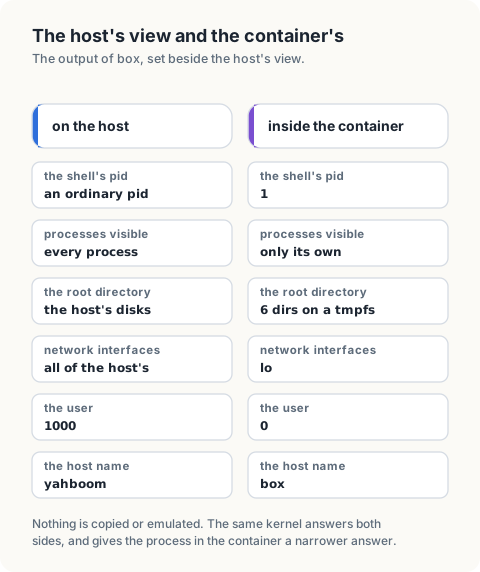
box, from the host and from inside.The table states the central fact about containers. A container is a view. The process inside is an ordinary process of the host, scheduled by the same scheduler and using the same memory, and the kernel answers its questions from a restricted set of objects.
When the shell exits, 4 sleep commands are still running. The shell was process 1 of
its PID namespace, and when the first process of a PID namespace ends, the kernel ends
every other process in it. No process of the container survives its first process,
which is why box can remove the control group as soon as its count reaches 0.
What a production runtime adds. box leaves out several parts of a container
runtime such as runc. It has no image and shares the host’s programs. Its network
namespace has only a loopback interface, where a runtime creates a pair of virtual
Ethernet devices and moves one end into the container to connect it. It keeps all
capabilities inside its user namespace and installs no system call filter, where a
runtime drops most capabilities and applies a seccomp filter, a list of permitted
system calls, to reduce what a compromised program can ask of the kernel. And it sets a
single limit, where a runtime sets memory, CPU and I/O limits as well.
A container is an ordinary process. ps, /proc and every other tool of the earlier chapters work on it from the host.
Images and runtimes
box borrows /usr from the host. A real container brings its own files, as an
image: an archive of a root file system, built in layers.
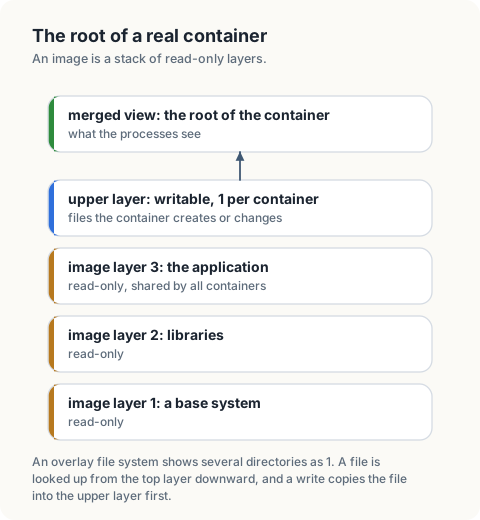
The layers are combined by an overlay file system, overlayfs. It is mounted with a
list of read-only directories, the lower layers, and a single writable directory, the
upper layer, and it shows their union. A file is looked up in the upper layer first
and then in each lower layer. A write to a file from a lower layer first copies the file
to the upper layer. The image is not modified, so many containers share its layers,
and each container’s changes are confined to its own upper layer. In terms of this
chapter, a runtime replaces the tmpfs and the bind mounts of buildRoot with a single
overlay mount, and everything after that is the same.
The software that people call “Docker” is several programs in a chain, and only the last makes the system calls.
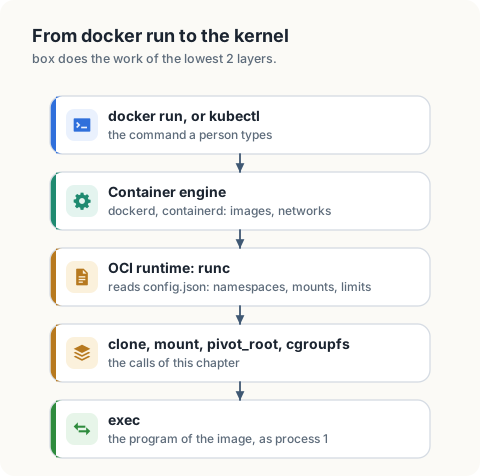
docker run to the system calls.The interface between the engine and the runtime is standardised by the Open Container
Initiative. The engine unpacks the image and writes a file, config.json, that lists
the namespaces to create, the mounts to make, the limits to set, and the command to run.
The runtime carries it out. box is a runtime with its configuration fixed in the
source.
Inspecting a container
A container is a set of ordinary processes, so every tool of the earlier chapters applies to it from the host.
| Command | Shows |
|---|---|
ps -ef --forest | the processes of a container, as children of its runtime, with their pids on the host |
ls -l /proc/<pid>/ns | the namespaces of a container process (chapter 11) |
cat /proc/<pid>/cgroup | its control group (chapter 12) |
cat /proc/<pid>/mountinfo | the mounts of its mount namespace |
cat /proc/<pid>/uid_map | the user mapping, when it runs in a user namespace |
nsenter --target <pid> --all sh | a shell inside all namespaces of the container |
The complete program
Listing 13.13 The complete box, in Go. code/go/box/main.go
// Command box runs a shell script in a container built by hand: new user,
// mount, UTS, PID, IPC and network namespaces, a root file system of its own, and a
// control group with a limit on the number of processes.
//
// Run it from code/go with:
//
//	go run ./box
package main

import (
	"bufio"
	"errors"
	"fmt"
	"log"
	"os"
	"os/exec"
	"path/filepath"
	"strings"
	"syscall"
	"time"

	"golang.org/x/sys/unix"
)


// createGroup makes a control group for the container below the nearest
// group that passes the pids controller to its children, and sets pids.max.
func createGroup(pidsMax int) (string, error) {
	line, err := os.ReadFile("/proc/self/cgroup")

	if err != nil {
		return "", err
	}

	_, path, _ := strings.Cut(strings.TrimSpace(string(line)), "::")

	for dir := filepath.Join("/sys/fs/cgroup", path); dir != "/sys/fs/cgroup"; dir = filepath.Dir(dir) {
		enabled, err := os.ReadFile(filepath.Join(dir, "cgroup.subtree_control"))

		if err != nil || !strings.Contains(string(enabled), "pids") {
			continue
		}

		group := filepath.Join(dir, fmt.Sprintf("box-%d", os.Getpid()))

		if err := os.Mkdir(group, 0o755); err != nil {
			return "", err
		}

		return group, os.WriteFile(filepath.Join(group, "pids.max"), fmt.Append(nil, pidsMax), 0)
	}

	return "", errors.New("no parent group passes on the pids controller")
}

// refused returns the number of forks the group has refused.
func refused(group string) (string, error) {
	events, err := os.Open(filepath.Join(group, "pids.events"))

	if err != nil {
		return "", err
	}

	defer events.Close()

	for lines := bufio.NewScanner(events); lines.Scan(); {
		if count, ok := strings.CutPrefix(lines.Text(), "max "); ok {
			return count, nil
		}
	}

	return "", errors.New("pids.events has no line max")
}

// removeGroup waits until the group is empty and deletes it.
func removeGroup(group string) error {
	for {
		current, err := os.ReadFile(filepath.Join(group, "pids.current"))

		if err != nil {
			return err
		}

		if strings.TrimSpace(string(current)) == "0" {
			return os.Remove(group)
		}

		time.Sleep(time.Millisecond)
	}
}


// launch starts this program again as the first process of a container. The
// clone flags create the namespaces, the mappings make the current user
// user 0 inside, and CgroupFD makes the kernel create the child inside the
// control group.
func launch(group, root, script string) (*exec.Cmd, error) {
	directory, err := os.Open(group)

	if err != nil {
		return nil, err
	}

	defer directory.Close()

	child := exec.Command("/proc/self/exe", "init", root, script)
	child.Stdout, child.Stderr = os.Stdout, os.Stderr

	child.SysProcAttr = &syscall.SysProcAttr{
		Cloneflags: syscall.CLONE_NEWUSER | syscall.CLONE_NEWNS | syscall.CLONE_NEWUTS |
			syscall.CLONE_NEWPID | syscall.CLONE_NEWIPC | syscall.CLONE_NEWNET,
		UidMappings: []syscall.SysProcIDMap{{ContainerID: 0, HostID: os.Getuid(), Size: 1}},
		GidMappings: []syscall.SysProcIDMap{{ContainerID: 0, HostID: os.Getgid(), Size: 1}},
		UseCgroupFD: true,
		CgroupFD:    int(directory.Fd()),
	}

	return child, child.Start()
}


// shared are the directories of the host that the container can see.
var shared = []string{"bin", "sbin", "lib", "usr"}

// buildRoot assembles the root file system of the container in an empty
// directory: a tmpfs, the host's program directories, the null device, and
// a new /proc.
func buildRoot(root string) error {
	// Mount changes made from here on stay in this mount namespace.
	if err := unix.Mount("", "/", "", unix.MS_REC|unix.MS_PRIVATE, ""); err != nil {
		return fmt.Errorf("make mounts private: %w", err)
	}

	if err := unix.Mount("tmpfs", root, "tmpfs", 0, ""); err != nil {
		return fmt.Errorf("mount tmpfs: %w", err)
	}

	for _, name := range shared {
		source, target := "/"+name, filepath.Join(root, name)

		// On this system /bin, /sbin and /lib are symbolic links into /usr.
		if link, err := os.Readlink(source); err == nil {
			if err := os.Symlink(link, target); err != nil {
				return err
			}

			continue
		}

		if err := os.Mkdir(target, 0o755); err != nil {
			return err
		}

		if err := unix.Mount(source, target, "", unix.MS_BIND|unix.MS_REC, ""); err != nil {
			return fmt.Errorf("bind %s: %w", source, err)
		}
	}

	// The container gets a /dev with the null device and nothing else.
	null := filepath.Join(root, "dev", "null")

	if err := os.Mkdir(filepath.Dir(null), 0o755); err != nil {
		return err
	}

	if err := os.WriteFile(null, nil, 0o666); err != nil {
		return err
	}

	if err := unix.Mount("/dev/null", null, "", unix.MS_BIND, ""); err != nil {
		return fmt.Errorf("bind /dev/null: %w", err)
	}

	proc := filepath.Join(root, "proc")

	if err := os.Mkdir(proc, 0o555); err != nil {
		return err
	}

	if err := unix.Mount("proc", proc, "proc", 0, ""); err != nil {
		return fmt.Errorf("mount proc: %w", err)
	}

	return nil
}

// enterRoot makes root the root directory of the mount namespace and
// detaches the host's file system from it.
func enterRoot(root string) error {
	old := filepath.Join(root, "old")

	if err := os.Mkdir(old, 0o700); err != nil {
		return err
	}

	if err := unix.PivotRoot(root, old); err != nil {
		return fmt.Errorf("pivot_root: %w", err)
	}

	if err := os.Chdir("/"); err != nil {
		return err
	}

	if err := unix.Unmount("/old", unix.MNT_DETACH); err != nil {
		return fmt.Errorf("unmount the old root: %w", err)
	}

	return os.Remove("/old")
}


// initialize runs as process 1 of the container. It builds and enters the
// root file system, sets the host name, and replaces itself with a shell
// that runs the script.
func initialize(root, script string) error {
	if err := buildRoot(root); err != nil {
		return err
	}

	if err := enterRoot(root); err != nil {
		return err
	}

	if err := unix.Sethostname([]byte("box")); err != nil {
		return err
	}

	environment := []string{"PATH=/usr/sbin:/usr/bin:/sbin:/bin"}

	return unix.Exec("/bin/sh", []string{"sh", "-c", script}, environment)
}


// script is what the container runs.
const script = `echo "host name: $(hostname)"
echo "process number of the shell: $$"
echo "user number: $(id -u)"
echo "processes under /proc:" /proc/[0-9]*
echo "root directory:" /*
while read device directory type rest; do echo "mounted: $directory ($type)"; done < /proc/mounts
echo "network interfaces:" $(tail -n +3 /proc/net/dev | cut -d: -f1)
echo "effective capabilities:" $(grep CapEff /proc/self/status | cut -f2)
for i in 1 2 3 4 5 6; do sleep 1 & echo "started a background command"; done 2>/dev/null`

func run() error {
	group, err := createGroup(5)

	if err != nil {
		return err
	}

	defer removeGroup(group)

	root, err := os.MkdirTemp("", "box-root")

	if err != nil {
		return err
	}

	defer os.Remove(root)

	before, err := os.Hostname()

	if err != nil {
		return err
	}

	child, err := launch(group, root, script)

	if err != nil {
		return err
	}

	child.Wait()

	count, err := refused(group)

	if err != nil {
		return err
	}

	after, err := os.Hostname()

	if err != nil {
		return err
	}

	fmt.Printf("the container ended with status %d; forks refused by its group: %s\n", child.ProcessState.ExitCode(), count)
	fmt.Printf("host name outside unchanged: %v\n", before == after)

	return nil
}

func main() {
	var err error

	if len(os.Args) == 4 && os.Args[1] == "init" {
		err = initialize(os.Args[2], os.Args[3])
	} else {
		err = run()
	}

	if err != nil {
		log.Fatal(err)
	}
}
 Listing 13.14 The complete
box, in Rust. code/rust/box/src/main.rs
//! Runs a shell script in a container built by hand: new user, mount, UTS,
//! PID, IPC and network namespaces, a root file system of its own, and a control group
//! with a limit on the number of processes.
//!
//! Run it from code/rust with:
//!
//! ```text
//! cargo run -p box
//! ```

use std::env;
use std::fs;
use std::io;
use std::os::unix::fs::symlink;
use std::os::unix::process::CommandExt;
use std::path::{Path, PathBuf};
use std::process::{self, Command};
use std::thread;
use std::time::Duration;

use nix::mount::{MntFlags, MsFlags, mount, umount2};
use nix::sched::{CloneFlags, unshare};
use nix::unistd::{chdir, getgid, gethostname, getuid, pivot_root, sethostname};

/// Makes a control group for the container below the nearest group that
/// passes the pids controller to its children, and sets `pids.max`.
fn create_group(pids_max: u32) -> io::Result<PathBuf> {
    let line = fs::read_to_string("/proc/self/cgroup")?;
    let path = line.trim().split_once("::").map_or("", |(_, path)| path);

    let root = Path::new("/sys/fs/cgroup");
    let own = root.join(path.trim_start_matches('/'));

    for dir in own.ancestors().take_while(|dir| *dir != root) {
        let Ok(enabled) = fs::read_to_string(dir.join("cgroup.subtree_control")) else {
            continue;
        };

        if enabled.contains("pids") {
            let group = dir.join(format!("box-{}", process::id()));

            fs::create_dir(&group)?;
            fs::write(group.join("pids.max"), pids_max.to_string())?;

            return Ok(group);
        }
    }

    Err(io::Error::other(
        "no parent group passes on the pids controller",
    ))
}

/// Returns the number of forks the group has refused.
fn refused(group: &Path) -> io::Result<String> {
    fs::read_to_string(group.join("pids.events"))?
        .lines()
        .find_map(|line| line.strip_prefix("max "))
        .map(str::to_owned)
        .ok_or_else(|| io::Error::other("pids.events has no line max"))
}

/// Waits until the group is empty and deletes it.
fn remove_group(group: &Path) -> io::Result<()> {
    while fs::read_to_string(group.join("pids.current"))?.trim() != "0" {
        thread::sleep(Duration::from_millis(1));
    }

    fs::remove_dir(group)
}

/// Runs in a helper process. It moves itself into new namespaces, maps the
/// current user to user 0 inside, and starts the first process of the
/// container. The new PID namespace takes effect for that child.
fn enter(group: &str, root: &str, script: &str) -> io::Result<()> {
    let (uid, gid) = (getuid(), getgid());

    unshare(
        CloneFlags::CLONE_NEWUSER
            | CloneFlags::CLONE_NEWNS
            | CloneFlags::CLONE_NEWUTS
            | CloneFlags::CLONE_NEWPID
            | CloneFlags::CLONE_NEWIPC
            | CloneFlags::CLONE_NEWNET,
    )?;

    fs::write("/proc/self/setgroups", "deny")?;
    fs::write("/proc/self/uid_map", format!("0 {uid} 1"))?;
    fs::write("/proc/self/gid_map", format!("0 {gid} 1"))?;

    let status = Command::new("/proc/self/exe")
        .args(["init", group, root, script])
        .status()?;

    let Some(code) = status.code() else {
        process::exit(1);
    };

    process::exit(code);
}

/// The directories of the host that the container can see.
const SHARED: [&str; 4] = ["bin", "sbin", "lib", "usr"];

/// No source, file system type or options, for the calls to `mount` that
/// need none.
const NONE: Option<&str> = None;

/// Assembles the root file system of the container in an empty directory: a
/// tmpfs, the host's program directories, the null device, and a new /proc.
fn build_root(root: &Path) -> io::Result<()> {
    // Mount changes made from here on stay in this mount namespace.
    mount(NONE, "/", NONE, MsFlags::MS_REC | MsFlags::MS_PRIVATE, NONE)?;
    mount(Some("tmpfs"), root, Some("tmpfs"), MsFlags::empty(), NONE)?;

    for name in SHARED {
        let (source, target) = (Path::new("/").join(name), root.join(name));

        // On this system /bin, /sbin and /lib are symbolic links into /usr.
        if let Ok(link) = fs::read_link(&source) {
            symlink(link, target)?;

            continue;
        }

        fs::create_dir(&target)?;
        mount(
            Some(&source),
            &target,
            NONE,
            MsFlags::MS_BIND | MsFlags::MS_REC,
            NONE,
        )?;
    }

    // The container gets a /dev with the null device and nothing else.
    let null = root.join("dev/null");

    fs::create_dir(root.join("dev"))?;
    fs::write(&null, "")?;
    mount(Some("/dev/null"), &null, NONE, MsFlags::MS_BIND, NONE)?;

    let proc = root.join("proc");

    fs::create_dir(&proc)?;
    mount(Some("proc"), &proc, Some("proc"), MsFlags::empty(), NONE)?;

    Ok(())
}

/// Makes `root` the root directory of the mount namespace and detaches the
/// host's file system from it.
fn enter_root(root: &Path) -> io::Result<()> {
    let old = root.join("old");

    fs::create_dir(&old)?;
    pivot_root(root, &old)?;
    chdir("/")?;
    umount2("/old", MntFlags::MNT_DETACH)?;

    fs::remove_dir("/old")
}

/// Runs as process 1 of the container. It moves itself into the control
/// group, where writing 0 to `cgroup.procs` means "the writing process".
/// Then it builds and enters the root file system, sets the host name, and
/// replaces itself with a shell that runs the script.
fn initialize(group: &Path, root: &Path, script: &str) -> io::Result<()> {
    fs::write(group.join("cgroup.procs"), "0")?;

    build_root(root)?;
    enter_root(root)?;
    sethostname("box")?;

    let error = Command::new("/bin/sh")
        .args(["-c", script])
        .env_clear()
        .env("PATH", "/usr/sbin:/usr/bin:/sbin:/bin")
        .exec();

    Err(error)
}

/// What the container runs.
const SCRIPT: &str = r#"echo "host name: $(hostname)"
echo "process number of the shell: $$"
echo "user number: $(id -u)"
echo "processes under /proc:" /proc/[0-9]*
echo "root directory:" /*
while read device directory type rest; do echo "mounted: $directory ($type)"; done < /proc/mounts
echo "network interfaces:" $(tail -n +3 /proc/net/dev | cut -d: -f1)
echo "effective capabilities:" $(grep CapEff /proc/self/status | cut -f2)
for i in 1 2 3 4 5 6; do sleep 1 & echo "started a background command"; done 2>/dev/null"#;

fn hostname() -> io::Result<String> {
    Ok(gethostname()?.to_string_lossy().into_owned())
}

fn run() -> io::Result<()> {
    let group = create_group(5)?;
    let root = env::temp_dir().join(format!("box-root-{}", process::id()));

    fs::create_dir(&root)?;

    let before = hostname()?;

    let status = Command::new("/proc/self/exe")
        .arg("enter")
        .args([&group, &root])
        .arg(SCRIPT)
        .status()?;

    let Some(code) = status.code() else {
        return Err(io::Error::other("the container was ended by a signal"));
    };

    let count = refused(&group)?;

    remove_group(&group)?;
    fs::remove_dir(&root)?;

    println!("the container ended with status {code}; forks refused by its group: {count}");
    println!("host name outside unchanged: {}", before == hostname()?);

    Ok(())
}

fn main() -> io::Result<()> {
    let args: Vec<String> = env::args().collect();
    let args: Vec<&str> = args.iter().map(String::as_str).collect();

    match args.as_slice() {
        [_, "enter", group, root, script] => enter(group, root, script),
        [_, "init", group, root, script] => initialize(Path::new(group), Path::new(root), script),
        _ => run(),
    }
}
Summary
- A container is a process in its own namespaces, with its own root file system, inside a control group. The kernel provides the parts, and a runtime assembles them.
- A user namespace lets an unprivileged user create the other namespaces and act as user 0 inside them.
- The root file system is assembled inside a new mount namespace, here from a tmpfs and
bind mounts, and
pivot_rootmakes it the root directory. /procis mounted again inside the container so that it describes the new PID namespace.- The first process sets up the container and then calls
exec, so the program it starts is process 1. - When process 1 of a PID namespace ends, the kernel ends the rest of the namespace.
References
pivot_root(2),mount_namespaces(7)andclone(2), Linux manual pages: https://man7.org/linux/man-pages/man2/pivot_root.2.html- Open Container Initiative Runtime Specification: https://github.com/opencontainers/runtime-spec
- runc, the reference runtime: https://github.com/opencontainers/runc
- L. Rice, Container Security, O’Reilly, 2020.