Training and serving on Thor (planned)
This chapter covers
- Definitions: fine-tuning, LoRA, QLoRA, quantization
- The five steps from
train.jsonlto an HTTP endpoint - Per-source weighting
- Run requirements and the diagnosis order
Status: design only. No code exists for this chapter.
5.1 Definitions
Fine-tuning: continued training of an existing large language model, the base model, on new examples.
LoRA (low-rank adaptation): the base weights are frozen. For selected weight matrices, two small matrices are trained, and their product is added to the layer output. For a 4096 × 4096 weight and rank 16, the adapter has 2 × 4096 × 16 = 131,072 trainable parameters. The full matrix has 16.8 million.
QLoRA: LoRA with the frozen base stored in 4-bit precision. Adapters train in 16-bit. The frozen weights of a 9B model take about 5 GB instead of about 18 GB.
Quantization: storing weights with fewer bits. It reduces memory and increases speed at some cost in accuracy, which depends on the method and the model and must be measured.
5.2 Steps
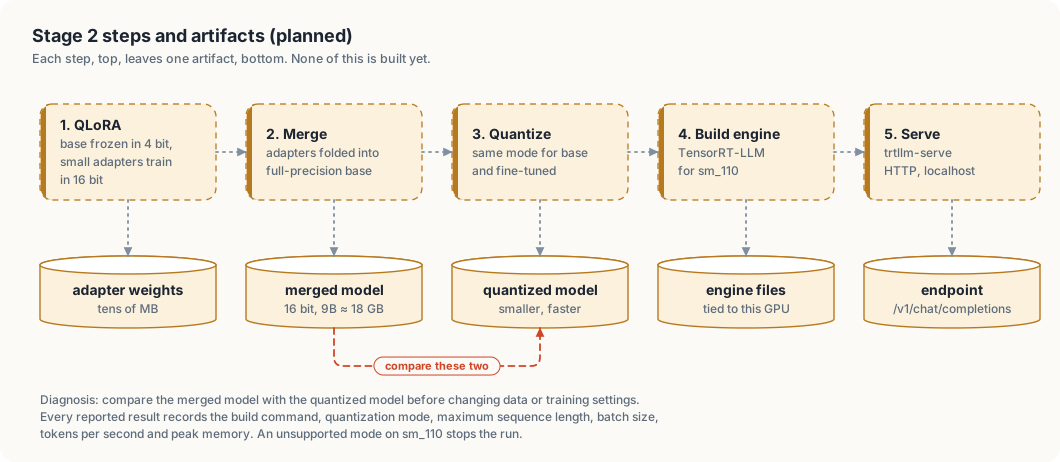
| Step | Tool | Input | Output |
|---|---|---|---|
| 1. Train | Python, Unsloth, TRL | train.jsonl, base model in 4-bit | adapter weights |
| 2. Merge | Python | base model in 16-bit, adapter | merged model, about 18 GB for 9B |
| 3. Quantize | TensorRT-LLM tooling | merged model | quantized model |
| 4. Build | TensorRT-LLM | quantized model | engine for sm_110 |
| 5. Serve | trtllm-serve | engine | OpenAI-compatible endpoint on localhost |
The base model used for comparison goes through steps 3 to 5 with identical settings.
5.3 Per-source weighting and preference training
The curated sets (readability, clever_vs_readable) are 1.7% of the tokens. The training script repeats them
about five times per epoch, raising their share to about 8%. Repetition increases the risk of verbatim
memorization; the evaluation prompt list includes prompts similar to, but not copied from, these sets.
After supervised fine-tuning on train.jsonl, an optional DPO pass trains on preferences.jsonl: 37 pairs of
readable (chosen) and clever (rejected) code. Examples flagged as slop (slop.jsonl) are candidates for further
rejected answers once a chosen rewrite exists for each.
5.4 Run requirements
- Confirm the TensorRT-LLM version or container that supports sm_110, JetPack 7 and CUDA 13 before any build.
- If a model or quantization mode is unsupported on sm_110, stop and report. No fallback to another engine.
- Record with every result: build command, quantization mode, maximum sequence length, batch size, tokens per second, peak memory.
5.5 Diagnosis order
If the fine-tuned model scores worse than expected:
- Compare the merged 16-bit model with the quantized model (dashed path in figure 5.1).
- If the merged model is good and the quantized one is not, change the quantization.
- Only then change the data or the training settings.
5.6 Open parameters
| Parameter | Constraint |
|---|---|
| Base model | to choose: a ~27–35B model that fits the Thor, e.g. Qwen3.6 or Nemotron 3 Nano |
| Maximum sequence length | one example exceeds 8,192 tokens; longer context costs memory per step |
| Serving quantization mode | limited to modes TensorRT-LLM supports on sm_110 |