
Bring your own agent
2026-10-11. A request may name any model the Thor lists, and a name nobody has is answered by the default server instead of being refused. The details are in chapter Coding tools on TensorRT Edge-LLM.
Nemotron on the Thor is an API anyone with a key can call. Point the coding agent you already use at it: Claude Code, openbatrangs, OpenCode, or anything that speaks the OpenAI or Anthropic API.
| Address | https://arpanpathak.taildb9a39.ts.net |
| Models | Nemotron 3 Nano 30B-A3B, Q8_0, 1M-token context (nemotron); Qwen3.6-35B-A3B NVFP4 on TensorRT Edge-LLM, 32K-token context (Qwen3.6-35B-A3B-NVFP4); others can be loaded with thor-tigress-serve (chapter “Model serving”) |
| Speed | about 53 tokens/s per reply; thinks before answering unless told not to (below) |
| OpenAI API | /v1/models, /v1/chat/completions |
| Anthropic API | /v1/messages (Claude Code) |
| Key | Authorization: Bearer <key> or x-api-key: <key> |
Thinking on or off, per tool
Nemotron can reason before it answers. Reasoning is generated at the same ~53 tokens/s as the answer, so it costs seconds per step: helpful on hard steps, wasted on easy ones. Each tool switches it differently:
| Tool | Thinking off | Thinking on | Default |
|---|---|---|---|
| Web chat | Think switch off | Think switch on | off |
| openbatrangs | --no-think | (nothing) | on |
| Claude Code | claude-thor (sets MAX_THINKING_TOKENS=0) | claude-thor-think | Claude Code asks for it |
| OpenCode | the nemotron model | the nemotron-think model; plan mode uses it | as configured |
| OpenAI SDKs, curl | "chat_template_kwargs": {"enable_thinking": false} | leave it out | on |
Anthropic API (/v1/messages) | leave thinking out, or "type": "disabled" | "thinking": {"type": "enabled"} or "adaptive" | off |
llama-server ignores the Anthropic thinking field, so thor-tigress-agent
translates it: a /v1/messages request that doesn’t ask for thinking gets
enable_thinking: false. Through the OpenAI path, Nemotron’s own default
(thinking on) applies unless the request says otherwise.
Get a key
Ask on the invite screen: give a
name and an email, then send a message on LinkedIn
or X. The author approves by hand and sends
back a key of your own. A key can be withdrawn at any time, after which
requests get 401; no other key is affected.
Save it where the tools below look for it:
mkdir -p ~/.config/thor-chat
(umask 077; printf '%s\n' 'PASTE-THE-KEY' > ~/.config/thor-chat/api-key)
Before you start:
- The Thor serves four replies at a time, shared by everyone, including the web chat. When all four are busy, your request waits.
- Prompts and code you send are processed on the author’s machine. Don’t send secrets.
- There is no uptime promise. It is a developer kit on a home network.
Check it works
K=$(cat ~/.config/thor-chat/api-key)
curl -s https://arpanpathak.taildb9a39.ts.net/v1/models -H "Authorization: Bearer $K"
It lists two models. 401 means the key is wrong or no longer valid.
Every request must name a model. nemotron and nemotron-think go to the
Nano, and the full id from /v1/models works too. Another model loaded with
thor-tigress-serve answers to its id. A missing or unknown name gets 400
(chapter “Model serving”).
Claude Code
Claude Code speaks the Anthropic API, and both servers answer it: llama-server
and TensorRT Edge-LLM each serve /v1/messages. The agent on :8080 picks the
engine from the model name, exactly as it does for the chat page, so a model on
either engine can be chosen. Two shell functions switch Claude Code to the Thor
only while they run; plain claude keeps using your Claude account.
thor-models lists what the agent is serving, and -m picks one. That list is
only what can answer this minute: llama.cpp in router mode also lists the models
in its preset that aren’t loaded, and the agent leaves those out, because asking
for one by name loads it — tens of gigabytes, for a minute or two. On Linux
~/.bashrc, on macOS ~/.zshrc:
cat >> ~/.bashrc <<'EOF'

# Claude Code on the Thor through the agent on :8080. thor-models lists the
# models; claude-thor -m MODEL picks one. claude-thor is the thinking-off one.
THOR_URL=${THOR_URL:-http://127.0.0.1:8080}
THOR_MODEL=${THOR_MODEL:-Nemotron-3-Nano-30B-A3B-NVFP4}
THOR_CONTEXT=${THOR_CONTEXT:-65536}

thor-models() {
  local key out
  key=$(cat ~/.config/thor-chat/api-key 2>/dev/null)
  if ! out=$(curl -sf -m 15 -H "Authorization: Bearer $key" "$THOR_URL/v1/models" 2>/dev/null); then
    echo "cannot reach $THOR_URL" >&2
    echo "  start the tunnel:  ssh -L 8080:localhost:8080 thor" >&2
    echo "  or a public url:   export THOR_URL=https://arpanpathak.taildb9a39.ts.net" >&2
    return 1
  fi
  printf '%s' "$out" | python3 -c 'import json,sys
for m in json.load(sys.stdin)["data"]:
    print("  %-42s %s" % (m["id"], m.get("owned_by", "")))'
}

_claude_thor() {
  local model="$THOR_MODEL"
  case "${1:-}" in
    -m|--model) model="$2"; shift 2 ;;
    --model=*)  model="${1#--model=}"; shift ;;
  esac
  CLAUDE_CONFIG_DIR="$HOME/.claude-thor" \
  ANTHROPIC_BASE_URL="$THOR_URL" \
  ANTHROPIC_AUTH_TOKEN="$(cat ~/.config/thor-chat/api-key)" \
  ANTHROPIC_MODEL="$model" \
  ANTHROPIC_DEFAULT_OPUS_MODEL="$model" \
  ANTHROPIC_DEFAULT_SONNET_MODEL="$model" \
  ANTHROPIC_DEFAULT_HAIKU_MODEL="$model" \
  CLAUDE_CODE_MAX_CONTEXT_TOKENS="$THOR_CONTEXT" \
  claude "$@"
}

claude-thor()       { ( MAX_THINKING_TOKENS=0; _claude_thor "$@" ); }
claude-thor-think() { _claude_thor "$@"; }
EOF
source ~/.bashrc
thor-models
Then claude-thor for the default, or a model by name:
claude-thor                                       # the Nano on TensorRT Edge-LLM
claude-thor -m Qwen3.6-35B-A3B-NVFP4              # Qwen, also on Edge-LLM
claude-thor -m nemotron-think                     # llama.cpp; loads 35 GB first
On a machine with the SSH tunnel (chapter “Local models”), THOR_URL stays
http://127.0.0.1:8080 and skips the public hop. It must be 8080, not 8079:
only thor-tigress-agent turns Claude Code’s thinking field into the chat
template setting, and only the agent knows which engine serves which model.
| Variable | Why |
|---|---|
CLAUDE_CONFIG_DIR=$HOME/.claude-thor | its own settings, history and memory; without it both commands share ~/.claude, so a setting changed in one applies to the other and /resume lists both |
ANTHROPIC_AUTH_TOKEN | the key, sent as Authorization: Bearer |
ANTHROPIC_*_MODEL | the model -m chose; every slot goes to it, and any name the agent serves is accepted |
CLAUDE_CODE_MAX_CONTEXT_TOKENS | the real window; Claude Code assumes 200K for a model it doesn’t know, and only compacts when it thinks it is near the limit |
MAX_THINKING_TOKENS=0 | Claude Code then sends no thinking field, so the Thor turns thinking off |
THOR_URL | the agent: :8080 through the tunnel, else the public address |
THOR_CONTEXT | 65536 for a model on an engine, whose input length is half its EDGE_CONTEXT; 131072 for llama.cpp, whose CONTEXT is the per-reply window |
One limit is worth knowing before it bites. An engine refuses a request longer
than its --max-input-len with 413 EDGELLM_INPUT_TOO_LONG, and Claude Code’s
own system prompt and tool list are about 19,000 tokens before you type
anything. So an engine has to be built with more room than that: EDGE_CONTEXT
of at least 65536, which is 32,768 tokens of input. llama.cpp has no such
wall; its context is the model’s own, cut by CONTEXT per reply.
Two warnings are expected on the first run in ~/.claude-thor: claude.ai
connectors are off, and the model name is not in Claude Code’s own list. Neither
changes what works.
Measured on 2026-10-05 (Claude Code 2.1.290, from a Jetson Orin NX on Linux through the public address, same prompt: “create a cargo project named dsa with a stack module with unit tests, then run cargo test”):
| Time | Tokens generated | Result | |
|---|---|---|---|
claude-thor-think | 207 s | about 11,000 | created the crate and the stack module; ran the tests |
claude-thor | 75 s | about 900 | ignored the task and wrote a CLAUDE.md template instead |
A smaller task (“create hello.rs, compile it with rustc and run it”) worked in 29 s with thinking on. The honest summary: Claude Code’s instructions are long and written for Claude; Nemotron needs its reasoning to follow them, and is then slow. For agent work on the Thor, openbatrangs (below) is the better fit: its prompt is short, and a larger version of the same task (five modules with tests) took 14 steps and 293 s, with all 14 tests passing.
To check requests reach the Thor, watch the server while it works:
ssh thor 'journalctl --user -fu thor-chat'.
openbatrangs
openbatrangs is a terminal
coding agent that edits files and runs commands in the current folder. It
needs Rust (curl https://sh.rustup.rs -sSf | sh).
Linux and macOS (Intel or Apple silicon):
xcode-select --install       # macOS only: C compiler for the TLS library
cargo install --git https://github.com/arpanpathak/openbatrangs --locked
cd ~/some-project
openbatrangs --openai-url https://arpanpathak.taildb9a39.ts.net/v1 \
             --api-key-file ~/.config/thor-chat/api-key
To avoid typing that each time:
echo 'alias obr="openbatrangs --openai-url https://arpanpathak.taildb9a39.ts.net/v1 --api-key-file ~/.config/thor-chat/api-key"' >> ~/.zshrc # ~/.bashrc on Linux
--no-think turns thinking off for faster steps; --max-steps raises the
limit of 40. The GPU panel is empty on a Mac, since it reads tegrastats or
nvidia-smi. The macOS build is checked on Linux, except for the TLS
library’s C code, which needs Apple’s compiler; it has not yet been run on a
Mac. On the Thor itself, and on any machine with the SSH tunnel,
openbatrangs --thor is enough
(chapter “Local models”).
OpenCode and other OpenAI clients
Anything with an OpenAI-compatible setting takes the base URL
https://arpanpathak.taildb9a39.ts.net/v1 and the key. For OpenCode, use
the config in chapter “Local models” with that baseURL. Keep
"chat_template_kwargs": { "enable_thinking": false } on the build model:
with thinking on, OpenCode got long reasoning and no tool calls.
Python:
from pathlib import Path
from openai import OpenAI

client = OpenAI(
    base_url="https://arpanpathak.taildb9a39.ts.net/v1",
    api_key=Path("~/.config/thor-chat/api-key").expanduser().read_text().strip(),
)
reply = client.chat.completions.create(
    model="nemotron",
    messages=[{"role": "user", "content": "Write a Rust function that reverses a string."}],
    extra_body={"chat_template_kwargs": {"enable_thinking": False}},
)
print(reply.choices[0].message.content)
Leave out extra_body to let it think first.
How it is wired
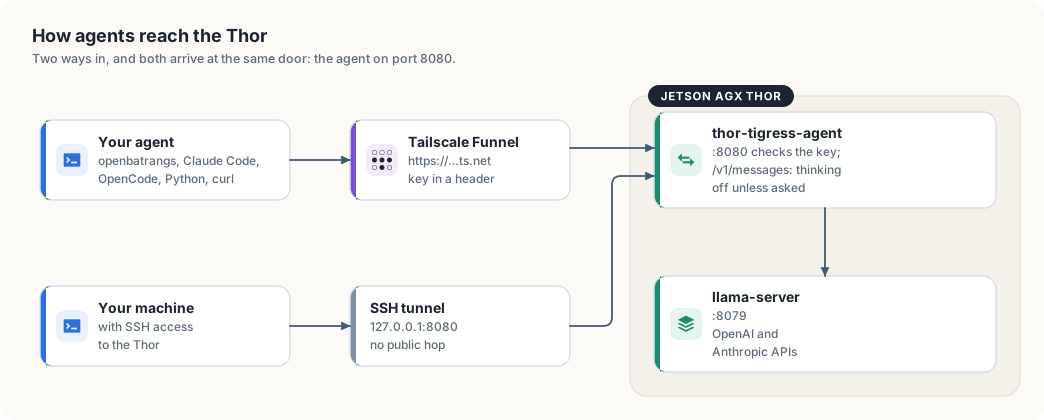
| Path | What thor-tigress-agent does |
|---|---|
/v1/models | passes it to llama-server |
/v1/chat/completions | streams it through; answers plain JSON when the request doesn’t ask for streaming (the OpenAI SDKs’ default) |
/v1/messages | passes it to llama-server’s Anthropic API, turning thinking off unless the request asks for it |
/v1/messages/count_tokens | passes it through |
It accepts the key as Authorization: Bearer or x-api-key, and allows
calls from other sites (CORS), so a page hosted elsewhere can use the API with
a key. Everything else about exposure is in chapter “Security”.