Iterators and references
This chapter covers
- What an iterator is, and what a
forloop does with one - The three ways to walk a collection: by reference, by mutable reference, and by value
- Chaining
filter,map, andcollect, and why nothing runs untilcollect - Why a closure sometimes receives
&&i32, and how patterns like|&&x|remove the references - Lifetimes: what they are, why the compiler needs them, and how to read
'ain a signature - Building a map that stores references instead of copies
Chapter 3 used iterators and references in almost every listing: nums.iter().enumerate(),
s.chars(), seen.get(&key). I explained each use briefly and moved on. This chapter slows down and
looks at them properly, because every later chapter depends on them.
The chapter has two halves. The first half is about iterators: what they are, how a for loop uses them,
and how to chain them. The second half is about references and lifetimes. A lifetime is the part of a
program during which a reference is guaranteed to point to valid data. You will see why Rust needs them,
how to read them, and how to write a function whose signature uses one.
Both halves meet in one short program. It turns a list of users into a map from each user’s ID to that user, without copying any user.
4.1 What an iterator is
An iterator is a value that hands out items one at a time. It has one required method, next, which
returns Some(item) while there are items left and None when there are none.
You can think of an iterator over a slice as a cursor that starts before the first element. Each call to
next returns the element under the cursor and moves the cursor one step (figure 4.1).
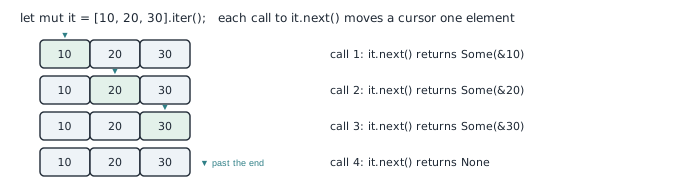
[10, 20, 30]. Each call to next returns one item. After the last item, it returns None.You rarely call next yourself. A for loop calls it for you. This loop:
for x in [10, 20, 30].iter() {
    println!("{x}");
}
does the same as this:
let mut it = [10, 20, 30].iter();
while let Some(x) = it.next() {
    println!("{x}");
}
while let Some(x) = it.next() keeps looping as long as next returns Some, and binds the item to x.
Section 2.8 used this form directly, because it needed to call next inside the loop body.
4.2 Three ways to walk a collection
A Vec<String> owns its strings. When you walk it, you have to decide what you get for each element: a
shared reference, a mutable reference, or the string itself. Each choice has its own method (figure 4.2).
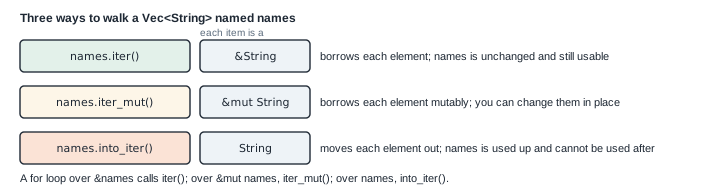
iter()gives&T, a shared reference to each element. You can read the elements, and the collection is unchanged afterward.iter_mut()gives&mut T. You can change each element in place.into_iter()givesT, the element itself. The collection is moved into the iterator, so you cannot use it afterward.
A for loop chooses for you based on what you write after in. for x in &names means names.iter().
for x in &mut names means names.iter_mut(). for x in names means names.into_iter(), and names is
gone after the loop.
TIP: When you are not sure which one you have, look at the item type the compiler reports. A
deliberate type error such as let () = x; inside the loop makes the compiler print the type of x.
4.3 Chaining iterators
An iterator adapter is a method that takes one iterator and returns another. filter keeps only the
items for which a closure returns true. map replaces each item with the closure’s result. collect
is different: it runs the whole chain and gathers the items into a collection, such as a Vec.
Figure 4.3 follows three numbers through a chain.
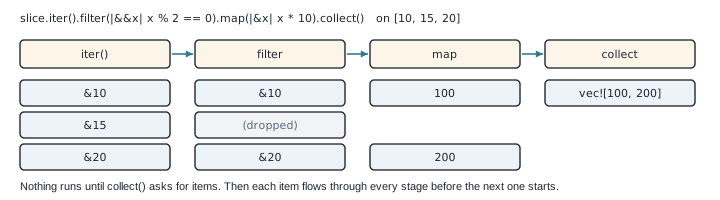
filter.Adapters are lazy. iter().filter(...).map(...) only builds a description of the work. Nothing happens
until something asks for items, as collect or a for loop does. Then each item goes through every stage
before the next item starts. No temporary vector is created between stages.
Animation 4.1 runs functional_numbers_drill from listing 4.1 on [10, 15, 20, 25, 30]. The requests go
backward, from collect toward the slice, and the items come forward one at a time.
collect pulls items through the chain one at a time. Without a consumer, no item is ever asked for, and the chain does nothing.WARNING: Because adapters are lazy, a chain that ends without collect, a for loop, or another method
that consumes it does nothing at all. The compiler warns about such a chain: “unused Map that must be used”.
4.4 References to references
Look closely at the chain in figure 4.3. slice.iter() yields items of type &i32. filter passes its
closure a reference to each item, so that the closure can look at the item without taking it. So the
closure receives &&i32: a reference to a reference to an i32 (figure 4.4).
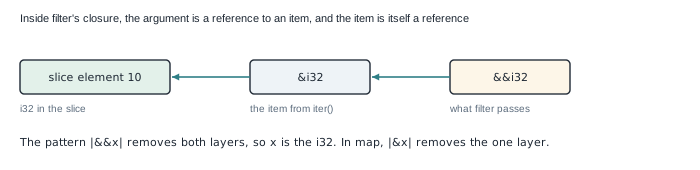
filter's closure.A closure’s parameter can be a pattern, the same as the left side of a let. The pattern &x matches a
reference and binds x to what it points to. So:
.filter(|&&x| x % 2 == 0)removes both layers. Inside the closure,xis ani32..map(|&x| x * 10)removes the one layer thatmapgives.mappasses the item itself, not a reference to it.
This works for i32 because i32 is Copy: removing the reference copies the number. A String is not
Copy. For it, a pattern like |&s| would try to move the value out of a reference, and the compiler
rejects that. You would write |s| and use s as a reference instead.
4.5 The same work in two styles
The program for this chapter starts with a small User type and two functions that do similar work in two
styles.
Listing 4.1 The User type and two ways to transform a slice (lines 1 to 23). src/bin/lifetime_reference_drill.rs
use std::collections::HashMap;

#[derive(Debug)]
struct User {
    id: u32,
    name: String,
}

fn functional_numbers_drill(slice: &[i32]) -> Vec<i32> {
    slice
        .iter()
        .filter(|&&x| x % 2 == 0)
        .map(|&x| x * 10)
        .collect()
}

fn imperative_numbers_map(slice: &[i32]) -> HashMap<i32, i32> {
    let mut map = HashMap::new();
    for &num in slice {
        map.insert(num, num * 100);
    }
    map
}
functional_numbers_drill is the chain from figure 4.3. collect() knows to build a Vec<i32> because
that is the function’s return type. When the type is not clear from context, you write it, as in
collect::<Vec<i32>>().
imperative_numbers_map uses a for loop and builds a HashMap from each number to that number times
100. for &num in slice removes the one reference that iterating a slice gives, so num is an i32.
Neither style is faster. Both compile to similar machine code. Iterator chains read well when the work is a sequence of steps. Loops read well when the body does several unrelated things.
With iterators covered, the rest of the chapter turns to the references they hand out, and to the rules that keep those references safe.
4.6 Lifetimes
A reference points to data owned by something else. If the owner is dropped while the reference is still in use, the reference points to freed memory. Reading through it would give garbage or crash the program. Figure 4.5 shows the smallest example.
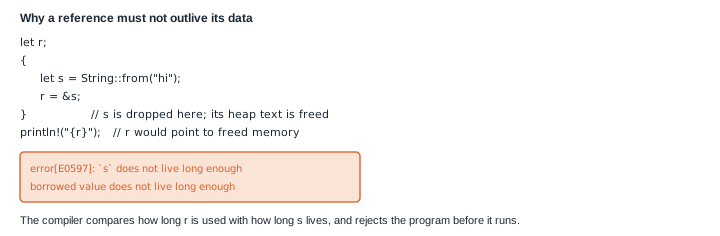
To prevent this, the compiler tracks, for every reference, the part of the program where it is used. It also knows where each value is dropped. If a reference is used after its value is dropped, the program does not compile. The part of the program where a reference is valid is its lifetime.
Inside one function, the compiler works out all lifetimes on its own. Across function calls it needs help. Consider a function that takes a reference and returns one:
fn first_word(s: &str) -> &str { ... }The caller needs to know how long the returned reference is valid. Here the only possible answer is “as
long as s”, and the compiler assumes that without being told. These assumptions are called lifetime
elision rules. For a function with one reference parameter, the returned reference gets that parameter’s
lifetime.
When the rules cannot decide, or when you want to state a relationship yourself, you name lifetimes. A
lifetime name is an apostrophe and a short name, usually 'a. You declare it in angle brackets after the
function name, like a generic type, and then attach it to references:
fn longest<'a>(x: &'a str, y: &'a str) -> &'a str { ... }Read this as: “for some lifetime 'a, both inputs are valid for 'a, and so is the output”. The compiler
then checks every caller. The returned reference may not be used after either input’s data is dropped.
A lifetime annotation does not change how long anything lives. It describes a relationship, and the compiler checks that the code keeps it.
4.7 A map that points into a slice
Now you have what you need to read the main functions of the program. The goal is to index a list of users
by ID. You could copy each user into a HashMap<u32, User>. Or you could store only a reference to each
user, in a HashMap<u32, &User>, and leave the users where they are. Figure 4.6 compares the two.

The map of references is cheaper. It also depends on the users staying alive while the map is used. The function’s signature states that dependency with a lifetime.
Listing 4.2 A map whose values point into the slice (lines 27 to 33).
fn struct_slice_to_map<'a>(slice: &'a [User]) -> HashMap<u32, &'a User> {
    let mut map = HashMap::new();
    for user in slice {
        map.insert(user.id, user);
    }
    map
}
Read the signature the way section 4.6 showed. For some lifetime 'a, the input is a slice of users valid
for 'a. The output is a map whose values are references valid for 'a. Because both mention the same
'a, the map may not be used after the users are dropped. If you tried, the compiler would reject the
program with the same error as figure 4.5.
Inside the function, for user in slice walks the slice by reference, so user is a &User. The map
stores that reference. No User is cloned.
4.8 Two lifetimes in one type
The second function takes a different input. Instead of a slice of users, it takes a slice of references to users.
Listing 4.3 A map built from a slice of references (lines 35 to 41).
fn ref_slice_to_map<'a>(slice: &[&'a User]) -> HashMap<u32, &'a User> {
    let mut map = HashMap::new();
    for &user in slice {
        map.insert(user.id, user);
    }
    map
}
The type &[&'a User] has two references in it:
- The outer
&is the slice itself, a short list of pointers. Its lifetime has no name here. - The inner
&'a Useris each pointer in the list. Its lifetime'abelongs to the users those pointers point to.
The returned map mentions only 'a. So the map depends on the users, not on the list of pointers. The list
can be dropped right after the call, and the map stays valid (figure 4.7).
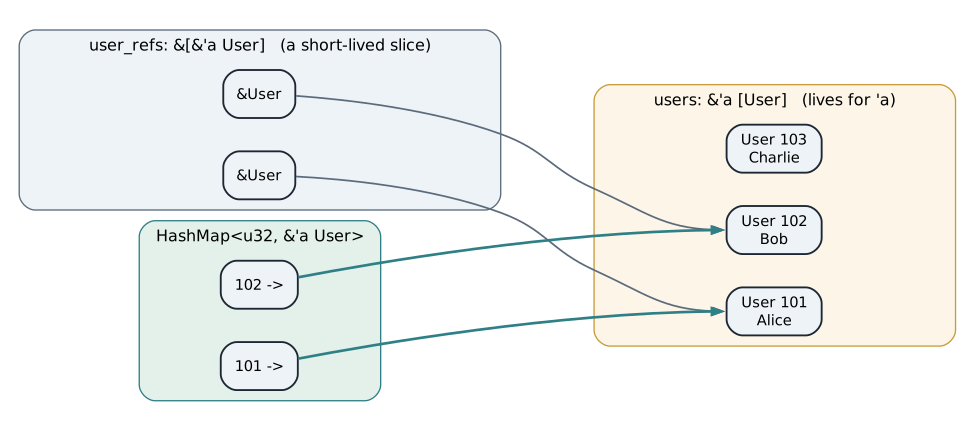
for &user in slice copies each pointer out of the slice. A reference is a Copy value, one machine word, so
this copy is cheap.
4.9 The complete program
Listing 4.4 The complete program. src/bin/lifetime_reference_drill.rs
use std::collections::HashMap;

#[derive(Debug)]
struct User {
    id: u32,
    name: String,
}

fn functional_numbers_drill(slice: &[i32]) -> Vec<i32> {
    slice
        .iter()
        .filter(|&&x| x % 2 == 0)
        .map(|&x| x * 10)
        .collect()
}

fn imperative_numbers_map(slice: &[i32]) -> HashMap<i32, i32> {
    let mut map = HashMap::new();
    for &num in slice {
        map.insert(num, num * 100);
    }
    map
}

// The lifetime could be elided. It is written out because section 4.7 reads it.
#[allow(clippy::needless_lifetimes)]
fn struct_slice_to_map<'a>(slice: &'a [User]) -> HashMap<u32, &'a User> {
    let mut map = HashMap::new();
    for user in slice {
        map.insert(user.id, user);
    }
    map
}

fn ref_slice_to_map<'a>(slice: &[&'a User]) -> HashMap<u32, &'a User> {
    let mut map = HashMap::new();
    for &user in slice {
        map.insert(user.id, user);
    }
    map
}

fn main() {
    let vv = [1, 2, 3, 4, 5, 6];

    let filtered: Vec<i32> = vv
        .iter()
        .filter(|x| *x % 2 == 0)
        .copied()
        .collect();
    println!("Filtered : {:?}", filtered);

    println!("--- Ultra-Lean Inline Slice Drill ---\n");

    let processed_nums = functional_numbers_drill(&[10, 15, 20, 25, 30]);
    println!("1. Functional Numbers (Even * 10): {:?}", processed_nums);

    let num_map = imperative_numbers_map(&[10, 15, 20, 25, 30]);
    println!("2. Imperative Numbers Map: {:?}", num_map);

    // explicit reference binding holding the inline array literal
    let users: &[User] = &[
        User {
            id: 101,
            name: "Alice".to_string(),
        },
        User {
            id: 102,
            name: "Bob".to_string(),
        },
        User {
            id: 103,
            name: "Charlie".to_string(),
        },
    ];
    println!("\n3. Zero-Allocation Struct Map (From &[User]):");
    let struct_map = struct_slice_to_map(users);
    for (id, user_ref) in &struct_map {
        println!("   Key ID: {} -> Value Name: {}", id, user_ref.name);
    }

    // explicit reference binding holding the inline array of &User
    let user_refs: &[&User] = &[struct_map[&101], struct_map[&102]];
    println!("\n4. Zero-Allocation Ref Slice Map (From &[&User]):");
    let ref_slice_map = ref_slice_to_map(user_refs);
    for (id, user_ref) in &ref_slice_map {
        println!("   Key ID: {} -> Value Name: {}", id, user_ref.name);
    }

    println!("\n--- Drill Completed Successfully! ---");
}
main starts with one more iterator chain. vv.iter() yields &i32, and filter receives &&i32. This
closure writes |x| and then *x % 2. The * removes one layer of reference, and the % operator works
through the other. .copied() turns each &i32 into an i32, so collect builds a Vec<i32>.
Two lines in main use a rule you have not seen yet:
let users: &[User] = &[ User { ... }, User { ... }, User { ... } ];&[ ... ] takes a reference to an array that was never given a name of its own. Such a value is a
temporary, and a temporary is normally dropped at the end of the statement. That would leave users
pointing to freed memory. Rust extends the temporary’s life to the end of the enclosing block when it is the
direct value of a let. This is called temporary lifetime extension. It is why users and user_refs
stay valid for the rest of main.
Run the program:
$ cargo run --bin lifetime_reference_drill
Filtered : [2, 4, 6]
--- Ultra-Lean Inline Slice Drill ---

1. Functional Numbers (Even * 10): [100, 200, 300]
2. Imperative Numbers Map: {20: 2000, 10: 1000, 25: 2500, 15: 1500, 30: 3000}

3. Zero-Allocation Struct Map (From &[User]):
   Key ID: 101 -> Value Name: Alice
   Key ID: 102 -> Value Name: Bob
   Key ID: 103 -> Value Name: Charlie

4. Zero-Allocation Ref Slice Map (From &[&User]):
   Key ID: 102 -> Value Name: Bob
   Key ID: 101 -> Value Name: Alice

--- Drill Completed Successfully! ---
Run it again and the map lines may come out in a different order. As section 3.4 explained, HashMap uses a
randomly seeded hash, so its iteration order is not fixed. When you need a stable order, use a BTreeMap,
which keeps its keys sorted, or sort the keys before printing.
Summary
- An iterator hands out items through
next, which returnsSome(item)orNone. Aforloop callsnextuntil it getsNone. iter()yields&T,iter_mut()yields&mut T, andinto_iter()yieldsTand uses up the collection.- Adapters such as
filterandmapare lazy.collector a loop drives them, one item at a time. filterpasses a reference to each item, so overiter()its closure receives&&T. Patterns like|&&x|remove the references forCopytypes.- A lifetime is the part of the program where a reference is valid. The compiler rejects a reference used after its data is dropped.
'ain a signature names a lifetime and ties inputs to outputs. It describes a relationship; it does not change how long anything lives.- A
HashMap<u32, &'a User>indexes data without copying it, and cannot outlive that data.
Chapter 5 uses iterators and collections to solve problems with heaps and sorted collections, such as finding the most frequent words in a text.
Exercises
- Rewrite
imperative_numbers_mapas an iterator chain that ends incollect::<HashMap<_, _>>(). - Write
fn longest<'a>(x: &'a str, y: &'a str) -> &'a str. Then write amainwhere calling it and using the result fails to compile, and read the error. - Change
struct_slice_to_mapto return aBTreeMap, and check that the output order is now stable. - Write a function that takes
&mut [User]and usesiter_mut()to append “ (admin)“ to every name.