Vectors, strings, and hash maps
This chapter covers
- Counting how much work an algorithm does, and the O(n) notation for it
- How a
Vec, aString, and aHashMapare laid out in memory - Finding a pair of numbers with a hash map
- Using a vector as a stack to check brackets and to track a minimum
- Walking an array with two indexes: reversing, sliding windows, and merging intervals
- Binary search, rotating a grid, and searching text
This chapter begins Part 2. Part 2 is about data structures and the algorithms that use them. In this
chapter you work with the three collections you will use most in Rust: Vec, String, and HashMap.
Before any problem, I spend a few sections on groundwork. First, a way to compare two solutions by how much work they do. Then a look at how each collection stores its data. With that in place, each problem in the rest of the chapter is short, and you can see why each solution is fast.
The problems are grouped by technique, not by topic. A technique is a pattern you can reuse. Two examples are “keep a stack of things not yet matched” and “move two indexes toward each other”. Table 3.1 lists them.
| Section | Technique | Problems |
|---|---|---|
| 3.5 | look things up in a hash map | find two numbers that add up to a target |
| 3.6 | a vector used as a stack | check brackets; a stack that knows its minimum |
| 3.7 | two indexes moving toward each other | reverse a string; find three numbers that add to zero |
| 3.8 | a window that slides along a string | longest piece of text with no repeated letter |
| 3.9 | sort, then walk once | merge overlapping ranges |
| 3.10 | halve the search each step | binary search in a rotated array |
| 3.11 | transform in place | rotate a square grid |
| 3.12 | reuse what you already matched | find text inside other text |
3.1 Counting the work an algorithm does
Two programs can give the same answer and take very different amounts of time. You saw this in chapter 1: the recursive Fibonacci took milliseconds where the loop took nanoseconds. To choose between solutions, you need a way to describe how their running time grows as the input grows.
The usual way is to count the basic steps a program takes for an input of size n. Here n is the length of the array or string. A basic step is something that takes a fixed amount of time, such as comparing two numbers or reading one element.
Consider three ways to answer questions about an array of n numbers:
- Reading the first element takes one step, whatever n is.
- Adding up all the elements takes n steps, one per element.
- Comparing every element with every other element takes about n × n steps.
Big-O notation is a short way to write how the count grows. You keep only the part that grows fastest and drop constant factors. So the three examples above are written O(1), O(n), and O(n²). You read O(n) as “order n”: the time grows in proportion to n.
Table 3.2 shows how different these are once n is large.
| n | O(1) | O(log n) | O(n) | O(n log n) | O(n²) |
|---|---|---|---|---|---|
| 10 | 1 | about 3 | 10 | about 33 | 100 |
| 1,000 | 1 | about 10 | 1,000 | about 10,000 | 1,000,000 |
| 1,000,000 | 1 | about 20 | 1,000,000 | about 20,000,000 | 1,000,000,000,000 |
A modern processor does roughly a billion simple steps per second. At a million elements, an O(n) solution finishes in about a millisecond. An O(n²) solution takes about a quarter of an hour.
The same notation describes memory. A solution that uses O(n) extra memory stores something for each input element. A solution that uses O(1) extra memory uses a fixed amount, however large the input.
NOTE: O(log n) appears when each step cuts the remaining work in half. Halving a million items takes about 20 steps to get down to one, because 2 multiplied by itself 20 times is about a million. Section 3.10 uses this.
3.2 How a Vec stores its elements
A Vec<T> is a growable array. Its elements sit next to each other in one block of heap memory. The
Vec value itself is small. It holds three numbers. The first is a pointer to the block. The second is
the number of elements in use, its length. The third is how many elements the block has room for, its
capacity. Figure 3.1
shows a vector of four i32 values with room for six.
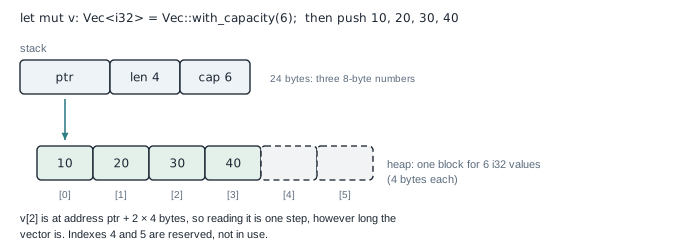
Vec<i32> with length 4 and capacity 6. The elements are next to each other, so the address of any element can be computed from its index.Because the elements are next to each other, reading v[i] takes one step. The address of element i is
the block’s address plus i times the size of one element. The length of the vector does not matter.
So indexing a Vec is O(1).
When you push an element and the block is full, the vector needs a bigger block. Figure 3.2 shows what happens.
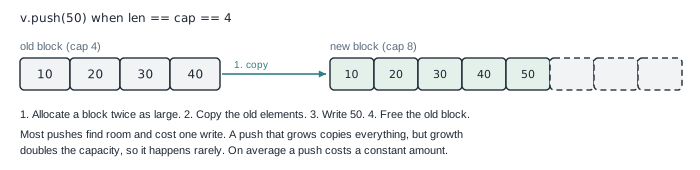
That copy costs O(n), but it happens rarely, because each growth doubles the capacity. Spread over all the pushes, each push costs a constant amount on average. This is called amortized O(1).
If you know how many elements you will push, Vec::with_capacity(n) allocates the whole block at once, and
no copy happens at all. You will see this in several listings below.
WARNING: A push can move every element to a new block. So Rust does not let you keep a reference to an
element while you push. The compiler rejects code that holds &v[0] across a v.push(...), since
the reference could point to freed memory afterward.
3.3 How a String stores text
A String is a Vec<u8> with one extra rule. Its bytes must always be valid UTF-8. UTF-8 is the
standard way of turning characters into bytes. An English letter takes one byte. Other characters take two,
three, or four bytes. Figure 3.3 shows the four characters of "café".
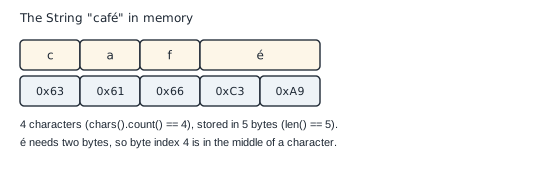
"café" has four characters and five bytes. The letter é takes two bytes.This has three consequences you will meet in this chapter:
s.len()counts bytes, not characters."café".len()is 5.s.chars()walks the characters one at a time, decoding the bytes as it goes.- You cannot index a
Stringwiths[3]. A byte index might fall in the middle of a character, as index 4 does in figure 3.3, so Rust does not allow it.
3.4 How a HashMap finds a key
A HashMap<K, V> stores pairs of a key and a value, and finds the value for a key quickly. It works in
three steps (figure 3.4):
- It runs the key through a hash function, which turns any key into a large number. The same key always gives the same number.
- It uses some of the bits of that number to pick a bucket, one slot in an array of buckets.
- It stores the pair in that bucket, or looks for it there.
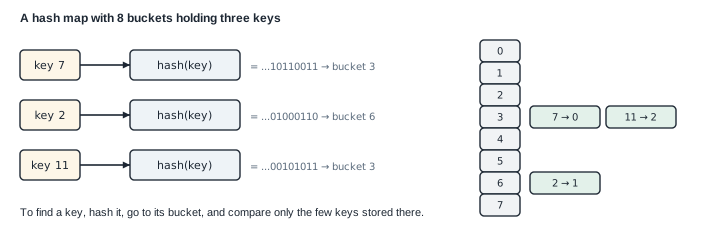
Two keys can land in the same bucket, as 7 and 11 do in the figure. Then a lookup compares the keys in
that bucket one by one. The map keeps the number of keys per bucket small by growing its bucket array as
it fills. So on average, insert and get are O(1), however many keys the map holds.
Rust’s HashMap uses a hash function with a random starting value, chosen when the program starts. This
stops an attacker from sending keys that all land in one bucket. It also means the order in which you
iterate over a map changes from one run to the next.
Now you have the tools for the problems. Each one starts with the simplest correct idea, then shows how a collection makes it faster.
3.5 Finding two numbers that add up to a target
The problem. Given an array of numbers and a target, find two positions whose numbers add up to the
target. For [2, 7, 11, 15] and target 9, the answer is positions 0 and 1, because 2 + 7 = 9.
The simple idea. Try every pair. For each position i, check every later position j. That is about
n × n / 2 pairs, so O(n²).
A faster idea. Walk the array once. For each number, you know which partner it needs: target - num.
If you have already seen that partner, you are done. To answer “have I seen it?” in one step, keep a
HashMap from each number seen so far to its position.
Trace it on [2, 7, 11, 15] with target 9:
| Position | Number | Partner needed | In the map? | Map afterward |
|---|---|---|---|---|
| 0 | 2 | 7 | no | {2: 0} |
| 1 | 7 | 2 | yes, at position 0 | answer: (0, 1) |
Listing 3.1 Two Sum with one pass and a hash map. src/problems/two_sum.rs
//! Two Sum: find the pair of indices whose values add up to a target.
//!
//! Use a `HashMap` for one pass: O(n) time, O(n) space.

use std::collections::HashMap;

pub fn two_sum(nums: &[i32], target: i32) -> Option<(usize, usize)> {
    let mut seen = HashMap::with_capacity(nums.len());
    for (idx, &num) in nums.iter().enumerate() {
        match seen.get(&(target - num)) {
            Some(&prev) => return Some((prev, idx)),
            None => {
                seen.insert(num, idx);
            }
        }
    }
    None
}

#[cfg(test)]
mod tests {
    use super::*;

    #[test]
    fn finds_pair() {
        let nums = [2, 7, 11, 15];
        assert_eq!(two_sum(&nums, 9), Some((0, 1)));
    }

    #[test]
    fn returns_none_when_missing() {
        assert_eq!(two_sum(&[1, 2, 3], 100), None);
    }
}
Walk through the function:
- The parameter
nums: &[i32]is a slice, a borrowed view of a sequence ofi32values. You can pass aVec, an array, or part of either. HashMap::with_capacity(nums.len())sizes the map for the worst case, so it never grows during the loop.nums.iter().enumerate()gives pairs of (position, reference to number). The pattern(idx, &num)copies the number out of the reference.seen.get(&(target - num))looks up the partner.gettakes a reference to the key, hence the&.- If the partner is found, the function returns both positions. Otherwise it records this number.
The lookup comes before the insert. Think of target 4 with a single 2 in the array. If the insert came first, the 2 would find itself and pair with itself.
The function returns Option<(usize, usize)>: Some with the two positions, or None if no pair exists.
It runs in O(n) time and uses O(n) extra memory for the map.
WARNING: target - num is computed in i32. For numbers near the ends of the i32 range, such as
i32::MIN, the subtraction overflows, and a debug build stops with a panic. Using i64 for the arithmetic,
or target.checked_sub(num), avoids it.
3.6 A vector used as a stack
A stack is a collection where you add and remove items at the same end, called the top. The last item
you added is the first one you remove. A Vec works as a stack. push adds to the end, and pop removes
the last item and returns it. last looks at the end without removing it. All three are O(1).
3.6.1 Checking brackets
The problem. A string of brackets is valid if every opening bracket is closed by the matching kind, in
the right order. "{[()]}" is valid. "([)]" is not, because ] arrives while ( is still open.
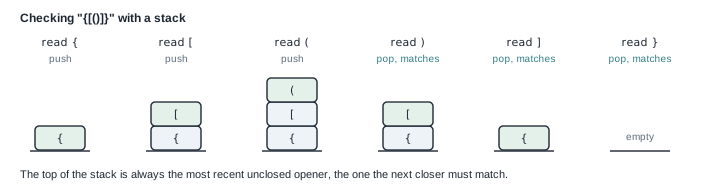
The idea. Read the string from left to right. Push each opening bracket onto a stack. When a closing
bracket arrives, the top of the stack must be its matching opener; pop it and continue. At the end, the
stack must be empty. Figure 3.5 traces "{[()]}".
"{[()]}". Each closing bracket pops the opener on top, which must be its partner.) pops [, so the check fails.Listing 3.2 Valid Parentheses. src/problems/valid_parentheses.rs
//! Valid Parentheses: classic stack problem with idiomatic pattern matching.
//!
pub fn is_valid(s: &str) -> bool {
    use std::collections::HashMap;

    let mut stack = Vec::with_capacity(s.len());

    // Maps each closing delimiter to the opening delimiter it must match.
    let expected = HashMap::from([(')', '('), ('}', '{'), (']', '[')]);

    for ch in s.chars() {
        match ch {
            '(' | '[' | '{' => stack.push(ch),
            // Every other character, including one outside the six delimiters,
            // must close the top of the stack.
            _ => {
                if stack.pop().as_ref() != expected.get(&ch) {
                    return false;
                }
            }
        }
    }

    stack.is_empty()
}

#[cfg(test)]
mod tests {
    use super::*;

    #[test]
    fn valid_cases() {
        assert!(is_valid("()"));
        assert!(is_valid("()[]{}"));
        assert!(is_valid("{[()]}"));
    }

    #[test]
    fn invalid_cases() {
        assert!(!is_valid("(]"));
        assert!(!is_valid("([)]"));
        assert!(!is_valid("("));
        assert!(!is_valid(")"));
        assert!(!is_valid("(("));
    }
}
The map expected records, for each closing bracket, the opener it needs. HashMap::from([...]) builds a
map from an array of pairs.
The match has two arms. The first pushes any of the three openers. The second handles every other
character and compares two Option values:
stack.pop()removes the top and returnsSome(opener), orNoneif the stack is empty..as_ref()turnsOption<char>intoOption<&char>, so it can be compared with the next value.expected.get(&ch)returnsSome(&opener)for a closing bracket.
If they differ, the string is invalid. An empty stack gives None, which differs from Some, so an extra
closer is caught. After the loop, stack.is_empty() catches openers that were never closed.
The tests list valid and invalid examples, including "([)]", a lone ")", and "((".
WARNING: Suppose a character that is not a bracket arrives while the stack is empty. It gives None
on both sides of the comparison, so it passes. is_valid("a") returns true. If your input can contain other
characters, skip or reject them in their own arm.
3.6.2 A stack that knows its minimum
The problem. Build a stack that supports push, pop, top, and get_min, the smallest value
currently in it, all in O(1).
The idea. Scanning the stack for the minimum takes O(n). Instead, keep a second stack beside the first. Each time you push a value, also push the minimum so far. Then the minimum of the whole stack is always on top of the second stack. When you pop, pop both.
Trace pushes of -2, 0, and -3:
| Operation | values | mins | get_min() |
|---|---|---|---|
| push -2 | [-2] | [-2] | -2 |
| push 0 | [-2, 0] | [-2, -2] | -2 |
| push -3 | [-2, 0, -3] | [-2, -2, -3] | -3 |
| pop | [-2, 0] | [-2, -2] | -2 |
Listing 3.3 Min Stack with a parallel stack of minimums. src/problems/min_stack.rs
//! Min Stack: O(1) push, pop, top, and get_min.
//!
//! We keep a parallel `mins` stack. Each push stores the current minimum at that
//! point in history, so pop is symmetric.

#[derive(Debug, Default)]
pub struct MinStack {
    values: Vec<i32>,
    mins: Vec<i32>,
}

impl MinStack {
    pub fn new() -> Self {
        Self::default()
    }

    pub fn push(&mut self, val: i32) {
        match self.mins.last() {
            Some(&min) if min <= val => self.mins.push(min),
            _ => self.mins.push(val),
        }
        self.values.push(val);
    }

    pub fn pop(&mut self) -> Option<i32> {
        self.mins.pop();
        self.values.pop()
    }

    pub fn top(&self) -> Option<i32> {
        self.values.last().copied()
    }

    pub fn get_min(&self) -> Option<i32> {
        self.mins.last().copied()
    }
}

#[cfg(test)]
mod tests {
    use super::*;

    #[test]
    fn stack_tracks_minimum() {
        let mut stack = MinStack::new();
        stack.push(-2);
        stack.push(0);
        stack.push(-3);
        assert_eq!(stack.get_min(), Some(-3));
        assert_eq!(stack.pop(), Some(-3));
        assert_eq!(stack.top(), Some(0));
        assert_eq!(stack.get_min(), Some(-2));
    }

    #[test]
    fn handles_duplicates() {
        let mut stack = MinStack::new();
        stack.push(1);
        stack.push(1);
        stack.pop();
        assert_eq!(stack.get_min(), Some(1));
    }
}
#[derive(Default)] gives MinStack a default() function that creates two empty vectors, and new calls
it.
In push, self.mins.last() returns the current minimum, if any. The arm Some(&min) if min <= val has a
guard, the if after the pattern. It pushes the old minimum again when the new value is not smaller.
The _ arm covers both an empty stack and a new smaller value, and pushes val.
The guard uses <=, not <. When you push a value equal to the current minimum, the minimum is recorded
again. So popping one copy leaves the other, and the minimum stays correct. The test handles_duplicates
checks this case.
top and get_min use .copied() to turn Option<&i32> into Option<i32>, so the caller gets a plain
number.
3.7 Two indexes moving toward each other
Some problems need you to look at both ends of an array at once. Keep one index at the start and one at the end, and move them toward each other. Each step moves at least one index, so the whole walk is O(n).
3.7.1 Reversing a string in place
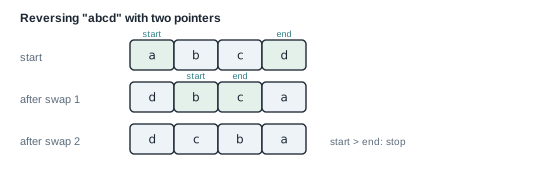
The idea. Swap the first and last bytes, then the second and second-to-last, and stop when the indexes meet (figure 3.6).
"abcd". Two swaps, then the indexes cross.There is a complication. As section 3.3 explained, a String must stay valid UTF-8, and swapping the bytes
of a two-byte character would break it. So Rust does not let you change a String’s bytes directly in safe
code. String::as_mut_vec gives you the bytes, but it is marked unsafe. unsafe marks code where the
compiler cannot check a rule, so the programmer must. Here the rule is “the bytes are valid UTF-8 when
you are done”.
Listing 3.4 The reversing function (lines 1 to 14). src/bin/reverse_string.rs
fn reverse_str(s: &mut String) {
    // SAFETY: s._as_mut_vec() is unsafe because it exposes the inner mutability to it's character buffer, and we must ensure
    // to leave valid UTF-8. We enforce ASCII only characters.
    assert!(s.is_ascii());
    let bytes = unsafe { s.as_mut_vec() };

    let (mut start, mut end) = (0, bytes.len() - 1);

    while start < end {
        bytes.swap(start, end);
        start += 1;
        end -= 1;
    }
}
The function keeps the rule by checking first: assert!(s.is_ascii()) stops the program unless every byte
is a plain ASCII character. Reversing ASCII bytes gives ASCII, which is valid UTF-8. The unsafe block is
then as small as possible, one call.
bytes.swap(start, end) exchanges two elements of the vector. The loop runs while start < end, so the
middle element of an odd-length string stays where it is.
Listing 3.5 The complete program, with its tests. src/bin/reverse_string.rs
fn reverse_str(s: &mut String) {
    // SAFETY: s._as_mut_vec() is unsafe because it exposes the inner mutability to it's character buffer, and we must ensure
    // to leave valid UTF-8. We enforce ASCII only characters.
    assert!(s.is_ascii());
    let bytes = unsafe { s.as_mut_vec() };

    let (mut start, mut end) = (0, bytes.len() - 1);

    while start < end {
        bytes.swap(start, end);
        start += 1;
        end -= 1;
    }
}

fn main() {
    for value in ["abcd", "abc", "a", "rust"] {
        let mut s = String::from(value);
        reverse_str(&mut s);
        println!("{value:>6} -> {s}");
    }
}

#[cfg(test)]
mod tests {
    use super::*;

    #[test]
    fn an_even_length_string_is_reversed() {
        let mut s = String::from("abcd");
        reverse_str(&mut s);
        assert_eq!(s, "dcba");
    }

    #[test]
    fn an_odd_length_string_keeps_its_middle_byte() {
        let mut s = String::from("abc");
        reverse_str(&mut s);
        assert_eq!(s, "cba");
    }

    #[test]
    fn a_single_byte_is_unchanged() {
        let mut s = String::from("a");
        reverse_str(&mut s);
        assert_eq!(s, "a");
    }

    #[test]
    fn the_buffer_is_reused() {
        let mut s = String::from("abcd");
        let capacity = s.capacity();
        let address = s.as_ptr();
        reverse_str(&mut s);
        assert_eq!(s.capacity(), capacity);
        assert_eq!(s.as_ptr(), address);
    }

    #[test]
    fn reversing_twice_restores_the_string() {
        let mut s = String::from("interview");
        reverse_str(&mut s);
        reverse_str(&mut s);
        assert_eq!(s, "interview");
    }

    #[test]
    #[should_panic]
    fn non_ascii_input_panics() {
        let mut s = String::from("café");
        reverse_str(&mut s);
    }
}
The test the_buffer_is_reused records the string’s capacity and the address of its bytes before the
call, then checks both afterward. They are unchanged, so the reversal used no new memory.
non_ascii_input_panics is marked #[should_panic]: it passes only if the call panics, which the
assert! does for "café".
$ cargo run --bin reverse_string
  abcd -> dcba
   abc -> cba
     a -> a
  rust -> tsur
WARNING: For an empty string, bytes.len() - 1 subtracts 1 from 0 in usize, which cannot go below
zero. A debug build panics. Return early when the string is empty.
3.7.2 Three numbers that add up to a target
The problem. Find every set of three numbers in an array that adds up to a target, without listing the same set twice.
The idea. Sort the array first. Then fix the first number, and look for the other two in the rest of the
array. Use two indexes: left starts right after the fixed number, and right starts at the end. Because the array is
sorted, you know which index to move:
- If the sum is too small, move
leftright. That can only increase the sum. - If the sum is too large, move
rightleft. That can only decrease it. - If the sum is right, record the three numbers, then move both.
Each fixed number costs one O(n) walk, and there are n fixed numbers, so the whole search is O(n²). Sorting costs O(n log n), which is smaller.
The function first sorts, then fixes each number in turn:
// Import the variants directly into scope
use std::cmp::Ordering::{Equal, Greater, Less};

pub fn three_sum(numbers: &mut [i32], target: i32) -> Vec<(i32, i32, i32)> {
    numbers.sort_unstable();

    let mut results = Vec::new();
    let target = i64::from(target);

    for i in 0..numbers.len() {
        // Skip a first value that was already used, so triplets stay unique.
        if i > 0 && numbers[i] == numbers[i - 1] {
            continue;
        }

        let (mut left, mut right) = (i + 1, numbers.len().saturating_sub(1));
        // ...
    }
}
use std::cmp::Ordering::{Equal, Greater, Less};lets the code writeLessinstead ofOrdering::Less. The next excerpt matches on these three.- The
continueskips a fixed value equal to the previous one, so the same set is not found twice. numbers.len().saturating_sub(1)gives 0 instead of underflowing when the slice is empty.
For each fixed number, left and right close in from the two ends of the rest:
pub fn three_sum(numbers: &mut [i32], target: i32) -> Vec<(i32, i32, i32)> {
    // ...
    for i in 0..numbers.len() {
        // ...
        while left < right {
            // Widen to i64 so the sum of three i32 values cannot overflow.
            let current_sum = numbers[i] as i64 + numbers[left] as i64 + numbers[right] as i64;

            match current_sum.cmp(&target) {
                Less => left += 1,
                Greater => right -= 1,
                Equal => {
                    results.push((numbers[i], numbers[left], numbers[right]));

                    while left < right && numbers[left] == numbers[left + 1] {
                        left += 1;
                    }
                    while left < right && numbers[right] == numbers[right - 1] {
                        right -= 1;
                    }

                    left += 1;
                    right -= 1;
                }
            }
        }
    }
    // ...
}- The sum is computed in
i64. Threei32values can add up to more thani32can hold. The testdoes_not_overflow_on_extreme_valuesusesi32::MAXtwice to check this. current_sum.cmp(&target)returnsLess,Greater, orEqual, and thematchturns each into the move from the list above.- After a match, the two inner
whileloops stepleftandrightpast values equal to the ones in the match.
Listing 3.6 Three Sum, with its tests. src/problems/three_sum.rs
//! Three Sum: every unique triplet of values that adds up to a target.
//!
//! Sort, fix the first value, then close in on the other two with two pointers.
//! Sorts the caller's slice in place: O(n^2) time, no extra space beyond the result.

// Import the variants directly into scope
use std::cmp::Ordering::{Equal, Greater, Less};

pub fn three_sum(numbers: &mut [i32], target: i32) -> Vec<(i32, i32, i32)> {
    numbers.sort_unstable();

    let mut results = Vec::new();
    let target = i64::from(target);

    for i in 0..numbers.len() {
        // Skip a first value that was already used, so triplets stay unique.
        if i > 0 && numbers[i] == numbers[i - 1] {
            continue;
        }

        let (mut left, mut right) = (i + 1, numbers.len().saturating_sub(1));
        while left < right {
            // Widen to i64 so the sum of three i32 values cannot overflow.
            let current_sum = numbers[i] as i64 + numbers[left] as i64 + numbers[right] as i64;

            match current_sum.cmp(&target) {
                Less => left += 1,
                Greater => right -= 1,
                Equal => {
                    results.push((numbers[i], numbers[left], numbers[right]));

                    while left < right && numbers[left] == numbers[left + 1] {
                        left += 1;
                    }
                    while left < right && numbers[right] == numbers[right - 1] {
                        right -= 1;
                    }

                    left += 1;
                    right -= 1;
                }
            }
        }
    }

    results
}

#[cfg(test)]
mod tests {
    use super::*;

    #[test]
    fn finds_all_unique_triplets() {
        let result = three_sum(&mut [-1, 0, 1, 2, -1, -4], 0);
        assert_eq!(result, vec![(-1, -1, 2), (-1, 0, 1)]);
    }

    #[test]
    fn skips_duplicates_on_every_position() {
        assert_eq!(three_sum(&mut [0, 0, 0, 0], 0), vec![(0, 0, 0)]);
        assert_eq!(three_sum(&mut [-2, 0, 0, 2, 2], 0), vec![(-2, 0, 2)]);
    }

    #[test]
    fn supports_a_non_zero_target() {
        assert_eq!(
            three_sum(&mut [1, 2, 3, 4, 5], 9),
            vec![(1, 3, 5), (2, 3, 4)]
        );
    }

    #[test]
    fn returns_nothing_when_no_triplet_exists() {
        assert!(three_sum(&mut [1, 2, 3], 100).is_empty());
        assert!(three_sum(&mut [1, 2], 3).is_empty());
        assert!(three_sum(&mut [], 0).is_empty());
    }

    #[test]
    fn does_not_overflow_on_extreme_values() {
        assert_eq!(
            three_sum(&mut [i32::MAX, i32::MAX, i32::MIN], i32::MAX - 1),
            vec![(i32::MIN, i32::MAX, i32::MAX)]
        );
    }
}[-4, -1, -1, 0, 1, 2], one comparison per step. The sign of the sum decides which pointer moves. The repeated -1 at index 2 is skipped.3.8 A window that slides along a string
The problem. Find the length of the longest piece of a string in which no character repeats. In
"pwwkew", the answer is 3, for "wke" or "kew".
The idea. Keep a window, a range start..=end of the string with no repeated character. Move end
forward one character at a time. When the new character already appears inside the window, move start to
the position right after its earlier one. The window never contains a repeat, and the answer is the largest window
seen.
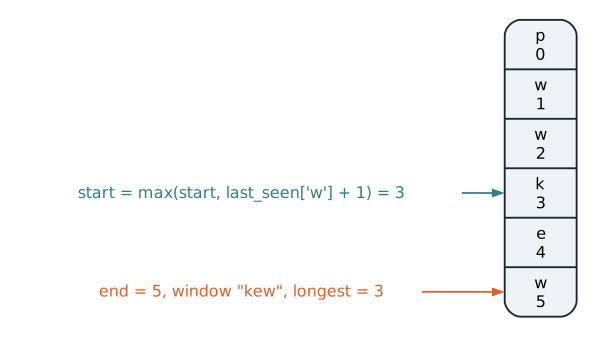
To know where a character last appeared, keep a HashMap from each character to its last position. Figure
3.7 shows the moment in "pwwkew" when the second w arrives.
end = 5, the w was last seen at index 2. start moves to 3, and the window is "kew".end moves right one character at a time, and start moves only when a repeat inside the window arrives. The run on "abba" shows the case that max handles.Listing 3.7 Longest substring without a repeated character. src/problems/sliding_window.rs
//! Longest substring without repeating characters.
//!
//! Sliding window with `HashMap<char, usize>`; the window start is monotonic.

use std::collections::HashMap;

pub fn length_of_longest_substring(s: &str) -> usize {
    let mut last_seen = HashMap::with_capacity(s.len());

    let (mut start, mut longest) = (0, 0);

    for (end, ch) in s.chars().enumerate() {
        if let Some(&previous) = last_seen.get(&ch) {
            start = start.max(previous + 1);
        }
        longest = longest.max(end - start + 1);
        last_seen.insert(ch, end);
    }

    longest
}

#[cfg(test)]
mod tests {
    use super::*;

    #[test]
    fn examples() {
        assert_eq!(length_of_longest_substring("abcabcbb"), 3);
        assert_eq!(length_of_longest_substring("bbbbb"), 1);
        assert_eq!(length_of_longest_substring("pwwkew"), 3);
        assert_eq!(length_of_longest_substring(""), 0);
    }
}
if let Some(&previous) = last_seen.get(&ch) runs its block only when the character has been seen before.
Then start = start.max(previous + 1) moves start past the earlier position. The max stops start from
moving backward when the earlier position is already outside the window. For example, in "abba", the last
a was seen at 0, but start is already at 2.
end - start + 1 is the current window’s length. Both start and end only move forward, so the loop does
O(n) work.
The positions come from chars().enumerate(), so they count characters, not bytes. That is what the
problem asks for.
3.9 Sort, then walk once: merging ranges
The problem. Given ranges such as [1,3] [2,6] [8,10] [15,18], merge every group that overlaps. The
answer here is [1,6] [8,10] [15,18].
The idea. Sort the ranges by their start. Then walk them once. Each range either overlaps the last merged range, and extends it, or starts a new merged range (figure 3.8).
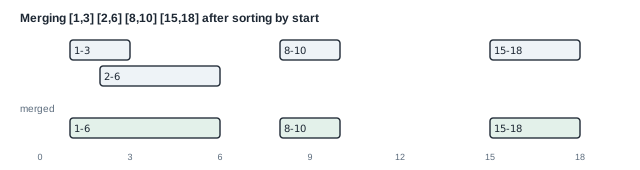
The file solves the problem three times: with a named struct, with plain tuples, and in place. First the struct and the first version:
Listing 3.8 Merging ranges held in a struct (lines 6 to 28). src/problems/merge_intervals.rs
#[derive(Debug, PartialEq, Clone, Copy)]
pub struct Interval {
    start: i32,
    end: i32,
}
pub fn merge_intervals(mut intervals: Vec<Interval>) -> Vec<Interval> {
    if intervals.is_empty() {
        return intervals;
    }

    intervals.sort_unstable_by_key(|interval| interval.start);

    let mut merged: Vec<Interval> = Vec::with_capacity(intervals.len());
    for Interval { start, end } in intervals {
        match merged.last_mut() {
            Some(previous) if start <= previous.end => {
                previous.end = previous.end.max(end);
            }
            _ => merged.push(Interval { start, end }),
        }
    }
    merged
}
sort_unstable_by_key(|interval| interval.start) sorts by start. “Unstable” means equal starts may change
order, which does not affect the result and is slightly faster.
The loop header for Interval { start, end } in intervals takes each range apart into two variables.
merged.last_mut() returns a mutable reference to the last merged range, or None if there is none yet.
The guard if start <= previous.end checks for overlap. When it holds, the code extends the range in place
through the reference: previous.end = previous.end.max(end). The max handles a range that lies entirely
inside the previous one. In every other case, the _ arm starts a new merged range.
The second version does the same with (i32, i32) tuples, so the end is written previous.1:
Listing 3.9 The same merge over tuples (lines 30 to 48).
pub fn merge_intervals2(mut intervals: Vec<(i32, i32)>) -> Vec<(i32, i32)> {
    if intervals.is_empty() {
        return intervals;
    }

    intervals.sort_unstable_by_key(|(start, _)| *start);

    let mut merged: Vec<(i32, i32)> = Vec::with_capacity(intervals.len());

    for &(start, end) in &intervals {
        match merged.last_mut() {
            Some(previous) if start <= previous.1 => {
                previous.1 = previous.1.max(end);
            }
            _ => merged.push((start, end)),
        }
    }
    merged
}
It works the same way. The struct version is easier to read, because previous.end says what previous.1
leaves to you to remember.
The third version needs no second vector. It writes the merged ranges into the front of the input vector:
Listing 3.10 Merging in place (lines 50 to 72).
/// In place: `last` is the last merged interval at the front of the vector.
/// O(1) extra space.
pub fn merge_intervals_in_place(intervals: &mut Vec<Interval>) {
    if intervals.is_empty() {
        return;
    }

    intervals.sort_unstable_by_key(|interval| interval.start);

    let mut last = 0;
    for i in 1..intervals.len() {
        match (intervals[last], intervals[i]) {
            (previous, current) if current.start <= previous.end => {
                intervals[last].end = previous.end.max(current.end);
            }
            (_, current) => {
                last += 1;
                intervals[last] = current;
            }
        }
    }
    intervals.truncate(last + 1);
}
last is the position of the last merged range. For each later range, the code either extends
intervals[last], or moves last forward one place and copies the range there. At the end,
truncate(last + 1) drops the leftovers. This version uses O(1) extra memory.
match (intervals[last], intervals[i]) copies both ranges out of the vector into a pair. That works
because Interval derives Copy. Because the arms work on copies, they are free to write to
intervals[last] without a borrowing conflict.
Listing 3.11 The tests (lines 74 to 106).
#[cfg(test)]
mod tests {
    use super::*;

    #[test]
    fn merges_overlapping_and_adjacent() {
        let input = [(1, 3), (2, 6), (8, 10), (15, 18)].map(|(start, end)| Interval { start, end });
        let expected = [(1, 6), (8, 10), (15, 18)].map(|(start, end)| Interval { start, end });
        assert_eq!(merge_intervals(input.into()), expected);
    }

    #[test]
    fn handles_empty_and_disjoint() {
        assert_eq!(merge_intervals(vec![]), vec![]);
        let input = [(1, 2), (3, 4)].map(|(start, end)| Interval { start, end });
        let expected = [(1, 2), (3, 4)].map(|(start, end)| Interval { start, end });
        assert_eq!(merge_intervals(input.into()), expected);
    }

    #[test]
    fn merges_in_place() {
        let mut intervals: Vec<Interval> = [(8, 10), (1, 3), (15, 18), (2, 6)]
            .map(|(start, end)| Interval { start, end })
            .into();
        merge_intervals_in_place(&mut intervals);
        let expected = [(1, 6), (8, 10), (15, 18)].map(|(start, end)| Interval { start, end });
        assert_eq!(intervals, expected);

        let mut empty = vec![];
        merge_intervals_in_place(&mut empty);
        assert!(empty.is_empty());
    }
}
The tests build ranges from tuples with .map(|(start, end)| Interval { start, end }) on arrays. They cover
overlapping ranges, an empty input, ranges that do not touch, and unsorted input for the in-place version.
All three versions merge ranges that only touch, such as [1,3] and [3,5], because the check is <=.
3.10 Halving the search: binary search
In a sorted array, you can find a value without looking at every element. Compare the value with the middle element. If the value is smaller, it can only be in the left half; if larger, only in the right half. Discard the other half and repeat. Figure 3.9 finds 23 in eight values in three steps.
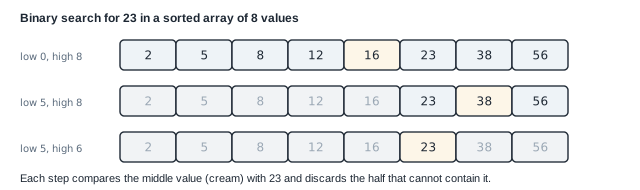
low..high. Eight elements take three comparisons. The search for 20 ends with an empty range.The code in this section uses a half-open range low..high. low is the first position still in the
range, and high is one past the last. The range is empty when low == high.
3.10.1 Searching a rotated array
The file solves a harder version. A sorted array has been rotated: some elements from the front were
moved to the back, as in [4, 5, 6, 7, 0, 1, 2]. You still want O(log n).
The idea rests on one observation. If you split a rotated array at any middle position, at least one of the two halves is still sorted. You can tell which by comparing its end values. Then:
- If the left half is sorted and the target lies between its first and middle values, search the left half.
- If the right half is sorted and the target lies between its middle and last values, search the right half.
- Otherwise, search the other half.
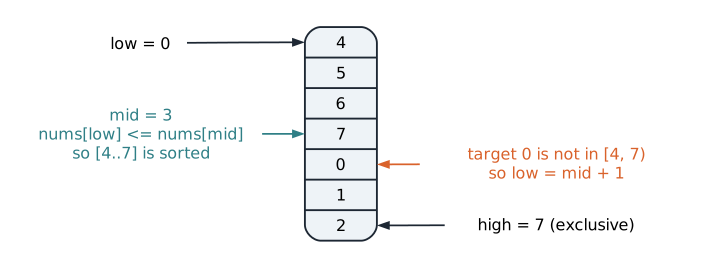
mid is sorted. The search keeps that half only if the target lies inside its end values.Listing 3.12 Search in a rotated sorted array. src/problems/binary_search.rs
//! Binary search on a rotated sorted array.
//!
//! O(log n). The code uses explicit range bounds and
//! sorted-half checks; no recursion or nested `if` chains are required.

pub fn search_rotated(nums: &[i32], target: i32) -> Option<usize> {
    let mut low = 0usize;
    let mut high = nums.len();

    while low < high {
        let mid = low + (high - low) / 2;
        if nums[mid] == target {
            return Some(mid);
        }

        let left_is_sorted = nums[low] <= nums[mid];
        if left_is_sorted {
            if nums[low] <= target && target < nums[mid] {
                high = mid;
            } else {
                low = mid + 1;
            }
        } else if nums[mid] < target && target <= nums[high - 1] {
            low = mid + 1;
        } else {
            high = mid;
        }
    }

    None
}

#[cfg(test)]
mod tests {
    use super::*;

    #[test]
    fn finds_target_in_rotated_array() {
        let nums = [4, 5, 6, 7, 0, 1, 2];
        assert_eq!(search_rotated(&nums, 0), Some(4));
        assert_eq!(search_rotated(&nums, 3), None);
        assert_eq!(search_rotated(&nums, 5), Some(1));
    }

    #[test]
    fn handles_unrotated_and_single() {
        assert_eq!(search_rotated(&[1, 2, 3, 4], 3), Some(2));
        assert_eq!(search_rotated(&[1], 1), Some(0));
        assert_eq!(search_rotated(&[1], 2), None);
    }
}
mid = low + (high - low) / 2 finds the middle. The shorter (low + high) / 2 can overflow when both are
very large; this form cannot.
nums[low] <= nums[mid] means the left half is sorted. The test that the target is in it is
nums[low] <= target && target < nums[mid]. The right-half test uses nums[high - 1], the last element,
because high itself is one past the end.
3.11 Rotating a square grid in place
The problem. Rotate an n × n grid a quarter turn clockwise, without a second grid.
The idea. Do it in two simple steps (figure 3.11). First transpose the grid. That means swapping the element at row i, column j with the one at row j, column i. It flips the grid across its diagonal. Then reverse each row.
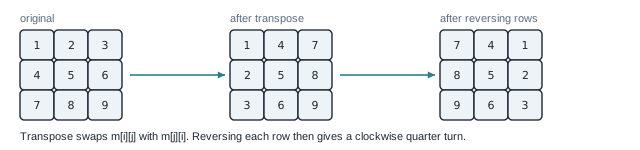
row.reverse() reverses each row. Starting j at 0 would swap every pair twice.Listing 3.13 The complete program. src/bin/rotate_matrix.rs
fn rotate(m: &mut [Vec<i32>]) {
    let n = m.len();

    for i in 0..n {
        for j in i + 1..n {
            let tmp = m[i][j];
            m[i][j] = m[j][i];
            m[j][i] = tmp;
        }
    }

    for row in m.iter_mut() {
        row.reverse();
    }
}

fn main() {
    let mut m = vec![vec![1, 2, 3], vec![4, 5, 6], vec![7, 8, 9]];

    rotate(&mut m);

    for row in &m {
        println!("{:?}", row);
    }
}
The grid is a Vec<Vec<i32>>, a vector of rows. rotate takes it as &mut [Vec<i32>], a mutable slice of rows, because it changes cells but never adds or removes a row. The transpose loop starts j at i + 1, so it visits only
the cells above the diagonal and swaps each pair once. Visiting every cell would swap each pair twice and
undo the work.
The swap uses a temporary variable tmp. std::mem::swap needs two mutable references, and
m[i][j] and m[j][i] are in different rows of the same outer vector. The borrow checker cannot see that
they do not overlap, so it would reject taking both at once.
for row in m.iter_mut() gives a mutable reference to each row, and row.reverse() reverses it.
$ cargo run --bin rotate_matrix
[7, 4, 1]
[8, 5, 2]
[9, 6, 3]
3.12 Finding text inside text
The problem. Find the first position where a short string, the needle, appears in a longer one, the haystack.
The simple idea. Try each position of the haystack, and compare the needle character by character. On a mismatch, move one position right and start over. In the worst case this compares every needle character at every position. For a haystack of length n and a needle of length m, that is O(n × m).
The better idea. Suppose a mismatch comes after several matching characters. You already know what those characters were, because they are the start of the needle. Often a later part of them is also the start of the needle, so you can continue from there instead of starting over. The Knuth-Morris-Pratt algorithm (KMP) uses this. It never moves backward in the haystack, so it runs in O(n + m).
Figure 3.12 shows one such jump.
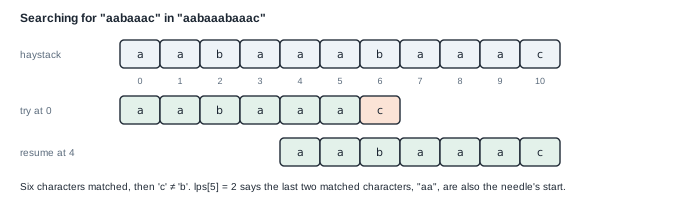
"aa", are also the start of the needle. The search continues with them already matched, and finds the needle at position 4.left falls back to lps[left - 1] and right stays where it is. The haystack is read once, from left to right.To know how far to jump, KMP first builds a table from the needle alone. For each position i, look at the piece needle[0..=i]. lps[i] is
the length of the longest part of that piece that is both its start and its end. The whole piece does not
count. The name “lps” stands for longest proper prefix that is also a suffix. For the needle in the figure:
| index | 0 | 1 | 2 | 3 | 4 | 5 | 6 |
|---|---|---|---|---|---|---|---|
| needle | a | a | b | a | a | a | c |
| lps | 0 | 1 | 0 | 1 | 2 | 2 | 0 |
For example, lps[4] = 2, because "aabaa" starts with "aa" and ends with "aa".
build_lps compares the needle with itself, using the same three branches as the search. The table ends as 0 1 0 1 2 2 0.Listing 3.14 The search and the table (lines 1 to 58). src/bin/kmp_pattern_matching.rs
struct Solution {}
impl Solution {
    /// @param haystack the string to search in
    /// @param needle   the pattern to find
    /// @return         first index of needle in haystack, or -1
    pub fn str_str(haystack: String, needle: String) -> i32 {
        let (haystack, needle) = (haystack.as_bytes(), needle.as_bytes());
        if needle.is_empty() {
            return 0;
        }

        let lps = Self::build_lps(needle);
        // left walks the needle, and right walks the haystack.
        let (mut left, mut right) = (0, 0);

        while right < haystack.len() {
            if haystack[right] == needle[left] {
                left += 1;
                right += 1;
            } else if left > 0 {
                // Fall back, keeping the characters that still match.
                left = lps[left - 1];
            } else {
                // A mismatch at the start of the needle.
                right += 1;
            }

            if left == needle.len() {
                // The whole needle matched.
                return (right - left) as i32;
            }
        }
        -1
    }

    // LPS: longest proper prefix of needle[0..=right] that is also a suffix
    fn build_lps(needle: &[u8]) -> Vec<usize> {
        let mut lps = vec![0; needle.len()];
        let (mut left, mut right) = (0, 1);

        while right < needle.len() {
            if needle[right] == needle[left] {
                left += 1;
                lps[right] = left;
                right += 1;
            } else if left > 0 {
                left = lps[left - 1];
            } else {
                // lps[right] stays 0.
                right += 1;
            }
        }
        lps
    }
}

fn main() {
    let cases = [
    // ...
}
str_str works on bytes, from as_bytes(), so it can index directly. left counts how many needle
characters currently match, and right walks the haystack. Each pass of the loop takes one of three
branches:
- The characters match: advance both.
- They do not match, but some characters had matched: jump
leftback tolps[left - 1], keepingrightwhere it is. - They do not match and nothing had matched: advance
right.
When left reaches the needle’s length, the needle starts at right - left.
build_lps runs the same three-branch loop, comparing the needle against itself. Both loops only move
forward, which gives the O(n + m) total.
Listing 3.15 The complete program. src/bin/kmp_pattern_matching.rs
struct Solution {}
impl Solution {
    /// @param haystack the string to search in
    /// @param needle   the pattern to find
    /// @return         first index of needle in haystack, or -1
    pub fn str_str(haystack: String, needle: String) -> i32 {
        let (haystack, needle) = (haystack.as_bytes(), needle.as_bytes());
        if needle.is_empty() {
            return 0;
        }

        let lps = Self::build_lps(needle);
        // left walks the needle, and right walks the haystack.
        let (mut left, mut right) = (0, 0);

        while right < haystack.len() {
            if haystack[right] == needle[left] {
                left += 1;
                right += 1;
            } else if left > 0 {
                // Fall back, keeping the characters that still match.
                left = lps[left - 1];
            } else {
                // A mismatch at the start of the needle.
                right += 1;
            }

            if left == needle.len() {
                // The whole needle matched.
                return (right - left) as i32;
            }
        }
        -1
    }

    // LPS: longest proper prefix of needle[0..=right] that is also a suffix
    fn build_lps(needle: &[u8]) -> Vec<usize> {
        let mut lps = vec![0; needle.len()];
        let (mut left, mut right) = (0, 1);

        while right < needle.len() {
            if needle[right] == needle[left] {
                left += 1;
                lps[right] = left;
                right += 1;
            } else if left > 0 {
                left = lps[left - 1];
            } else {
                // lps[right] stays 0.
                right += 1;
            }
        }
        lps
    }
}

fn main() {
    let cases = [
        ("sadbutsad", "sad"),
        ("leetcode", "leeto"),
        ("aabaaabaaac", "aabaaac"),
        ("hello", ""),
    ];

    for (haystack, needle) in cases {
        let result = Solution::str_str(haystack.to_string(), needle.to_string());
        println!("str_str({haystack:?}, {needle:?}) = {result}\n");
    }
}
$ cargo run --bin kmp_pattern_matching
str_str("sadbutsad", "sad") = 0
str_str("leetcode", "leeto") = -1
str_str("aabaaabaaac", "aabaaac") = 4
str_str("hello", "") = 0
The function returns -1 when the needle is absent, following the convention of the problem it solves. In
your own code, Option<usize> states that more clearly. For everyday searching, the standard library’s
str::find is also linear time.
3.13 The complete files
The sections above showed these files in excerpts. Here each one is whole.
Listing 3.16 Merging overlapping intervals, with its tests. src/problems/merge_intervals.rs
//! Merge Intervals: sort by start, then merge overlapping intervals in one pass.
//!
//! The `match out.last_mut()` pattern is intentionally clean: no deep nesting,
//! no confusing boolean flags.

#[derive(Debug, PartialEq, Clone, Copy)]
pub struct Interval {
    start: i32,
    end: i32,
}
pub fn merge_intervals(mut intervals: Vec<Interval>) -> Vec<Interval> {
    if intervals.is_empty() {
        return intervals;
    }

    intervals.sort_unstable_by_key(|interval| interval.start);

    let mut merged: Vec<Interval> = Vec::with_capacity(intervals.len());
    for Interval { start, end } in intervals {
        match merged.last_mut() {
            Some(previous) if start <= previous.end => {
                previous.end = previous.end.max(end);
            }
            _ => merged.push(Interval { start, end }),
        }
    }
    merged
}

pub fn merge_intervals2(mut intervals: Vec<(i32, i32)>) -> Vec<(i32, i32)> {
    if intervals.is_empty() {
        return intervals;
    }

    intervals.sort_unstable_by_key(|(start, _)| *start);

    let mut merged: Vec<(i32, i32)> = Vec::with_capacity(intervals.len());

    for &(start, end) in &intervals {
        match merged.last_mut() {
            Some(previous) if start <= previous.1 => {
                previous.1 = previous.1.max(end);
            }
            _ => merged.push((start, end)),
        }
    }
    merged
}

/// In place: `last` is the last merged interval at the front of the vector.
/// O(1) extra space.
pub fn merge_intervals_in_place(intervals: &mut Vec<Interval>) {
    if intervals.is_empty() {
        return;
    }

    intervals.sort_unstable_by_key(|interval| interval.start);

    let mut last = 0;
    for i in 1..intervals.len() {
        match (intervals[last], intervals[i]) {
            (previous, current) if current.start <= previous.end => {
                intervals[last].end = previous.end.max(current.end);
            }
            (_, current) => {
                last += 1;
                intervals[last] = current;
            }
        }
    }
    intervals.truncate(last + 1);
}

#[cfg(test)]
mod tests {
    use super::*;

    #[test]
    fn merges_overlapping_and_adjacent() {
        let input = [(1, 3), (2, 6), (8, 10), (15, 18)].map(|(start, end)| Interval { start, end });
        let expected = [(1, 6), (8, 10), (15, 18)].map(|(start, end)| Interval { start, end });
        assert_eq!(merge_intervals(input.into()), expected);
    }

    #[test]
    fn handles_empty_and_disjoint() {
        assert_eq!(merge_intervals(vec![]), vec![]);
        let input = [(1, 2), (3, 4)].map(|(start, end)| Interval { start, end });
        let expected = [(1, 2), (3, 4)].map(|(start, end)| Interval { start, end });
        assert_eq!(merge_intervals(input.into()), expected);
    }

    #[test]
    fn merges_in_place() {
        let mut intervals: Vec<Interval> = [(8, 10), (1, 3), (15, 18), (2, 6)]
            .map(|(start, end)| Interval { start, end })
            .into();
        merge_intervals_in_place(&mut intervals);
        let expected = [(1, 6), (8, 10), (15, 18)].map(|(start, end)| Interval { start, end });
        assert_eq!(intervals, expected);

        let mut empty = vec![];
        merge_intervals_in_place(&mut empty);
        assert!(empty.is_empty());
    }
}
Summary
- Big-O notation describes how running time or memory grows with the input size, keeping only the fastest growing part.
- A
Vecstores its elements next to each other on the heap, so indexing is O(1). Pushing is amortized O(1) because the capacity doubles when it runs out. - A
Stringis UTF-8 bytes.len()counts bytes, andchars()walks characters. - A
HashMaphashes each key to a bucket, sogetandinsertare O(1) on average. - A hash map turns “have I seen the partner?” into one step (Two Sum).
- A vector used as a stack tracks unmatched openers (brackets) and running minimums (Min Stack).
- Two indexes moving toward each other reverse a string or search a sorted array for sums in O(n) per pass.
- A sliding window with a map of last positions finds the longest run without repeats in O(n).
- Sorting first lets one pass merge overlapping ranges.
- Binary search halves the range each step, O(log n), and still works on a rotated sorted array.
- KMP reuses matched characters, so text search takes O(n + m).
This chapter used iterators such as iter() and enumerate() without much comment. Chapter 4 looks at them
closely, along with the references they hand you and the lifetimes that keep those references valid.
Exercises
- Change
two_sumto usei64arithmetic so that it cannot overflow, and add a test withi32::MIN. - Fix
is_validso that characters other than brackets are rejected, and add a test for"a". - Make
reverse_strhandle an empty string, then write a version that reverses the characters of any UTF-8 string, including"café". - Write a plain binary search over a sorted slice that returns
Option<usize>, and test it on arrays of length 0, 1, and 2. - Rotate the grid counterclockwise instead, using a transpose and one other reversal.