Processes
A process is a program in execution, together with everything the kernel keeps for it:
its memory, its open files, its identity for permission checks, and its place in the
scheduler. The kernel represents each process by a record, struct task_struct, and
identifies it by a number, the process ID or pid.
In this chapter, we will follow a process through its whole life: how it is created,
how it comes to run a different program, how it ends, and how the process that created
it learns the result. We will read the kernel’s record of a process field by field and
find the same information under /proc. Then we will write procfacts, which measures
each step on a running kernel, and proctable, a model of the kernel’s process table.
This chapter covers
- what happens when a shell runs a command, step by step
struct task_struct: the kernel’s record of a process- process states, and how to read them from
/proc fork: what the child copies, what it shares, and what is newexec: what is replaced and what survivesexitandwait, and the integer that carries the result- zombies, orphans, and the process that adopts them
- how the kernel chooses a pid
- threads, and the difference between a process and a task
A shell runs a command
When we type ls in a shell, 4 system calls do the work, 2 in the shell and 2 in a new
process.
- The shell calls
fork. The kernel creates a second process that is a copy of the shell: the same program, the same memory contents, the same open files. The new process is the child, and the shell is its parent.forkreturns in both processes. In the parent it returns the pid of the child, and in the child it returns 0, which is how each of them knows which one it is. - The child calls
execwith the path of thelsprogram. The kernel discards the memory of the child, loadslsin its place, and starts it. The pid does not change. It is the same process running a different program. lsdoes its work and callsexitwith a status, 0 for success.- Meanwhile the parent has called
wait, which puts it to sleep until a child ends.waitnow returns the pid of the child and its status, and the shell prints the next prompt.
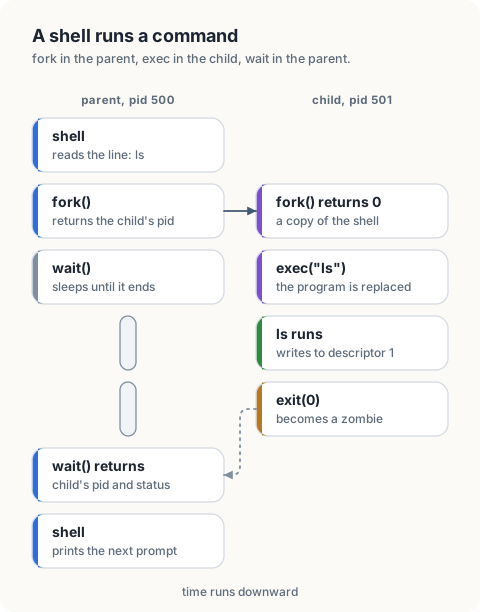
fork and wait in the parent, exec and exit in the child.Creating a process and loading a program are separate calls, and that is deliberate.
Between fork and exec the child is still running the shell’s code, with the shell’s
descriptors. The shell uses that interval to prepare the environment of the new program:
it redirects descriptors with dup2, changes the working directory, or adjusts signal
handling. Then it calls exec. The new program starts in the prepared environment and
contains no code for the preparation. The redirections of
chapter 2 are performed in this interval, and
chapter 4 builds a shell that does it.
The kernel’s record of a process
Every process has a struct task_struct. It is one of the largest structures in the
kernel, about 700 lines in include/linux/sched.h. These are the fields that this
chapter and the following chapters use, as they appear in Linux 5.15.
struct task_struct {
        unsigned int __state;                  /* running, sleeping, stopped, ... */
        struct sched_entity se;                /* scheduling data, chapter 6 */
        struct mm_struct *mm;                  /* the address space, chapter 7 */
        int exit_state;                        /* EXIT_ZOMBIE after exit */
        int exit_code;                         /* the status for the parent */
        pid_t pid;                             /* the number of this task */
        pid_t tgid;                            /* the number of its process */
        struct task_struct *real_parent;       /* the process that created it */
        struct list_head children;             /* its children */
        struct list_head sibling;              /* its place in the parent's list */
        const struct cred *cred;               /* user and group, capabilities */
        char comm[TASK_COMM_LEN];              /* the name of the program */
        struct files_struct *files;            /* the descriptor table, chapter 2 */
        struct nsproxy *nsproxy;               /* its namespaces, chapter 11 */
        struct signal_struct *signal;          /* signal state, chapter 5 */
        struct sighand_struct *sighand;        /* signal handlers, chapter 5 */
        struct css_set *cgroups;               /* its control groups, chapter 12 */
        /* ... */
};
| Field | Meaning |
|---|---|
pid | The number by which system calls and /proc name the task. |
real_parent | The process that is told when this one ends and that collects its status. |
children, sibling | The children of a process form a linked list. children is the head of the list in the parent, and sibling links a child into it. |
__state | Whether the task is runnable, sleeping or stopped. |
exit_state, exit_code | Set when the task ends, and kept until the parent has read them. |
comm | The name of the program, at most 15 characters. ps and /proc/<pid>/comm show it. |
cred | The user and group the process runs as. The kernel checks these when the process opens a file or sends a signal. |
mm, files, signal, nsproxy, cgroups | Pointers to the other resources of the process. Each is the subject of a later chapter. |
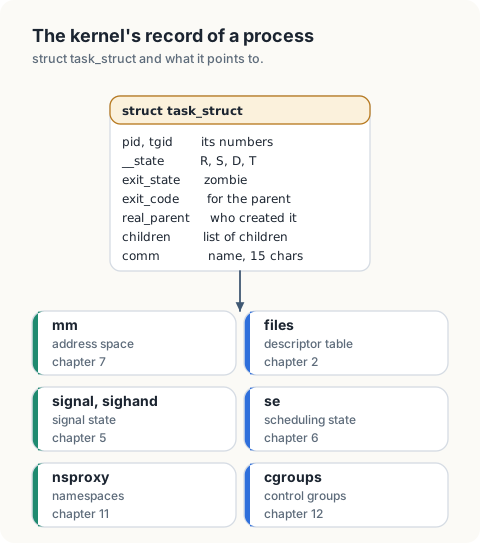
struct task_struct and the structures it points to.The resources are separate structures reached through pointers, and this is what makes
fork and threads possible with the same code. A new task can receive a copy of a
resource or a pointer to the same one, resource by resource.
Reading the record from /proc
The kernel publishes the record of every process as text files in /proc/<pid>. This is
a sleep started from a shell with pid 565533:
$ ps -o pid,ppid,stat,comm
    PID    PPID STAT COMMAND
 565533  565532 S    sh
 565534  565533 S    sleep
$ grep -E 'Name|State|Tgid|Pid|PPid|Threads' /proc/565534/status
Name:	sleep
State:	S (sleeping)
Tgid:	565534
Pid:	565534
PPid:	565533
Threads:	1
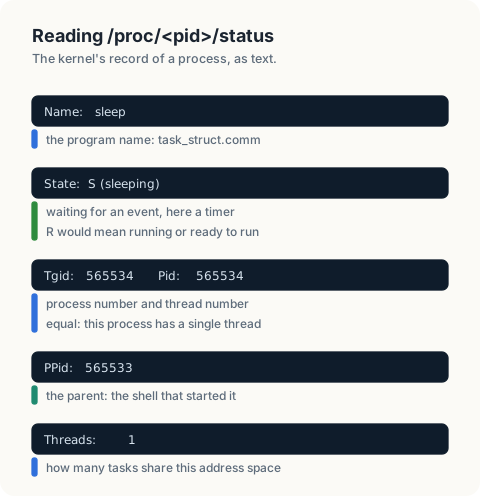
sleep process, line by line.Name is comm, Pid and Tgid are pid and tgid, and PPid is the pid of
real_parent. State is a letter derived from __state and exit_state.
| Letter | State | Meaning |
|---|---|---|
R | running | The task is on a CPU or waiting in the run queue for one. |
S | sleeping | The task waits for an event, such as input or a timer, and a signal can wake it. |
D | uninterruptible sleep | The task waits for an event, usually disk I/O, and signals are held back until it arrives. |
T | stopped | The task was stopped by a signal such as SIGSTOP and continues on SIGCONT. |
Z | zombie | The task has ended, and its parent has not yet collected its status. |
Most processes on a system are in state S at any moment. A process in state R uses
CPU time, and chapter 6 describes how the kernel divides the
CPUs among them.
fork
fork creates a new struct task_struct and decides, for each resource of the parent,
whether the child gets a copy.
| Resource | In the child |
|---|---|
| pid | new |
| parent | the process that called fork |
| memory | a copy, made lazily: the pages are shared until one side writes (chapter 7) |
| descriptor table | a copy; the entries refer to the same open files (chapter 2) |
| signal handlers | a copy |
| pending signals | none |
| working directory, user and group | the same |
| namespaces and control group | the same |
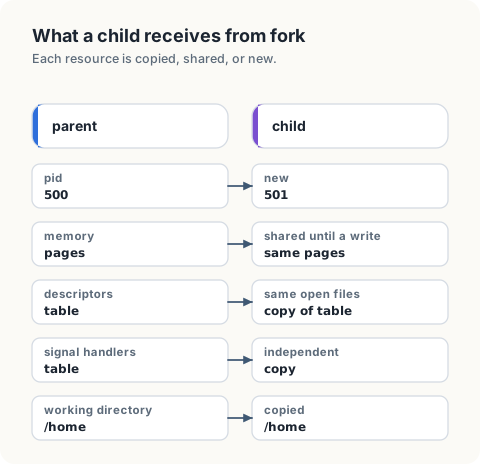
fork.A way to remember the table: the child starts as a photograph of the parent, taken at
the moment of the call. Everything that is true of the parent at that moment is true of
the child, with 2 differences that let them tell each other apart: the pid, and the
return value of fork. From then on they are separate processes, and a change in one is
invisible to the other, except through the open files they still share.
The copy of the memory is what makes fork look expensive and why it is cheap in
practice. The kernel copies the page table and leaves the pages themselves shared and
read-only. A page is copied only when one of the processes writes to it. A child that
calls exec immediately, the usual case, discards the address space before it has
written to more than a few pages.
On Linux, fork is a special case of a more general call, clone, which takes a flag
for each resource: with the flag, the child shares the parent’s structure, and without
it the child gets a copy. fork is clone with no sharing flags.
exec
exec keeps the task_struct and replaces what the process runs. The kernel reads the
header of the program file, which is in the ELF format on Linux, to learn which parts of
the file to map into memory and at which address execution starts. It builds a new
address space, places the arguments and the environment variables on a new stack, and
sets the processor to the entry point.
Kept across exec | Replaced or reset |
|---|---|
| pid, parent, children | the address space: code, data, heap and stack |
| open descriptors without the close-on-exec flag | descriptors with the flag are closed |
| working directory, user and group | signal handlers return to the default action |
| ignored signals stay ignored | comm becomes the name of the new program |
| namespaces and control group |
The table explains why the preparation between fork and exec works. Everything the
shell arranges in that interval is in the left column.
exit and wait
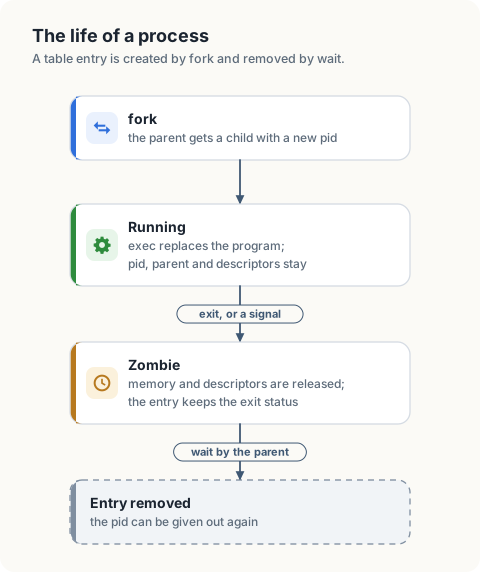
A process ends by calling exit with a status, or because a signal ends it. In both
cases the kernel releases its memory and closes its descriptors at once. The
task_struct remains, with exit_state set to EXIT_ZOMBIE and the result in
exit_code, because the parent has not yet asked for the result. A process in this
condition is a zombie. It uses no memory and no CPU. It occupies a task_struct and a
pid.
The parent collects the result with wait or waitpid, and the kernel then frees the
task_struct. This is called reaping the child. wait delivers both kinds of ending
in a single integer.
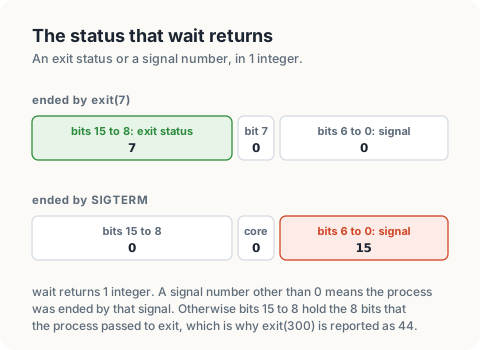
wait returns.The exit status has 8 bits. A program that calls exit(300) is reported with status
44, the low 8 bits of 300. A shell folds the integer into its own $?: the exit status
itself, or 128 + n for a process ended by signal n, so a process ended by SIGTERM,
signal 15, appears as 143.
A parent that does not call wait leaves a zombie for each child that ends. The zombies
disappear when the parent itself ends, for the reason given next.
A zombie cannot be ended with kill. It has already ended, and only its parent can remove it, by calling wait.
Orphans
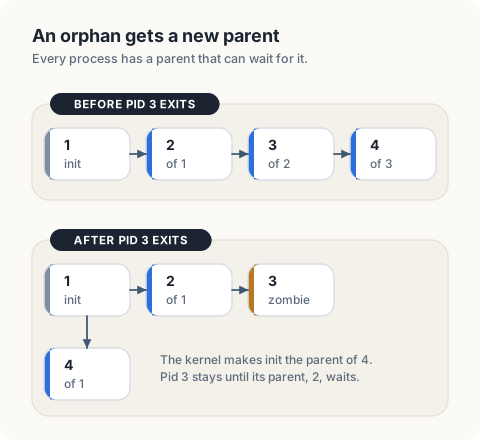
A zombie can be reaped only by its parent, so every process needs a living parent. When
a process ends before its children, the children are orphans, and the kernel gives
them a new parent at once. The new parent is process 1, the first process of the system,
unless a closer ancestor has asked for the role: a process can declare itself a
subreaper with prctl(PR_SET_CHILD_SUBREAPER), and it then adopts the orphans among
its descendants. Process 1 and every subreaper call wait in a loop for exactly this
purpose.
task_struct of a process, from fork to wait.Processes and threads
task_struct has 2 numbers, pid and tgid, because the kernel schedules tasks, and
a process can consist of several. A thread is a task that shares the address space,
the descriptor table and the signal handlers of another task. It is created by clone
with the sharing flags set, where fork sets none.
All threads of a process have the same tgid, the thread group ID, and each has its
own pid. The number that getpid returns, and that we call the pid of a process, is
the tgid. The number of each thread is visible under /proc/<pid>/task, and the
Threads line of /proc/<pid>/status counts them. The sleep above has 1. A Go
program always has several, because the Go runtime starts threads of its own to run
goroutines.
Measuring processes
procfacts starts child processes with the standard libraries, os/exec in Go and
std::process in Rust. Both perform the creation of the child and the exec in a
single call, since a program with several threads cannot safely run arbitrary code
between fork and exec. The Rust version uses the nix crate with the signal
feature to send a signal.
$ cargo new procfacts
$ cargo add -p procfacts nix --features signal
field reads a field of /proc/<pid>/stat, a single line with the same information as
status in a fixed order. Field 3 is the state letter and field 4 is the parent’s pid.
 Listing 3.1 The imports of
procfacts, in Go. code/go/procfacts/main.go
import (
	"errors"
	"fmt"
	"log"
	"os"
	"os/exec"
	"strconv"
	"strings"
	"syscall"
	"time"
)
 Listing 3.2 The imports of
procfacts, in Rust. code/rust/procfacts/src/main.rs
use std::fs;
use std::io;
use std::os::unix::process::ExitStatusExt;
use std::path::Path;
use std::process::{self, Command};
use std::thread;
use std::time::Duration;

use nix::sys::signal::{Signal, kill};
use nix::unistd::Pid;
Listing 3.3 Reading a field of a process's record, in Go. code/go/procfacts/main.go
// field returns one field of /proc/<pid>/stat, counted from 1. The second
// field, the command name, is in parentheses and may contain spaces, so the
// fields after it are counted from the closing parenthesis.
func field(pid, n int) (string, error) {
	stat, err := os.ReadFile(fmt.Sprintf("/proc/%d/stat", pid))

	if err != nil {
		return "", err
	}

	end := strings.LastIndexByte(string(stat), ')')
	rest := strings.Fields(string(stat[end+1:]))

	return rest[n-3], nil
}

// output runs a shell command and returns what it printed, without the final
// newline.
func output(script string) (string, error) {
	text, err := exec.Command("sh", "-c", script).Output()

	return strings.TrimSpace(string(text)), err
}
Listing 3.4 Reading a field of a process's record, in Rust. code/rust/procfacts/src/main.rs
/// Returns one field of `/proc/<pid>/stat`, counted from 1. The second field,
/// the command name, is in parentheses and may contain spaces, so the fields
/// after it are counted from the closing parenthesis.
fn field(pid: u32, n: usize) -> io::Result<String> {
    let stat = fs::read_to_string(format!("/proc/{pid}/stat"))?;
    let rest = stat.rsplit_once(')').map_or("", |(_, rest)| rest);

    rest.split_whitespace()
        .nth(n - 3)
        .map(str::to_owned)
        .ok_or_else(|| io::ErrorKind::InvalidData.into())
}

/// Runs a shell command and returns what it printed, without the final
/// newline.
fn output(script: &str) -> io::Result<String> {
    let output = Command::new("sh").args(["-c", script]).output()?;

    Ok(String::from_utf8_lossy(&output.stdout).trim().to_owned())
}
parent runs a shell that prints $PPID, the pid of its parent, and compares it with
the pid of the program.
Listing 3.5 The parent of a child, in Go. code/go/procfacts/main.go
// parent asks a child for the number of its parent process.
func parent() error {
	text, err := output("echo $PPID")

	if err != nil {
		return err
	}

	fmt.Printf("the child's parent is this process: %v\n", text == strconv.Itoa(os.Getpid()))

	return nil
}
Listing 3.6 The parent of a child, in Rust. code/rust/procfacts/src/main.rs
/// Asks a child for the number of its parent process.
fn parent() -> io::Result<()> {
    let text = output("echo $PPID")?;

    println!(
        "the child's parent is this process: {}",
        text == process::id().to_string()
    );

    Ok(())
}
status runs a script and reports how it ended. The program calls it with exit 7,
with exit 300, and with a script that sends itself SIGTERM.
Listing 3.7 Exit status and signal, in Go. code/go/procfacts/main.go
// status runs a script and reports how it terminated.
func status(script string) error {
	err := exec.Command("sh", "-c", script).Run()

	var exit *exec.ExitError

	if !errors.As(err, &exit) {
		return fmt.Errorf("%s: %v", script, err)
	}

	wait, ok := exit.Sys().(syscall.WaitStatus)

	switch {
	case ok && wait.Signaled():
		fmt.Printf("%s: killed by signal %d\n", script, wait.Signal())
	default:
		fmt.Printf("%s: exited with status %d\n", script, exit.ExitCode())
	}

	return nil
}
Listing 3.8 Exit status and signal, in Rust. code/rust/procfacts/src/main.rs
/// Runs a script and reports how it terminated.
fn status(script: &str) -> io::Result<()> {
    let status = Command::new("sh").args(["-c", script]).status()?;

    match (status.signal(), status.code()) {
        (Some(signal), _) => println!("{script}: killed by signal {signal}"),
        (None, Some(code)) => println!("{script}: exited with status {code}"),
        (None, None) => println!("{script}: {status}"),
    }

    Ok(())
}
execKeepsPid runs a shell that prints its pid, replaces itself with another shell by
exec, and prints the pid again.
Listing 3.9 The pid before and after exec, in Go. code/go/procfacts/main.go
// execKeepsPid prints the process number of a shell before and after the
// shell replaces its program with exec.
func execKeepsPid() error {
	text, err := output(`echo $$; exec sh -c 'echo $$'`)

	if err != nil {
		return err
	}

	pids := strings.Fields(text)

	fmt.Printf("pid before and after exec: equal %v\n", len(pids) == 2 && pids[0] == pids[1])

	return nil
}
Listing 3.10 The pid before and after exec, in Rust. code/rust/procfacts/src/main.rs
/// Prints the process number of a shell before and after the shell replaces
/// its program with exec.
fn exec_keeps_pid() -> io::Result<()> {
    let text = output("echo $$; exec sh -c 'echo $$'")?;
    let pids: Vec<&str> = text.split_whitespace().collect();

    println!(
        "pid before and after exec: equal {}",
        pids.len() == 2 && pids[0] == pids[1]
    );

    Ok(())
}
zombie starts true, which exits immediately, and polls the state field until the
child has ended. Then it waits for the child and checks whether the /proc entry still
exists.
Listing 3.11 A child between exit and wait, in Go. code/go/procfacts/main.go
// zombie starts a child that exits at once, and reads its state before and
// after waiting for it.
func zombie() error {
	child := exec.Command("true")

	if err := child.Start(); err != nil {
		return err
	}

	pid := child.Process.Pid
	state, err := field(pid, 3)

	for err == nil && state != "Z" {
		time.Sleep(time.Millisecond)
		state, err = field(pid, 3)
	}

	if err != nil {
		return err
	}

	if err := child.Wait(); err != nil {
		return err
	}

	_, err = os.Stat(fmt.Sprintf("/proc/%d", pid))

	fmt.Printf("exited child: state %s before wait, /proc entry present after wait: %v\n", state, err == nil)

	return nil
}
Listing 3.12 A child between exit and wait, in Rust. code/rust/procfacts/src/main.rs
/// Starts a child that exits at once, and reads its state before and after
/// waiting for it.
fn zombie() -> io::Result<()> {
    let mut child = Command::new("true").spawn()?;
    let pid = child.id();

    let mut state = field(pid, 3)?;

    while state != "Z" {
        thread::sleep(Duration::from_millis(1));
        state = field(pid, 3)?;
    }

    child.wait()?;

    let present = Path::new(&format!("/proc/{pid}")).exists();
    println!("exited child: state {state} before wait, /proc entry present after wait: {present}");

    Ok(())
}
orphan runs a shell that starts sleep 30 in the background, prints the pid of the
sleep, and exits. The sleep is then an orphan. The program reads the pid of its new
parent and the name of that process.
Listing 3.13 The new parent of an orphan, in Go. code/go/procfacts/main.go
// orphan starts a shell that starts a background sleep and exits. The sleep
// outlives its parent, and the kernel gives it a new one.
func orphan() error {
	text, err := output("sleep 30 >/dev/null 2>&1 & echo $!")

	if err != nil {
		return err
	}

	pid, err := strconv.Atoi(text)

	if err != nil {
		return err
	}

	defer syscall.Kill(pid, syscall.SIGKILL)

	adopter, err := field(pid, 4)

	if err != nil {
		return err
	}

	name, err := os.ReadFile("/proc/" + adopter + "/comm")

	if err != nil {
		return err
	}

	fmt.Printf("orphan adopted by: %s\n", strings.TrimSpace(string(name)))

	return nil
}
Listing 3.14 The new parent of an orphan, in Rust. code/rust/procfacts/src/main.rs
/// Starts a shell that starts a background sleep and exits. The sleep
/// outlives its parent, and the kernel gives it a new one.
fn orphan() -> io::Result<()> {
    let text = output("sleep 30 >/dev/null 2>&1 & echo $!")?;

    let pid: u32 = text
        .parse()
        .map_err(|_| io::Error::from(io::ErrorKind::InvalidData))?;

    let adopter = field(pid, 4);
    kill(Pid::from_raw(pid as i32), Signal::SIGKILL)?;

    let name = fs::read_to_string(format!("/proc/{}/comm", adopter?))?;
    println!("orphan adopted by: {}", name.trim());

    Ok(())
}
the child's parent is this process: true
exit 7: exited with status 7
exit 300: exited with status 44
kill -TERM $$: killed by signal 15
pid before and after exec: equal true
exited child: state Z before wait, /proc entry present after wait: false
orphan adopted by: systemd
| Output | Conclusion |
|---|---|
| the child’s parent is this process | real_parent of a child is the process that created it. |
exit 7: status 7 | The status passed to exit reaches the parent. |
exit 300: status 44 | Only the low 8 bits are kept: 300 - 256 = 44. |
kill -TERM $$: signal 15 | A process ended by a signal has no exit status. The parent receives the signal number. |
the pid is equal before and after exec | exec replaces the program inside the same task_struct. |
state Z before wait, no entry after | A process that has ended is a zombie until its parent reaps it. |
the orphan is adopted by systemd | The kernel gave the orphan a new parent. |
The process named systemd in the last line is the service manager of the user’s
session, which has registered as a subreaper. On a system without one, the line would
name process 1.
Modelling the process table
proctable is a model of the part of the kernel that this chapter describes: the table
of processes, the allocation of pids, the zombie state, and the adoption of orphans.
Low-level design: proctable
| Type | Kernel structure | Fields | Invariant |
|---|---|---|---|
process | struct task_struct | parent, state, status | state is running or zombie; status is meaningful for a zombie |
table | the kernel’s table of pids | procs, last, pidMax | every parent except that of process 1 is a pid in procs |
| Operation | Behaviour | Error |
|---|---|---|
allocate() | returns the first free pid after last, wrapping at pidMax | EAGAIN when every pid is in use |
fork(parent) | adds a running child of parent | ESRCH when parent does not exist |
exit(pid, status) | marks pid a zombie, stores status, gives its children to process 1 | ESRCH |
wait(parent) | removes a zombie child and returns its pid and status | ECHILD when parent has no children |
The table maps a pid to an entry. last remembers the pid allocated most recently.
Listing 3.15 The imports of proctable, in Go. code/go/proctable/main.go
import (
	"errors"
	"fmt"
	"log"
	"slices"
	"strings"
)
Listing 3.16 The imports of proctable, in Rust. code/rust/proctable/src/main.rs
use std::collections::BTreeMap;
use std::fmt;
Listing 3.17 The process table, in Go. code/go/proctable/main.go
// The errors carry the names of the kernel's error codes for the same cases.
var (
	errAgain   = errors.New("EAGAIN: no process number is free")
	errNoChild = errors.New("ECHILD: the caller has no child to wait for")
	errSearch  = errors.New("ESRCH: no such process")
)

// initPid is the process that adopts orphans.
const initPid = 1

type state byte

const (
	running state = 'R'
	zombie  state = 'Z'
)

// A process is one entry of the table.
type process struct {
	parent int
	state  state
	status int
}

// A table maps process numbers to entries. last is the number given out most
// recently, and pidMax is the largest number allowed.
type table struct {
	procs  map[int]*process
	last   int
	pidMax int
}

func newTable(pidMax int) *table {
	return &table{
		procs:  map[int]*process{initPid: {state: running}},
		last:   initPid,
		pidMax: pidMax,
	}
}
Listing 3.18 The process table, in Rust. code/rust/proctable/src/main.rs
/// The errors carry the names of the kernel's error codes for the same cases.
#[derive(Debug)]
enum Error {
    Again,
    NoChild,
    Search,
}

impl fmt::Display for Error {
    fn fmt(&self, f: &mut fmt::Formatter<'_>) -> fmt::Result {
        f.write_str(match self {
            Error::Again => "EAGAIN: no process number is free",
            Error::NoChild => "ECHILD: the caller has no child to wait for",
            Error::Search => "ESRCH: no such process",
        })
    }
}

impl std::error::Error for Error {}

/// The process that adopts orphans.
const INIT_PID: u32 = 1;

#[derive(Clone, Copy, PartialEq)]
enum State {
    Running,
    Zombie,
}

/// One entry of the table.
struct Process {
    parent: u32,
    state: State,
    status: i32,
}

/// Maps process numbers to entries. `last` is the number given out most
/// recently, and `pid_max` is the largest number allowed.
struct Table {
    procs: BTreeMap<u32, Process>,
    last: u32,
    pid_max: u32,
}

impl Table {
    fn new(pid_max: u32) -> Table {
        let init = Process {
            parent: 0,
            state: State::Running,
            status: 0,
        };

        Table {
            procs: BTreeMap::from([(INIT_PID, init)]),
            last: INIT_PID,
            pid_max,
        }
    }
}
allocate searches upward from last and wraps around at pidMax. A pid that has been
freed is therefore reused only after all higher numbers have been tried. The delay
protects programs that hold a pid: a process that stored the pid of another, to send it
a signal later, would otherwise reach an unrelated new process if the number were reused
quickly. /proc/sys/kernel/pid_max sets the limit, 4194304 on this machine.
Listing 3.19 Allocating a pid and creating a child, in Go. code/go/proctable/main.go
// allocate returns the first free number after last, wrapping around from
// pidMax to the number after initPid.
func (t *table) allocate() (int, error) {
	pid := t.last

	for range t.pidMax {
		pid++

		if pid > t.pidMax {
			pid = initPid + 1
		}

		if _, used := t.procs[pid]; !used {
			t.last = pid

			return pid, nil
		}
	}

	return 0, errAgain
}

// fork creates a child of parent and returns the child's number.
func (t *table) fork(parent int) (int, error) {
	if _, ok := t.procs[parent]; !ok {
		return 0, errSearch
	}

	pid, err := t.allocate()

	if err != nil {
		return 0, err
	}

	t.procs[pid] = &process{parent: parent, state: running}

	return pid, nil
}
Listing 3.20 Allocating a pid and creating a child, in Rust. code/rust/proctable/src/main.rs
impl Table {
    /// Returns the first free number after `last`, wrapping around from
    /// `pid_max` to the number after `INIT_PID`.
    fn allocate(&mut self) -> Result<u32, Error> {
        let mut pid = self.last;

        for _ in 0..self.pid_max {
            pid += 1;

            if pid > self.pid_max {
                pid = INIT_PID + 1;
            }

            if !self.procs.contains_key(&pid) {
                self.last = pid;

                return Ok(pid);
            }
        }

        Err(Error::Again)
    }

    /// Creates a child of `parent` and returns the child's number.
    fn fork(&mut self, parent: u32) -> Result<u32, Error> {
        if !self.procs.contains_key(&parent) {
            return Err(Error::Search);
        }

        let pid = self.allocate()?;

        let child = Process {
            parent,
            state: State::Running,
            status: 0,
        };

        self.procs.insert(pid, child);

        Ok(pid)
    }
}
exit keeps the entry and changes its state. It then gives every child of the ended
process to process 1.
Listing 3.21 Ending a process, in Go. code/go/proctable/main.go
// exit ends a process. The entry stays in the table as a zombie that holds
// the exit status, and the children of the process become children of init.
func (t *table) exit(pid, status int) error {
	p, ok := t.procs[pid]

	if !ok {
		return errSearch
	}

	p.state, p.status = zombie, status

	for _, child := range t.procs {
		if child.parent == pid {
			child.parent = initPid
		}
	}

	return nil
}
Listing 3.22 Ending a process, in Rust. code/rust/proctable/src/main.rs
impl Table {
    /// Ends a process. The entry stays in the table as a zombie that holds
    /// the exit status, and the children of the process become children of
    /// init.
    fn exit(&mut self, pid: u32, status: i32) -> Result<(), Error> {
        let process = self.procs.get_mut(&pid).ok_or(Error::Search)?;

        process.state = State::Zombie;
        process.status = status;

        for child in self.procs.values_mut() {
            if child.parent == pid {
                child.parent = INIT_PID;
            }
        }

        Ok(())
    }
}
wait has 3 outcomes. A zombie child exists, and it is removed and returned. Children
exist and none has ended, where the kernel would put the caller to sleep. Or the caller
has no children, which is the error ECHILD.
Listing 3.23 Collecting a child, in Go. code/go/proctable/main.go
// wait removes a zombie child of parent from the table and returns its number
// and exit status. ok is false when parent has children and none of them has
// exited, the case in which the kernel suspends the caller.
func (t *table) wait(parent int) (pid, status int, ok bool, err error) {
	children := 0

	for _, pid := range t.pids() {
		child := t.procs[pid]

		if child.parent != parent {
			continue
		}

		children++

		if child.state == zombie {
			delete(t.procs, pid)

			return pid, child.status, true, nil
		}
	}

	if children == 0 {
		return 0, 0, false, errNoChild
	}

	return 0, 0, false, nil
}

// pids returns the process numbers in use, in increasing order.
func (t *table) pids() []int {
	pids := make([]int, 0, len(t.procs))

	for pid := range t.procs {
		pids = append(pids, pid)
	}

	slices.Sort(pids)

	return pids
}
Listing 3.24 Collecting a child, in Rust. code/rust/proctable/src/main.rs
impl Table {
    /// Removes a zombie child of `parent` from the table and returns its
    /// number and exit status. The result is `None` when `parent` has
    /// children and none of them has exited, the case in which the kernel
    /// suspends the caller.
    fn wait(&mut self, parent: u32) -> Result<Option<(u32, i32)>, Error> {
        let mut children = self
            .procs
            .iter()
            .filter(|(_, child)| child.parent == parent)
            .peekable();

        if children.peek().is_none() {
            return Err(Error::NoChild);
        }

        let Some((&pid, child)) = children.find(|(_, child)| child.state == State::Zombie) else {
            return Ok(None);
        };

        let status = child.status;
        self.procs.remove(&pid);

        Ok(Some((pid, status)))
    }
}
The program applies a sequence of calls to a table with pidMax set to 6 and prints the
table after each call. An entry is printed as pid(parent)state.
Listing 3.25 The trace, in Go. code/go/proctable/main.go
// String renders the table as pid(parent)state for each entry.
func (t *table) String() string {
	var cells []string

	for _, pid := range t.pids() {
		p := t.procs[pid]
		cells = append(cells, fmt.Sprintf("%d(%d)%c", pid, p.parent, p.state))
	}

	return strings.Join(cells, " ")
}

// A call is one step of the trace: an operation, the process it applies to,
// and for exit the status.
type call struct {
	op     string
	pid    int
	status int
}

// apply performs a call and describes its result.
func (t *table) apply(c call) (string, error) {
	switch c.op {
	case "fork":
		child, err := t.fork(c.pid)

		return fmt.Sprintf("fork by %d: pid %d", c.pid, child), err

	case "exit":
		return fmt.Sprintf("exit of %d, status %d", c.pid, c.status), t.exit(c.pid, c.status)

	default:
		child, status, ok, err := t.wait(c.pid)

		if !ok {
			return fmt.Sprintf("wait by %d: would block", c.pid), err
		}

		return fmt.Sprintf("wait by %d: pid %d, status %d", c.pid, child, status), nil
	}
}

func main() {
	t := newTable(6)

	calls := []call{
		{op: "fork", pid: 1},
		{op: "fork", pid: 2},
		{op: "fork", pid: 3},
		{op: "wait", pid: 2},
		{op: "exit", pid: 3},
		{op: "wait", pid: 2},
		{op: "fork", pid: 2},
		{op: "exit", pid: 4, status: 7},
		{op: "wait", pid: 1},
		{op: "fork", pid: 2},
		{op: "fork", pid: 2},
	}

	fmt.Printf("%-30s %s\n", "start", t)

	for _, c := range calls {
		result, err := t.apply(c)

		if err != nil {
			log.Fatal(err)
		}

		fmt.Printf("%-30s %s\n", result, t)
	}
}
Listing 3.26 The trace, in Rust. code/rust/proctable/src/main.rs
/// Renders the table as pid(parent)state for each entry.
impl fmt::Display for Table {
    fn fmt(&self, f: &mut fmt::Formatter<'_>) -> fmt::Result {
        let cells: Vec<String> = self
            .procs
            .iter()
            .map(|(pid, process)| {
                let state = match process.state {
                    State::Running => 'R',
                    State::Zombie => 'Z',
                };

                format!("{pid}({}){state}", process.parent)
            })
            .collect();

        f.write_str(&cells.join(" "))
    }
}

/// One step of the trace.
enum Call {
    Fork(u32),
    Exit(u32, i32),
    Wait(u32),
}

impl Table {
    /// Performs a call and describes its result.
    fn apply(&mut self, call: &Call) -> Result<String, Error> {
        match *call {
            Call::Fork(parent) => {
                let child = self.fork(parent)?;

                Ok(format!("fork by {parent}: pid {child}"))
            }
            Call::Exit(pid, status) => {
                self.exit(pid, status)?;

                Ok(format!("exit of {pid}, status {status}"))
            }
            Call::Wait(parent) => match self.wait(parent)? {
                Some((child, status)) => {
                    Ok(format!("wait by {parent}: pid {child}, status {status}"))
                }
                None => Ok(format!("wait by {parent}: would block")),
            },
        }
    }
}

fn main() -> Result<(), Error> {
    let mut table = Table::new(6);

    let calls = [
        Call::Fork(1),
        Call::Fork(2),
        Call::Fork(3),
        Call::Wait(2),
        Call::Exit(3, 0),
        Call::Wait(2),
        Call::Fork(2),
        Call::Exit(4, 7),
        Call::Wait(1),
        Call::Fork(2),
        Call::Fork(2),
    ];

    println!("{:<30} {table}", "start");

    for call in &calls {
        let result = table.apply(call)?;
        println!("{result:<30} {table}");
    }

    Ok(())
}
start 1(0)R
fork by 1: pid 2 1(0)R 2(1)R
fork by 2: pid 3 1(0)R 2(1)R 3(2)R
fork by 3: pid 4 1(0)R 2(1)R 3(2)R 4(3)R
wait by 2: would block 1(0)R 2(1)R 3(2)R 4(3)R
exit of 3, status 0 1(0)R 2(1)R 3(2)Z 4(1)R
wait by 2: pid 3, status 0 1(0)R 2(1)R 4(1)R
fork by 2: pid 5 1(0)R 2(1)R 4(1)R 5(2)R
exit of 4, status 7 1(0)R 2(1)R 4(1)Z 5(2)R
wait by 1: pid 4, status 7 1(0)R 2(1)R 5(2)R
fork by 2: pid 6 1(0)R 2(1)R 5(2)R 6(2)R
fork by 2: pid 3 1(0)R 2(1)R 3(2)R 5(2)R 6(2)R
| Line | What it shows |
|---|---|
wait by 2: would block | Process 2 has a child, 3, which is still running. |
exit of 3 | Entry 3 becomes Z and stays. Its child 4 now has parent 1. |
wait by 2: pid 3 | The zombie is removed and its status is returned. |
fork by 2: pid 5 | Pid 3 is free, and the search continues upward from last, which is 4. |
wait by 1: pid 4, status 7 | Process 1 reaps the orphan it adopted. |
fork by 2: pid 3 | After pid 6 the search wraps around. Pid 2 is in use, and 3 is the first free number. |
exit of 3.Correspondence with the kernel source. kernel/fork.c contains copy_process,
which builds the new task_struct and calls a copy_ function for each resource
(copy_mm, copy_files, copy_sighand, and others), each of which copies or shares
according to the clone flags. alloc_pid in kernel/pid.c allocates numbers with
idr_alloc_cyclic, the cyclic search that allocate models. do_exit in
kernel/exit.c sets EXIT_ZOMBIE and calls forget_original_parent, which chooses the
new parent of each child with find_new_reaper. The kernel keeps a list of children in
each task, where proctable scans the whole table.
Inspecting processes on a live system
| Command | Shows |
|---|---|
ps -o pid,ppid,stat,comm | pid, parent, state and name of the processes of the terminal |
ps -ef --forest or pstree -p | every process, drawn as a tree of parents and children |
cat /proc/<pid>/status | the record of a process: state, parent, threads, memory, user |
ls /proc/<pid>/task | the threads of a process |
cat /proc/sys/kernel/pid_max | the largest pid |
ps -eo stat,pid,ppid,comm | grep '^Z' | the zombies of the system, with the parent that has not reaped them |
A zombie cannot be removed with kill, since it has already ended. The last command
gives the pid of the parent, and the remedy is there: the parent has to call wait, or
end.
The complete programs
Listing 3.27 The complete procfacts, in Go. code/go/procfacts/main.go
// Command procfacts measures the life cycle of a process: who its parent is,
// how its termination is reported, what exec keeps, what remains of a child
// that has exited and has not been waited for, and who becomes the parent of
// an orphan.
//
// Run it from code/go with:
//
//	go run ./procfacts
package main

import (
	"errors"
	"fmt"
	"log"
	"os"
	"os/exec"
	"strconv"
	"strings"
	"syscall"
	"time"
)


// field returns one field of /proc/<pid>/stat, counted from 1. The second
// field, the command name, is in parentheses and may contain spaces, so the
// fields after it are counted from the closing parenthesis.
func field(pid, n int) (string, error) {
	stat, err := os.ReadFile(fmt.Sprintf("/proc/%d/stat", pid))

	if err != nil {
		return "", err
	}

	end := strings.LastIndexByte(string(stat), ')')
	rest := strings.Fields(string(stat[end+1:]))

	return rest[n-3], nil
}

// output runs a shell command and returns what it printed, without the final
// newline.
func output(script string) (string, error) {
	text, err := exec.Command("sh", "-c", script).Output()

	return strings.TrimSpace(string(text)), err
}


// parent asks a child for the number of its parent process.
func parent() error {
	text, err := output("echo $PPID")

	if err != nil {
		return err
	}

	fmt.Printf("the child's parent is this process: %v\n", text == strconv.Itoa(os.Getpid()))

	return nil
}


// status runs a script and reports how it terminated.
func status(script string) error {
	err := exec.Command("sh", "-c", script).Run()

	var exit *exec.ExitError

	if !errors.As(err, &exit) {
		return fmt.Errorf("%s: %v", script, err)
	}

	wait, ok := exit.Sys().(syscall.WaitStatus)

	switch {
	case ok && wait.Signaled():
		fmt.Printf("%s: killed by signal %d\n", script, wait.Signal())
	default:
		fmt.Printf("%s: exited with status %d\n", script, exit.ExitCode())
	}

	return nil
}


// execKeepsPid prints the process number of a shell before and after the
// shell replaces its program with exec.
func execKeepsPid() error {
	text, err := output(`echo $$; exec sh -c 'echo $$'`)

	if err != nil {
		return err
	}

	pids := strings.Fields(text)

	fmt.Printf("pid before and after exec: equal %v\n", len(pids) == 2 && pids[0] == pids[1])

	return nil
}


// zombie starts a child that exits at once, and reads its state before and
// after waiting for it.
func zombie() error {
	child := exec.Command("true")

	if err := child.Start(); err != nil {
		return err
	}

	pid := child.Process.Pid
	state, err := field(pid, 3)

	for err == nil && state != "Z" {
		time.Sleep(time.Millisecond)
		state, err = field(pid, 3)
	}

	if err != nil {
		return err
	}

	if err := child.Wait(); err != nil {
		return err
	}

	_, err = os.Stat(fmt.Sprintf("/proc/%d", pid))

	fmt.Printf("exited child: state %s before wait, /proc entry present after wait: %v\n", state, err == nil)

	return nil
}


// orphan starts a shell that starts a background sleep and exits. The sleep
// outlives its parent, and the kernel gives it a new one.
func orphan() error {
	text, err := output("sleep 30 >/dev/null 2>&1 & echo $!")

	if err != nil {
		return err
	}

	pid, err := strconv.Atoi(text)

	if err != nil {
		return err
	}

	defer syscall.Kill(pid, syscall.SIGKILL)

	adopter, err := field(pid, 4)

	if err != nil {
		return err
	}

	name, err := os.ReadFile("/proc/" + adopter + "/comm")

	if err != nil {
		return err
	}

	fmt.Printf("orphan adopted by: %s\n", strings.TrimSpace(string(name)))

	return nil
}


func main() {
	experiments := []func() error{
		parent,
		func() error { return status("exit 7") },
		func() error { return status("exit 300") },
		func() error { return status("kill -TERM $$") },
		execKeepsPid,
		zombie,
		orphan,
	}

	for _, experiment := range experiments {
		if err := experiment(); err != nil {
			log.Fatal(err)
		}
	}
}
 Listing 3.28 The complete
procfacts, in Rust. code/rust/procfacts/src/main.rs
//! Measures the life cycle of a process: who its parent is, how its
//! termination is reported, what exec keeps, what remains of a child that has
//! exited and has not been waited for, and who becomes the parent of an
//! orphan.
//!
//! Run it from code/rust with:
//!
//! ```text
//! cargo run -p procfacts
//! ```

use std::fs;
use std::io;
use std::os::unix::process::ExitStatusExt;
use std::path::Path;
use std::process::{self, Command};
use std::thread;
use std::time::Duration;

use nix::sys::signal::{Signal, kill};
use nix::unistd::Pid;

/// Returns one field of `/proc/<pid>/stat`, counted from 1. The second field,
/// the command name, is in parentheses and may contain spaces, so the fields
/// after it are counted from the closing parenthesis.
fn field(pid: u32, n: usize) -> io::Result<String> {
    let stat = fs::read_to_string(format!("/proc/{pid}/stat"))?;
    let rest = stat.rsplit_once(')').map_or("", |(_, rest)| rest);

    rest.split_whitespace()
        .nth(n - 3)
        .map(str::to_owned)
        .ok_or_else(|| io::ErrorKind::InvalidData.into())
}

/// Runs a shell command and returns what it printed, without the final
/// newline.
fn output(script: &str) -> io::Result<String> {
    let output = Command::new("sh").args(["-c", script]).output()?;

    Ok(String::from_utf8_lossy(&output.stdout).trim().to_owned())
}

/// Asks a child for the number of its parent process.
fn parent() -> io::Result<()> {
    let text = output("echo $PPID")?;

    println!(
        "the child's parent is this process: {}",
        text == process::id().to_string()
    );

    Ok(())
}

/// Runs a script and reports how it terminated.
fn status(script: &str) -> io::Result<()> {
    let status = Command::new("sh").args(["-c", script]).status()?;

    match (status.signal(), status.code()) {
        (Some(signal), _) => println!("{script}: killed by signal {signal}"),
        (None, Some(code)) => println!("{script}: exited with status {code}"),
        (None, None) => println!("{script}: {status}"),
    }

    Ok(())
}

/// Prints the process number of a shell before and after the shell replaces
/// its program with exec.
fn exec_keeps_pid() -> io::Result<()> {
    let text = output("echo $$; exec sh -c 'echo $$'")?;
    let pids: Vec<&str> = text.split_whitespace().collect();

    println!(
        "pid before and after exec: equal {}",
        pids.len() == 2 && pids[0] == pids[1]
    );

    Ok(())
}

/// Starts a child that exits at once, and reads its state before and after
/// waiting for it.
fn zombie() -> io::Result<()> {
    let mut child = Command::new("true").spawn()?;
    let pid = child.id();

    let mut state = field(pid, 3)?;

    while state != "Z" {
        thread::sleep(Duration::from_millis(1));
        state = field(pid, 3)?;
    }

    child.wait()?;

    let present = Path::new(&format!("/proc/{pid}")).exists();
    println!("exited child: state {state} before wait, /proc entry present after wait: {present}");

    Ok(())
}

/// Starts a shell that starts a background sleep and exits. The sleep
/// outlives its parent, and the kernel gives it a new one.
fn orphan() -> io::Result<()> {
    let text = output("sleep 30 >/dev/null 2>&1 & echo $!")?;

    let pid: u32 = text
        .parse()
        .map_err(|_| io::Error::from(io::ErrorKind::InvalidData))?;

    let adopter = field(pid, 4);
    kill(Pid::from_raw(pid as i32), Signal::SIGKILL)?;

    let name = fs::read_to_string(format!("/proc/{}/comm", adopter?))?;
    println!("orphan adopted by: {}", name.trim());

    Ok(())
}

fn main() -> io::Result<()> {
    parent()?;
    status("exit 7")?;
    status("exit 300")?;
    status("kill -TERM $$")?;
    exec_keeps_pid()?;
    zombie()?;
    orphan()
}
Listing 3.29 The complete proctable, in Go. code/go/proctable/main.go
// Command proctable models the kernel's process table: process numbers handed
// out in a cycle, a parent for every process, a zombie state between exit and
// wait, and a new parent for orphans. It applies a sequence of calls and
// prints the table after each.
//
// Run it from code/go with:
//
//	go run ./proctable
package main

import (
	"errors"
	"fmt"
	"log"
	"slices"
	"strings"
)


// The errors carry the names of the kernel's error codes for the same cases.
var (
	errAgain   = errors.New("EAGAIN: no process number is free")
	errNoChild = errors.New("ECHILD: the caller has no child to wait for")
	errSearch  = errors.New("ESRCH: no such process")
)

// initPid is the process that adopts orphans.
const initPid = 1

type state byte

const (
	running state = 'R'
	zombie  state = 'Z'
)

// A process is one entry of the table.
type process struct {
	parent int
	state  state
	status int
}

// A table maps process numbers to entries. last is the number given out most
// recently, and pidMax is the largest number allowed.
type table struct {
	procs  map[int]*process
	last   int
	pidMax int
}

func newTable(pidMax int) *table {
	return &table{
		procs:  map[int]*process{initPid: {state: running}},
		last:   initPid,
		pidMax: pidMax,
	}
}


// allocate returns the first free number after last, wrapping around from
// pidMax to the number after initPid.
func (t *table) allocate() (int, error) {
	pid := t.last

	for range t.pidMax {
		pid++

		if pid > t.pidMax {
			pid = initPid + 1
		}

		if _, used := t.procs[pid]; !used {
			t.last = pid

			return pid, nil
		}
	}

	return 0, errAgain
}

// fork creates a child of parent and returns the child's number.
func (t *table) fork(parent int) (int, error) {
	if _, ok := t.procs[parent]; !ok {
		return 0, errSearch
	}

	pid, err := t.allocate()

	if err != nil {
		return 0, err
	}

	t.procs[pid] = &process{parent: parent, state: running}

	return pid, nil
}


// exit ends a process. The entry stays in the table as a zombie that holds
// the exit status, and the children of the process become children of init.
func (t *table) exit(pid, status int) error {
	p, ok := t.procs[pid]

	if !ok {
		return errSearch
	}

	p.state, p.status = zombie, status

	for _, child := range t.procs {
		if child.parent == pid {
			child.parent = initPid
		}
	}

	return nil
}


// wait removes a zombie child of parent from the table and returns its number
// and exit status. ok is false when parent has children and none of them has
// exited, the case in which the kernel suspends the caller.
func (t *table) wait(parent int) (pid, status int, ok bool, err error) {
	children := 0

	for _, pid := range t.pids() {
		child := t.procs[pid]

		if child.parent != parent {
			continue
		}

		children++

		if child.state == zombie {
			delete(t.procs, pid)

			return pid, child.status, true, nil
		}
	}

	if children == 0 {
		return 0, 0, false, errNoChild
	}

	return 0, 0, false, nil
}

// pids returns the process numbers in use, in increasing order.
func (t *table) pids() []int {
	pids := make([]int, 0, len(t.procs))

	for pid := range t.procs {
		pids = append(pids, pid)
	}

	slices.Sort(pids)

	return pids
}


// String renders the table as pid(parent)state for each entry.
func (t *table) String() string {
	var cells []string

	for _, pid := range t.pids() {
		p := t.procs[pid]
		cells = append(cells, fmt.Sprintf("%d(%d)%c", pid, p.parent, p.state))
	}

	return strings.Join(cells, " ")
}

// A call is one step of the trace: an operation, the process it applies to,
// and for exit the status.
type call struct {
	op     string
	pid    int
	status int
}

// apply performs a call and describes its result.
func (t *table) apply(c call) (string, error) {
	switch c.op {
	case "fork":
		child, err := t.fork(c.pid)

		return fmt.Sprintf("fork by %d: pid %d", c.pid, child), err

	case "exit":
		return fmt.Sprintf("exit of %d, status %d", c.pid, c.status), t.exit(c.pid, c.status)

	default:
		child, status, ok, err := t.wait(c.pid)

		if !ok {
			return fmt.Sprintf("wait by %d: would block", c.pid), err
		}

		return fmt.Sprintf("wait by %d: pid %d, status %d", c.pid, child, status), nil
	}
}

func main() {
	t := newTable(6)

	calls := []call{
		{op: "fork", pid: 1},
		{op: "fork", pid: 2},
		{op: "fork", pid: 3},
		{op: "wait", pid: 2},
		{op: "exit", pid: 3},
		{op: "wait", pid: 2},
		{op: "fork", pid: 2},
		{op: "exit", pid: 4, status: 7},
		{op: "wait", pid: 1},
		{op: "fork", pid: 2},
		{op: "fork", pid: 2},
	}

	fmt.Printf("%-30s %s\n", "start", t)

	for _, c := range calls {
		result, err := t.apply(c)

		if err != nil {
			log.Fatal(err)
		}

		fmt.Printf("%-30s %s\n", result, t)
	}
}
Listing 3.30 The complete proctable, in Rust. code/rust/proctable/src/main.rs
//! Models the kernel's process table: process numbers handed out in a cycle,
//! a parent for every process, a zombie state between exit and wait, and a
//! new parent for orphans. It applies a sequence of calls and prints the
//! table after each.
//!
//! Run it from code/rust with:
//!
//! ```text
//! cargo run -p proctable
//! ```

use std::collections::BTreeMap;
use std::fmt;

/// The errors carry the names of the kernel's error codes for the same cases.
#[derive(Debug)]
enum Error {
    Again,
    NoChild,
    Search,
}

impl fmt::Display for Error {
    fn fmt(&self, f: &mut fmt::Formatter<'_>) -> fmt::Result {
        f.write_str(match self {
            Error::Again => "EAGAIN: no process number is free",
            Error::NoChild => "ECHILD: the caller has no child to wait for",
            Error::Search => "ESRCH: no such process",
        })
    }
}

impl std::error::Error for Error {}

/// The process that adopts orphans.
const INIT_PID: u32 = 1;

#[derive(Clone, Copy, PartialEq)]
enum State {
    Running,
    Zombie,
}

/// One entry of the table.
struct Process {
    parent: u32,
    state: State,
    status: i32,
}

/// Maps process numbers to entries. `last` is the number given out most
/// recently, and `pid_max` is the largest number allowed.
struct Table {
    procs: BTreeMap<u32, Process>,
    last: u32,
    pid_max: u32,
}

impl Table {
    fn new(pid_max: u32) -> Table {
        let init = Process {
            parent: 0,
            state: State::Running,
            status: 0,
        };

        Table {
            procs: BTreeMap::from([(INIT_PID, init)]),
            last: INIT_PID,
            pid_max,
        }
    }
}

impl Table {
    /// Returns the first free number after `last`, wrapping around from
    /// `pid_max` to the number after `INIT_PID`.
    fn allocate(&mut self) -> Result<u32, Error> {
        let mut pid = self.last;

        for _ in 0..self.pid_max {
            pid += 1;

            if pid > self.pid_max {
                pid = INIT_PID + 1;
            }

            if !self.procs.contains_key(&pid) {
                self.last = pid;

                return Ok(pid);
            }
        }

        Err(Error::Again)
    }

    /// Creates a child of `parent` and returns the child's number.
    fn fork(&mut self, parent: u32) -> Result<u32, Error> {
        if !self.procs.contains_key(&parent) {
            return Err(Error::Search);
        }

        let pid = self.allocate()?;

        let child = Process {
            parent,
            state: State::Running,
            status: 0,
        };

        self.procs.insert(pid, child);

        Ok(pid)
    }
}

impl Table {
    /// Ends a process. The entry stays in the table as a zombie that holds
    /// the exit status, and the children of the process become children of
    /// init.
    fn exit(&mut self, pid: u32, status: i32) -> Result<(), Error> {
        let process = self.procs.get_mut(&pid).ok_or(Error::Search)?;

        process.state = State::Zombie;
        process.status = status;

        for child in self.procs.values_mut() {
            if child.parent == pid {
                child.parent = INIT_PID;
            }
        }

        Ok(())
    }
}

impl Table {
    /// Removes a zombie child of `parent` from the table and returns its
    /// number and exit status. The result is `None` when `parent` has
    /// children and none of them has exited, the case in which the kernel
    /// suspends the caller.
    fn wait(&mut self, parent: u32) -> Result<Option<(u32, i32)>, Error> {
        let mut children = self
            .procs
            .iter()
            .filter(|(_, child)| child.parent == parent)
            .peekable();

        if children.peek().is_none() {
            return Err(Error::NoChild);
        }

        let Some((&pid, child)) = children.find(|(_, child)| child.state == State::Zombie) else {
            return Ok(None);
        };

        let status = child.status;
        self.procs.remove(&pid);

        Ok(Some((pid, status)))
    }
}

/// Renders the table as pid(parent)state for each entry.
impl fmt::Display for Table {
    fn fmt(&self, f: &mut fmt::Formatter<'_>) -> fmt::Result {
        let cells: Vec<String> = self
            .procs
            .iter()
            .map(|(pid, process)| {
                let state = match process.state {
                    State::Running => 'R',
                    State::Zombie => 'Z',
                };

                format!("{pid}({}){state}", process.parent)
            })
            .collect();

        f.write_str(&cells.join(" "))
    }
}

/// One step of the trace.
enum Call {
    Fork(u32),
    Exit(u32, i32),
    Wait(u32),
}

impl Table {
    /// Performs a call and describes its result.
    fn apply(&mut self, call: &Call) -> Result<String, Error> {
        match *call {
            Call::Fork(parent) => {
                let child = self.fork(parent)?;

                Ok(format!("fork by {parent}: pid {child}"))
            }
            Call::Exit(pid, status) => {
                self.exit(pid, status)?;

                Ok(format!("exit of {pid}, status {status}"))
            }
            Call::Wait(parent) => match self.wait(parent)? {
                Some((child, status)) => {
                    Ok(format!("wait by {parent}: pid {child}, status {status}"))
                }
                None => Ok(format!("wait by {parent}: would block")),
            },
        }
    }
}

fn main() -> Result<(), Error> {
    let mut table = Table::new(6);

    let calls = [
        Call::Fork(1),
        Call::Fork(2),
        Call::Fork(3),
        Call::Wait(2),
        Call::Exit(3, 0),
        Call::Wait(2),
        Call::Fork(2),
        Call::Exit(4, 7),
        Call::Wait(1),
        Call::Fork(2),
        Call::Fork(2),
    ];

    println!("{:<30} {table}", "start");

    for call in &calls {
        let result = table.apply(call)?;
        println!("{result:<30} {table}");
    }

    Ok(())
}
Summary
- A process is a
struct task_structand the resources it points to: an address space, a descriptor table, signal state, namespaces and control groups. forkcreates a child with a new pid and copies of the parent’s resources. Memory is copied lazily.execreplaces the program and keeps thetask_struct.- The code that runs between
forkandexecprepares the environment of the new program. - A process ends with an 8-bit exit status or by a signal, and
waitreports which in a single integer. - A process that has ended is a zombie until its parent reaps it with
wait. - An orphan is adopted by the nearest subreaper among its ancestors, or by process 1.
- Pids are allocated in a cycle, so a freed pid is reused as late as possible.
- A thread is a task that shares the resources of another. The pid of a process is the thread group ID of its tasks.
References
fork(2),clone(2),execve(2),wait(2),prctl(2)andproc(5), Linux manual pages: https://man7.org/linux/man-pages/man2/fork.2.html- M. Kerrisk, The Linux Programming Interface, No Starch Press, 2010, chapters 6 and 24 to 28.
include/linux/sched.h,kernel/fork.c,kernel/exit.candkernel/pid.c, Linux 5.15: https://elixir.bootlin.com/linux/v5.15/source/kernel/fork.c