Chapter 17: Tiled Matrix Multiplication
A GPU can perform arithmetic far faster than it can read operands from its global memory. In the direct kernel of Chapter 16, every thread read both of its operands from global memory for every multiply-add it performed, so the kernel spent most of its time waiting for memory rather than computing. Tiling is the standard technique for reducing this traffic. The threads of a block first copy a small piece of each input matrix into the fast on-chip shared memory, and then every thread of the block takes its operands from that copy. A value that would otherwise be read from global memory by many threads is then read from global memory only once per block.
In this chapter, we develop the tiled kernel step by step, using the same pair of 4 × 4 matrices as in Chapter 16, so that every number can be checked by hand. We first determine which values one block needs and how often the direct kernel reads them. We then split each dot product into phases, let the threads of a block load the pieces they need into shared memory together, and count the reads from global memory again. After that, we remove each of the kernel’s 2 barriers in turn and follow the wrong values that appear, and we prove that the complete kernel is correct. Finally, we implement the kernel in Rust and in CUDA C++, measure it, and explain why the measured speedup is much smaller than the reduction in reads.
This chapter covers
- the values 1 block of the direct kernel needs, and how often it fetches them
- splitting a dot product into phases, and tiles in shared memory
- the barrier, and the tiled algorithm with its 2 barriers
- the fetches of the tiled kernel: \(2MNK/T\) instead of \(2MNK\)
- each barrier removed, with the wrong values 7 and 15 on the example
- a proof of correctness by a loop invariant, and matrices of any size
- shared memory in Rust (
SharedArray,DynamicSharedArray,unsafewith// SAFETY:) and in CUDA C++ (__shared__arrays sized by a template parameter) - measured speeds, and why the speedup is not \(T\)
The code of the chapter is in
code/oxide/ch17_matmul_tiled/
for Rust and in
code/cuda/ch17_matmul_tiled/
for C++. We use the notation of Chapter 16: \(A\) is \(M \times K\), \(B\) is
\(K \times N\), \(C = AB\), all stored in row-major order, and \([a, b)\) is the range of
integers from \(a\) to \(b - 1\).
17.1 Values needed by 1 block
Recall from Section 16.4.3 that the 4 threads computing row 0 of \(C\) all read the same value \(a_{01}\) from global memory, each on its own. Our goal is to let such threads share a single copy of the value. Since only threads of the same block can share data, we start by asking which values one block needs. We take block \((0, 0)\) of the grid in Figure 16.5. Its 4 threads compute the top-left 2 × 2 square of \(C\), that is, \(c_{00} = 11\), \(c_{01} = 13\), \(c_{10} = 27\) and \(c_{11} = 29\). An entry \(c_{ij}\) needs row \(i\) of \(A\) and column \(j\) of \(B\), so together the 4 threads need rows 0 and 1 of \(A\) and columns 0 and 1 of \(B\). These are 8 values from each matrix, 16 values in all, as shown in Figure 17.1.
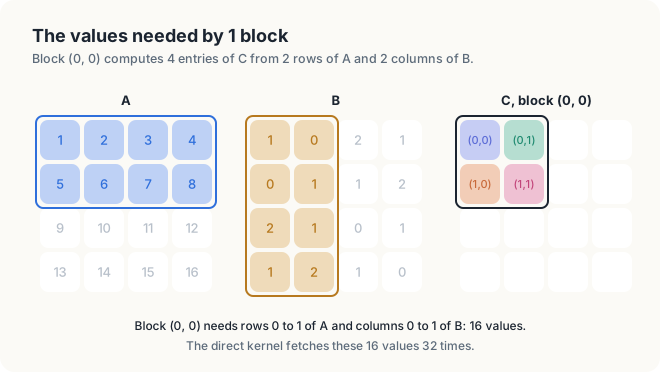
Let us count how often the direct kernel reads these 16 values. Thread \((0, 0)\) reads the 4 values of row 0 of \(A\) and the 4 values of column 0 of \(B\). Thread \((0, 1)\) reads the same row 0 of \(A\) again, together with column 1 of \(B\). In the same way, each of the 4 threads makes 8 reads, so the block makes 32 reads in total, and every one of the 16 values is read twice. If the block instead copied each of the 16 values into shared memory once, and its threads then took their operands from that copy, the block would read global memory only 16 times, half as often.
This plan has one difficulty. Shared memory is small: a block can use at most 48 KB of it by default, and a streaming multiprocessor (SM) has between 48 KB and 228 KB in total, shared by all the blocks that it runs. In our example, the rows are only 4 values long, but in a real problem a row of \(A\) holds thousands of values. For example, with \(K = 4{,}096\), a block of 16 × 16 threads needs 16 rows of \(A\) and 16 columns of \(B\), which hold \(2 \cdot 16 \cdot 4{,}096 = 131{,}072\) floats, or 512 KB. Such a strip of rows and columns does not fit into shared memory, so the block cannot copy everything it needs at once. In the next section, we see that it does not have to.
17.2 Splitting the sum
The key to the solution is that a thread does not need its whole row and column at the same time. The entry \(c_{00}\) is a sum of 4 products, and the terms of a sum may be added in any grouping. Figure 17.2 groups the 4 terms of \(c_{00}\) in 2 pairs. The first pair uses the first 2 values of row 0 of \(A\) and the first 2 values of column 0 of \(B\), and adds up to \(1 \cdot 1 + 2 \cdot 0 = 1\). The second pair uses the last 2 values of each, and adds up to \(3 \cdot 2 + 4 \cdot 1 = 10\). Together the 2 pairs give \(1 + 10 = 11\), which is \(c_{00}\).
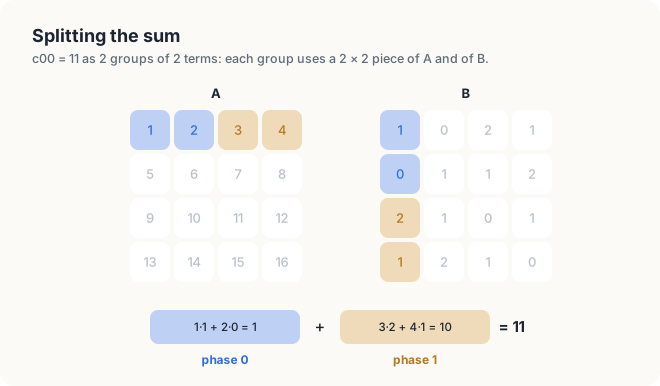
Now consider all 4 threads of the block. For its first pair of terms, every thread needs only columns 0 and 1 of rows 0 and 1 of \(A\), which form a 2 × 2 piece of \(A\), and rows 0 and 1 of columns 0 and 1 of \(B\), which form a 2 × 2 piece of \(B\). For its second pair, every thread needs the 2 × 2 pieces next to these: columns 2 and 3 of \(A\), and rows 2 and 3 of \(B\). The block can therefore work in 2 rounds. In each round, it copies 1 small piece of \(A\) and 1 small piece of \(B\) into shared memory, and every thread adds the matching pair of terms to its sum. At any moment, the block holds only 2 pieces of 4 values each in shared memory, however long the rows are.
Definition 17.1 Tile and phase. A tile is a square piece of \(A\) or \(B\), of \(T\) rows and \(T\) columns, that a block holds in shared memory. The number \(T\) is called the tile width. A phase is 1 round of the tiled kernel: the block copies 1 tile of \(A\) and 1 tile of \(B\) into shared memory, and every thread adds \(T\) products to its sum.
Example. With \(T = 2\), block \((0, 0)\) runs 2 phases. In phase 0, it uses the tile of \(A\) in rows 0 and 1 and columns 0 and 1; in phase 1, the tile of \(A\) in rows 0 and 1 and columns 2 and 3.
We can now state the grouping in general. We number the phases 0, 1, 2 and so on, and we write \(\mathsf{phase}\) for the number of a phase. Each phase handles \(T\) consecutive terms of each sum, so phase 0 handles the terms with \(s = 0, \ldots, T - 1\), phase 1 the terms with \(s = T, \ldots, 2T - 1\), and in general, the phase with number \(\mathsf{phase}\) handles the \(T\) terms that begin at \(s = \mathsf{phase} \cdot T\). The product \(\mathsf{phase} \cdot T\) is therefore the position at which the phase begins. In our example, with \(T = 2\), phase 0 begins at \(s = 0\) and phase 1 at \(s = 1 \cdot 2 = 2\). We write the position of a term within its phase as \(\mathsf{offset}\), which runs from 0 to \(T - 1\), so that every index \(s\) can be written as \(s = \mathsf{phase} \cdot T + \mathsf{offset}\). For example, the term with \(s = 3\) is the term with \(\mathsf{offset} = 1\) in phase 1, since \(3 = 1 \cdot 2 + 1\). With this notation, the definition of the matrix product in Definition 16.1 becomes a sum over the phases of a sum within each phase:
\[ c_{ij} = \sum_{\mathsf{phase} \in [0, \lceil K/T \rceil)} \; \underbrace{\sum_{\mathsf{offset} \in [0, T)} a_{i,\, \mathsf{phase} \cdot T + \mathsf{offset}}\; b_{\mathsf{phase} \cdot T + \mathsf{offset},\, j}}_{\text{one phase}}. \]
| Symbol | Meaning | In the example |
|---|---|---|
| \(T\) | tile width: rows and columns of a tile, terms added per phase | 2 |
| \(\mathsf{phase}\) | number of the phase | 0 or 1 |
| \(\mathsf{phase} \cdot T\) | index \(s\) at which the phase begins | 0 in phase 0, 2 in phase 1 |
| \(\mathsf{offset}\) | position of a term inside its phase | 0 or 1 |
| \(\lceil K/T \rceil\) | number of phases, \(K/T\) rounded up | \(4/2 = 2\) |
| \(a_{i,\, \mathsf{phase} \cdot T + \mathsf{offset}}\) | value of \(A\) in row \(i\), column \(\mathsf{phase} \cdot T + \mathsf{offset}\) | \(a_{0,3} = 4\) for \(i = 0\), \(\mathsf{phase} = 1\), \(\mathsf{offset} = 1\) |
The number of phases is \(\lceil K/T \rceil\), the quotient \(K/T\) rounded up, because when \(K\) is not a multiple of \(T\), the last phase is only partly filled. In that case, we treat the entries beyond the edge of a matrix as 0, so that the missing terms add nothing to the sum. Note also how the tiles move. From 1 phase to the next, the tile of \(A\) moves \(T\) columns to the right along the rows of the block, and the tile of \(B\) moves \(T\) rows down along its columns. Each thread still uses its entire row of \(A\) and column of \(B\); it receives them 1 tile at a time.
17.3 Loading a tile together
Next, we decide which thread copies which value of a tile. A tile holds \(T \times T = T^2\) values, and a block of the tiled kernel has \(T \times T = T^2\) threads, so the work divides evenly. We let each thread copy exactly 1 value of the tile of \(A\) and 1 value of the tile of \(B\). The natural choice is to let every thread copy the value that belongs at its own position in the tile. Recall from Chapter 16 that thread \((\mathsf{threadIdx{.}y}, \mathsf{threadIdx{.}x})\) is the thread in row \(\mathsf{threadIdx{.}y}\) and column \(\mathsf{threadIdx{.}x}\) of its block, and that it computes the entry of \(C\) in row \(\mathsf{row}\) and column \(\mathsf{col}\). We call the 2 tiles in shared memory tileA and tileB. In the phase with number \(\mathsf{phase}\), thread \((\mathsf{threadIdx{.}y}, \mathsf{threadIdx{.}x})\) performs the 2 copies
\[ \mathsf{tileA}[\mathsf{threadIdx{.}y}][\mathsf{threadIdx{.}x}] = a_{\mathsf{row},\; \mathsf{phase} \cdot T + \mathsf{threadIdx{.}x}}, \qquad \mathsf{tileB}[\mathsf{threadIdx{.}y}][\mathsf{threadIdx{.}x}] = b_{\mathsf{phase} \cdot T + \mathsf{threadIdx{.}y},\; \mathsf{col}}. \]
The first copy reads from the thread’s own row of \(A\), at column \(\mathsf{phase} \cdot T + \mathsf{threadIdx{.}x}\): the tile of this phase begins at column \(\mathsf{phase} \cdot T\), and the thread takes the value \(\mathsf{threadIdx{.}x}\) places further along. The second copy reads from the thread’s own column of \(B\), at row \(\mathsf{phase} \cdot T + \mathsf{threadIdx{.}y}\), that is, \(\mathsf{threadIdx{.}y}\) places below the first row of the tile. For example, in phase 1, thread \((0, 1)\) of block \((0, 0)\) has \(\mathsf{row} = 0\) and \(\mathsf{col} = 1\), and copies \(a_{0,\, 2 + 1} = a_{03} = 4\) into tileA[0][1] and \(b_{2 + 0,\, 1} = b_{21} = 1\) into tileB[0][1].
| Symbol | Meaning | Thread \((0, 1)\), phase 1 |
|---|---|---|
| \(\mathsf{threadIdx{.}y}, \mathsf{threadIdx{.}x}\) | row and column of the thread within its block | 0, 1 |
| \(\mathsf{row}, \mathsf{col}\) | row and column of the entry of \(C\) the thread computes | 0, 1 |
| \(\mathsf{phase} \cdot T + \mathsf{threadIdx{.}x}\) | column of \(A\) the thread copies | \(1 \cdot 2 + 1 = 3\) |
| \(\mathsf{phase} \cdot T + \mathsf{threadIdx{.}y}\) | row of \(B\) the thread copies | \(1 \cdot 2 + 0 = 2\) |
As \((\mathsf{threadIdx{.}y}, \mathsf{threadIdx{.}x})\) runs over all threads of the block, these copies fill every position of both tiles exactly once, so no value is copied twice and none is missed. Note also that the threads with the same \(\mathsf{threadIdx{.}y}\) copy \(T\) neighboring values of the same row of \(A\), which lie next to each other in memory, so their reads can be combined into few memory transactions. In Figure 17.3, we follow block \((0, 0)\) through both phases. Each color belongs to 1 thread and marks the values that the thread copies as well as the sum that it accumulates.
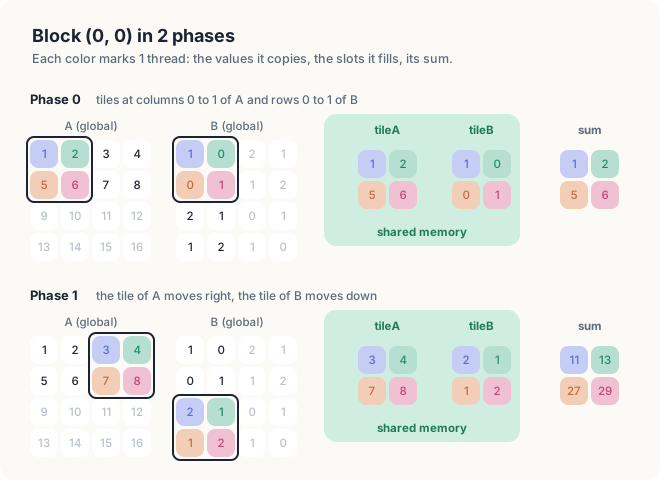
Let us follow thread \((0, 0)\). In phase 0, it copies \(a_{00} = 1\) and \(b_{00} = 1\), while the other 3 threads of the block copy the remaining 6 values of the 2 tiles. Once both tiles are complete, the thread multiplies row 0 of tileA by column 0 of tileB and obtains \(1 \cdot 1 + 2 \cdot 0 = 1\). In phase 1, the tiles hold the next 2 pieces of \(A\) and \(B\), and the thread adds \(3 \cdot 2 + 4 \cdot 1 = 10\), which brings its sum to \(c_{00} = 11\). Thread \((0, 1)\) performs the same steps with column 1 of each tile of \(B\). It obtains \(1 \cdot 0 + 2 \cdot 1 = 2\) in phase 0, and \(2 + 3 \cdot 1 + 4 \cdot 2 = 13\) after phase 1, which is \(c_{01}\).
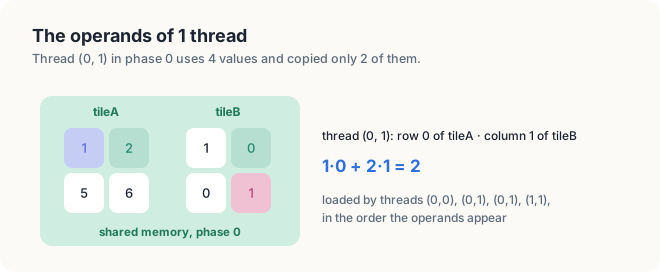
We can now see where the saving comes from. Consider thread \((0, 1)\) in phase 0, shown in Figure 17.4. It uses 4 values from shared memory, but it copied only 2 of them, \(a_{01}\) and \(b_{01}\); the other 2 were copied by its neighbors. In general, each value of tileA is used by the \(T\) threads in its row of the block, and each value of tileB by the \(T\) threads in its column. Every value that the block reads from global memory is therefore used \(T\) times.
Exercises
17.1 Carry out both phases of block \((0, 1)\), which computes \(c_{02}\), \(c_{03}\),
\(c_{12}\) and \(c_{13}\). Which values does thread \((1, 0)\) copy in each phase?
17.2 With \(T = 4\), the whole example is a single block. How many phases does it run, and which
values does thread \((2, 3)\) copy?
17.3 In the phase with number \(\mathsf{phase}\), which thread of block \((\mathsf{blockIdx{.}y}, \mathsf{blockIdx{.}x})\) copies \(a_{i, s}\)? Express \(\mathsf{threadIdx{.}y}\)
and \(\mathsf{threadIdx{.}x}\) in terms of \(i\), \(s\), \(\mathsf{blockIdx{.}y}\), \(\mathsf{phase}\) and \(T\).
17.4 The algorithm
17.4.1 The barrier
In Section 17.3, we let every thread copy 1 value of each tile and then compute with values that other threads had copied. In Figure 17.4, for example, thread \((0, 1)\) uses \(\mathsf{tileA}[0][0] = 1\), which thread \((0, 0)\) copied, and \(\mathsf{tileB}[1][1] = 1\), which thread \((1, 1)\) copied. This is correct only if thread \((0, 1)\) reads these 2 slots after its neighbors have stored their values in them. The threads of a block, however, do not move in lockstep. One thread may run ahead while another falls behind, because their warps are scheduled independently and their memory reads finish at different times. From its own progress alone, thread \((0, 1)\) therefore cannot tell whether thread \((1, 1)\) has already stored its value. When threads exchange data through shared memory, they need a common point in the program at which all of them wait for one another, so that each thread knows that the work of every other thread before that point is finished. Such a point is called a barrier.
Definition 17.2 Barrier. A barrier is a point in a kernel
that no thread of a block may pass until every thread of the block has reached it. The writes to
shared memory that a thread made before the barrier are visible to every thread of the block after
it. In cuda-oxide, a barrier is thread::sync_threads(), and in CUDA C++, it is __syncthreads().
Example. In Figure 17.5, thread 3 arrives first and waits; thread 1 arrives last, and then all 4 threads continue together.
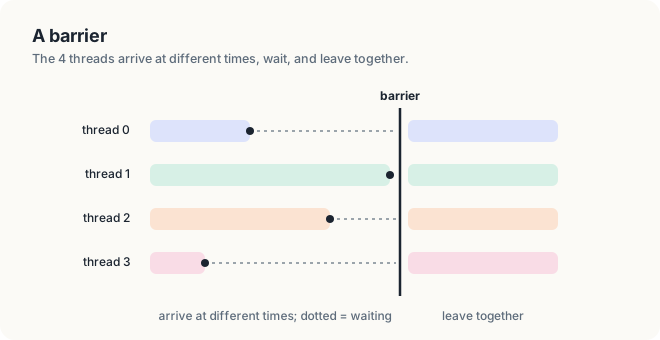
Note that a barrier costs time. In Figure 17.5, the threads that arrive early do no work between their arrival and the arrival of thread 1, so the block as a whole advances at the pace of its slowest thread. We will return to this cost in Section 17.8.2.
17.4.2 The tiled kernel
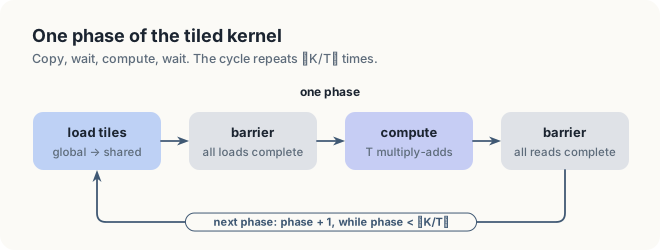
We now have all the pieces of the tiled kernel. In every phase, each thread performs the same 4 steps, shown in Figure 17.6. It first copies its 1 value of each tile. It then waits at a barrier until the whole block has finished copying. Next, it adds the \(T\) products of the phase to its sum, and finally, it waits at a second barrier until the whole block has finished reading the tiles. The phase then begins again with the next pair of tiles. In Section 17.6, we explain why each of the 2 barriers is needed.
Every thread executes the following procedure. The arrays tileA and tileB live in shared memory, and each block has its own pair of them.
Tiled-Kernel(\(A, B, C, M, K, N\))
- \(\mathsf{row} = \mathsf{blockIdx{.}y} \cdot T + \mathsf{threadIdx{.}y}\)
- \(\mathsf{col} = \mathsf{blockIdx{.}x} \cdot T + \mathsf{threadIdx{.}x}\)
- \(\mathsf{sum} = 0\)
- for \(\mathsf{phase} \in [0, \lceil K/T \rceil)\) {
- \(\mathsf{aCol} = \mathsf{phase} \cdot T + \mathsf{threadIdx{.}x}\)
- \(\mathsf{bRow} = \mathsf{phase} \cdot T + \mathsf{threadIdx{.}y}\)
- \(\mathsf{tileA}[\mathsf{threadIdx{.}y}][\mathsf{threadIdx{.}x}] = a_{\mathsf{row},\, \mathsf{aCol}}\) if \(\mathsf{row} \in [0, M)\) and \(\mathsf{aCol} \in [0, K)\), else 0
- \(\mathsf{tileB}[\mathsf{threadIdx{.}y}][\mathsf{threadIdx{.}x}] = b_{\mathsf{bRow},\, \mathsf{col}}\) if \(\mathsf{bRow} \in [0, K)\) and \(\mathsf{col} \in [0, N)\), else 0
- Barrier() // wait until both tiles are full
- for \(\mathsf{offset} \in [0, T)\) {
- \(\mathsf{sum} = \mathsf{sum} + \mathsf{tileA}[\mathsf{threadIdx{.}y}][\mathsf{offset}] \cdot \mathsf{tileB}[\mathsf{offset}][\mathsf{threadIdx{.}x}]\)
- }
- Barrier() // wait until every thread has read the tiles
- }
- if \(\mathsf{row} \in [0, M)\) and \(\mathsf{col} \in [0, N)\) {
- \(c_{\mathsf{row}, \mathsf{col}} = \mathsf{sum}\)
- }
Lines 1 and 2 compute the row and column of the entry of \(C\) that the thread computes, as in Direct-Kernel. A block of the tiled kernel has \(T \times T\) threads, so \(\mathsf{blockDim{.}x} = \mathsf{blockDim{.}y} = T\). For thread \((0, 1)\) of block \((0, 0)\) with \(T = 2\), \(\mathsf{threadIdx{.}y} = 0\) and \(\mathsf{threadIdx{.}x} = 1\), so the 2 lines give \(\mathsf{row} = 0 \cdot 2 + 0 = 0\) and \(\mathsf{col} = 0 \cdot 2 + 1 = 1\). Line 3 sets the sum to 0, and line 4 starts the loop over the \(\lceil K/T \rceil\) phases, of which there are 2 in our example. Lines 5 and 6 name the 2 positions that the thread copies in this phase, the column \(\mathsf{aCol}\) of \(A\) and the row \(\mathsf{bRow}\) of \(B\). For thread \((0, 1)\) in phase 1, they are \(1 \cdot 2 + 1 = 3\) and \(1 \cdot 2 + 0 = 2\). Lines 7 and 8 are the joint copy of Section 17.3. Lines 10 to 12 add 1 phase of the sum, that is, the inner sum over \(\mathsf{offset}\) of the formula in Section 17.2. In phase 0, for thread \((0, 1)\), they compute \(\mathsf{tileA}[0][0] \cdot \mathsf{tileB}[0][1] + \mathsf{tileA}[0][1] \cdot \mathsf{tileB}[1][1] = 1 \cdot 0 + 2 \cdot 1 = 2\). Lines 9 and 13 are the 2 barriers. The conditions in lines 7 and 8, which store 0 in place of a value outside the matrix, handle matrices whose size is not a multiple of \(T\); we treat both the barriers and these zeros in Section 17.6. Finally, lines 15 to 17 store the result. They replace the early return of the direct kernel, for a reason that we give in Section 17.6.5.
17.5 Counting the fetches again
We can now count how often the tiled kernel reads global memory, in the same way as we counted the reads of the direct kernel in Section 17.1. As in Chapter 16, we call each read of a value from global memory a fetch. In each phase, every thread fetches 2 values, 1 for each tile, in lines 7 and 8. Block \((0, 0)\) has 4 threads and runs 2 phases, so it makes \(4 \cdot 2 \cdot 2 = 16\) fetches. This is half of the 32 fetches that the direct kernel makes for the same block, and it equals the number of different values that the block needs, so the block now fetches each of these values exactly once. The other 3 blocks behave in the same way, and over the whole grid we count \(4 \cdot 16 = 64\) fetches instead of 128 (Figure 17.7).
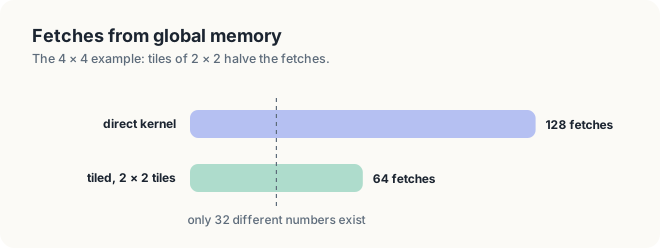
The dashed line in Figure 17.7 marks the 32 different values of \(A\) and \(B\), which is the least that any kernel must fetch. The tiled kernel still fetches each value twice, because 2 blocks need it. For example, \(a_{00}\) is fetched by block \((0, 0)\) and again by block \((0, 1)\), which computes the right half of the same 2 rows of \(C\).
In general, a block has \(T^2\) threads, each of which fetches 2 values per phase, so a block makes \(2T^2\) fetches per phase. When \(T\) divides every dimension, the grid has \((M/T)(N/T)\) blocks, because each block covers a \(T \times T\) square of the \(M \times N\) matrix \(C\), and each block runs \(K/T\) phases. The total number of fetches is therefore
\[ \frac{M}{T} \cdot \frac{N}{T} \cdot \frac{K}{T} \cdot 2T^2 = \frac{2MNK}{T}. \]
| Symbol | Meaning | In the example |
|---|---|---|
| \(M, N\) | rows and columns of \(C\) | 4, 4 |
| \(K\) | columns of \(A\) and rows of \(B\), the length of each dot product | 4 |
| \(T\) | tile width | 2 |
| \((M/T)(N/T)\) | number of blocks in the grid | \(2 \cdot 2 = 4\) |
| \(K/T\) | number of phases each block runs | 2 |
| \(2T^2\) | fetches of 1 block in 1 phase | 8 |
| \(2MNK/T\) | fetches of the whole kernel | \(2 \cdot 4 \cdot 4 \cdot 4 / 2 = 64\) |
Recall that the direct kernel makes \(2MNK\) fetches, 2 for each of its \(MNK\) multiply-adds, which in our example is \(2 \cdot 64 = 128\). Tiling therefore divides the traffic to global memory by exactly \(T\). Equivalently, each value of \(A\) is fetched \(N/T\) times instead of \(N\) times, once by each of the \(N/T\) blocks that compute its rows of \(C\), and each value of \(B\) is fetched \(M/T\) times instead of \(M\) times. With \(T = 16\), the product of 2 matrices of 1,024 × 1,024 moves 0.54 GB instead of 8.6 GB. In the units of Chapter 9, the kernel performs \(T\) FLOP per float fetched from global memory, 16 instead of 1.
Since a larger tile saves more fetches, it is natural to ask how large \(T\) can be. There are 2 limits. A block holds at most 1,024 threads, and a block of the tiled kernel has \(T^2\) threads, so \(T \le 32\). The 2 tiles hold \(2T^2\) values of 4 bytes each, which is 2 KB of shared memory for \(T = 16\) and 8 KB for \(T = 32\), well within the 48 KB that a block may use. The number of threads in a block, not the size of shared memory, therefore limits \(T\). In Section 17.8, we will see that the largest \(T\) is nevertheless not the fastest.
Exercises
17.4 With \(T = 4\), the example is 1 block. How many fetches does it make, and how often is each
value fetched?
17.5 Let \(M = N = K = 100\) and \(T = 16\). How many phases does each block run, and what
fraction of the values copied in the last phase are zeros?
17.6 For \(M = N = K = 4{,}096\) and \(T = 32\), how many bytes does the tiled kernel fetch
from global memory?
17.6 Correctness
In Section 17.4, we placed 2 barriers in every phase without explaining why both are needed. The threads of a block run at different speeds, yet they read and write the same slots of shared memory. Without coordination, 2 things can go wrong. A thread can read a slot before the thread responsible for it has filled it, or a thread can overwrite a slot that another thread has not yet finished reading. In this section, we remove the barriers of Tiled-Kernel one at a time and follow each error on our example. We then prove that the kernel with both barriers is correct, and we extend it to matrices of any size.
17.6.1 The first barrier: copy before computing
Suppose that we delete line 9, the first barrier. Consider phase 1 of block \((0, 0)\). Thread \((0, 0)\) finishes its copies early and goes on to line 11, where it computes \(\mathsf{tileA}[0][0] \cdot \mathsf{tileB}[0][0] + \mathsf{tileA}[0][1] \cdot \mathsf{tileB}[1][0]\). The slot \(\mathsf{tileB}[1][0]\) belongs to thread \((1, 0)\), which in phase 1 is to fill it with \(b_{30} = 1\). Thread \((1, 0)\), however, is running late, and it has not yet stored this value when thread \((0, 0)\) reads the slot (Figure 17.8).
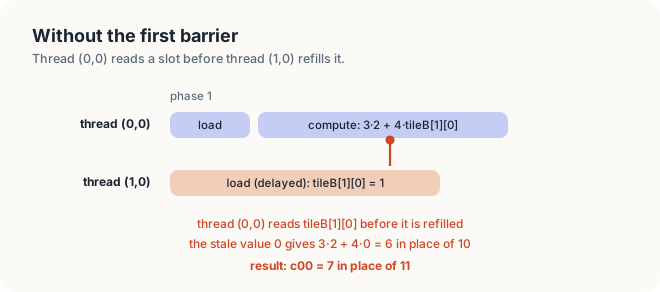
The slot therefore still holds the value that thread \((1, 0)\) stored in phase 0, which is \(b_{10} = 0\). Thread \((0, 0)\) adds \(3 \cdot 2 + 4 \cdot 0 = 6\) instead of \(3 \cdot 2 + 4 \cdot 1 = 10\), and its sum becomes \(c_{00} = 1 + 6 = 7\) instead of 11. Line 9 prevents this error, because no thread may start computing until every thread of the block has finished copying.
17.6.2 The second barrier: compute before the next copy
Now we restore line 9 and delete line 13, the second barrier, instead. This time, the error occurs at the end of a phase rather than at its start. In phase 0, thread \((1, 1)\) finishes its multiply-adds early and moves on to phase 1, where its first task is to store \(b_{31} = 2\) in \(\mathsf{tileB}[1][1]\). Thread \((0, 1)\), however, is still in phase 0, and it still needs the old value of that slot, \(b_{11} = 1\) (Figure 17.9).
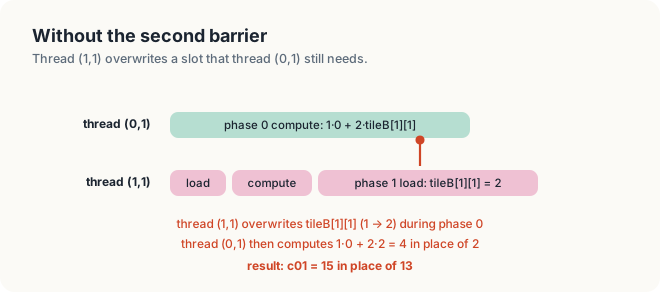
Thread \((0, 1)\) reads the new value and computes \(1 \cdot 0 + 2 \cdot 2 = 4\) instead of \(1 \cdot 0 + 2 \cdot 1 = 2\) in phase 0. Phase 1 then adds the correct \(3 \cdot 1 + 4 \cdot 2 = 11\), so this time we get \(c_{01} = 4 + 11 = 15\) instead of 13. Line 13 prevents this error, because no thread may overwrite a tile until every thread of the block has finished reading it. With both barriers in place, every phase follows the same orderly schedule, shown in Figure 17.10. The threads copy, wait for the slowest of them, compute, and wait again before the next copy.
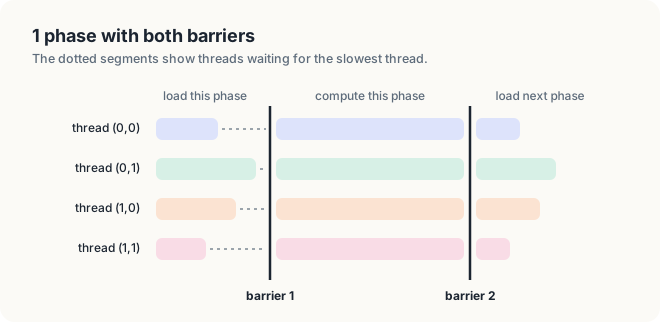
The two errors are of different kinds. The first barrier orders a write of a slot before a read of the same slot. Here, the reading thread needs the value that the writing thread produces, and such an ordering is called a read-after-write dependence. In Section 17.6.1, thread \((0, 0)\) had to read \(\mathsf{tileB}[1][0]\) after thread \((1, 0)\) had written it. The second barrier orders a read of a slot before the next write of the same slot. Here, the writing thread needs nothing from the reading thread, and the conflict exists only because both use the same slot in consecutive phases. Such an ordering is called a write-after-read dependence. In Section 17.6.2, thread \((1, 1)\) had to write \(\mathsf{tileB}[1][1]\) only after thread \((0, 1)\) had read it. Both errors are data races in the sense of Definition 16.8.
17.6.3 The broken kernels on the GPU
Figures 17.8 and 17.9 show what can happen, but whether it actually happens depends on the timing
of the threads. To find out, we built the Rust kernel twice more, once without each barrier. We ran
each broken kernel 3 times on the 4 × 4 example with \(T = 2\) and 5 times on matrices of
512 × 512 with \(T = 16\), and we compared every entry of the result with a product computed on
the CPU. On the example, all 6 runs printed equal to the product computed by hand: yes. At
512 × 512, the kernel without the first barrier printed the following lines.
without barrier 1, n = 512, T = 16: 260406 of 262144 entries wrong
without barrier 1, n = 512, T = 16: 260433 of 262144 entries wrong
without barrier 1, n = 512, T = 16: 260452 of 262144 entries wrong
without barrier 1, n = 512, T = 16: 260531 of 262144 entries wrong
without barrier 1, n = 512, T = 16: 260351 of 262144 entries wrong
The kernel without the second barrier printed the following lines.
without barrier 2, n = 512, T = 16: 24255 of 262144 entries wrong
without barrier 2, n = 512, T = 16: 24704 of 262144 entries wrong
without barrier 2, n = 512, T = 16: 27347 of 262144 entries wrong
without barrier 2, n = 512, T = 16: 25287 of 262144 entries wrong
without barrier 2, n = 512, T = 16: 23913 of 262144 entries wrong
On the 4 × 4 example, both broken kernels happened to give the right product in every run. A block of 2 × 2 threads consists of 4 threads of a single warp, and the hardware issued their loads and their multiply-adds together, so no thread ran ahead of another. A missing barrier therefore does not guarantee a wrong result; it only allows one. At 512 × 512, each block has 256 threads in 8 warps, which the SM schedules independently, and the errors appeared at once. Without the first barrier, 99.3% of the entries were wrong, because almost every dot product met at least 1 slot that its writer had not yet filled. Without the second barrier, about 9.5% were wrong. This error is rarer, because it requires 1 warp to finish a whole phase while another warp of the same block is still in it. In both cases, the count changed from run to run, since it depends on the order in which the warps happen to run. The CUDA C++ kernels behaved in the same way, with 260,014 to 260,438 and 23,424 to 25,694 wrong entries. Neither program reported an error, and both compiled without a warning, because a missing barrier breaks no rule that a compiler checks.
17.6.4 The proof
The experiments of Section 17.6.3 show that the kernel fails without its barriers, but tests on a few matrices cannot show that it is correct with them. For that, we need a proof. The idea is to follow the variable sum of 1 thread as it grows, phase by phase. Figure 17.11 shows this for thread \((0, 0)\) with \(T = 2\). Before phase 0, sum is 0. Before phase 1, it holds the first 2 terms of \(c_{00}\), \(1 \cdot 1 + 2 \cdot 0 = 1\), and after phase 1, it holds all 4 terms, which add up to 11. In general, before the phase with number \(\mathsf{phase}\), sum holds exactly the first \(\mathsf{phase} \cdot T\) terms of the thread’s entry of \(C\). A statement that holds every time a loop begins a new iteration is called a loop invariant, and we prove the theorem by showing that this statement is one.
![Row 0 of A, 1 2 3 4, and column 0 of B, 1 0 2 1, drawn as 2 rows of cells: the first 2 cells of each in blue (phase 0), the last 2 in amber (phase 1). Below, 3 bars show how much of the dot product sum covers: at the start of phase 0 no terms, sum = 0; at the start of phase 1 the terms s in [0, 2), sum = 1 times 1 plus 2 times 0 = 1; at the end of the loop, the terms s in [0, 4), sum = 1 + 3 times 2 + 4 times 1 = 11 = c00.](../../figures/ch17-invariant.svg)
Theorem 17.1 When Tiled-Kernel finishes, every entry of \(C\) equals the corresponding entry of \(AB\).
Proof. Fix a thread with \(\mathsf{row} \in [0, M)\) and \(\mathsf{col} \in [0, N)\), and treat entries beyond the edge of a matrix as 0. We show that the loop of lines 4 to 14 maintains the invariant
\[ \text{at the start of the phase with number } \mathsf{phase}, \qquad \mathsf{sum} = \sum_{s \in [0,\, \mathsf{phase} \cdot T)} a_{\mathsf{row}, s}\; b_{s, \mathsf{col}}. \]
| Symbol | Meaning | Thread \((0, 0)\), start of phase 1 |
|---|---|---|
| \(\mathsf{phase}\) | phase about to begin | 1 |
| \(\mathsf{phase} \cdot T\) | number of terms already added | \(1 \cdot 2 = 2\) |
| \(s \in [0, \mathsf{phase} \cdot T)\) | indices of the terms already added | 0 and 1 |
| \(a_{\mathsf{row}, s}\, b_{s, \mathsf{col}}\) | term \(s\) of the dot product | \(1 \cdot 1\) and \(2 \cdot 0\) |
| \(\mathsf{sum}\) | value of the variable | 1 |
Initialization. Before phase 0, \(\mathsf{sum} = 0\), which is the empty sum.
Maintenance. Assume that the invariant holds at the start of the phase with number \(\mathsf{phase}\). In lines 7 and 8, the threads of the block fill both tiles completely (Section 17.3). Because of the barrier in line 9, every one of these stores is complete and visible before any thread reaches line 11; this excludes the error of Section 17.6.1. Hence \(\mathsf{tileA}[\mathsf{threadIdx{.}y}][\mathsf{offset}] = a_{\mathsf{row}, \mathsf{phase} \cdot T + \mathsf{offset}}\) and \(\mathsf{tileB}[\mathsf{offset}][\mathsf{threadIdx{.}x}] = b_{\mathsf{phase} \cdot T + \mathsf{offset}, \mathsf{col}}\) for every \(\mathsf{offset} \in [0, T)\), and lines 10 to 12 add exactly the terms with \(s \in [\mathsf{phase} \cdot T, \mathsf{phase} \cdot T + T)\). For thread \((0, 0)\) in phase 1, these are the terms with \(s = 2\) and \(s = 3\), which add \(3 \cdot 2 + 4 \cdot 1 = 10\). Because of the barrier in line 13, no thread overwrites a tile for the next phase while another thread is still reading it in this one; this excludes the error of Section 17.6.2. Therefore, the invariant holds at the start of the phase with number \(\mathsf{phase} + 1\).
Termination. The loop ends with \(\mathsf{phase} = \lceil K/T \rceil\), so \(\mathsf{phase} \cdot T \ge K\). All terms with \(s \ge K\) are 0, hence \(\mathsf{sum} = c_{\mathsf{row}, \mathsf{col}}\), and line 16 stores it.
The proof uses each barrier exactly once, in the maintenance step, and each use excludes 1 of the two errors of Sections 17.6.1 and 17.6.2. The proof covers only the threads that have an entry of \(C\). A thread outside \(C\) stores nothing, so there is no result of its own to prove correct. It still takes part in lines 7 to 13, however, and in the next section, we show why it must.
17.6.5 Matrices of any size
So far, we have assumed that \(T\) divides every dimension of the matrices. Nothing in the algorithm requires this, and in this section, we see how the kernel handles the other cases. Take \(C\) of size 3 × 3 with \(T = 2\). A single block covers only a 2 × 2 square, so we still need 2 × 2 = 4 blocks to cover \(C\). Together they have 16 threads, but \(C\) has only 9 entries, so the blocks stick out past the edge of \(C\), and 7 of their 16 threads have no entry to compute. If also \(K = 3\), the matrix \(A\) has only 3 columns, and in phase 1, the tile of \(A\), which covers columns 2 and 3, reaches for a column that does not exist (Figure 17.12).
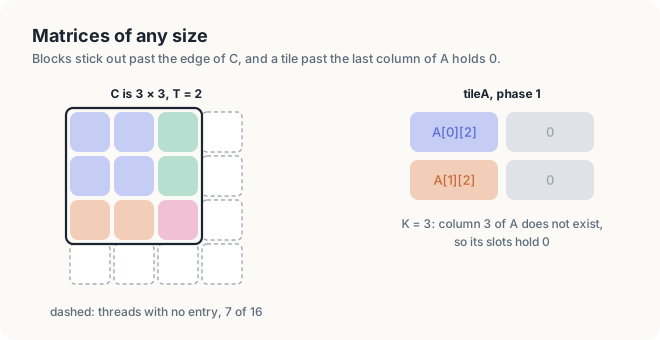
Lines 7 and 8 handle a missing value by storing 0 in its place, and a product with 0 adds nothing to the sum. In Figure 17.12, the right column of tileA in phase 1 would hold column 3 of \(A\); both of its slots hold 0, so the term with \(s = 3\), which does not exist, contributes nothing.
Threads with no entry need more care, and they explain the only structural difference between the direct kernel and the tiled kernel. In the direct kernel, such a thread returns at once. In the tiled kernel, it must not return, because a barrier releases the block only when every thread has arrived. A thread that has returned never arrives, so the rest of the block would wait forever, or, on some GPUs, continue with an undefined result. Instead, these threads stay in the loop, copy zeros, wait at every barrier together with the other threads, and skip only the final store in lines 15 to 17. For example, thread \((1, 1)\) of block \((1, 1)\) has \(\mathsf{row} = 3\) and \(\mathsf{col} = 3\), outside the 3 × 3 matrix \(C\). In both phases, it copies 0 into both tiles, since row 3 of \(A\) and column 3 of \(B\) do not exist, and it waits at all 4 barriers. At line 15, the condition \(\mathsf{row} \in [0, M)\) is false, so it stores nothing. Both programs check 3 shapes of this kind, comparing every entry: the 3 × 3 product with \(T = 2\), a 128 × 64 by 64 × 96 product, and a 1,000 × 1,000 product with \(T = 16\).
Rule Every thread of a block must reach every barrier. Never place a barrier where some threads of the block can skip it.
Exercises
17.7 Without line 9, thread \((1, 1)\) might read \(\mathsf{tileA}[1][0]\) in phase 1 before
the slot is refilled. Which value would it use, and what would \(c_{11}\) become?
17.8 Explain why the proof of Theorem 17.1 breaks when a thread returns early, even though that
thread writes no entry of \(C\).
17.9 Without line 13, could \(c_{00}\) become wrong in our example? Which thread would have to
run ahead, and which slot would it overwrite?
17.7 Implementation
We now turn Tiled-Kernel into code, in Rust and in CUDA C++. The main new element in both languages is shared memory, so we begin with the declaration of the 2 tiles.
17.7.1 Shared arrays
In CUDA C++, an array in shared memory is a local array declared with the qualifier __shared__.
Its length must be known at compile time, and a template parameter satisfies this requirement.
The kernel matmulTiled<T> therefore declares 2 tiles of T × T floats, and the compiler builds
1 kernel for each value of T that the program uses.
In cuda-oxide, a fixed-size array in shared memory is a static mut of type
SharedArray<f32, N> declared inside the kernel, where N must be known at compile time; we use
one in Chapter 18 for comparison. This form does not work for a kernel that is generic over the
tile width. A static declared inside a function is a separate item of the program, with exactly
1 instance, and Rust does not allow its type to mention a generic parameter of the function that
contains it. For example, SharedArray<f32, { T * T }> inside fn matmul_tiled<const T: usize> is
refused with error E0401. A kernel that is generic over the tile width therefore takes its tiles
from dynamic shared memory. This is a single region per block, whose size in bytes the host
passes in the launch configuration. The call DynamicSharedArray::<f32>::get() returns a raw
pointer of type *mut f32 to the start of the region, and the call
DynamicSharedArray::<f32>::offset(bytes) returns a pointer that lies bytes bytes further on.
The following code declares the 2 tiles in each language.
mod kernels {
    // ...
    pub fn matmul_tiled<const T: usize>(
        m: u32,
        n: u32,
        k: u32,
        a: &[f32],
        b: &[f32],
        mut c: DisjointSlice<f32, Runtime2DIndex>,
    ) {
        let tile_a: *mut f32 = DynamicSharedArray::<f32>::get();
        let tile_b: *mut f32 = DynamicSharedArray::<f32>::offset(T * T * 4);
        // ...
    }
}
// The same product with T x T tiles in shared memory. A block of T x T threads computes
// a T x T square of C in ceil(k / T) phases.
template <int T>
__global__ void matmulTiled(int m, int n, int k, const float* a, const float* b, float* c)
{
__shared__ float tile_a[T][T];
__shared__ float tile_b[T][T];
// ...
}
In Rust, tileA starts at byte 0 of the region and tileB at byte \(4T^2\), immediately after
the \(T^2\) floats of tileA, each of which takes 4 bytes. With \(T = 2\), for example,
tileA occupies bytes 0 to 15 and tileB bytes 16 to 31, so the region must hold 32 bytes. Both
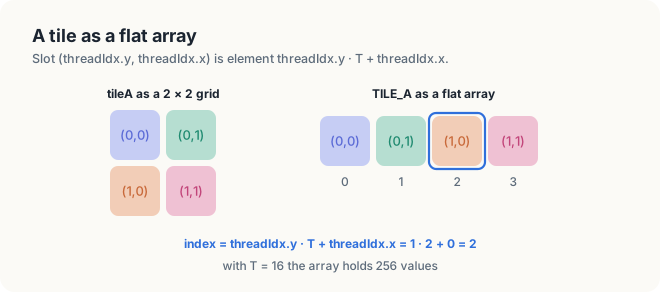
programs store a tile as a flat array of \(T^2\) values in row-major order (Figure 17.13). In
C++, the compiler lays out the 2-dimensional array tile_a[threadIdx.y][threadIdx.x] in this way, while the Rust
kernel computes the index \(\mathsf{threadIdx{.}y} \cdot T + \mathsf{threadIdx{.}x}\) of Definition 16.2 itself. In our example, slot
\((1, 0)\) of a 2 × 2 tile is at index \(1 \cdot 2 + 0 = 2\).
17.7.2 The tiled kernel
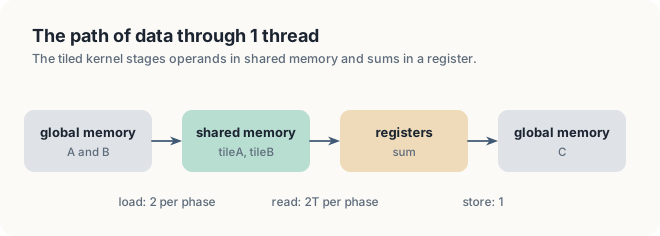
Before reading the code, we trace where the data of 1 thread travel (Figure 17.14). In each phase, the thread copies 2 values from global memory into shared memory. From shared memory, it then reads \(2T\) values, \(T\) from a row of tileA and \(T\) from a column of tileB, which feed its \(T\) multiply-adds. Its sum stays in a register throughout, and at the end, a single store writes it into \(C\). In our example with \(T = 2\), thread \((0, 1)\) copies 2 values and reads 4 values in each phase, as in Figure 17.4.
The following code is the loop over the phases, lines 4 to 14 of the pseudocode, together with the initialization of the sum in line 3.
mod kernels {
    // ...
    pub fn matmul_tiled<const T: usize>(
        m: u32,
        n: u32,
        k: u32,
        a: &[f32],
        b: &[f32],
        mut c: DisjointSlice<f32, Runtime2DIndex>,
    ) {
        // ...
        let mut sum = 0.0;
        let mut phase = 0;
        while phase < k.div_ceil(T) {
            let a_col = phase * T + thread_x;
            let b_row = phase * T + thread_y;
            let a_value = if row < m && a_col < k { a[row * k + a_col] } else { 0.0 };
            let b_value = if b_row < k && col < n { b[b_row * n + col] } else { 0.0 };
            // SAFETY: tiled_config::<T> launches T x T threads with 2 T^2 floats
            // of shared memory, so slot thread_y * T + thread_x lies in each tile
            // and belongs to this thread alone; the barrier below completes these writes
            // before any thread reads them.
            unsafe {
                *tile_a.add(thread_y * T + thread_x) = a_value;
                *tile_b.add(thread_y * T + thread_x) = b_value;
            }
            thread::sync_threads();

            let mut offset = 0;
            #[unroll]
            while offset < T {
                let a_slot = thread_y * T + offset;
                let b_slot = offset * T + thread_x;
                // SAFETY: between the 2 barriers no thread writes either tile.
                sum += unsafe { *tile_a.add(a_slot) * *tile_b.add(b_slot) };
                offset += 1;
            }
            thread::sync_threads();

            phase += 1;
        }
        // ...
    }
}
// The same product with T x T tiles in shared memory. A block of T x T threads computes
// a T x T square of C in ceil(k / T) phases.
template <int T>
__global__ void matmulTiled(int m, int n, int k, const float* a, const float* b, float* c)
{
// ...
float sum = 0.0f;
int phases = (k + T - 1) / T;
for (int phase = 0; phase < phases; ++phase) {
int a_col = phase * T + threadIdx.x;
int b_row = phase * T + threadIdx.y;
float a_value = row < m && a_col < k ? a[row * k + a_col] : 0.0f;
float b_value = b_row < k && col < n ? b[b_row * n + col] : 0.0f;
tile_a[threadIdx.y][threadIdx.x] = a_value;
tile_b[threadIdx.y][threadIdx.x] = b_value;
__syncthreads();
for (int offset = 0; offset < T; ++offset) {
sum += tile_a[threadIdx.y][offset] * tile_b[offset][threadIdx.x];
}
__syncthreads();
}
// ...
}
The variable phase counts the phases of line 4. In Rust, the bound of the loop, k.div_ceil(T), is
\(\lceil K/T \rceil\), the quotient \(K/T\) rounded up; in C++, the same bound is computed as
(k + T - 1) / T and stored in phases. The variables a_col and b_row are the indices
\(\mathsf{phase} \cdot T + \mathsf{threadIdx{.}x}\) and \(\mathsf{phase} \cdot T + \mathsf{threadIdx{.}y}\) of lines 7 and 8, that is, the column of \(A\) and the row of
\(B\) that the thread copies. For thread \((0, 1)\) in phase 1 with \(T = 2\), they are
\(1 \cdot 2 + 1 = 3\) and \(1 \cdot 2 + 0 = 2\), as in Section 17.3. When an index lies past
the edge of a matrix, the conditional expression yields 0 instead of reading memory. The first
call to the barrier, thread::sync_threads() in Rust and __syncthreads() in C++, is line 9. It
lies outside every if, so every thread reaches it, as the Rule of Section 17.6.5 requires.
In Rust, the copy is split into two halves. The reads a[row * k + a_col] and b[b_row * n + col]
are ordinary slice reads, bounds-checked like every slice access in safe Rust. The stores through
the raw pointers tile_a and tile_b are different. The compiler cannot check how many threads
write a slot of shared memory, or when, so every access to shared memory must stand in an
unsafe block. Each unsafe block carries a // SAFETY: comment, which is the Rust convention for
stating why the block is sound. The 2 comments of the kernel summarize Section 17.6. The first
states that every thread writes only its own slot, which lies inside the tile because the block
has \(T \times T\) threads, and that the barrier completes these writes before any thread reads
them. The second states that no thread writes either tile between the 2 barriers. In C++, the same
stores need no marking. The argument for their correctness is the same, but the language does not
ask for it.
The inner loop is lines 10 to 12 of the pseudocode. In Rust, thread_x and thread_y hold
\(\mathsf{threadIdx{.}x}\) and \(\mathsf{threadIdx{.}y}\). The slot a_slot, which is
thread_y * T + offset, is the flat index of
\(\mathsf{tileA}[\mathsf{threadIdx{.}y}][\mathsf{offset}]\), so as offset runs from 0 to \(T - 1\), the thread walks along
its own row of tileA. Likewise, b_slot, which is offset * T + thread_x, is the flat index of
\(\mathsf{tileB}[\mathsf{offset}][\mathsf{threadIdx{.}x}]\), and the thread walks down its own column of tileB. For thread
\((0, 1)\) with \(T = 2\), the flat indices are 0 and 1 in tileA and 1 and 3 in tileB. The
Rust loop is a while loop marked #[unroll]. Inside each specialization of the generic kernel,
T is a constant, so the loop has a fixed count, and the compiler replaces it by \(T\) copies of
its body. The C++ compiler unrolls the for loop over a template constant by itself. The second
barrier, line 13, again lies outside every if.
The following code stores the result, lines 15 to 17 of the pseudocode.
mod kernels {
    // ...
    pub fn matmul_tiled<const T: usize>(
        m: u32,
        n: u32,
        k: u32,
        a: &[f32],
        b: &[f32],
        mut c: DisjointSlice<f32, Runtime2DIndex>,
    ) {
        // ...
        if row < m
            && col < n
            && let Some(idx) = thread::index_2d_runtime(&c)
            && let Some(out) = c.get_mut(idx)
        {
            *out = sum;
        }
    }
}
// The same product with T x T tiles in shared memory. A block of T x T threads computes
// a T x T square of C in ceil(k / T) phases.
template <int T>
__global__ void matmulTiled(int m, int n, int k, const float* a, const float* b, float* c)
{
// ...
if (row < m && col < n) {
c[row * n + col] = sum;
}
}
The final store goes through DisjointSlice exactly as in the direct kernel, guarded by the
condition row < m && col < n. Unlike the direct kernel, however, the tiled kernel has no early
return. A thread outside \(C\) reaches this point only after it has taken part in every phase,
and only then does it skip the store.
17.7.3 The launch
The launch configuration must match T in 3 respects. The block must have \(T \times T\)
threads, so that every slot of a tile has exactly 1 thread to fill it. The grid must have enough
blocks to cover \(C\). In Rust, the dynamic shared memory must also hold the 2 tiles, which take
\(2T^2 \cdot 4\) bytes. The following code builds this configuration and launches the kernel. In
Rust, the function tiled_config computes the configuration and the method Problem::tiled
launches the kernel with it; in C++, the function launchTiled does both.
/// The launch of matmul_tiled::<T> for an m x n matrix C: T x T threads per block,
/// enough blocks to cover C, and 2 tiles of T x T floats in dynamic shared memory.
fn tiled_config<const T: usize>(m: usize, n: usize) -> LaunchConfig2D {
    let side = T as u32;
    let grid = ((n as u32).div_ceil(side), (m as u32).div_ceil(side));
    let shared = (2 * T * T * size_of::<f32>()) as u32;
    LaunchConfig2D::new(grid, (side, side), shared)
}

impl Problem {
    // ...
    /// Launch matmul_tiled::<T> on this problem.
    fn tiled<const T: usize>(
        &mut self,
        module: &Module,
        stream: &Arc<CudaStream>,
    ) -> Result<(), Error> {
        let prepared = module.prepare_matmul_tiled::<T>(tiled_config::<T>(self.m, self.n))?;
        let (m, n, k) = (self.m as u32, self.n as u32, self.k as u32);
        let width = RowWidth::new(&mut self.c, n);
        module.matmul_tiled::<T>(stream, &prepared, m, n, k, &self.a, &self.b, width)?;
        Ok(())
    }
    // ...
}
template <int T>
void launchTiled(const Product& p)
{
dim3 grid((p.n + T - 1) / T, (p.m + T - 1) / T);
matmulTiled<T><<<grid, dim3(T, T)>>>(p.m, p.n, p.k, p.a, p.b, p.c);
}
For \(T = 16\) and \(M = N = 1{,}000\), tiled_config returns a grid of 63 × 63 blocks, since
\(\lceil 1{,}000/16 \rceil = 63\), with 16 × 16 threads per block and
\(2 \cdot 16^2 \cdot 4 = 2{,}048\) bytes of dynamic shared memory. The launch contract of the
Rust kernel checks what it can. The setting dynamic_shared_range = (32, 8192) accepts amounts
from the 32 bytes of \(T = 2\) up to the 8,192 bytes of \(T = 32\), and the attribute
#[launch_bounds(1024)] limits a block to 1,024 threads. The requires clause checks the lengths
of the buffers, as in Chapter 16. An exact block shape such as block = (16, 16, 1), however, must
be written as literal numbers, so it cannot depend on T, and the contract therefore cannot check
that the block is \(T \times T\). This condition moves into the program instead. The function
tiled_config::<T> derives the block, the grid and the shared memory from T in 1 place, and the
SAFETY comment of the copy names it.
Exercises
17.10 Set T to 32. Predict the effect on fetches from global memory and on shared memory per
block.
17.11 Launch matmul_tiled::<16> with blocks of 8 × 8 threads and 2,048 bytes of dynamic shared
memory. Does the contract accept the launch? Which part of the SAFETY argument fails, and which
entries of \(C\) are wrong?
17.12 Each thread of the tiled kernel performs 2 arithmetic operations for every 2 values it reads
from shared memory. Design a variant in which each thread computes several entries of \(C\), so
that every value read from shared memory is used more than once.
17.8 Measurements
17.8.1 Results
The measurements come from the GPU of Chapter 16, which has 8 SMs, a memory bandwidth of 102 GB/s and an FP32 peak of 2,400 GFLOP/s, and we use the method of Section 16.6.1. Both programs time the direct kernel and the tiled kernel with \(T = 8\), 16 and 32, on square matrices from 512 × 512 to 4,096 × 4,096. The Rust program prints the following output.
$ cargo oxide run
C = A B on the 4 x 4 example, tiles of 2 x 2, 2 phases
11 13 8 8
27 29 24 24
43 45 40 40
59 61 56 56
equal to the product computed by hand: yes
Sizes that are not multiples of the tile width
m = 3, k = 3, n = 3, T = 2: 9 of 9 entries exact
m = 128, k = 64, n = 96, T = 16: 12288 of 12288 entries exact
m = 1000, k = 1000, n = 1000, T = 16: 1000000 of 1000000 entries exact
C = A B, n x n; fetched: the modelled reads from global memory
n kernel ms GFLOP/s fetched MiB fetch GB/s exact
512 direct 1.462 183.6 1024.0 734.3 64 of 64
512 T = 8 1.918 140.0 128.0 70.0 64 of 64
512 T = 16 0.946 283.6 64.0 70.9 64 of 64
512 T = 32 1.133 237.0 32.0 29.6 64 of 64
1024 direct 15.561 138.0 8192.0 552.0 64 of 64
1024 T = 8 15.368 139.7 1024.0 69.9 64 of 64
1024 T = 16 8.192 262.1 512.0 65.5 64 of 64
1024 T = 32 9.816 218.8 256.0 27.3 64 of 64
2048 direct 125.589 136.8 65536.0 547.2 64 of 64
2048 T = 8 123.308 139.3 8192.0 69.7 64 of 64
2048 T = 16 66.321 259.0 4096.0 64.8 64 of 64
2048 T = 32 80.277 214.0 2048.0 26.8 64 of 64
4096 direct 996.270 138.0 524288.0 551.8 64 of 64
4096 T = 8 1004.860 136.8 65536.0 68.4 64 of 64
4096 T = 16 531.679 258.5 32768.0 64.6 64 of 64
4096 T = 32 668.652 205.5 16384.0 25.7 64 of 64
PASSED
The first part of the output repeats the 4 × 4 example and the 3 shapes of Section 17.6.5. In the table that follows, the column fetched MiB is the model of Section 17.5, \(2n^3/T\) values of 4 bytes, where \(n\) is the size of the matrices and \(T = 1\) for the direct kernel. For example, at \(n = 512\) with \(T = 16\), the model gives \(2 \cdot 512^3 / 16 = 16{,}777{,}216\) values, or 64 MiB. The column fetch GB/s divides this amount by the time, so it is the rate at which the kernel requests data from global memory, whether or not a cache answers the request. The C++ program prints the same lines. The following table compares the two languages at the smallest and the largest size.
| n | kernel | modeled fetches | C++ time | C++ rate | Rust time | Rust rate |
|---|---|---|---|---|---|---|
| 512 | direct | 1,024 MiB | 1.495 ms | 179.5 GFLOP/s | 1.462 ms | 183.6 GFLOP/s |
| 512 | \(T = 8\) | 128 MiB | 1.809 ms | 148.4 GFLOP/s | 1.918 ms | 140.0 GFLOP/s |
| 512 | \(T = 16\) | 64 MiB | 0.976 ms | 275.2 GFLOP/s | 0.946 ms | 283.6 GFLOP/s |
| 512 | \(T = 32\) | 32 MiB | 1.079 ms | 248.7 GFLOP/s | 1.133 ms | 237.0 GFLOP/s |
| 4,096 | direct | 524,288 MiB | 744.953 ms | 184.5 GFLOP/s | 996.270 ms | 138.0 GFLOP/s |
| 4,096 | \(T = 8\) | 65,536 MiB | 982.887 ms | 139.8 GFLOP/s | 1,004.860 ms | 136.8 GFLOP/s |
| 4,096 | \(T = 16\) | 32,768 MiB | 505.159 ms | 272.1 GFLOP/s | 531.679 ms | 258.5 GFLOP/s |
| 4,096 | \(T = 32\) | 16,384 MiB | 637.641 ms | 215.5 GFLOP/s | 668.652 ms | 205.5 GFLOP/s |
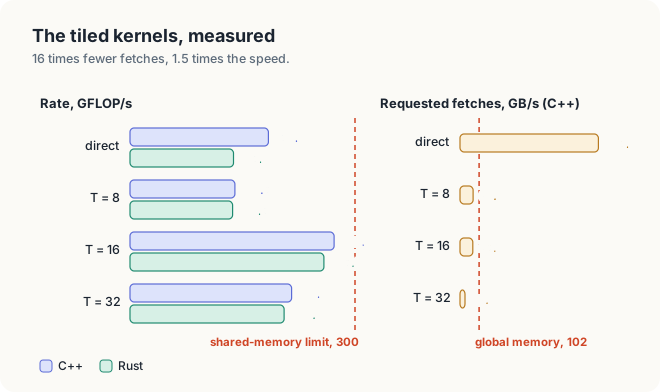
With \(T = 16\), the tiled kernel made, in the model of Section 17.5, 16 times fewer fetches than the direct kernel. In C++, it ran 1.53 times as fast as the direct kernel at 512 × 512 (1.495 ms against 0.976 ms) and 1.47 times as fast at 4,096 × 4,096. In Rust, the factors are 1.55 and 1.87. The second Rust factor is larger because the generic Rust direct kernel is slower at large sizes (Section 16.6.3). The Rust and C++ tiled kernels agree within 6% at every size. All checked entries were exact, including those of the 3 shapes that are not multiples of the tile width. Figure 17.15 shows the rates at \(n = 4{,}096\) against two limits, which we explain in the next section.
17.8.2 Why the speedup is 1.5, not 16
Tiling reduced the fetches by a factor of 16, yet the kernel became only about 1.5 times as fast. The reason is that our model in Section 17.5 counted fetches as if every fetch went all the way to global memory. In Section 16.6.3, we saw that this is not true for the direct kernel. It requested 738 GB/s, which is 7.2 times what global memory can deliver, so at least 86% of its fetches were answered by the L1 and L2 caches. Tiling removes 15 of every 16 requested fetches, but most of the fetches that it removes were already cheap. In effect, the hardware caches had already recovered part of the reuse that tiling makes explicit.
The difference between the two approaches is control. A value stays in a cache only by chance, and the chance shrinks as the matrices grow beyond the size of the cache. A value in shared memory stays there for exactly 1 phase, by construction, at every matrix size. The tiled kernel with \(T = 16\) requested 68 GB/s from global memory, two-thirds of the 102 GB/s available, so global memory is no longer what limits it.
What limits the tiled kernel now is shared memory. Each execution of line 11 performs 1 multiply-add and reads 2 values from shared memory, \(\mathsf{tileA}[\mathsf{threadIdx{.}y}][\mathsf{offset}]\) and \(\mathsf{tileB}[\mathsf{offset}][\mathsf{threadIdx{.}x}]\). The shared memory of an SM serves 1 read instruction of a warp per cycle, that is, 32 values of 4 bytes, or 128 bytes per cycle, provided that the 32 addresses fall in different banks or coincide. The 128 FP32 units of the SM, on the other hand, can perform 128 multiply-adds per cycle. Let us count for 1 warp. Its 32 multiply-adds need 2 read instructions, 1 for each tile, and therefore 2 cycles of shared memory. The SM thus completes at most \(32 / 2 = 16\) multiply-adds per cycle, 1/8 of the 128 that its units could perform. On the measured GPU, that limit is \(2{,}400 / 8 = 300\) GFLOP/s. The C++ kernel with \(T = 16\) reached 272 to 275 GFLOP/s at every size, 91% of the limit, and the Rust kernel reached 259 to 284 GFLOP/s. A larger tile reduces the fetches from global memory, but it does not change this ratio, because every multiply-add of the tiled kernel still costs 2 reads of shared memory.
The other 2 tile widths are slower, each for a reason of its own. To explain the first reason, we need 1 more definition. A block of 32 × 32 = 1,024 threads leaves no room for a second block on an SM of the measured GPU, which holds at most 1,536 threads.
Definition 17.3 Occupancy. The occupancy of a kernel is the number of threads resident on an SM divided by the largest number the SM can hold.
Example. With \(T = 32\), each SM of the measured GPU runs 1 block of 1,024 threads out of 1,536, an occupancy of 67%; with \(T = 16\), it runs 6 blocks of 256 threads, an occupancy of 100%.
With \(T = 32\), the SM therefore runs a single block, and when the threads of that block wait at a barrier, the SM has no other block to run, so it idles. This kernel ran at 216 GFLOP/s, although it fetched half as much as the kernel with \(T = 16\). With \(T = 8\), a block has only 64 threads, and each thread performs only 8 multiply-adds between 2 barriers, so the copy and the barriers take a larger share of each phase. Moreover, an SM holds at most 16 blocks, which with \(T = 8\) is only 1,024 threads. This kernel ran at 140 GFLOP/s, slower than the direct kernel in C++.
The speedup differs between GPUs, because it depends on how well the caches serve the direct kernel. On a Jetson AGX Thor, Rust kernels for the same two algorithms with \(T = 16\) took 1.158 ms and 0.285 ms for 512 × 512 matrices, a speedup of 4.06 (Pathak, 2026). On that GPU, the direct kernel requested 927 GB/s, 3.4 times the 273 GB/s of the Thor’s memory, so the caches answered at least 70% of its fetches, against 86% on the measured GPU, and tiling had more to gain. The tiled kernel ran at 941.5 GFLOP/s, 93% of the Thor’s shared-memory limit of \(8{,}100 / 8 = 1{,}012\) GFLOP/s. On both GPUs, the tiled kernel ends near the same limit, 1/8 of the arithmetic peak, and we remove this limit in Chapter 18.
17.9 The complete programs
The following listings are the complete programs of this chapter, in Rust and in CUDA C++.
//! Chapter 17: tiled matrix multiplication in shared memory, against the direct kernel.
//!
//! cargo oxide run
use std::sync::Arc;
use std::time::Instant;
use cuda_core::{CudaContext, CudaStream, DeviceBuffer, LaunchConfig2D};
use cuda_device::thread::Runtime2DIndex;
use cuda_device::{DisjointSlice, DynamicSharedArray, cuda_module, kernel, thread};
use cuda_device::{launch_bounds, launch_contract};
use cuda_host::RowWidth;
type Error = Box<dyn std::error::Error>;
type Module = kernels::LoadedModule;
#[cuda_module]
mod kernels {
use super::*;
/// C (m x n) = A (m x k) B (k x n), all row-major. 1 thread computes 1 entry of C and
/// fetches all its operands from global memory.
#[kernel]
#[launch_bounds(256)]
#[launch_contract(
domain = 2,
coordinates = u32,
requires = (a.len() >= m * k, b.len() >= k * n, c.len() >= m * n)
)]
pub fn matmul_direct(
m: u32,
n: u32,
k: u32,
a: &[f32],
b: &[f32],
mut c: DisjointSlice<f32, Runtime2DIndex>,
) {
let row = thread::index_2d_row();
let col = thread::index_2d_col();
let (m, n, k) = (m as usize, n as usize, k as usize);
if row < m
&& col < n
&& let Some(idx) = thread::index_2d_runtime(&c)
&& let Some(out) = c.get_mut(idx)
{
let mut sum = 0.0;
let mut inner = 0;
#[unroll(4)]
while inner < k {
sum += a[row * k + inner] * b[inner * n + col];
inner += 1;
}
*out = sum;
}
}
/// The same product with T x T tiles in shared memory. A block of T x T threads
/// computes a T x T square of C in ceil(k / T) phases.
#[kernel]
#[launch_bounds(1024)]
#[launch_contract(
domain = 2,
coordinates = u32,
dynamic_shared_range = (32, 8192),
requires = (a.len() >= m * k, b.len() >= k * n, c.len() >= m * n)
)]
pub fn matmul_tiled<const T: usize>(
m: u32,
n: u32,
k: u32,
a: &[f32],
b: &[f32],
mut c: DisjointSlice<f32, Runtime2DIndex>,
) {
let tile_a: *mut f32 = DynamicSharedArray::<f32>::get();
let tile_b: *mut f32 = DynamicSharedArray::<f32>::offset(T * T * 4);
let thread_x = thread::threadIdx_x() as usize;
let thread_y = thread::threadIdx_y() as usize;
let row = thread::index_2d_row();
let col = thread::index_2d_col();
let (m, n, k) = (m as usize, n as usize, k as usize);
let mut sum = 0.0;
let mut phase = 0;
while phase < k.div_ceil(T) {
let a_col = phase * T + thread_x;
let b_row = phase * T + thread_y;
let a_value = if row < m && a_col < k { a[row * k + a_col] } else { 0.0 };
let b_value = if b_row < k && col < n { b[b_row * n + col] } else { 0.0 };
// SAFETY: tiled_config::<T> launches T x T threads with 2 T^2 floats
// of shared memory, so slot thread_y * T + thread_x lies in each tile
// and belongs to this thread alone; the barrier below completes these writes
// before any thread reads them.
unsafe {
*tile_a.add(thread_y * T + thread_x) = a_value;
*tile_b.add(thread_y * T + thread_x) = b_value;
}
thread::sync_threads();
let mut offset = 0;
#[unroll]
while offset < T {
let a_slot = thread_y * T + offset;
let b_slot = offset * T + thread_x;
// SAFETY: between the 2 barriers no thread writes either tile.
sum += unsafe { *tile_a.add(a_slot) * *tile_b.add(b_slot) };
offset += 1;
}
thread::sync_threads();
phase += 1;
}
if row < m
&& col < n
&& let Some(idx) = thread::index_2d_runtime(&c)
&& let Some(out) = c.get_mut(idx)
{
*out = sum;
}
}
}
/// The launch of matmul_tiled::<T> for an m x n matrix C: T x T threads per block,
/// enough blocks to cover C, and 2 tiles of T x T floats in dynamic shared memory.
fn tiled_config<const T: usize>(m: usize, n: usize) -> LaunchConfig2D {
let side = T as u32;
let grid = ((n as u32).div_ceil(side), (m as u32).div_ceil(side));
let shared = (2 * T * T * size_of::<f32>()) as u32;
LaunchConfig2D::new(grid, (side, side), shared)
}
/// The launch of matmul_direct: blocks of 16 x 16 threads that cover C.
fn direct_config(m: usize, n: usize) -> LaunchConfig2D {
let grid = ((n as u32).div_ceil(16), (m as u32).div_ceil(16));
LaunchConfig2D::new(grid, (16, 16), 0)
}
/// Average time of `runs` launches in milliseconds, after 1 launch that is not timed.
fn time_ms<F>(stream: &CudaStream, runs: u32, mut launch: F) -> Result<f64, Error>
where
F: FnMut() -> Result<(), Error>,
{
launch()?;
stream.synchronize()?;
let start = Instant::now();
for _ in 0..runs {
launch()?;
}
stream.synchronize()?;
Ok(start.elapsed().as_secs_f64() * 1e3 / runs as f64)
}
/// Integers in [-5, 5] from a small linear congruential generator: every partial sum
/// of a product with k <= 4096 is an integer below 2^24, so f32 results are exact.
fn integers(len: usize, state: &mut u32) -> Vec<f32> {
let mut values = Vec::with_capacity(len);
for _ in 0..len {
*state = state.wrapping_mul(1_664_525).wrapping_add(1_013_904_223);
values.push(((*state >> 8) % 11) as f32 - 5.0);
}
values
}
/// An m x k by k x n product: the inputs on the host and all 3 matrices on the device.
struct Problem {
m: usize,
n: usize,
k: usize,
a_host: Vec<f32>,
b_host: Vec<f32>,
a: DeviceBuffer<f32>,
b: DeviceBuffer<f32>,
c: DeviceBuffer<f32>,
}
impl Problem {
fn new(stream: &Arc<CudaStream>, m: usize, n: usize, k: usize) -> Result<Self, Error> {
let mut state = if m == n && n == k { 1 } else { 7 };
let a_host = integers(m * k, &mut state);
let b_host = integers(k * n, &mut state);
let a = DeviceBuffer::from_host(stream, &a_host)?;
let b = DeviceBuffer::from_host(stream, &b_host)?;
let c = DeviceBuffer::<f32>::zeroed(stream, m * n)?;
Ok(Problem { m, n, k, a_host, b_host, a, b, c })
}
/// Launch matmul_direct on this problem.
fn direct(&mut self, module: &Module, stream: &Arc<CudaStream>) -> Result<(), Error> {
let prepared = module.prepare_matmul_direct(direct_config(self.m, self.n))?;
let (m, n, k) = (self.m as u32, self.n as u32, self.k as u32);
let width = RowWidth::new(&mut self.c, n);
module.matmul_direct(stream, &prepared, m, n, k, &self.a, &self.b, width)?;
Ok(())
}
/// Launch matmul_tiled::<T> on this problem.
fn tiled<const T: usize>(
&mut self,
module: &Module,
stream: &Arc<CudaStream>,
) -> Result<(), Error> {
let prepared = module.prepare_matmul_tiled::<T>(tiled_config::<T>(self.m, self.n))?;
let (m, n, k) = (self.m as u32, self.n as u32, self.k as u32);
let width = RowWidth::new(&mut self.c, n);
module.matmul_tiled::<T>(stream, &prepared, m, n, k, &self.a, &self.b, width)?;
Ok(())
}
/// The number of `samples` entries of C (all of them if C is smaller) that are exact.
fn exact_entries(&self, stream: &CudaStream, samples: usize) -> Result<usize, Error> {
let (m, n, k) = (self.m, self.n, self.k);
let c = self.c.to_host_vec(stream)?;
let count = samples.min(m * n);
let mut exact = 0;
for sample in 0..count {
let row = if count == m * n { sample / n } else { sample * 977 % m };
let col = if count == m * n { sample % n } else { (sample * 1231 + 7) % n };
let mut sum = 0.0;
for inner in 0..k {
let a_value = self.a_host[row * k + inner] as f64;
let b_value = self.b_host[inner * n + col] as f64;
sum += a_value * b_value;
}
if c[row * n + col] as f64 == sum {
exact += 1;
}
}
Ok(exact)
}
}
/// The 4 x 4 example with T = 2: 4 blocks of 2 x 2 threads, 2 phases each.
fn run_example(module: &Module, stream: &Arc<CudaStream>) -> Result<bool, Error> {
let a_int = [1, 2, 3, 4, 5, 6, 7, 8, 9, 10, 11, 12, 13, 14, 15, 16];
let b_int = [1, 0, 2, 1, 0, 1, 1, 2, 2, 1, 0, 1, 1, 2, 1, 0];
let want = [11, 13, 8, 8, 27, 29, 24, 24, 43, 45, 40, 40, 59, 61, 56, 56];
let mut p = Problem::new(stream, 4, 4, 4)?;
p.a_host = a_int.iter().map(|&x| x as f32).collect();
p.b_host = b_int.iter().map(|&x| x as f32).collect();
p.a = DeviceBuffer::from_host(stream, &p.a_host)?;
p.b = DeviceBuffer::from_host(stream, &p.b_host)?;
p.tiled::<2>(module, stream)?;
let c = p.c.to_host_vec(stream)?;
println!("C = A B on the 4 x 4 example, tiles of 2 x 2, 2 phases");
for row in c.chunks(4) {
println!(" {:4} {:4} {:4} {:4}", row[0], row[1], row[2], row[3]);
}
let same = c.iter().zip(want).all(|(&got, w)| got == w as f32);
let answer = if same { "yes" } else { "no" };
println!("equal to the product computed by hand: {answer}\n");
Ok(same)
}
/// Sizes that are not multiples of T: every entry of C is checked.
fn run_shape<const T: usize>(
module: &Module,
stream: &Arc<CudaStream>,
(m, n, k): (usize, usize, usize),
) -> Result<bool, Error> {
let mut p = Problem::new(stream, m, n, k)?;
p.tiled::<T>(module, stream)?;
let exact = p.exact_entries(stream, m * n)?;
let all = m * n;
print!(" m = {m:4}, k = {k:4}, n = {n:4}, T = {T:2}:");
println!(" {exact:7} of {all:7} entries exact");
Ok(exact == all)
}
/// Time 1 kernel on n x n matrices and print 1 line of the table. `tile` is 1 for the
/// direct kernel, which fetches every operand from global memory.
fn run_timed<F>(
stream: &Arc<CudaStream>,
name: &str,
n: usize,
tile: usize,
launch: F,
) -> Result<bool, Error>
where
F: Fn(&mut Problem) -> Result<(), Error>,
{
let mut p = Problem::new(stream, n, n, n)?;
let cube = (n * n * n) as f64;
let runs = (1e11 / (cube * 4.0)) as u32 + 2;
let ms = time_ms(stream, runs.min(50), || launch(&mut p))?;
let exact = p.exact_entries(stream, 64)?;
let gflops = 2.0 * cube / ms / 1e6;
let fetched = 2.0 * cube / tile as f64 * 4.0;
let mib = fetched / (1 << 20) as f64;
let rate = fetched / ms / 1e6;
print!(" {n:5} {name:<10} {ms:9.3} {gflops:9.1} {mib:12.1} {rate:11.1}");
println!(" {exact:6} of 64");
Ok(exact == 64)
}
/// About 0.5 s of 1024 x 1024 products: the GPU raises its clocks under sustained load.
fn warm_up(module: &Module, stream: &Arc<CudaStream>) -> Result<(), Error> {
let mut p = Problem::new(stream, 1024, 1024, 1024)?;
let start = Instant::now();
while start.elapsed().as_millis() < 500 {
p.tiled::<16>(module, stream)?;
stream.synchronize()?;
}
Ok(())
}
fn main() -> Result<(), Error> {
let ctx = CudaContext::new(0)?;
let stream = ctx.default_stream();
// SAFETY: the loaded code was compiled from the `kernels` module above.
let module = unsafe { kernels::load(&ctx)? };
let (module, stream) = (&module, &stream);
let mut passed = run_example(module, stream)?;
println!("Sizes that are not multiples of the tile width");
passed &= run_shape::<2>(module, stream, (3, 3, 3))?;
passed &= run_shape::<16>(module, stream, (128, 96, 64))?;
passed &= run_shape::<16>(module, stream, (1000, 1000, 1000))?;
println!();
warm_up(module, stream)?;
println!("C = A B, n x n; fetched: the modelled reads from global memory");
print!(" n kernel ms GFLOP/s");
println!(" fetched MiB fetch GB/s exact");
for n in [512, 1024, 2048, 4096] {
passed &= run_timed(stream, "direct", n, 1, |p| p.direct(module, stream))?;
passed &= run_timed(stream, "T = 8", n, 8, |p| p.tiled::<8>(module, stream))?;
passed &= run_timed(stream, "T = 16", n, 16, |p| p.tiled::<16>(module, stream))?;
passed &= run_timed(stream, "T = 32", n, 32, |p| p.tiled::<32>(module, stream))?;
}
println!("{}", if passed { "PASSED" } else { "FAILED" });
Ok(())
}// Chapter 17: tiled matrix multiplication in shared memory, against the direct kernel.
// Build: nvcc -O3 -arch=native matmul_tiled.cu -o matmul_tiled
#include <chrono>
#include <cstdio>
#include <cstdlib>
#include <vector>
#include <cuda_runtime.h>
using Matrix = std::vector<float>;
void check(cudaError_t err)
{
if (err != cudaSuccess) {
std::fprintf(stderr, "CUDA error: %s\n", cudaGetErrorString(err));
std::exit(1);
}
}
// C (m x n) = A (m x k) B (k x n), all row-major. 1 thread computes 1 entry of C and
// fetches all its operands from global memory.
__global__ void matmulDirect(int m, int n, int k, const float* a, const float* b, float* c)
{
int row = blockIdx.y * blockDim.y + threadIdx.y;
int col = blockIdx.x * blockDim.x + threadIdx.x;
if (row >= m || col >= n) {
return;
}
float sum = 0.0f;
for (int inner = 0; inner < k; ++inner) {
sum += a[row * k + inner] * b[inner * n + col];
}
c[row * n + col] = sum;
}
// The same product with T x T tiles in shared memory. A block of T x T threads computes
// a T x T square of C in ceil(k / T) phases.
template <int T>
__global__ void matmulTiled(int m, int n, int k, const float* a, const float* b, float* c)
{
__shared__ float tile_a[T][T];
__shared__ float tile_b[T][T];
int row = blockIdx.y * T + threadIdx.y;
int col = blockIdx.x * T + threadIdx.x;
float sum = 0.0f;
int phases = (k + T - 1) / T;
for (int phase = 0; phase < phases; ++phase) {
int a_col = phase * T + threadIdx.x;
int b_row = phase * T + threadIdx.y;
float a_value = row < m && a_col < k ? a[row * k + a_col] : 0.0f;
float b_value = b_row < k && col < n ? b[b_row * n + col] : 0.0f;
tile_a[threadIdx.y][threadIdx.x] = a_value;
tile_b[threadIdx.y][threadIdx.x] = b_value;
__syncthreads();
for (int offset = 0; offset < T; ++offset) {
sum += tile_a[threadIdx.y][offset] * tile_b[offset][threadIdx.x];
}
__syncthreads();
}
if (row < m && col < n) {
c[row * n + col] = sum;
}
}
// A product on the device: the 3 buffers and their sizes.
struct Product {
int m, n, k;
float *a, *b, *c;
};
template <int T>
void launchTiled(const Product& p)
{
    dim3 grid((p.n + T - 1) / T, (p.m + T - 1) / T);
    matmulTiled<T><<<grid, dim3(T, T)>>>(p.m, p.n, p.k, p.a, p.b, p.c);
}
void launchDirect(const Product& p)
{
dim3 grid((p.n + 15) / 16, (p.m + 15) / 16);
matmulDirect<<<grid, dim3(16, 16)>>>(p.m, p.n, p.k, p.a, p.b, p.c);
}
double nowMs()
{
using namespace std::chrono;
return duration<double, std::milli>(steady_clock::now().time_since_epoch()).count();
}
// Average time of `runs` launches in milliseconds, after 1 launch that is not timed.
template <typename F>
double timeMs(F launch, int runs)
{
launch();
check(cudaDeviceSynchronize());
double start = nowMs();
for (int r = 0; r < runs; ++r) {
launch();
}
check(cudaGetLastError());
check(cudaDeviceSynchronize());
return (nowMs() - start) / runs;
}
// Integers in [-5, 5] from a small linear congruential generator: every partial sum
// of a product with k <= 4096 is an integer below 2^24, so float results are exact.
Matrix integers(size_t len, unsigned* state)
{
Matrix values(len);
for (size_t i = 0; i < len; ++i) {
*state = *state * 1664525u + 1013904223u;
values[i] = float(int((*state >> 8) % 11) - 5);
}
return values;
}
// The number of `samples` entries of C (all of them if C is smaller) that are exact.
int exactEntries(const Matrix& a, const Matrix& b, const Matrix& c,
int m, int n, int k, int samples)
{
int count = m * n < samples ? m * n : samples;
int exact = 0;
for (int sample = 0; sample < count; ++sample) {
int row = count == m * n ? sample / n : sample * 977 % m;
int col = count == m * n ? sample % n : (sample * 1231 + 7) % n;
double sum = 0.0;
for (int inner = 0; inner < k; ++inner) {
sum += double(a[row * k + inner]) * double(b[inner * n + col]);
}
exact += double(c[row * n + col]) == sum;
}
return exact;
}
// Host and device copies of A, B and C for an m x k by k x n product.
struct Problem {
Matrix a, b, c;
Product gpu;
};
Problem makeProblem(int m, int n, int k, unsigned seed)
{
Problem p;
p.a = integers(size_t(m) * k, &seed);
p.b = integers(size_t(k) * n, &seed);
p.c.resize(size_t(m) * n);
p.gpu = {m, n, k, nullptr, nullptr, nullptr};
check(cudaMalloc(&p.gpu.a, p.a.size() * sizeof(float)));
check(cudaMalloc(&p.gpu.b, p.b.size() * sizeof(float)));
check(cudaMalloc(&p.gpu.c, p.c.size() * sizeof(float)));
check(cudaMemcpy(p.gpu.a, p.a.data(), p.a.size() * 4, cudaMemcpyHostToDevice));
check(cudaMemcpy(p.gpu.b, p.b.data(), p.b.size() * 4, cudaMemcpyHostToDevice));
return p;
}
// Copy C back, free the device buffers, and count the exact entries.
int finish(Problem& p, int samples)
{
check(cudaMemcpy(p.c.data(), p.gpu.c, p.c.size() * 4, cudaMemcpyDeviceToHost));
check(cudaFree(p.gpu.a));
check(cudaFree(p.gpu.b));
check(cudaFree(p.gpu.c));
return exactEntries(p.a, p.b, p.c, p.gpu.m, p.gpu.n, p.gpu.k, samples);
}
// The 4 x 4 example with T = 2: 4 blocks of 2 x 2 threads, 2 phases each.
bool runExample()
{
Matrix a{1, 2, 3, 4, 5, 6, 7, 8, 9, 10, 11, 12, 13, 14, 15, 16};
Matrix b{1, 0, 2, 1, 0, 1, 1, 2, 2, 1, 0, 1, 1, 2, 1, 0};
Matrix want{11, 13, 8, 8, 27, 29, 24, 24, 43, 45, 40, 40, 59, 61, 56, 56};
Matrix c(16);
Product p = {4, 4, 4, nullptr, nullptr, nullptr};
check(cudaMalloc(&p.a, 64));
check(cudaMalloc(&p.b, 64));
check(cudaMalloc(&p.c, 64));
check(cudaMemcpy(p.a, a.data(), 64, cudaMemcpyHostToDevice));
check(cudaMemcpy(p.b, b.data(), 64, cudaMemcpyHostToDevice));
launchTiled<2>(p);
check(cudaGetLastError());
check(cudaMemcpy(c.data(), p.c, 64, cudaMemcpyDeviceToHost));
check(cudaFree(p.a));
check(cudaFree(p.b));
check(cudaFree(p.c));
std::printf("C = A B on the 4 x 4 example, tiles of 2 x 2, 2 phases\n");
for (int i = 0; i < 4; ++i) {
const float* row = &c[i * 4];
std::printf(" %4.0f %4.0f %4.0f %4.0f\n", row[0], row[1], row[2], row[3]);
}
bool same = c == want;
std::printf("equal to the product computed by hand: %s\n\n", same ? "yes" : "no");
return same;
}
// Sizes that are not multiples of T: every entry of C is checked.
template <int T>
bool runShape(int m, int n, int k)
{
Problem p = makeProblem(m, n, k, 7);
launchTiled<T>(p.gpu);
check(cudaGetLastError());
int exact = finish(p, m * n);
std::printf(" m = %4d, k = %4d, n = %4d, T = %2d:", m, k, n, T);
std::printf(" %7d of %7d entries exact\n", exact, m * n);
return exact == m * n;
}
// Time 1 kernel on n x n matrices and print 1 line of the table.
template <typename F>
bool runTimed(const char* name, int n, int tile, F launch)
{
Problem p = makeProblem(n, n, n, 1);
double cube = double(n) * n * n;
int runs = cube * 4 > 1e11 ? 2 : int(1e11 / (cube * 4)) + 2;
double ms = timeMs([&] { launch(p.gpu); }, runs < 50 ? runs : 50);
int exact = finish(p, 64);
double gflops = 2.0 * cube / ms / 1e6;
double fetched = 2.0 * cube / tile * 4.0;
double mib = fetched / (1 << 20);
double rate = fetched / ms / 1e6;
std::printf(" %5d %-10s %9.3f %9.1f %12.1f %11.1f", n, name, ms, gflops, mib, rate);
std::printf(" %6d of 64\n", exact);
return exact == 64;
}
// About 0.5 s of 1024 x 1024 products: the GPU raises its clocks under sustained load.
void warmUp()
{
Problem p = makeProblem(1024, 1024, 1024, 1);
double start = nowMs();
while (nowMs() - start < 500.0) {
launchTiled<16>(p.gpu);
check(cudaDeviceSynchronize());
}
finish(p, 1);
}
int main()
{
cudaDeviceProp prop;
check(cudaGetDeviceProperties(&prop, 0));
std::printf("GPU: %s, %d SMs\n\n", prop.name, prop.multiProcessorCount);
bool passed = runExample();
std::printf("Sizes that are not multiples of the tile width\n");
passed &= runShape<2>(3, 3, 3);
passed &= runShape<16>(128, 96, 64);
passed &= runShape<16>(1000, 1000, 1000);
std::printf("\n");
warmUp();
std::printf("C = A B, n x n; fetched: the modelled reads from global memory\n");
std::printf(" n kernel ms GFLOP/s");
std::printf(" fetched MiB fetch GB/s exact\n");
for (int n : {512, 1024, 2048, 4096}) {
passed &= runTimed("direct", n, 1, launchDirect);
passed &= runTimed("T = 8", n, 8, launchTiled<8>);
passed &= runTimed("T = 16", n, 16, launchTiled<16>);
passed &= runTimed("T = 32", n, 32, launchTiled<32>);
}
std::printf("%s\n", passed ? "PASSED" : "FAILED");
return passed ? 0 : 1;
}
The Rust program is built and run with cargo oxide run in its directory, and the C++ program
with nvcc -O3 -arch=native matmul_tiled.cu -o matmul_tiled && ./matmul_tiled.
Common mistakes
- Omitting a barrier. Without the first barrier, threads read slots before they are filled. Without the second, a fast thread overwrites a tile that a slow thread is still reading. Neither mistake produces an error or a compiler warning (Section 17.6.3).
- Returning early from a tiled kernel. A thread outside \(C\) must still copy zeros and reach every barrier; only its final store is skipped.
- Forgetting the zeros. Without the
else 0of lines 7 and 8, a tile at the edge holds values of the previous phase or of another matrix, and the last phase adds them to the sum. - A block shape that does not match the tile. With fewer than \(T \times T\) threads, part of
each tile is never filled; with more, threads write past the end of the tile. In Rust, the shape
is best derived from
Tin 1 function. - Assuming that shared-memory indices are checked. An index through the pointers of
DynamicSharedArray, or into a C++__shared__array, is not compared with any length. - Choosing the largest tile. \(T = 32\) fetches half as much as \(T = 16\), but it ran slower, because a block of 1,024 threads fills an SM on its own (Section 17.8.2).
Summary
- A block of \(T \times T\) threads needs \(T\) rows of \(A\) and \(T\) columns of \(B\), and the direct kernel fetches each of these values \(T\) times.
- Splitting each dot product into phases of \(T\) terms lets the block copy 1 tile of \(A\) and 1 tile of \(B\) into shared memory per phase, 1 value per thread, after which every thread adds \(T\) terms from the copy.
- The tiled kernel fetches \(2MNK/T\) values instead of \(2MNK\), that is, it performs \(T\) FLOP per float fetched instead of 1.
- The first barrier orders the copy before the reads (without it, \(c_{00} = 7\)), and the second orders the reads before the next copy (without it, \(c_{01} = 15\)). A loop invariant proves the kernel correct, and the proof uses each barrier once.
- Zeros outside the matrices, together with threads that stay in the loop, handle matrices of any size. Every thread of a block must reach every barrier.
- In Rust, shared memory is
unsafeto access, and each access states its argument in a// SAFETY:comment; a tile sized by a generic parameter lives in dynamic shared memory. In C++, a__shared__array can be sized by a template parameter. - On the measured GPU, tiles of 16 × 16 ran about 1.5 times as fast as the direct kernel, not 16 times. The caches had already absorbed most of the direct kernel’s repeated fetches, and the tiled kernel is limited by its 2 shared-memory reads per multiply-add.
In Chapter 18, we remove the second limit by letting each thread compute several entries of \(C\) and keep their sums in registers, so that each value read from shared memory is used several times.
Exercises
- For \(T = 16\) and \(M = N = K = 4{,}096\), how many floats does 1 block copy from global memory over the whole kernel, and how many FLOP does it perform? Check that the ratio is 16.
- Thread \((7, 12)\) of block \((3, 5)\) with \(T = 16\): which slot of each tile does it write, and which entries of \(A\) and \(B\) does it copy in phase 2?
- Remove the second barrier from the Rust kernel and run it 5 times on your GPU at 512 × 512. Record the number of wrong entries each time, and explain why the number varies.
- Change the phase sum to compute
a_slotasoffset * T + thread_yinstead ofthread_y * T + offset, without changing the copy. Which entries of the 4 × 4 example are still correct, and why? - Add \(T = 4\) to the program. Predict its fetches and its shared-memory limit, and compare with the measured rate.
- Draw the timeline of Figure 17.8 for thread \((1, 1)\) instead of \((0, 0)\). Which entry becomes wrong, and what value does it take?
- Rewrite
tiled_config::<T>to return an error whenT * Texceeds 1,024 threads, and call it for \(T = 64\).
Sources and further reading
- A. Pathak, An Introduction to Tiled Parallel Programming, Simplified, 2026: the derivation of the tiled kernel on the 4 × 4 example, the 2 broken kernels, the proof, and the measurements on a Jetson AGX Thor quoted in Section 17.8.
- T. H. Cormen, C. E. Leiserson, R. L. Rivest and C. Stein, Introduction to Algorithms, 4th ed., MIT Press, 2022: loop invariants.
- NVIDIA, CUDA C++ Programming Guide, “Shared Memory” and
__syncthreads(): https://docs.nvidia.com/cuda/cuda-c-programming-guide/ - cuda-oxide, rev b7fe543,
crates/cuda-device/src/shared.rs:SharedArrayandDynamicSharedArray;cuda-macros:dynamic_shared_rangeand#[launch_bounds]. - The Rust Reference, “Static items”, and
rustc --explain E0401. - V. Volkov and J. Demmel, “Benchmarking GPUs to Tune Dense Linear Algebra”, SC08, 2008.
- Chapter 9 of this book, for the same algorithm in CUDA C++ and the comparison with cuBLAS.