
What a context window is
Chapter “Memory, context and slots” has the arithmetic: 6 KiB of keys and values per token, a pool of 24 GiB holding the windows, and about 1,050 tokens a second spent reading a prompt. This chapter is the same subject without the arithmetic: what fills one window, why the model reads everything again for each message, and what happens when a conversation reaches the end of it.
This chapter covers
- the five things that fill one reply’s window
- why the model holds nothing between requests
- keys and values, the part that grows with the conversation
- what a full window does, and the four ways to work within it
One budget per reply
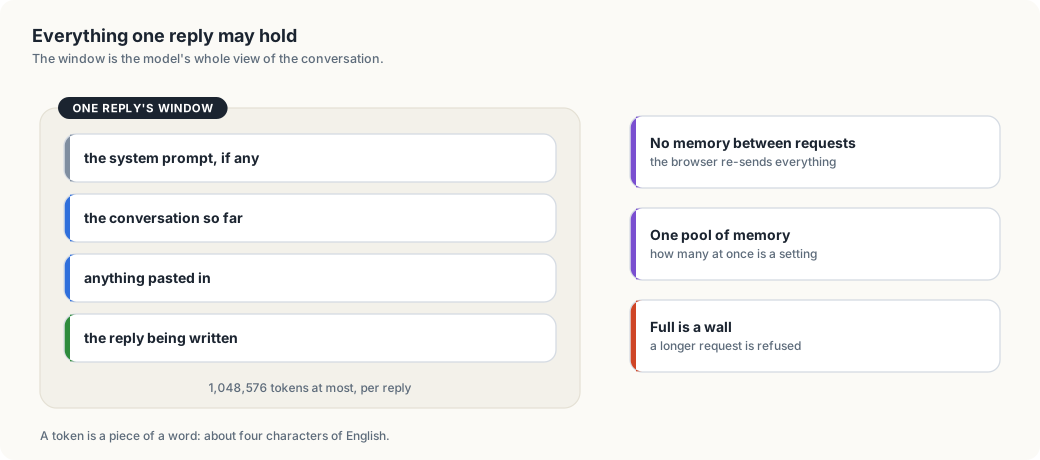
A token is a piece of a word: about four characters of English, a little less for code. One reply may hold 1,048,576 of them. Everything in the table counts against that number.
| Fills the window | Counts as |
|---|---|
| the system prompt, if the page sets one | tokens at the start of every request |
| every earlier message in the conversation | tokens, whole, every time |
| anything pasted: a log, a file, an error | tokens, in full |
| the reasoning, while Think is on | tokens, kept in the history after the answer |
| the reply being written | one token at a time, as it is generated |
Every message reads the conversation again
The model holds nothing between requests. The browser keeps the conversation and sends the whole of it with every message; the server reads from the start. On a long conversation, that reading is where the pause before the first word comes from.
A slot keeps the conversation it read last, which llama-server calls the prompt cache. If the same conversation comes back to the same slot, the part already read is not read again. The cache lives in memory and goes away when the server restarts.
The part that grows: keys and values
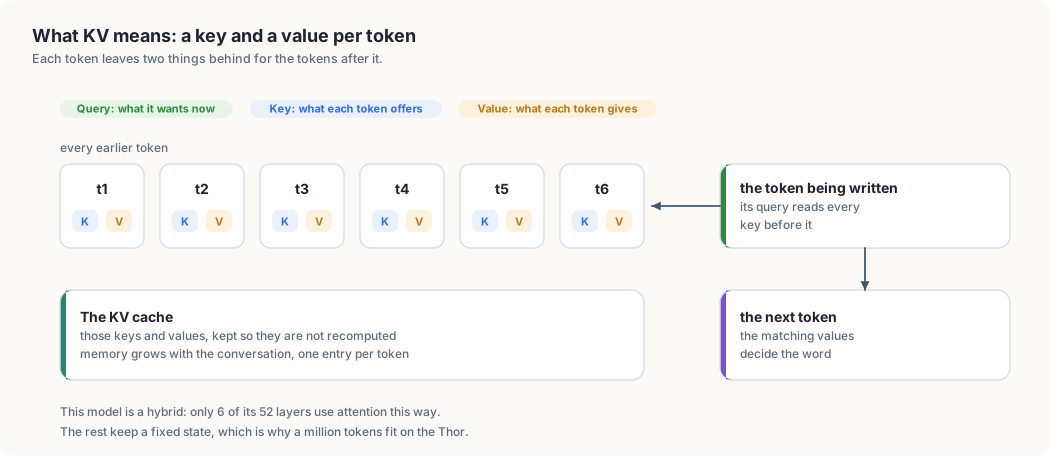
To write the next token, the attention layers compare it with every token before it. Each earlier token leaves two short vectors behind, a key and a value, and keeping them instead of recomputing them is the KV cache. It grows with the conversation, one entry per token per attention layer. The sum is in chapter “Memory, context and slots”: 6 KiB per token, 6 GiB for a window of a million tokens, and 24 GiB for the pool of them.
Nemotron 3 Nano is a hybrid. Six of its 52 layers work by attention; the rest carry one state of fixed size, however long the conversation runs. A model built from attention layers alone would need about 128 GiB for a single million-token conversation — Llama 3 8B is the example in that chapter — and the Thor has 128 GB in total.
Reading time before the first word
Measured on the Thor on 2026-10-06, reading runs at about 1,050 to 1,100 tokens per second:
| Conversation | Wait before the first word |
|---|---|
| 10,000 tokens | about 9 s (measured) |
| 100,000 tokens | about 1.5 minutes |
| 1,048,576 tokens | about 16 minutes, and likely more, since reading slows as the context grows |
When the window is full
The server refuses the request. Nothing is cut short and nothing is dropped quietly; the page shows the error. Four ways out:
- Start a new conversation with +. The old one stays in the browser.
- Paste less: name the file and the line instead of the whole file.
- Turn Think off for routine questions, so the reasoning does not stay in the history.
- Raise
CONTEXT, which memory pays for:USERS × CONTEXT × 6 KiB.
Some clients have a fifth: a sliding window, where the browser sends only the last messages. That trades the start of the conversation for room at the end.
How many replies run at once
A window belongs to a reply. Every reply that runs at the same time needs a window of its own, and all of them come out of one pool of memory. The count is therefore a setting, and memory sets its ceiling: four windows of a million tokens each take 24 GiB, and the same 24 GiB also pays for eight windows of 524,288 or sixteen of 262,144. Requests beyond that number wait in the queue. The windows are shared by the page and by every coding agent using the API, and chapter “Memory, context and slots” has the table of shapes and the measured numbers behind it.