Chapter 23: Softmax and Layer Normalization
Every layer of a transformer model applies 2 operations to the rows of a matrix. The first, softmax, turns a row of scores into probabilities that are positive and add up to 1. The second, layer normalization, shifts and scales a row so that its values have mean 0 and variance 1. The 2 operations have one property in common, which shapes everything in this chapter. No output value can be computed from its own input alone. Every output depends on a statistic of its whole row, namely the largest value and the sum of exponentials for softmax, and the mean and the variance for layer normalization. Each operation is therefore a reduction over the row, which produces the statistic, followed by an element-by-element computation that uses the result of the reduction.
In this chapter, we derive both operations on a matrix of 2 rows of 4 values, which is small enough to check every number with a pencil. We first find 2 numerical failures of the direct formulas in single precision, an overflow in softmax and a cancellation in the variance, and we study the standard remedy for each. The remedies appear to require extra passes over the row, and we then show how to remove those passes. The online softmax finds the maximum and the sum in 1 pass, and Welford’s method finds the mean and the variance in 1 pass. Both rest on the same idea, a partial result that can be corrected when more of the row arrives, and both allow partial results computed by different threads to be combined. We prove each algorithm correct, map it onto 1 block of threads per row, implement it in Rust and in CUDA C++, and finally measure it against the memory bandwidth of the GPU.
This chapter covers
- softmax and layer normalization of the rows of a matrix, computed by hand
- overflow of the exponential in
f32, and why subtracting the row maximum leaves softmax unchanged - cancellation in the variance formula \(\overline{x^2} - \mu^2\), with a negative variance in
f32 - the online softmax and Welford’s method, each with a loop invariant and a proof
- merging 2 partial results, and the empty state
- One block per row: warp shuffles, block-wide reductions and their 2 barriers
- fused kernels that read each value once, and the bytes per element of every version
- measured times in Rust and C++, and the reasons for each gap to the memory bandwidth
The code of the chapter is in
code/oxide/ch23_softmax_layernorm/
for Rust and in
code/cuda/ch23_softmax_layernorm/
for C++. The Rust crate’s Cargo.toml and rust-toolchain.toml are those of Chapter 13 with a
different package name.
23.1 The problem
23.1.1 The worked example
We use the same matrix throughout the chapter. It has 2 rows of 4 values each:
\[ X = \begin{pmatrix} 1 & 2 & 3 & 4 \\ 2 & 4 & 4 & 5 \end{pmatrix}. \]
We write \(x_{rj}\) for the value in row \(r\) and column \(j\), counting both from 0, and \(n\) for the length of a row, which is 4 here. For example, \(x_{03} = 4\) is the last value of row 0, and \(x_{12} = 4\) is the third value of row 1. Both operations of the chapter work on 1 row at a time. Each reads a row of \(X\) and writes the row with the same number of its result, and it never looks at any other row. Figure 23.1 shows \(X\) together with the 2 results that we compute by hand in this section, the softmax \(P\) and the layer normalization \(Y\).
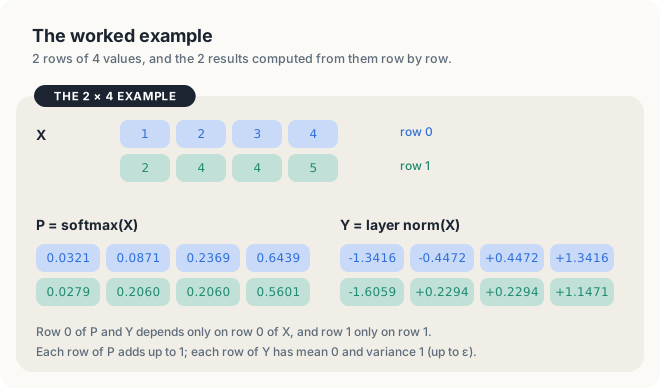
We will return several times to 2 entries of these results, \(p_{03} = 0.6439\) and \(y_{00} = -1.3416\). In Section 23.2, we will see that the direct formulas turn both of them into NaN for rows that differ from row 0 only by a constant added to every value.
The matrix is stored in row-major order, that is, row 0 first and then row 1, in a single array of \(2n = 8\) floats. The value \(x_{rj}\) therefore sits at position \(r \cdot n + j\) of the array, since the \(r\) rows before it occupy \(r \cdot n\) positions. For example, \(x_{12}\) sits at position \(1 \cdot 4 + 2 = 6\). A whole row is thus a contiguous piece of memory, and the GPU algorithm of Section 23.4 relies on this fact.
23.1.2 Softmax
A model often produces a row of scores, 1 score per possible answer, and needs to turn the row into probabilities. Probabilities must be positive and must add up to 1, while scores can be any real numbers, including negative ones. A simple way to obtain positive numbers is to apply the exponential function to every score, since \(e^x > 0\) for every real \(x\). A simple way to make positive numbers add up to 1 is to divide each of them by their total. Softmax performs exactly these 2 steps.
Definition 23.1 Softmax. The softmax of a row \(x_0, \dots, x_{n-1}\) is the row \(p_0, \dots, p_{n-1}\) with
\[ p_j = \frac{e^{x_j}}{\sum_{i \in [0, n)} e^{x_i}}, \qquad j \in [0, n). \]
The inputs \(x_j\) are often called logits, and the outputs are positive and add up to 1.
Example. For row 0 of \(X\), \(p_3 = e^4 / (e^1 + e^2 + e^3 + e^4) = 54.598 / 84.791 = 0.6439\).
| Symbol | Meaning | In the example (row 0, \(j = 3\)) |
|---|---|---|
| \(n\) | number of values in the row | 4 |
| \(x_j\) | input value in column \(j\) of the row | \(x_3 = 4\) |
| \(e^{x_j}\) | exponential of the input, the numerator | \(e^4 = 54.598\) |
| \(\sum_{i \in [0, n)} e^{x_i}\) | sum of the exponentials of the whole row, the denominator | 84.791 |
| \(p_j\) | output in column \(j\) | 0.6439 |
Note that the numerator depends only on \(x_j\), whereas the denominator is the same for every column and depends on the whole row. Every output is positive because an exponential is positive, and the outputs add up to 1 because they share 1 denominator, which is the sum of all the numerators. Softmax therefore turns any row of real numbers into a probability distribution. It also preserves order: a larger input receives a larger output. More precisely, an input larger by 1 receives an output larger by a factor of \(e = 2.718\), since \(e^{x + 1} = e \cdot e^x\).
Figure 23.2 computes row 0 by hand. The 4 exponentials are 2.718, 7.389, 20.086 and 54.598, and their sum is 84.791. Dividing each of them by the sum gives 0.0321, 0.0871, 0.2369 and 0.6439. The value 4 receives 64% of the total, although it is only 4 times the value 1. The reason is that the exponential magnifies differences: \(e^4\) is \(e^3 = 20.1\) times \(e^1\).
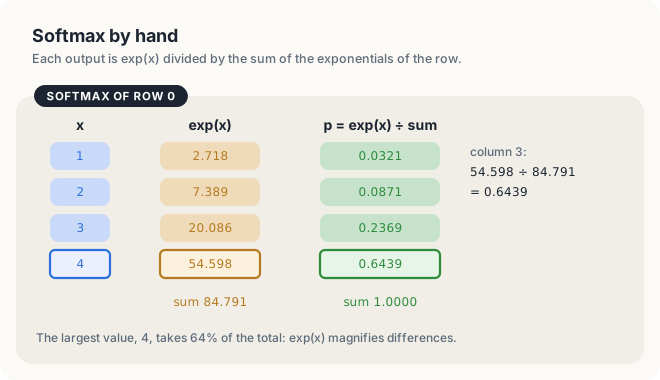
Row 1 is computed in the same way. Its denominator is \(e^2 + e^4 + e^4 + e^5 = 7.389 + 54.598 + 54.598 + 148.413 = 264.998\), and its outputs are 0.0279, 0.2060, 0.2060 and 0.5601. As we would expect, the 2 equal inputs receive equal outputs.
Softmax appears in 2 places in a transformer. In an attention layer, it is applied to every row of a matrix of scores between tokens, so a row holds one value per token of the sequence, often 1,024 to 32,768 values. At the output of the model, it is applied to a row with one value per word of the vocabulary, often 32,000 to 128,000 values. A GPU implementation must therefore handle many short rows as well as a few long ones, and in Section 23.7, we measure both cases.
23.1.3 Layer normalization
The values that a layer of a model produces can drift: from 1 row to the next, or from 1 training step to the next, their center may move and their spread may grow or shrink. Layer normalization removes this drift. It measures where the values of a row are centered and how widely they are spread, and then rescales the row so that it is centered at 0 with a spread of 1. The center is measured by the mean, and the spread by the variance, which we now define.
Definition 23.2 Mean, variance and layer normalization. The mean of a row is \(\mu = \frac{1}{n} \sum_{j} x_j\), and its variance is the mean squared deviation from the mean, \(\sigma^2 = \frac{1}{n} \sum_j (x_j - \mu)^2\). The square root \(\sigma\) is the standard deviation. The layer normalization of the row is
\[ y_j = \frac{x_j - \mu}{\sqrt{\sigma^2 + \varepsilon}} \, \gamma_j + \beta_j, \qquad j \in [0, n), \]
where \(\varepsilon\) is a small constant, and \(\gamma_j\) and \(\beta_j\) are a scale and a shift for column \(j\) that the model learns.
Example. For row 0 of \(X\), \(\mu = 2.5\), \(\sigma^2 = 1.25\), and with \(\gamma_j = 1\), \(\beta_j = 0\) and \(\varepsilon = 10^{-5}\), \(y_0 = -1.5 / \sqrt{1.25001} = -1.3416\).
| Symbol | Meaning | In the example (row 0, \(j = 0\)) |
|---|---|---|
| \(\mu\) | mean of the row, the center of its values | 2.5 |
| \(x_j - \mu\) | deviation of value \(j\) from the mean | \(1 - 2.5 = -1.5\) |
| \(\sigma^2\) | variance, the mean of the squared deviations | 1.25 |
| \(\sigma\) | standard deviation, the square root of the variance | 1.118 |
| \(\varepsilon\) | small constant that keeps the square root away from 0 | \(10^{-5}\) |
| \(\gamma_j, \beta_j\) | learned scale and shift of column \(j\) | 1 and 0 |
| \(y_j\) | output in column \(j\) | \(-1.3416\) |
The formula is easiest to read from the inside out. The deviation \(x_j - \mu\) moves the center of the row to 0. Dividing by \(\sqrt{\sigma^2 + \varepsilon}\), which is almost exactly the standard deviation, makes the spread 1. Finally, \(\gamma_j\) and \(\beta_j\) let the model choose a different scale and center for each column, if that serves it better. In this chapter, we take \(\gamma_j = 1\) and \(\beta_j = 0\) in all hand computations, so that the last step changes nothing.
Figure 23.3 carries out the definition on row 0. The mean is \(10 / 4 = 2.5\). The deviations from the mean are \(-1.5, -0.5, 0.5\) and \(1.5\), their squares are 2.25, 0.25, 0.25 and 2.25, and the variance is the mean of these squares, \(5 / 4 = 1.25\). Each deviation is then multiplied by \(1 / \sqrt{1.25 + 10^{-5}} = 0.8944\), which gives \(-1.3416, -0.4472, 0.4472\) and \(1.3416\). The outputs have mean 0 and variance \(1.25 / 1.25001\), which is 1 up to the small effect of \(\varepsilon\).
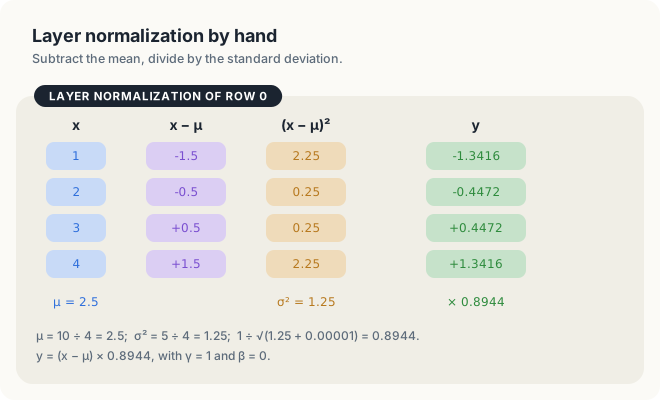
For row 1, the mean is \(15 / 4 = 3.75\), the deviations are \(-1.75, 0.25, 0.25\) and \(1.25\), the variance is \(4.75 / 4 = 1.1875\), and the outputs are \(-1.6059, 0.2294, 0.2294\) and \(1.1471\). The constant \(\varepsilon\) matters only for a row whose values are all equal. Such a row has variance 0, and without \(\varepsilon\), every output would be \(0 / 0\).
We can now see that both definitions have the same shape. Each of them needs 1 or 2 numbers computed from the whole row, the sum of exponentials in one case and the mean and the variance in the other, before it can produce its first output. In the rest of the chapter, we study how to compute these numbers quickly and accurately.
Exercises
23.1 Compute the softmax of the row 0, 0, 0, 10. Which fraction of the total does the last value
receive?
23.2 Show that the outputs of softmax add up to 1, and that the outputs of layer normalization
with \(\gamma_j = 1\) and \(\beta_j = 0\) add up to 0.
23.3 Compute the layer normalization of the row 4, 4, 4, 4 with and without \(\varepsilon\).
23.2 The sequential algorithms
23.2.1 Overflow in f32
The formulas of Section 23.1 are exact in real arithmetic, but a computer evaluates them with
numbers of limited range and precision. The kernels of this chapter compute in single
precision, the 32-bit floating-point type f32 in Rust and float in C++. Before we evaluate
softmax in this type, we recall what it can hold.
Definition 23.3 The f32 type. An f32 number holds a sign,
an 8-bit exponent and a 24-bit significand. Its largest finite value is about
\(3.40 \times 10^{38}\). A result larger than that is rounded to the special value
\(\infty\), and an expression without a defined value, such as \(\infty / \infty\) or
\(0 \cdot \infty\), gives the special value NaN, “not a number”. Every arithmetic operation
with a NaN operand gives NaN.
Example. \(e^{88} = 1.65 \times 10^{38}\) fits in an f32; \(e^{89} = 4.49 \times 10^{38}\)
does not and becomes \(\infty\).
The largest f32 equals \(e^{88.72}\), so the exponential of any input above 88.72 overflows.
Inputs of that size are not unusual in a model, and we now follow what happens to one of them.
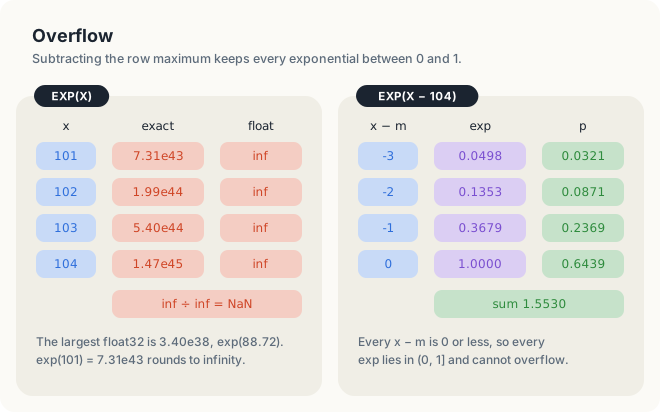
Suppose that we add 100 to every value of \(X\). Row 0 becomes 101, 102, 103 and 104, and the
exponentials range from \(7.31 \times 10^{43}\) to \(1.47 \times 10^{45}\), all beyond the
largest f32. Each of them therefore becomes \(\infty\), their sum is \(\infty\), and every
output is \(\infty / \infty\), which is NaN, as shown in the left half of Figure 23.4. The entry
\(p_{03} = 0.6439\) is lost, and so is every other entry of the row, although the true softmax
of this row is ordinary, as we show next.
23.2.2 Subtracting the maximum
The exponentials in Figure 23.4 overflow because the inputs are large, yet the outputs that we want are ordinary probabilities. This suggests that the size of the inputs should not matter to the result, and indeed it does not. The reason is a familiar property of fractions: multiplying the numerator and the denominator of a fraction by the same nonzero number does not change its value. Subtracting a constant \(c\) from every input multiplies every exponential by the same number \(e^{-c}\), and therefore leaves every output unchanged. If we choose \(c\) to be the largest input of the row, no exponential can exceed 1.
Theorem 23.1 For every real number \(c\), the softmax of \(x_0 - c, \dots, x_{n-1} - c\) equals the softmax of \(x_0, \dots, x_{n-1}\). If \(c = m = \max_j x_j\), then every exponential \(e^{x_j - m}\) lies in \((0, 1]\), and the denominator \(\sum_j e^{x_j - m}\) lies in \([1, n]\).
Proof. Since \(e^{x_j - c} = e^{x_j} e^{-c}\),
\[ \frac{e^{x_j - c}}{\sum_i e^{x_i - c}} = \frac{e^{x_j} e^{-c}}{e^{-c} \sum_i e^{x_i}} = \frac{e^{x_j}}{\sum_i e^{x_i}}, \]
because the positive factor \(e^{-c}\) cancels. With \(c = m\), every \(x_j - m \le 0\), so \(0 < e^{x_j - m} \le 1\). The sum has \(n\) such terms, so it is at most \(n\), and the term of a column where \(x_j = m\) equals \(e^0 = 1\), so the sum is at least 1.
In the theorem, \(c\) is any constant subtracted from all inputs, and \(m\) is the largest input of the row. For row 0 of \(X + 100\), \(m = 104\), and the shifted inputs \(x_j - m\) are \(-3, -2, -1\) and 0.
The theorem gives more than freedom from overflow. A denominator of at least 1 cannot be 0, so the division is always defined. Moreover, since shifting a whole row by a constant does not change its softmax, the matrix \(X + 100\) has exactly the softmax \(P\) of \(X\). For row 0 of \(X + 100\), the exponentials of the shifted inputs are 0.0498, 0.1353, 0.3679 and 1, which add up to 1.5530, and the outputs are 0.0321, 0.0871, 0.2369 and 0.6439 again, as shown in the right half of Figure 23.4.
23.2.3 Softmax in 3 passes
The subtraction of the maximum has a cost. The maximum must be known before the first exponential is computed, and the sum of the exponentials must be known before the first output is written. The algorithm therefore reads the row 3 times, once for each of these 3 steps. Since the number of times an algorithm reads its data will decide its speed on a GPU, we first give this quantity a name.
Definition 23.4 Pass. A pass is 1 traversal of a row in which every value of the row is read once. The memory traffic of an algorithm is the number of bytes it reads and writes in main memory.
Example. An algorithm that reads a row of 4 f32 values 3 times and writes 4 results has 3
passes and moves \(12 \cdot 4 + 4 \cdot 4 = 64\) bytes.
Softmax-3-Pass(\(x, p, n\))
- \(m = -\infty\)
- for \(j \in [0, n)\) {
- \(m = \max(m, x_j)\) // pass 1: the maximum
- }
- \(s = 0\)
- for \(j \in [0, n)\) {
- \(s = s + e^{x_j - m}\) // pass 2: the sum
- }
- for \(j \in [0, n)\) {
- \(p_j = e^{x_j - m} / s\) // pass 3: the outputs
- }
Lines 1 to 4 find the maximum \(m\), lines 5 to 8 add the shifted exponentials into the sum \(s\), and lines 9 to 11 write the outputs. Each of lines 3, 7 and 10 executes \(n\) times, so the algorithm performs \(n\) comparisons, \(2n\) exponentials and \(n\) divisions. Figure 23.5 follows the 3 passes on row 1. Pass 1 finds \(m = 5\). Pass 2 adds \(e^{-3} + e^{-1} + e^{-1} + e^{0} = 0.0498 + 0.3679 + 0.3679 + 1 = 1.7855\). Pass 3 writes 0.0279, 0.2060, 0.2060 and 0.5601, which is row 1 of \(P\) in Figure 23.1.
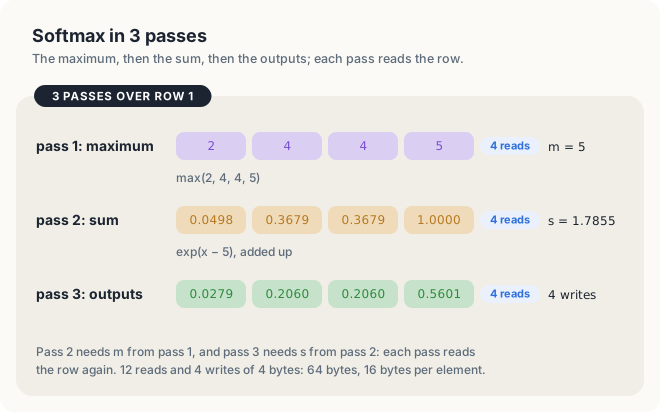
Let us count the memory traffic of the example. Each pass reads all 4 values of the row, so the row of 16 bytes is read 3 times, and 16 bytes of output are written. This makes 64 bytes in all, or 16 bytes per element. In general, a matrix of \(R\) rows of \(C\) values each costs \(16RC\) bytes, where \(R\) counts the rows and \(C\) the values in a row. For \(R = C = 4{,}096\), that is 268 MB, which takes 2.63 ms on a GPU whose memory delivers 102 GB/s. The arithmetic, about 3 operations per element, takes little time compared with this traffic, and therefore the number of passes decides the time.
23.2.4 Layer normalization in 2 or 3 passes
Layer normalization has the same difficulty. The definition of the variance needs the mean before the squared deviations can be summed, so a direct algorithm also reads the row 3 times, once for the mean, once for the variance and once for the outputs. A well-known identity removes one of these passes, because it expresses the variance through sums that do not need the mean in advance.
Theorem 23.2 The variance of a row equals the mean of the squares minus the square of the mean: \(\sigma^2 = \frac{1}{n} \sum_j x_j^2 - \mu^2\).
Proof. We expand the square in the definition of the variance. This gives \(\frac{1}{n} \sum_j (x_j - \mu)^2 = \frac{1}{n} \sum_j x_j^2 - 2 \mu \frac{1}{n} \sum_j x_j + \mu^2 = \frac{1}{n} \sum_j x_j^2 - 2\mu^2 + \mu^2\), since \(\frac{1}{n} \sum_j x_j = \mu\).
For row 0 of \(X\), the mean of the squares is \((1 + 4 + 9 + 16) / 4 = 7.5\), the square of the mean is \(2.5^2 = 6.25\), and their difference is 1.25, the variance that we found in Figure 23.3. The point of the identity is that the sum of the values and the sum of their squares can both be accumulated in the same pass, since neither needs the mean. The variance then needs 1 pass instead of 2, as the following procedure shows.
LayerNorm-Sum-Of-Squares(\(x, y, n, \gamma, \beta\))
- \(\mathsf{sum} = 0\), \(\mathsf{squares} = 0\)
- for \(j \in [0, n)\) {
- \(\mathsf{sum} = \mathsf{sum} + x_j\), \(\mathsf{squares} = \mathsf{squares} + x_j^2\) // pass 1: 2 sums
- }
- \(\mu = \mathsf{sum} / n\), \(\sigma^2 = \mathsf{squares} / n - \mu^2\)
- for \(j \in [0, n)\) {
- \(y_j = (x_j - \mu) / \sqrt{\sigma^2 + \varepsilon} \cdot \gamma_j + \beta_j\) // pass 2: the outputs
- }
Here \(\mathsf{sum}\) is the running sum of the values and \(\mathsf{squares}\) the running sum of their squares. On
row 0, line 3 accumulates \(\mathsf{sum} = 10\) and \(\mathsf{squares} = 1 + 4 + 9 + 16 = 30\), and line 5 gives
\(\mu = 10 / 4 = 2.5\) and \(\sigma^2 = 30 / 4 - 2.5^2 = 7.5 - 6.25 = 1.25\), the variance of
Figure 23.3. The algorithm reads each value twice and writes each output once, which makes 12
bytes per element. In exact arithmetic, it is correct. In f32, however, it can fail completely,
as we show next.
23.2.5 Cancellation
An f32 number has only 24 bits of significand, so it can represent only a limited number of
digits. Large numbers are therefore stored less finely than small ones: near 1, neighboring f32
numbers are very close together, while near \(10^8\), they are several units apart. A result that
falls between 2 neighbors must be rounded to one of them. We make this precise before we apply
it to the variance.
Definition 23.5 Spacing and cancellation. The f32 numbers
between \(2^k\) and \(2^{k+1}\) are spaced \(2^{k-23}\) apart, so every result in that range
is rounded to a multiple of \(2^{k-23}\). Cancellation is the loss of correct digits when 2
nearly equal numbers, each carrying a rounding error, are subtracted: the difference is small,
but the errors are not.
Example. Between \(2^{26} = 67{,}108{,}864\) and \(2^{27}\), f32 numbers are
\(2^3 = 8\) apart, so \(10{,}001^2 = 100{,}020{,}001\) is stored as 100,020,000.
In the definition, \(2^k\) is the power of 2 just below the number, and \(2^{k-23}\) is the gap
between 2 neighboring f32 numbers in that range. For example, for numbers near \(10^8\),
\(k = 26\), and the gap is \(2^{26-23} = 8\).
We now add 10,000 to every value of \(X\). Row 0 becomes 10,001, 10,002, 10,003 and 10,004. Its
deviations from the mean are those of row 0 of \(X\), so its variance is still 1.25, and its
layer normalization is still \(-1.3416, -0.4472, 0.4472\) and \(1.3416\). Figure 23.6 runs
LayerNorm-Sum-Of-Squares on this row in f32, 1 rounding at a time.
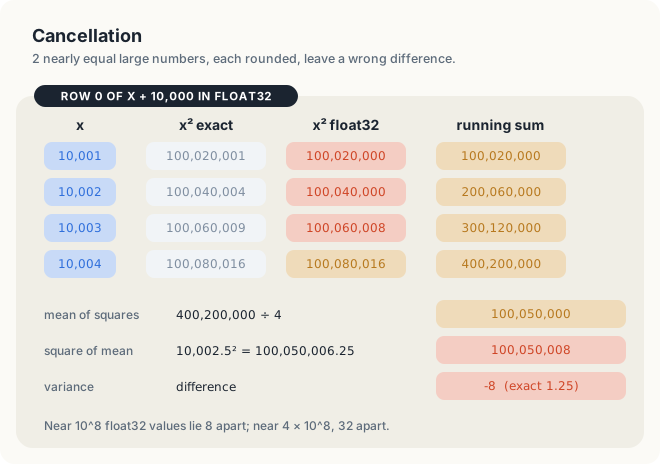
f32: \(-8\) instead of 1.25.Let us follow the roundings in order. The squares lie near \(10^8\), where f32 numbers are 8
apart, and 3 of the 4 squares are rounded. Once the running sum passes \(2.68 \times 10^8\), the
spacing becomes 32. The last addition, \(300{,}120{,}000 + 100{,}080{,}016 = 400{,}200{,}016\),
lies exactly halfway between 2 neighbors and is rounded to 400,200,000. Dividing by 4 gives the
mean of the squares, 100,050,000. The mean itself is 10,002.5, which is exact in f32, but its
square, 100,050,006.25, is rounded to 100,050,008. Line 5 then subtracts the 2 results:
\[ \sigma^2 = 100{,}050{,}000 - 100{,}050{,}008 = -8. \]
The first number is the mean of the squares, \(b / n\), and the second is the square of the mean, \(\mu^2\), each after rounding. The true difference, 1.25, is smaller than the spacing 8 of the numbers being subtracted, so not a single correct digit survives the subtraction. The result is not even positive, so \(\sqrt{-8 + 10^{-5}}\) is NaN, and every output of the row is NaN. The entry \(y_{00} = -1.3416\) is lost. The GPU kernel of Section 23.6 prints the same 8 NaNs for \(X + 10{,}000\).
The failure needs no extreme values. Rows of activations with a large common offset and a small spread occur in practice, and in Section 23.7, we measure an error of 2.97 on outputs of size 1 for values near 1,000. The difficulty lies in forming the squares of the values themselves, which are large whenever the values are large, even when the variance is small. The remedy is therefore to form only squares of deviations, which are small whenever the variance is small.
Exercises
23.4 Which is the largest integer \(k\) for which \(e^k\) is finite in f32? And in f64,
whose largest value is about \(1.8 \times 10^{308}\)?
23.5 Show that Theorem 23.1 holds for any \(c\), but that only \(c \ge \max_j x_j\) guarantees
that no exponential overflows. Which choice of \(c\) also guarantees a denominator of at least
1?
23.6 Repeat Figure 23.6 for row 0 of \(X + 1{,}000\), where f32 numbers near \(10^6\) are
0.0625 apart. Is the variance exact?
23.3 One pass over the row
23.3.1 The dependence on the maximum
Recall that Softmax-3-Pass reads the row 3 times because of 2 dependences. Line 7 needs \(m\), which is known only after the last iteration of line 3, and line 10 needs \(s\), which is known only after the last iteration of line 7. The second dependence cannot be avoided, since an output \(e^{x_j - m} / s\) cannot be written before the whole sum \(s\) is known. The first dependence, however, deserves a closer look.
Suppose that we process row 1, which holds 2, 4, 4 and 5, from the left, and that we pretend that the largest value seen so far is the maximum. After the first value, the maximum so far is 2, and the sum so far is \(e^{2-2} = 1\). The second value, 4, is larger, so the sum so far was taken relative to the wrong maximum. We wanted the term \(e^{2-4}\), and we have \(e^{2-2}\) instead. The work is not lost, however. Since \(e^{a} \cdot e^{b} = e^{a+b}\), the term that we have becomes the term that we want when we multiply it by \(e^{2-4}\):
\[ e^{2-2} \cdot e^{2-4} = e^{2-4}. \]
Here, the first factor is the term relative to the old maximum 2, the second factor is the correction from the old maximum 2 to the new maximum 4, and the right side is the term relative to the new maximum. The correction factor depends only on the 2 maxima, not on the value of the term. The same multiplication therefore corrects any number of terms at once, because every term of the sum was taken relative to the same old maximum.
Key observation A sum of exponentials taken relative to 1 maximum \(m\) becomes the sum relative to a larger maximum \(m’\) by 1 multiplication, since \(e^{x - m} \cdot e^{m - m’} = e^{x - m’}\) for every term. The maximum therefore does not have to be known before the sum begins: the sum can be corrected each time the maximum grows.
| Symbol | Meaning | In the example |
|---|---|---|
| \(x\) | a value already added to the sum | 2 |
| \(m\) | the old maximum, relative to which the sum was taken | 2 |
| \(m’\) | the new, larger maximum | 4 |
| \(e^{m - m’}\) | correction factor, the same for every term | \(e^{-2} = 0.1353\) |
23.3.2 The online softmax
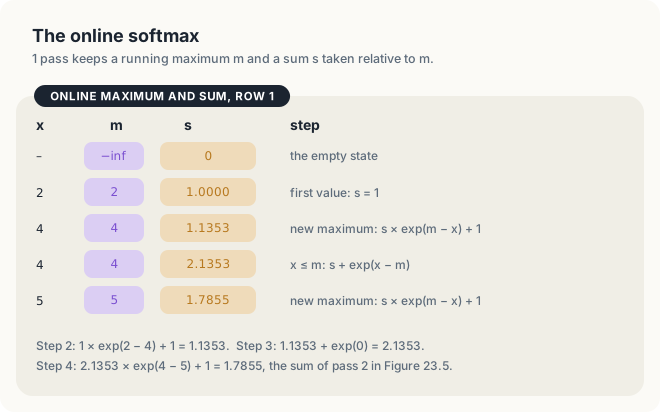
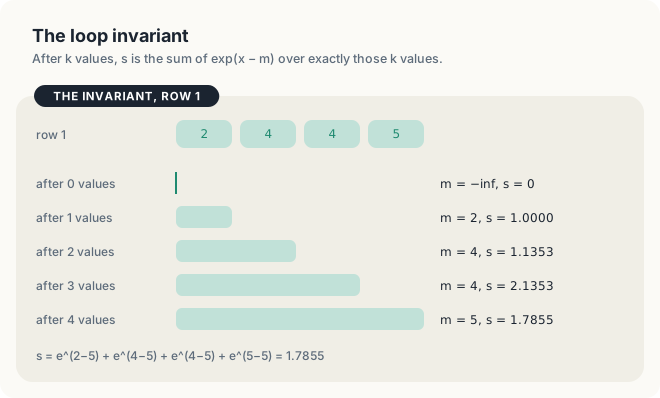
We now carry out the observation on row 1, 1 value at a time. We keep 2 numbers while we read the row: \(m\), the largest value seen so far, and \(s\), the sum of \(e^{x - m}\) over the values \(x\) seen so far. We start from \(m = -\infty\) and \(s = 0\), which describe a row with no values, since no value has been seen and the sum of no terms is 0. Figure 23.7 shows the 4 steps.
- The first value is 2. It is larger than \(m = -\infty\), so the old sum is multiplied by \(e^{-\infty - 2} = 0\), and the new value contributes \(e^{2-2} = 1\). We now have \(m = 2\) and \(s = 1\).
- The second value is 4. It is larger than \(m = 2\), so the old sum is moved to the new maximum by the factor \(e^{2-4}\), and the new value contributes \(e^0 = 1\). We now have \(s = 1 \cdot e^{2-4} + 1 = 0.1353 + 1 = 1.1353\) and \(m = 4\).
- The third value is 4. It is not larger than \(m = 4\), so the maximum stays, and the value adds \(e^{4-4} = 1\) to the sum, which becomes \(s = 2.1353\).
- The fourth value is 5. It is larger than \(m = 4\), so we obtain \(s = 2.1353 \cdot e^{4-5} + 1 = 0.7855 + 1 = 1.7855\) and \(m = 5\).
The final pair, \(m = 5\) and \(s = 1.7855\), is exactly what passes 1 and 2 of Figure 23.5 computed, but we obtained it in 1 pass instead of 2.
The pair \((m, s)\) carries everything that the algorithm needs to remember about the values already read. We give such a pair a name, so that we can reason about it.
Definition 23.6 Softmax state. A softmax state \((m, s)\) describes a set \(S\) of values when \(m = \max S\) and \(s = \sum_{x \in S} e^{x - m}\). The empty state \((-\infty, 0)\) describes the empty set.
Example. \((4, 1.1353)\) describes the values 2, 4: \(4 = \max\{2, 4\}\) and \(e^{2-4} + e^{4-4} = 1.1353\).
Online-Softmax(\(x, p, n\))
- \(m = -\infty\), \(s = 0\) // the empty state
- for \(j \in [0, n)\) {
- if \(x_j > m\) {
- \(s = s \cdot e^{m - x_j} + 1\) // move the sum to the new maximum
- \(m = x_j\)
- } else {
- \(s = s + e^{x_j - m}\)
- }
- }
- for \(j \in [0, n)\) {
- \(p_j = e^{x_j - m} / s\)
- }
Lines 1 to 9 form the first pass, and they replace lines 1 to 8 of Softmax-3-Pass. Lines 10 to 12 are its third pass, unchanged. Line 4 is the correction of the key observation, followed by the term \(e^{x_j - x_j} = 1\) of the new value. Line 4 also handles the first value without a special case: when \(m = -\infty\), the factor \(e^{m - x_j}\) is 0, and \(s\) becomes 1. The loop computes 1 exponential per value, either on line 4 or on line 7, so the amount of arithmetic is the same as before, \(2n\) exponentials in all. What changes is the traffic. The algorithm makes 2 reads and 1 write per element, which is 12 bytes instead of 16.
The algorithm is short, but each step relies on the previous state being exactly right, so we now prove that it is correct.
Theorem 23.3 When the loop of lines 2 to 9 of Online-Softmax ends, \(m = \max_j x_j\) and \(s = \sum_{j \in [0,n)} e^{x_j - m}\). The outputs of line 11 are therefore the softmax of \(x\).
Proof. We show that the loop maintains the invariant
\[ \text{at the start of iteration } j, \quad (m, s) \text{ describes } \{x_0, \dots, x_{j-1}\}, \]
that is, \(m = \max_{i < j} x_i\) and \(s = \sum_{i < j} e^{x_i - m}\), where \(i\) runs over the values already read (Figure 23.8). For example, on row 1 at the start of iteration \(j = 2\), the values read are 2 and 4, and \((m, s) = (4, 1.1353)\).
Initialization. Before iteration 0, the set is empty, and line 1 sets the empty state.
Maintenance. Assume that the invariant holds at the start of iteration \(j\). If \(x_j > m\), the new maximum is \(x_j\). Line 4 multiplies every term \(e^{x_i - m}\) of \(s\) by \(e^{m - x_j}\), which turns it into \(e^{x_i - x_j}\) by the key observation, and adds \(e^{x_j - x_j} = 1\), the term of the new value. Line 5 sets \(m = x_j\). If \(x_j \le m\), the maximum does not change, and line 7 adds the term \(e^{x_j - m}\) of the new value. In both cases, \((m, s)\) describes \(\{x_0, \dots, x_j\}\) at the start of iteration \(j + 1\).
Termination. The loop ends with \(j = n\), when \((m, s)\) describes the whole row. Line 11 then computes \(e^{x_j - m} / s\), which is the softmax by Theorem 23.1.
The online softmax was published by Milakov and Gimelshein in 2018. It is also at the core of attention kernels that never store the full matrix of scores, because such kernels, too, see a row of scores in pieces.
23.3.3 Merging 2 states
A GPU does not traverse a row from the left with a single thread. Instead, many threads each traverse a part of the row, and their partial results must then be combined. Suppose, for example, that 1 thread has read the values 2 and 4 of row 1, and another thread the values 4 and 5. Each thread holds a softmax state of its own part, taken relative to its own maximum. To combine the 2 states, we move both sums to the larger of the 2 maxima, by the key observation, and add them. The key observation thus combines 2 states as easily as it adds 1 value.
Merge-Softmax(\((m_a, s_a), (m_b, s_b)\))
- \(m = \max(m_a, m_b)\)
- if \(m = -\infty\) {
- return \((-\infty, 0)\) // both states are empty
- }
- return \((m,\; s_a e^{m_a - m} + s_b e^{m_b - m})\)
Theorem 23.4 If \((m_a, s_a)\) describes a set \(A\) and \((m_b, s_b)\) describes a set \(B\) disjoint from \(A\), then Merge-Softmax returns the state that describes \(A \cup B\).
Proof. The maximum of \(A \cup B\) is the larger of the 2 maxima, which line 1 computes. If both sets are empty, so is the union, and line 3 returns the empty state. Otherwise, \(m\) is finite, and line 5 moves each sum to \(m\) by the key observation: \(s_a e^{m_a - m} = \sum_{x \in A} e^{x - m}\), and likewise for \(B\). If 1 of the sets is empty, its factor is \(e^{-\infty} = 0\) and its sum 0 contributes nothing. Because \(A\) and \(B\) are disjoint, the 2 sums together contain each term of \(A \cup B\) once.
In the procedure, \((m_a, s_a)\) and \((m_b, s_b)\) are the 2 states to be merged, and the factors \(e^{m_a - m}\) and \(e^{m_b - m}\) move each sum from its own maximum to the common maximum \(m\). The factor of the state that already has the larger maximum is \(e^0 = 1\).
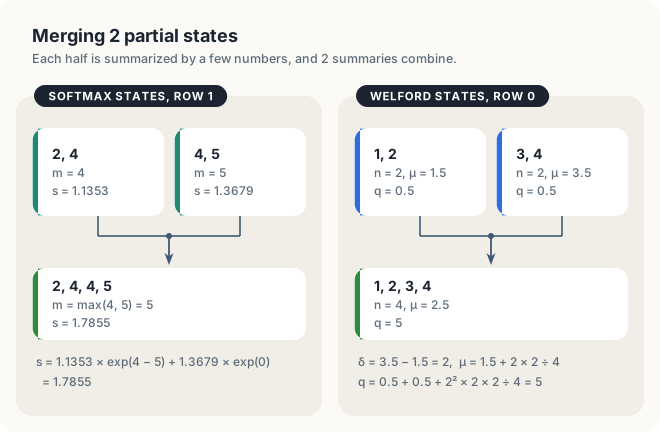
The left half of Figure 23.9 merges the two halves of row 1 in this way. The values 2 and 4 have the state \((m_a, s_a) = (4, 1.1353)\), and the values 4 and 5 have the state \((m_b, s_b) = (5, e^{-1} + 1) = (5, 1.3679)\). The merge gives \(m = 5\) and \(s = 1.1353 \cdot e^{4-5} + 1.3679 \cdot e^{5-5} = 0.4177 + 1.3679 = 1.7855\), which is the sum of Figure 23.7.
The theorem has two consequences that matter for the GPU. First, the result depends only on the
union of the sets, so merges can be grouped in any order. Merging \(A\) with \(B\) and then
with a third set \(C\) gives the same state as merging \(A\) with the merge of \(B\) and
\(C\). An operation with this property is called associative, and associativity is what
allows the threads to combine their states in a tree of merges instead of a chain. Second, the
test on line 2 is necessary. Without it, 2 empty states give \(0 \cdot e^{-\infty - (-\infty)}\),
and \(-\infty - (-\infty)\) is NaN in f32. On a GPU, many threads can hold empty states, and in
Section 23.5, we show what happens when line 2 is missing.
23.3.4 Welford’s method
The same idea removes the extra pass of the variance, and it removes the cancellation at the same time. Recall from Section 23.2.5 that the trouble came from squaring the values themselves. We would rather sum the squared deviations from the mean, as the definition does, but the mean is not known until the whole row has been read. We therefore proceed as we did with the maximum. We use the mean of the values seen so far, and we correct the sum each time this mean moves.
While reading the row, we keep 3 numbers: the count \(n\) of values seen, their mean \(\mu\), and the sum \(q\) of their squared deviations from \(\mu\). The variance of the values seen is then \(q / n\). For example, after the values 1 and 2 of row 0, we have \(n = 2\), \(\mu = 1.5\) and \(q = (-0.5)^2 + 0.5^2 = 0.5\). When a new value \(x\) arrives, the mean moves, while every deviation in \(q\) was measured from the old mean. As with the maximum, the old sum can be corrected without visiting the old values again, and we now derive the correction.
Let \(\mu\) be the mean of the first \(k - 1\) values, let \(x\) be the \(k\)-th value, and let \(\delta = x - \mu\) be the deviation of the new value from the old mean. In our example, with the third value \(x = 3\), we have \(k = 3\), \(\mu = 1.5\) and \(\delta = 1.5\). The new mean is the total of the \(k\) values divided by \(k\):
\[ \mu’ = \frac{(k - 1)\mu + x}{k} = \mu + \frac{\delta}{k}. \]
| Symbol | Meaning | In the example |
|---|---|---|
| \(k\) | number of values after the new one is added | 3 |
| \(\mu\) | mean of the first \(k - 1\) values, the old mean | 1.5 |
| \(x\) | the new value | 3 |
| \(\delta\) | deviation of the new value from the old mean, \(x - \mu\) | 1.5 |
| \(\mu’\) | mean of all \(k\) values, the new mean | \(1.5 + 1.5 / 3 = 2\) |
In words, the mean moves toward the new value by \(1/k\) of the distance between them. The old values now deviate from \(\mu’\) instead of \(\mu\). Shifting the center of \(k - 1\) values by \(\mu’ - \mu = \delta / k\) adds \((k - 1)(\delta / k)^2\) to the sum of their squared deviations. No other term appears, because the cross terms contain the sum of the deviations from \(\mu\), which is 0. In the example, the old values 1 and 2 had the squared deviations 0.25 and 0.25 from 1.5, and they have 1 and 0 from 2, so their sum grows by \(2 \cdot 0.5^2 = 0.5\). The new value adds its own squared deviation, \((x - \mu’)^2 = (\delta (k-1)/k)^2\), which is \(1^2 = 1\) in the example. Together, the new sum is
\[ q’ = q + (k-1)\frac{\delta^2}{k^2} + \frac{(k-1)^2 \delta^2}{k^2} = q + \delta^2 \frac{k-1}{k} = q + \delta \, (x - \mu’), \]
where the last step uses \(x - \mu’ = \delta (k-1)/k\).
| Symbol | Meaning | In the example |
|---|---|---|
| \(q\) | sum of squared deviations of the old values from \(\mu\) | 0.5 |
| \(x - \mu’\) | deviation of the new value from the new mean | \(3 - 2 = 1\) |
| \(q’\) | sum of squared deviations of all \(k\) values from \(\mu’\) | \(0.5 + 1.5 \cdot 1 = 2\) |
Indeed, the values 1, 2 and 3 have the squared deviations 1, 0 and 1 from their mean 2, which add up to 2. The final form of the update needs only the old mean and the new mean, and that it multiplies 2 deviations, never 2 values.
Welford-Update(\((n, \mu, q), x\))
- \(n = n + 1\)
- \(\delta = x - \mu\) // deviation from the old mean
- \(\mu = \mu + \delta / n\)
- \(q = q + \delta \cdot (x - \mu)\) // old deviation times new deviation
- return \((n, \mu, q)\)
Line 2 computes the deviation \(\delta\) from the old mean, line 3 moves the mean, and line 4 adds the product of the old and the new deviation of \(x\) to \(q\). Figure 23.10 applies the update to the whole of row 0, starting from the state \((0, 0, 0)\). The value 1 gives \(\delta = 1\), \(\mu = 1\) and \(q = 1 \cdot 0 = 0\). The value 2 gives \(\delta = 1\), \(\mu = 1.5\) and \(q = 0 + 1 \cdot 0.5 = 0.5\). The value 3 gives \(\delta = 1.5\), \(\mu = 2\) and \(q = 0.5 + 1.5 \cdot 1 = 2\), as we computed above. The value 4 gives \(\delta = 2\), \(\mu = 2.5\) and \(q = 2 + 2 \cdot 1.5 = 5\). The variance is therefore \(5 / 4 = 1.25\), as in Figure 23.3.
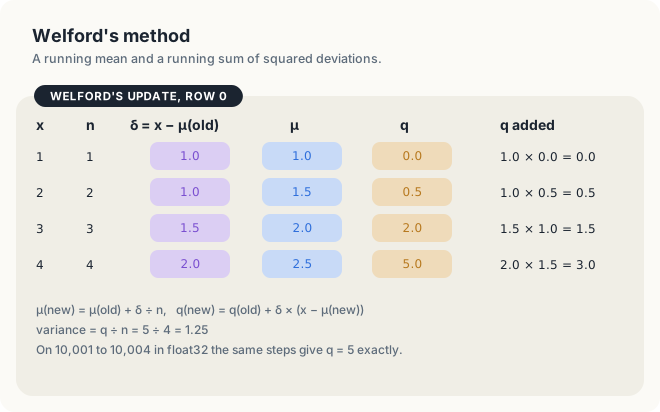
We now run the same steps on the row 10,001 to 10,004 in f32, the row on which the sum of
squares failed. The means 10,001, 10,001.5, 10,002 and 10,002.5 are exact in f32, and the
deviations are 1, 1, 1.5 and 2, as before, so \(q\) is again exactly 5, and the variance is 1.25.
No square of a value near 10,000 is ever formed. Every number added to \(q\) is of the size of
the deviations, and the deviations are small whenever the variance is small. This is exactly the
property that the sum of squares lacked.
Theorem 23.5 After Welford-Update has been applied to \(x_0, \dots, x_{k-1}\), starting from \((0, 0, 0)\), the state is \(\big(k, \mu_k, \sum_{i<k} (x_i - \mu_k)^2\big)\), where \(\mu_k\) is the mean of the \(k\) values.
Proof. We use the invariant that after \(k\) updates, the state is \((k, \mu_k, q_k)\) with \(q_k = \sum_{i<k} (x_i - \mu_k)^2\). For example, after \(k = 3\) updates on row 0, the state is \((3, 2, 2)\).
Initialization. For \(k = 0\), the state \((0, 0, 0)\) has count 0 and \(q_0 = 0\), the empty sum. The mean 0 of the empty state does not enter any later result, since line 3 of the first update gives \(\mu = 0 + (x_0 - 0)/1 = x_0\).
Maintenance. Assume that the invariant holds after \(k - 1\) updates, and apply the update to \(x_{k-1}\). Line 1 makes the count \(k\), and line 3 computes \(\mu_k = \mu_{k-1} + \delta / k\), the new mean derived above. For the sum, write each old deviation as \(x_i - \mu_k = (x_i - \mu_{k-1}) - \delta/k\). Squaring and summing over \(i < k - 1\) gives \(q_{k-1} + (k-1)\delta^2/k^2\), since \(\sum_{i<k-1} (x_i - \mu_{k-1}) = 0\). Adding the new term \((x_{k-1} - \mu_k)^2 = \delta^2 (k-1)^2/k^2\) gives \(q_{k-1} + \delta^2 (k-1)/k\), which is what line 4 adds, \(\delta (x_{k-1} - \mu_k)\).
Termination. After the last value, the state is \((n, \mu, q)\) with \(q / n = \sigma^2\).
Welford’s method has a price. It performs 1 division per value, on line 3, where the sum of squares performs only 1 multiplication. In Section 23.7, we measure what this division costs on a GPU.
23.3.5 Merging 2 Welford states
As with softmax, each thread of a GPU will hold the state of a part of the row, and the states must then be merged. Suppose that 1 thread has read the values 1 and 2 of row 0, and another thread the values 3 and 4. The first thread holds the state \((2, 1.5, 0.5)\), and the second the state \((2, 3.5, 0.5)\). The count and the mean of the union are easy to obtain: the counts add up, and the mean of the union is the average of the 2 means, weighted by the counts. The sums \(q\), however, were measured from 2 different means, and neither of them is the mean of the union. They must be corrected in the same way as in Welford’s update. The following rule is due to Chan, Golub and LeVeque.
Merge-Welford(\((n_a, \mu_a, q_a), (n_b, \mu_b, q_b)\))
- \(n = n_a + n_b\)
- if \(n = 0\) {
- return \((0, 0, 0)\) // both states are empty
- }
- \(\delta = \mu_b - \mu_a\)
- \(\mu = \mu_a + \delta \, n_b / n\)
- \(q = q_a + q_b + \delta^2 \, n_a n_b / n\)
- return \((n, \mu, q)\)
Theorem 23.6 If \((n_a, \mu_a, q_a)\) and \((n_b, \mu_b, q_b)\) are the states of 2 disjoint sets \(A\) and \(B\), then Merge-Welford returns the state of \(A \cup B\).
Proof. If both sets are empty, line 3 returns the empty state. Otherwise, the mean of the union is the weighted mean \((n_a \mu_a + n_b \mu_b)/n = \mu_a + \delta n_b / n\), which line 6 computes. Each value of \(A\) deviates from the new mean \(\mu\) by its deviation from \(\mu_a\) minus \(\mu - \mu_a = \delta n_b / n\). As in the proof of Theorem 23.5, the cross terms vanish, so \(A\) contributes \(q_a + n_a (\delta n_b / n)^2\). Likewise, \(B\) contributes \(q_b + n_b (\delta n_a / n)^2\). The sum of the 2 extra terms is \(\delta^2 n_a n_b (n_b + n_a) / n^2 = \delta^2 n_a n_b / n\), which line 7 adds.
The right half of Figure 23.9 merges the halves of row 0 with this rule.
| Symbol | Meaning | In the example |
|---|---|---|
| \(n_a, \mu_a, q_a\) | count, mean and sum of squared deviations of the first part | 2, 1.5, 0.5 (values 1, 2) |
| \(n_b, \mu_b, q_b\) | the same for the second part | 2, 3.5, 0.5 (values 3, 4) |
| \(n\) | count of the union | 4 |
| \(\delta\) | distance between the 2 means, \(\mu_b - \mu_a\) | 2 |
| \(\mu\) | mean of the union | \(1.5 + 2 \cdot 2 / 4 = 2.5\) |
| \(q\) | sum of squared deviations of the union | \(0.5 + 0.5 + 4 \cdot 2 \cdot 2 / 4 = 5\) |
The result, \((4, 2.5, 5)\), is the state that Figure 23.10 reached by updating 1 value at a time. The last term of line 7, \(\delta^2 n_a n_b / n = 4\) in the example, accounts for the distance between the 2 means. Each half measured its deviations from its own mean, whereas the union needs them from the common mean. In the example, the mean of each half lies 1 unit from the common mean 2.5, which adds \(2 \cdot 1^2 = 2\) for the 2 values of each half, and 4 in all.
Exercises
23.7 Run Online-Softmax on row 0, 1, 2, 3, 4. How many times does line 4
execute, and how many times line 7?
23.8 Merge the softmax states of the values 2 and of 4, 4, 5 (first compute each state), and check
the result against Figure 23.7.
23.9 Apply Welford-Update to row 1 and check that \(q / 4 = 1.1875\).
Then merge the states of 2, 4, 4 and of 5 with Merge-Welford.
23.4 The parallel algorithm
23.4.1 Rows and blocks
We now distribute the work over the threads of a GPU. Before we do so, we recall the terms that we need.
Definition 23.7 Kernel, thread, block, grid. A kernel is a function that the GPU runs many times at once; each run is a thread with its own variables. A block is a group of threads that run on the same streaming multiprocessor (SM), share a region of fast memory, and can wait for one another. The grid is the set of all blocks of 1 launch. Inside a block, each thread can read its index \(\mathsf{threadIdx{.}x}\), and the index of its block, \(\mathsf{blockIdx{.}x}\).
Example. For the 4,096 rows of Section 23.7, the grid has 4,096 blocks of 256 threads; for \(X\), it has 2 blocks of 256 threads.
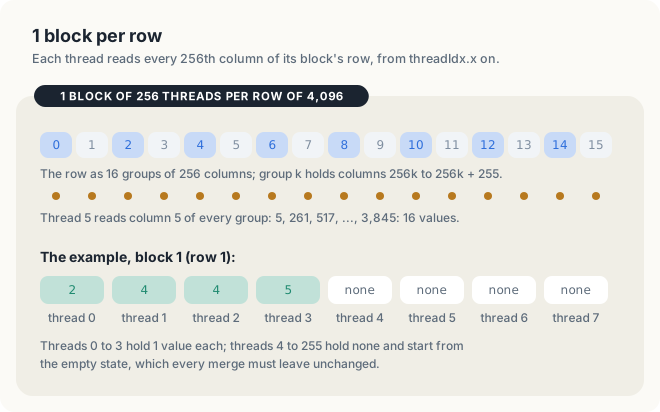
The rows are independent of each other, and every row needs a reduction whose result all its outputs share. Since the threads of a block can share data and wait for one another, while different blocks cannot, we give each row to 1 block: block \(\mathsf{blockIdx{.}x}\) computes row \(\mathsf{blockIdx{.}x}\). The threads of the block then divide the row between them in a fixed pattern. The number of threads in a block, \(\mathsf{blockDim{.}x}\), is 256 in all our kernels. Thread \(\mathsf{threadIdx{.}x}\) takes the columns \(\mathsf{threadIdx{.}x}, \mathsf{threadIdx{.}x} + \mathsf{blockDim{.}x}, \mathsf{threadIdx{.}x} + 2 \cdot \mathsf{blockDim{.}x}, \dots\) of its row, that is, every column whose remainder on division by \(\mathsf{blockDim{.}x}\) is \(\mathsf{threadIdx{.}x}\). A row of 4,096 values therefore gives each thread \(4{,}096 / 256 = 16\) values. For example, thread 5 takes the columns 5, 261, 517, and so on up to 3,845, as shown in Figure 23.11.
It may seem more natural to give each thread a contiguous piece of the row. The interleaved pattern is chosen instead because of the way the memory serves reads. The threads of a block run in groups of 32, and the hardware serves the reads of such a group together when they fall on neighboring addresses.
Definition 23.8 Warp, lane, coalesced access. A warp is a group of 32 consecutive threads of a block, threads \(32 \cdot \mathsf{warp}\) to \(32 \cdot \mathsf{warp} + 31\) for warp \(\mathsf{warp}\), that execute each instruction together. The position \(\mathsf{threadIdx{.}x} \bmod 32\) of a thread in its warp is its lane. A memory access of a warp is coalesced when its 32 threads read 32 consecutive 4-byte values, 128 contiguous bytes, which the memory system serves together.
Example. A block of 256 threads has 8 warps. In the first step, warp 0 of a block reads columns 0 to 31 of its row, 128 contiguous bytes.
In every step of the interleaved pattern, the 32 threads of a warp read 32 consecutive columns, so every access is coalesced. For example, in the second step, warp 0 reads columns 256 to 287. The contiguous alternative, which gives thread \(\mathsf{threadIdx{.}x}\) the 16 columns \(16 \cdot \mathsf{threadIdx{.}x}\) to \(16 \cdot \mathsf{threadIdx{.}x} + 15\), would make the 32 threads of a warp read addresses that lie \(16 \cdot 4 = 64\) bytes apart, and the memory system could not serve them together.
On \(X\), block 1 has 256 threads for only 4 values. Threads 0 to 3 receive 2, 4, 4 and 5, and threads 4 to 255 receive nothing. Each thread runs Online-Softmax or Welford-Update over its own columns, and a thread without columns keeps the empty state. Every thread then holds the state of a different set of columns. These sets are disjoint, and their union is the row. By Theorems 23.4 and 23.6, merging all 256 states therefore gives the state of the row. It remains to merge them quickly, and to give the result to all 256 threads, because every thread writes outputs.
23.4.2 Merging inside a warp
We begin with the 32 threads of a single warp. Each of them holds a state in its registers, and we want every one of them to end with the merge of all 32 states. The threads of a warp can read each other’s registers directly, with an instruction that we now define.
Definition 23.9 Warp shuffle. A warp shuffle lets every lane of a warp read a register of another lane of the same warp in 1 instruction, without shared memory and without a barrier. In the xor shuffle with mask \(k\), lane \(i\) receives the value of lane \(i \oplus k\), where \(\oplus\) is the bitwise exclusive or of the 2 lane numbers.
Example. With mask 16, lane 3 receives the value of lane \(3 \oplus 16 = 19\), and lane 19 the value of lane 3: the 2 lanes exchange values.
When the mask \(k\) is a power of 2, the exclusive or flips exactly 1 bit of the lane number. In the example, 3 is 00011 in binary, and flipping the bit of value 16 gives 10011, which is 19. With such a mask, the lanes therefore form pairs \(\{i, i \oplus k\}\) that exchange values. If both lanes of each pair merge the value they receive into their own, both of them hold the merge of the pair. With mask 16, for example, lanes 3 and 19 both end with the merge of their 2 states. Repeating the exchange with masks 16, 8, 4, 2 and 1 leaves every lane holding the merge of all 32 states, after 5 steps. This pattern is called a butterfly, after the crossing lines of its diagram. Figure 23.12 shows it on 8 lanes, with the maximum as the merge, for block 1 of the example: 4 lanes hold 2, 4, 4 and 5, and the other 4 lanes hold \(-\infty\). After the steps with masks 4, 2 and 1, every lane holds 5.
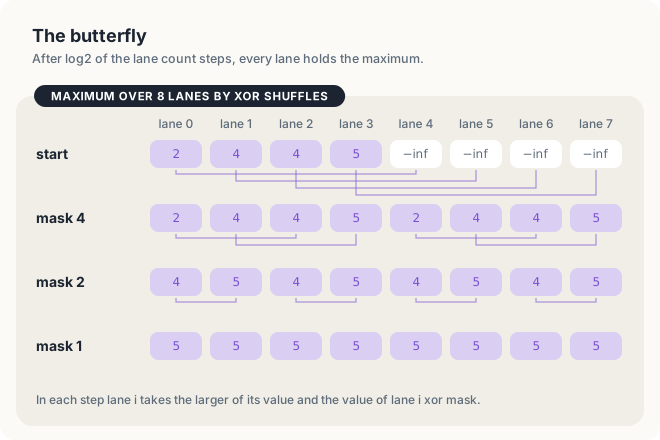
The butterfly is correct for the same reason as the merges. Before the first step, lane \(i\)
holds the state of its own set of columns. After the steps with masks 16 down to \(k\), lane
\(i\) holds the merge over all lanes whose numbers differ from \(i\) only in the bits of value
\(k\) or more. For example, after the step with mask 16, lane 3 holds the merge over lanes 3 and
19, and after the step with mask 8, the merge over lanes 3, 11, 19 and 27. The step with mask
\(k / 2\) merges this group with the group of lane \(i \oplus k/2\), which is disjoint from it
and which, together with it, forms the group for \(k / 2\). After the step with mask 1, the group
is the whole warp. In Chapter 8, we used a different shuffle, shfl_down, which leaves the result
in lane 0 only, whereas the xor shuffle leaves it in every lane.
23.4.3 Merging across the warps of a block
After the butterfly, every lane of a warp holds the state of its warp, but a block of 256 threads has 8 warps, and a shuffle cannot reach a register in another warp. The 8 warps of a block must therefore exchange their results through memory that the whole block shares.
Definition 23.10 Shared memory and barrier. Shared memory is a small, fast memory on each SM that the threads of 1 block can read and write, and no other block can. A barrier is a point in a kernel that no thread of a block may pass until every thread of the block has reached it.
Example. A block of 8 warps keeps 8 slots of shared memory, 1 per warp, 32 bytes in all.
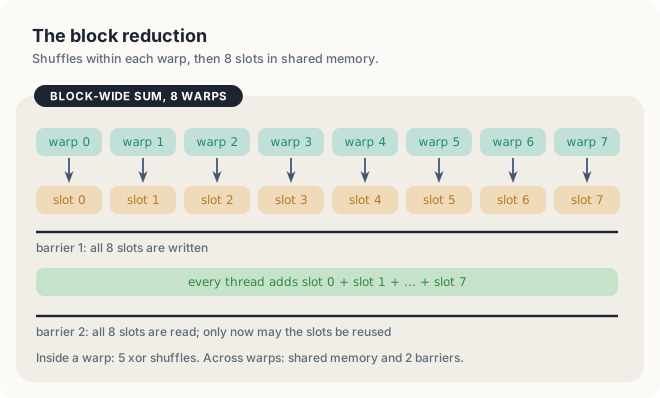
The exchange takes 3 steps. First, lane 0 of each warp writes its warp’s result to the slot of its warp. Then, a barrier makes sure that all 8 slots have been written before anyone reads them. Finally, every thread reads all 8 slots and merges them itself, so that every thread ends with the result of the row. Reading 8 slots costs less than a second round of shuffles, and it needs no broadcast of the result afterward. The following procedure, shown in Figure 23.13, combines the butterfly with these 3 steps.
Block-Reduce(\(\mathsf{value}, \otimes, \mathsf{slots}\))
- for \(\mathsf{mask} \in (16, 8, 4, 2, 1)\) {
- \(\mathsf{value} = \mathsf{value} \otimes \mathsf{Shuffle-Xor}(\mathsf{value}, \mathsf{mask})\) // the butterfly of Section 23.4.2
- }
- if \(\mathsf{threadIdx{.}x} \bmod 32 = 0\) {
- \(\mathsf{slots}[\lfloor \mathsf{threadIdx{.}x} / 32 \rfloor] = \mathsf{value}\) // lane 0 writes its warp's slot
- }
- Barrier() // barrier 1: all slots written
- \(\mathsf{result} = \mathsf{slots}[0] \otimes \mathsf{slots}[1] \otimes \dots \otimes \mathsf{slots}[7]\)
- Barrier() // barrier 2: all slots read
- return \(\mathsf{result}\)
Here \(\mathsf{value}\) is the value or state that the calling thread contributes, and \(\otimes\) is the merge: \(\max\) for the maximum, \(+\) for a sum, and Merge-Softmax or Merge-Welford for a state. The expression \(\lfloor \mathsf{threadIdx{.}x} / 32 \rfloor\) is the number of the warp of the thread; for example, thread 70 belongs to warp 2. Line 7 is needed because line 8 reads slots that other warps write on line 5. Line 9 is needed when the same slots are used again by a second reduction, since no warp may write a slot for the second reduction while another warp is still reading the slots of the first. In Section 23.5, we remove line 9 and show what goes wrong.
23.4.4 The kernels
We now have all the pieces of the kernels. For the online softmax, every thread of block \(\mathsf{blockIdx{.}x}\) works on row \(\mathsf{row} = \mathsf{blockIdx{.}x}\) and executes the following procedure. A block has \(\mathsf{blockDim{.}x} = 256\) threads, and \(C\) is the length of a row, 4 for \(X\) and 4,096 in the measurements.
Softmax-Online-Kernel(\(X, P, C\))
- \((m, s) = (-\infty, 0)\)
- for \(\mathsf{column} \in [\mathsf{threadIdx{.}x}, C)\) stride \(\mathsf{blockDim{.}x}\) {
- update \((m, s)\) with \(x_{\mathsf{row},\mathsf{column}}\) // lines 3 to 8 of Online-Softmax
- }
- \((m, s) = \) Block-Reduce\(((m, s),\) Merge-Softmax\()\)
- for \(\mathsf{column} \in [\mathsf{threadIdx{.}x}, C)\) stride \(\mathsf{blockDim{.}x}\) {
- \(p_{\mathsf{row},\mathsf{column}} = e^{x_{\mathsf{row},\mathsf{column}} - m} / s\)
- }
Lines 1 to 4 run the first pass of Online-Softmax on the thread’s own columns. Line 5 merges the 256 states into the state of the row and gives it to every thread. Lines 6 to 8 then write the thread’s outputs. In block 1 of \(X\), for example, thread 2 reads \(x_{1,2} = 4\) on line 3, receives \((m, s) = (5, 1.7855)\) on line 5, and writes \(p_{1,2} = e^{4-5} / 1.7855 = 0.2060\) on line 7. Because the kernel calls Block-Reduce only once, barrier 2 is not needed, and the code leaves it out.
The layer-normalization kernel has the same shape, with Welford-Update on line 3, Merge-Welford on line 5, and the output \(y_{\mathsf{row},\mathsf{column}} = (x_{\mathsf{row},\mathsf{column}} - \mu)\, \gamma_{\mathsf{column}} / \sqrt{q / C + \varepsilon} + \beta_{\mathsf{column}}\) on line 7, where \(q / C\) is the variance of the row. The 3-pass softmax calls Block-Reduce twice, with \(\max\) after pass 1 and with \(+\) after pass 2.
Each of these kernels still reads the row at least twice, once to reduce it and once to write the outputs. Note, however, that a thread of a row of 4,096 values handles only 16 of them, and a thread can keep 16 values in its registers. If it does, the second read is unnecessary.
Definition 23.11 Register, fused kernel. Registers are the fastest storage of a GPU; each thread has its own, and a value in a register costs no memory traffic to reuse. A fused kernel keeps its share of the row in registers between the reduction and the output, so it reads each value from memory once.
Example. For rows of 4,096 values and 256 threads, a fused kernel holds 16 values per thread in 16 registers, 64 bytes per thread.
Softmax-Fused-Kernel(\(X, P\))
- for \(\mathsf{index} \in [0, 16)\) {
- \(\mathsf{kept}[\mathsf{index}] = x_{\mathsf{row},\, \mathsf{index} \cdot \mathsf{blockDim{.}x} + \mathsf{threadIdx{.}x}}\) // the only read of the row
- }
- \(m = \) Block-Reduce\((\max_{\mathsf{index}} \mathsf{kept}[\mathsf{index}], \max)\)
- for \(\mathsf{index} \in [0, 16)\) {
- \(\mathsf{kept}[\mathsf{index}] = e^{\mathsf{kept}[\mathsf{index}] - m}\)
- }
- \(s = \) Block-Reduce\((\sum_{\mathsf{index}} \mathsf{kept}[\mathsf{index}], +)\)
- for \(\mathsf{index} \in [0, 16)\) {
- \(p_{\mathsf{row},\, \mathsf{index} \cdot \mathsf{blockDim{.}x} + \mathsf{threadIdx{.}x}} = \mathsf{kept}[\mathsf{index}] / s\)
- }
Here \(\mathsf{kept}[\mathsf{index}]\) is a value that the thread keeps in a register, and it holds column \(\mathsf{index} \cdot \mathsf{blockDim{.}x} + \mathsf{threadIdx{.}x}\) of the row. For example, thread 5 keeps column \(0 \cdot 256 + 5 = 5\) in \(\mathsf{kept}[0]\) and column \(15 \cdot 256 + 5 = 3{,}845\) in \(\mathsf{kept}[15]\), the same 16 columns as in Figure 23.11.
The fused kernel needs no online softmax. Once the values are in registers, a second and a third pass over them cost no memory traffic, and the plain 3-pass order is the simplest. Line 6 overwrites each value with its exponential, so that line 10 only divides. Likewise, the fused layer normalization uses the definition directly, with 1 reduction for the mean and then 1 over the squared deviations \((\mathsf{kept}[\mathsf{index}] - \mu)^2\), both from registers. It thereby avoids the cancellation without paying for Welford’s division. The price of fusion is generality. The number of values per thread must be a constant when the kernel is compiled, because registers cannot be indexed by a value known only at run time. Moreover, a row of 65,536 values would need 256 registers per thread for the row alone. For these reasons, libraries compile fused kernels for common row lengths and fall back to a 2-pass kernel for the others.
23.4.5 Counting the bytes
We can now compare the kernels by the number of bytes that each of them moves. Figure 23.14 counts the traffic of each kernel per element of the matrix, with 4 bytes per value.
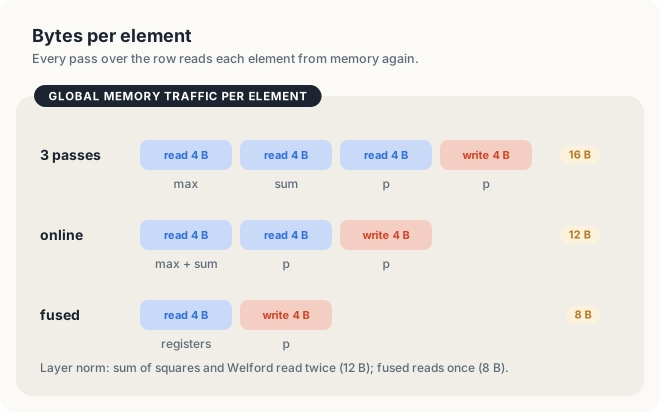
For a matrix of \(R\) rows of \(C\) values each, a kernel that moves \(b\) bytes per element moves \(bRC\) bytes in all. On a memory of bandwidth \(W\), that is, a memory that delivers \(W\) bytes per second, it therefore needs at least \(bRC / W\) seconds. For example, the 3-pass softmax, with \(b = 16\), \(R = C = 4{,}096\) and \(W = 102\) GB/s, needs at least \(16 \cdot 4{,}096^2 / (102 \cdot 10^9) \) s, or 2.63 ms. The following table gives the bound for every kernel.
| Kernel | Bytes per element | Bytes per matrix | Lower bound at 102 GB/s |
|---|---|---|---|
| softmax, 3 passes | 16 | 268 MB | 2.63 ms |
| softmax, online; layer norm, sum of squares or Welford | 12 | 201 MB | 1.97 ms |
| softmax or layer norm, fused | 8 | 134 MB | 1.32 ms |
Each kernel performs only a few arithmetic operations per 4 bytes that it reads, far fewer than a GPU can perform in the time that the memory needs to deliver those bytes, so the bytes set the time. The model assumes that every read reaches main memory. A block reads its row of 16 KiB repeatedly within a short time, however, and some of the repeated reads may be served by a cache instead. In Section 23.7, we measure how much this matters.
Exercises
23.10 Which columns does thread 200 read in a row of 4,096? Which warp does it belong to, and
which lane?
23.11 Carry out Figure 23.12 with the sum instead of the maximum, on the values 0.0498, 0.3679,
0.3679, 1 and 4 zeros.
23.12 A row has 65,536 values and a block has 256 threads. How many values does each thread read,
and how many bytes does the 3-pass kernel move for 256 such rows?
23.5 Correctness
The warps of a block do not run in lockstep. They run at different speeds, and 1 warp can be several instructions ahead of another. The kernels contain 2 safeguards against the errors that this can cause, the second barrier of Block-Reduce and the test for 2 empty states in the merges. In this section, we remove 1 safeguard at a time, follow the wrong values that appear, and then prove that the complete kernel is correct.
23.5.1 The second barrier
Suppose that we remove line 9 of Block-Reduce and run the layer normalization by the sum of squares. This kernel calls Block-Reduce twice in a row, once for \(\sum x\) and once for \(\sum x^2\), and both calls use the same 8 slots. Between the 2 calls, a warp does almost nothing, only 1 division and 5 shuffles. A fast warp can therefore leave the first call, finish the shuffles of the second, and write its sum of squares into its slot while a slow warp is still reading the sums of the first call.
Figure 23.15 follows this sequence of events on row 94 of the test matrix of Section 23.7, whose 4,096 values lie between 999 and 1,001. Each warp holds 512 values, so the sums in the slots are near 512,000, and the sums of squares are near \(5.12 \times 10^8\). Suppose that warp 5 finishes reading the 8 sums early and writes its sum of squares, 511,965,734, into slot 5, while warp 0 has read only slots 0 to 4. Warp 0 then adds 511,965,734 instead of 511,982.8, and it obtains the sum 515,549,697 instead of 4,095,945. Its mean is therefore \(515{,}549{,}697 / 4{,}096 = 125{,}866.6\) instead of 999.99, its variance \(999{,}973.7 - 125{,}866.6^2\) is negative, and its 512 outputs are NaN.
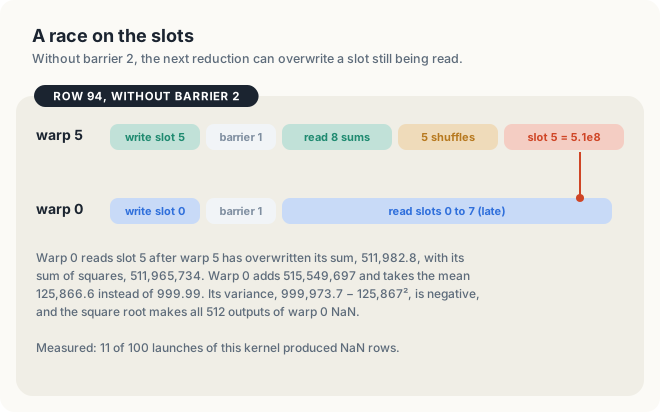
A failure of this kind is called a race, because the result depends on the relative speed of the warps. On most launches, the slow warp finishes reading in time, and the result is correct. We ran the kernel without barrier 2 on the 4,096 rows of the test 100 times and compared every row with a reference. The program printed the following summary.
first bad row 94 error NaN
layernorm sum of squares: 11 of 100 runs wrong, 12 rows
In 11 of the 100 launches, at least 1 row was NaN, 12 rows in all, and the first wrong row of the first failing launch was row 94. The other 89 launches were correct. A race is therefore hard to find, since a test that runs the kernel once passes 9 times in 10. On the example, \(X\), the race cannot change the output at all. Only warp 0 of each block holds values, and the other warps write sums of 0, which do not change any total (Exercise 23.13).
23.5.2 The empty state
We now restore barrier 2 and remove instead lines 2 to 4 of Merge-Softmax, the test for 2 empty states. On rows of 4,096 values, every thread holds 16 values, so no state is empty, and every result is still correct. On \(X\), however, threads 4 to 255 of each block hold the empty state \((-\infty, 0)\). In the first step of the butterfly, lane 4 merges with lane 20, and both of them are empty. The merge computes \(m = -\infty\) and \(s = 0 \cdot e^{-\infty - (-\infty)} + 0 \cdot e^{-\infty - (-\infty)}\). The difference \(-\infty - (-\infty)\) is NaN, so \(s\) is NaN. Every later merge that includes lane 4 inherits the NaN, and after the 5 steps, every lane of warp 0 holds \(s = \text{NaN}\). The program, run with the test removed, prints the following rows.
  softmax, online, X
         NaN      NaN      NaN      NaN
         NaN      NaN      NaN      NaN
Recall that the proof of Theorem 23.4 relied on the merge returning the empty state for 2 empty states. Without line 2, the merge does not do so, and the proof no longer applies. The same holds for Merge-Welford, where 2 empty states would compute \(0 \cdot 0 / 0\).
23.5.3 The kernels are correct
With both safeguards in place, the kernels are correct, and we now prove this for the online softmax. The proof assembles the results of Sections 23.3 and 23.4: each thread computes the state of its own columns, the butterfly merges the states of a warp, and the slots merge the states of the warps.
Theorem 23.7 When Softmax-Online-Kernel finishes, \(p_{\mathsf{row},j}\) is the softmax of row \(\mathsf{row}\) of \(X\) for every row and every \(j \in [0, C)\).
Proof. Fix a block, and let \(\mathsf{row} = \mathsf{blockIdx{.}x}\). By Theorem 23.3 applied to the columns of thread \(\mathsf{threadIdx{.}x}\), after line 4 the state of thread \(\mathsf{threadIdx{.}x}\) describes the set \(S_{\mathsf{threadIdx{.}x}} = \{x_{\mathsf{row},j} : j \equiv \mathsf{threadIdx{.}x} \pmod{\mathsf{blockDim{.}x}}\}\) of the values in the columns whose remainder on division by \(\mathsf{blockDim{.}x}\) is \(\mathsf{threadIdx{.}x}\). This set is empty when \(\mathsf{threadIdx{.}x} \ge C\). For example, in block 1 of \(X\), \(S_2 = \{x_{1,2}\} = \{4\}\), and \(S_7\) is empty. The sets \(S_0, \dots, S_{255}\) are disjoint, and their union is the row. In the butterfly of line 5, each step merges 2 disjoint groups of lanes (Section 23.4.2), so by Theorem 23.4, lane 0 of warp \(\mathsf{warp}\) holds the state of the union of the sets of its 32 threads, after the 5 steps. The merge is defined even for 2 empty states, because of line 2 of Merge-Softmax. Lane 0 writes it to slot \(\mathsf{warp}\). Because of barrier 1, every slot is written before any thread reads it, so every thread merges the 8 states of the 8 warps, which by Theorem 23.4 is the state \((m, s)\) of the whole row. The slots are not written again in this kernel, so no barrier 2 is needed. Lines 6 to 8 then compute \(e^{x_{\mathsf{row},j} - m} / s\) for the thread’s columns, which is the softmax by Theorem 23.1, and the columns of the 256 threads cover the row. Different blocks touch different rows, so they do not interfere.
The same argument, with Theorems 23.5 and 23.6 in place of Theorems 23.3 and 23.4, proves the Welford kernel. For a kernel that calls Block-Reduce twice with the same slots, the proof needs 1 more fact, namely that no slot is written by the second call before every thread has read it in the first. Barrier 2 provides this fact, and it is exactly the barrier that we removed in Section 23.5.1.
Rule Between the last read of a shared slot and the next write to it, place a barrier that every thread of the block reaches.
Exercises
23.13 Explain why removing barrier 2 can never change the outputs for \(X\), where only warp 0
of each block holds values.
23.14 In the fused softmax, Block-Reduce is called with \(\max\) and then
with \(+\). Describe an interleaving without barrier 2 that gives a wrong maximum, and the effect
on the outputs.
23.15 Why does the online kernel of Section 23.4.4 not need barrier 2, while the 3-pass kernel
does?
23.6 Implementation
23.6.1 Warp and block reductions
We now turn the procedures of Section 23.4 into code, beginning with the reductions that every
kernel uses. The following code implements the butterfly, lines 1 to 3 of
Block-Reduce, twice: warp_max uses \(\max\) as the merge, and
warp_sum uses \(+\).
mod kernels {
    // ...
    #[device]
    fn warp_max(mut value: f32) -> f32 {
        let mut mask = 16;
        while mask > 0 {
            value = value.max(warp::shuffle_xor_f32(value, mask));
            mask /= 2;
        }
        value
    }

    #[device]
    fn warp_sum(mut value: f32) -> f32 {
        let mut mask = 16;
        while mask > 0 {
            value += warp::shuffle_xor_f32(value, mask);
            mask /= 2;
        }
        value
    }
    // ...
}
__device__ float warpMax(float value)
{
for (int mask = 16; mask > 0; mask /= 2) {
value = fmaxf(value, __shfl_xor_sync(0xffffffff, value, mask));
}
return value;
}
__device__ float warpSum(float value)
{
for (int mask = 16; mask > 0; mask /= 2) {
value += __shfl_xor_sync(0xffffffff, value, mask);
}
return value;
}
The loop runs for the masks 16, 8, 4, 2 and 1, halving the mask after each step. In Rust, it is a
while loop, which is the form of device loop that cuda-oxide compiles (Section 9.7), and
warp::shuffle_xor_f32 is the xor shuffle. In C++, __shfl_xor_sync takes a first argument,
0xffffffff, whose 32 bits name the 32 lanes that take part, and all of them must execute the
call. Both f32::max and fmaxf return the larger of 2 floats.
The following code implements the whole of Block-Reduce for the maximum. It calls the warp maximum and then adds lines 4 to 10 of the procedure.
mod kernels {
// ...
/// The maximum over the block, returned to every thread. `slots` holds 8 floats.
#[device]
fn block_max(value: f32, slots: *mut f32) -> f32 {
let value = warp_max(value);
let warp = thread::threadIdx_x() as usize / 32;
if warp::lane_id() == 0 {
// SAFETY: lane 0 of each warp writes its own slot, before the barrier.
unsafe { *slots.add(warp) = value };
}
thread::sync_threads();
// SAFETY: between the 2 barriers the slots are only read.
let mut largest = unsafe { *slots };
let mut other = 1;
while other < WARPS {
largest = largest.max(unsafe { *slots.add(other) });
other += 1;
}
thread::sync_threads();
largest
}
// ...
}// The maximum over the block, returned to every thread. `slots` holds 8 floats.
__device__ float blockMax(float value, float* slots)
{
value = warpMax(value);
int warp = threadIdx.x / 32;
if (threadIdx.x % 32 == 0) {
slots[warp] = value;
}
__syncthreads();
float largest = slots[0];
for (int other = 1; other < WARPS; ++other) {
largest = fmaxf(largest, slots[other]);
}
__syncthreads();
return largest;
}
The correspondence with the procedure is direct. Lane 0 writes the slot of its warp, the first
call to sync_threads is barrier 1, the loop over other is line 8, and the second call to
sync_threads is barrier 2. Both barriers sit outside every if, so every thread of the block
reaches them. The function block_sum differs only in the merge. The two languages differ, however,
in where the slots live. A cuda-oxide #[device] function cannot declare shared memory of its
own, so each kernel declares static mut SLOTS: SharedArray<f32, 8> and passes a raw pointer to
the helper. Every access through the pointer is unsafe, with a // SAFETY: comment that names
the threads that touch the slots and the barriers between which they do so. The C++ helper
receives the same pointer from a __shared__ array of its kernel and needs no such annotation.
23.6.2 The 3-pass kernel
The following kernel implements Softmax-3-Pass with one block per row.
mod kernels {
// ...
/// 3 passes over the row: the maximum, the sum of exp(x - max), the outputs.
#[kernel]
#[launch_contract(domain = 1, block = (256, 1, 1))]
pub fn softmax_three_pass(input: &[f32], mut out: DisjointSlice<f32>, cols: u32) {
static mut SLOTS: SharedArray<f32, 8> = SharedArray::UNINIT;
// SAFETY: the pointer is only used by the block helpers, between barriers.
let slots = unsafe { (*&raw mut SLOTS).as_mut_ptr() };
let base = thread::blockIdx_x() as usize * cols as usize;
let tid = thread::threadIdx_x() as usize;
let mut largest = f32::NEG_INFINITY;
let mut column = tid;
while column < cols as usize {
largest = largest.max(input[base + column]);
column += BLOCK as usize;
}
let top = block_max(largest, slots);
let mut sum = 0.0;
let mut column = tid;
while column < cols as usize {
sum += (input[base + column] - top).exp();
column += BLOCK as usize;
}
let total = block_sum(sum, slots);
let mut column = tid;
while column < cols as usize {
let probability = (input[base + column] - top).exp() / total;
// SAFETY: each block writes only its own row, and each thread only its own
// columns threadIdx.x, threadIdx.x + 256, ...
unsafe { *out.get_unchecked_mut(base + column) = probability };
column += BLOCK as usize;
}
}
// ...
}// 3 passes over the row: the maximum, the sum of exp(x - max), the outputs.
__global__ void softmaxThreePass(const float* in, float* out, int cols)
{
__shared__ float slots[WARPS];
const float* row = in + (size_t)blockIdx.x * cols;
float* result = out + (size_t)blockIdx.x * cols;
float largest = -INFINITY;
for (int column = threadIdx.x; column < cols; column += BLOCK) {
largest = fmaxf(largest, row[column]);
}
float top = blockMax(largest, slots);
float sum = 0.0f;
for (int column = threadIdx.x; column < cols; column += BLOCK) {
sum += expf(row[column] - top);
}
float total = blockSum(sum, slots);
for (int column = threadIdx.x; column < cols; column += BLOCK) {
result[column] = expf(row[column] - top) / total;
}
}
Block \(\mathsf{blockIdx{.}x}\) starts at element base = blockIdx.x × cols of the matrix, which is
the row-major position of its row; for row 1 of \(X\), base is \(1 \cdot 4 = 4\). Each of the 3 loops starts at
column tid and advances by BLOCK, the pattern of Figure 23.11. The 3 loops are the 3 passes of
Softmax-3-Pass, with block_max and block_sum between them. The kernel
works for any row length, including the 4 of \(X\).
The Rust kernel writes through a DisjointSlice<f32>, the output type of Chapter 13, whose safe
method lets each thread write only the element at its own global index. Here, however, thread
\(\mathsf{threadIdx{.}x}\) of block \(\mathsf{blockIdx{.}x}\) writes the elements
\(\mathsf{blockIdx{.}x} \cdot C + \mathsf{threadIdx{.}x} + 256 \cdot \mathsf{step}\) for
\(\mathsf{step} = 0, 1, \dots\).
No other thread writes these elements, but they are not the thread’s global index, so the kernel
calls get_unchecked_mut and states this argument in the SAFETY comment. The C++ kernel writes
through a plain pointer. The attribute #[launch_contract(domain = 1, block = (256, 1, 1))] records
that the kernel expects 1-dimensional blocks of 256 threads, and the host’s
prepare_softmax_three_pass checks a launch configuration against it before the first launch. The
Rust kernel also reads through a slice, input[base + j], and every such read is checked against
the slice length. In Section 23.7.5, we measure what these checks cost.
23.6.3 The online kernel
The following code shows the merge of 2 softmax states and the kernel Softmax-Online-Kernel that uses it.
mod kernels {
// ...
/// Merges 2 softmax states (maximum m, sum of exp(x - m)); (-inf, 0) is empty.
#[device]
fn merge_softmax(
largest: f32,
sum: f32,
other_largest: f32,
other_sum: f32,
) -> (f32, f32) {
let top = largest.max(other_largest);
if top == f32::NEG_INFINITY {
return (top, 0.0);
}
let first_part = sum * (largest - top).exp();
let second_part = other_sum * (other_largest - top).exp();
(top, first_part + second_part)
}
// ...
}
mod kernels {
// ...
/// 2 passes: a running maximum and a rescaled running sum, then the outputs.
#[kernel]
#[launch_contract(domain = 1, block = (256, 1, 1))]
pub fn softmax_online(input: &[f32], mut out: DisjointSlice<f32>, cols: u32) {
static mut MAXES: SharedArray<f32, 8> = SharedArray::UNINIT;
static mut SUMS: SharedArray<f32, 8> = SharedArray::UNINIT;
let base = thread::blockIdx_x() as usize * cols as usize;
let tid = thread::threadIdx_x() as usize;
let mut largest = f32::NEG_INFINITY;
let mut sum = 0.0;
let mut column = tid;
while column < cols as usize {
let value = input[base + column];
if value > largest {
sum = sum * (largest - value).exp() + 1.0;
largest = value;
} else {
sum += (value - largest).exp();
}
column += BLOCK as usize;
}
let mut mask = 16;
while mask > 0 {
let m2 = warp::shuffle_xor_f32(largest, mask);
let s2 = warp::shuffle_xor_f32(sum, mask);
(largest, sum) = merge_softmax(largest, sum, m2, s2);
mask /= 2;
}
let warp = tid / 32;
if warp::lane_id() == 0 {
// SAFETY: lane 0 of each warp writes its own slots, before the barrier.
unsafe {
MAXES[warp] = largest;
SUMS[warp] = sum;
}
}
thread::sync_threads();
// SAFETY: after the barrier the slots are only read.
let (mut top, mut total) = unsafe { (MAXES[0], SUMS[0]) };
let mut other = 1;
while other < WARPS {
(top, total) = unsafe { merge_softmax(top, total, MAXES[other], SUMS[other]) };
other += 1;
}
let mut column = tid;
while column < cols as usize {
let probability = (input[base + column] - top).exp() / total;
// SAFETY: each block writes only its own row, and each thread only its own
// columns threadIdx.x, threadIdx.x + 256, ...
unsafe { *out.get_unchecked_mut(base + column) = probability };
column += BLOCK as usize;
}
}
// ...
}// A softmax state: the maximum m and the sum s of exp(x - m). (-inf, 0) is the empty state.
struct SoftmaxState {
float largest; // m
float sum; // s
};
__device__ SoftmaxState mergeSoftmax(SoftmaxState first, SoftmaxState second)
{
float top = fmaxf(first.largest, second.largest);
if (top == -INFINITY) {
return {top, 0.0f};
}
float firstPart = first.sum * expf(first.largest - top);
float secondPart = second.sum * expf(second.largest - top);
return {top, firstPart + secondPart};
}
// 2 passes: a running maximum and a rescaled running sum, then the outputs.
__global__ void softmaxOnline(const float* in, float* out, int cols)
{
__shared__ SoftmaxState slots[WARPS];
const float* row = in + (size_t)blockIdx.x * cols;
float* result = out + (size_t)blockIdx.x * cols;
SoftmaxState state = {-INFINITY, 0.0f};
for (int column = threadIdx.x; column < cols; column += BLOCK) {
float value = row[column];
if (value > state.largest) {
state.sum = state.sum * expf(state.largest - value) + 1.0f;
state.largest = value;
} else {
state.sum += expf(value - state.largest);
}
}
for (int mask = 16; mask > 0; mask /= 2) {
SoftmaxState other;
other.largest = __shfl_xor_sync(0xffffffff, state.largest, mask);
other.sum = __shfl_xor_sync(0xffffffff, state.sum, mask);
state = mergeSoftmax(state, other);
}
if (threadIdx.x % 32 == 0) {
slots[threadIdx.x / 32] = state;
}
__syncthreads();
SoftmaxState all = slots[0];
for (int other = 1; other < WARPS; ++other) {
all = mergeSoftmax(all, slots[other]);
}
for (int column = threadIdx.x; column < cols; column += BLOCK) {
result[column] = expf(row[column] - all.largest) / all.sum;
}
}
The function merge_softmax is Merge-Softmax, including the test for 2
empty states that we removed in Section 23.5.2. The first loop of the kernel is lines 1 to 4 of
Softmax-Online-Kernel, and its if and else branches are lines 3 to 8
of Online-Softmax. The butterfly shuffles both numbers of the state in each
step. Lane 0 of each warp then writes its state to 2 slots, and after the barrier, every thread
merges the 8 states. The final loop is lines 6 to 8. In Rust, the state is 2 local variables
updated by a destructuring assignment, (m, s) = merge_softmax(m, s, m2, s2). In C++, it is a
struct with 2 members, and the slots are an array of that struct.
23.6.4 Welford’s kernel
The following code shows the merge of 2 Welford states and the layer-normalization kernel built on Welford-Update.
mod kernels {
// ...
/// Merges 2 Welford states (count n, mean, sum of squared deviations q).
#[device]
fn merge_welford(first: (f32, f32, f32), second: (f32, f32, f32)) -> (f32, f32, f32) {
let count = first.0 + second.0;
if count == 0.0 {
return first;
}
let delta = second.1 - first.1;
let mean = first.1 + delta * second.0 / count;
let between = delta * delta * first.0 * second.0 / count;
(count, mean, first.2 + second.2 + between)
}
// ...
}
mod kernels {
// ...
/// Layer norm with Welford's running mean and squared deviations, merged per block.
#[kernel]
#[launch_contract(domain = 1, block = (256, 1, 1))]
pub fn layernorm_welford(
input: &[f32],
gamma: &[f32],
beta: &[f32],
mut out: DisjointSlice<f32>,
cols: u32,
) {
static mut STATE: SharedArray<f32, 24> = SharedArray::UNINIT;
let base = thread::blockIdx_x() as usize * cols as usize;
let tid = thread::threadIdx_x() as usize;
let mut state = (0.0f32, 0.0f32, 0.0f32);
let mut column = tid;
while column < cols as usize {
let value = input[base + column];
let count = state.0 + 1.0;
let delta = value - state.1;
let mean = state.1 + delta / count;
state = (count, mean, state.2 + delta * (value - mean));
column += BLOCK as usize;
}
let mut mask = 16;
while mask > 0 {
let other = (
warp::shuffle_xor_f32(state.0, mask),
warp::shuffle_xor_f32(state.1, mask),
warp::shuffle_xor_f32(state.2, mask),
);
state = merge_welford(state, other);
mask /= 2;
}
let warp = tid / 32;
if warp::lane_id() == 0 {
// SAFETY: lane 0 of each warp writes its own 3 slots, before the barrier.
unsafe {
STATE[3 * warp] = state.0;
STATE[3 * warp + 1] = state.1;
STATE[3 * warp + 2] = state.2;
}
}
thread::sync_threads();
// SAFETY: after the barrier the slots are only read.
let mut all = unsafe { (STATE[0], STATE[1], STATE[2]) };
let mut other = 1;
while other < WARPS {
let slot = 3 * other;
let next = unsafe { (STATE[slot], STATE[slot + 1], STATE[slot + 2]) };
all = merge_welford(all, next);
other += 1;
}
let mean = all.1;
let inverse_std = 1.0 / (all.2 / cols as f32 + EPS).sqrt();
let mut column = tid;
while column < cols as usize {
let scaled = (input[base + column] - mean) * inverse_std;
let normalized = scaled * gamma[column] + beta[column];
// SAFETY: each block writes only its own row, and each thread only its own
// columns threadIdx.x, threadIdx.x + 256, ...
unsafe { *out.get_unchecked_mut(base + column) = normalized };
column += BLOCK as usize;
}
}
// ...
}// A Welford state: the count n, the mean, and the sum q of squared deviations.
struct WelfordState {
float count; // n
float mean;
float squares; // q
};
__device__ WelfordState mergeWelford(WelfordState first, WelfordState second)
{
float count = first.count + second.count;
if (count == 0.0f) {
return first;
}
float delta = second.mean - first.mean;
float mean = first.mean + delta * second.count / count;
float between = delta * delta * first.count * second.count / count;
return {count, mean, first.squares + second.squares + between};
}
// Layer norm with Welford's running mean and squared deviations, merged per block.
__global__ void layernormWelford(const float* in, const float* gamma, const float* beta,
float* out, int cols)
{
__shared__ WelfordState slots[WARPS];
const float* row = in + (size_t)blockIdx.x * cols;
float* result = out + (size_t)blockIdx.x * cols;
WelfordState state = {0.0f, 0.0f, 0.0f};
for (int column = threadIdx.x; column < cols; column += BLOCK) {
float value = row[column];
state.count += 1.0f;
float delta = value - state.mean;
state.mean += delta / state.count;
state.squares += delta * (value - state.mean);
}
for (int mask = 16; mask > 0; mask /= 2) {
WelfordState other;
other.count = __shfl_xor_sync(0xffffffff, state.count, mask);
other.mean = __shfl_xor_sync(0xffffffff, state.mean, mask);
other.squares = __shfl_xor_sync(0xffffffff, state.squares, mask);
state = mergeWelford(state, other);
}
if (threadIdx.x % 32 == 0) {
slots[threadIdx.x / 32] = state;
}
__syncthreads();
WelfordState all = slots[0];
for (int other = 1; other < WARPS; ++other) {
all = mergeWelford(all, slots[other]);
}
float inverseStd = 1.0f / sqrtf(all.squares / cols + EPS);
for (int column = threadIdx.x; column < cols; column += BLOCK) {
float normalized = (row[column] - all.mean) * inverseStd;
result[column] = normalized * gamma[column] + beta[column];
}
}
The first loop applies Welford-Update to the thread’s columns, and its 4
lines are the 4 lines of the procedure. The state holds the count as a float, so that
all 3 numbers can be shuffled with the same instruction. This is safe, because counts up to
\(2^{24}\) are exact in f32. After the warp merge, lane 0 writes 3 numbers. In Rust, they
occupy 3 consecutive slots of a SharedArray<f32, 24>, and in C++, 1 slot of an array of
WelfordState. The variance of the row is \(q / C\), and inverseStd (inverse_std in Rust),
the reciprocal of the standard
deviation, is \(1 / \sqrt{q / C + \varepsilon}\). For row 0 of \(X\), inverseStd is
\(1 / \sqrt{5 / 4 + 10^{-5}} = 0.8944\), the factor of Figure 23.3.
23.6.5 The fused kernels
The following code implements Softmax-Fused-Kernel, which keeps the 16 values of each thread in registers.
mod kernels {
// ...
/// 1 read: each thread keeps its 16 values of the row in registers.
#[kernel]
#[launch_contract(domain = 1, block = (256, 1, 1))]
pub fn softmax_fused(input: &[f32], mut out: DisjointSlice<f32>) {
static mut SLOTS: SharedArray<f32, 8> = SharedArray::UNINIT;
// SAFETY: the pointer is only used by the block helpers, between barriers.
let slots = unsafe { (*&raw mut SLOTS).as_mut_ptr() };
let base = thread::blockIdx_x() as usize * COLS;
let tid = thread::threadIdx_x() as usize;
let mut kept = [0.0f32; PER_THREAD];
let mut largest = f32::NEG_INFINITY;
let mut index = 0;
#[unroll]
while index < PER_THREAD {
kept[index] = input[base + index * BLOCK as usize + tid];
largest = largest.max(kept[index]);
index += 1;
}
let top = block_max(largest, slots);
let mut sum = 0.0;
let mut index = 0;
#[unroll]
while index < PER_THREAD {
kept[index] = (kept[index] - top).exp();
sum += kept[index];
index += 1;
}
let scale = 1.0 / block_sum(sum, slots);
let mut index = 0;
#[unroll]
while index < PER_THREAD {
let column = index * BLOCK as usize + tid;
// SAFETY: each block writes only its own row, and each thread only its own
// columns threadIdx.x, threadIdx.x + 256, ...
unsafe { *out.get_unchecked_mut(base + column) = kept[index] * scale };
index += 1;
}
}
// ...
}// 1 read: each thread keeps its 16 values of the row in registers.
__global__ void softmaxFused(const float* in, float* out)
{
__shared__ float slots[WARPS];
const float* row = in + (size_t)blockIdx.x * COLS;
float* result = out + (size_t)blockIdx.x * COLS;
float kept[PER_THREAD];
float largest = -INFINITY;
#pragma unroll
for (int index = 0; index < PER_THREAD; ++index) {
kept[index] = row[index * BLOCK + threadIdx.x];
largest = fmaxf(largest, kept[index]);
}
float top = blockMax(largest, slots);
float sum = 0.0f;
#pragma unroll
for (int index = 0; index < PER_THREAD; ++index) {
kept[index] = expf(kept[index] - top);
sum += kept[index];
}
float scale = 1.0f / blockSum(sum, slots);
#pragma unroll
for (int index = 0; index < PER_THREAD; ++index) {
result[index * BLOCK + threadIdx.x] = kept[index] * scale;
}
}
The 3 loops are lines 1 to 3, 5 to 7 and 9 to 11 of Softmax-Fused-Kernel.
The array kept of PER_THREAD = COLS / 256 = 16 values has a size fixed at compile time, and this
is why the row length is the constant COLS = 4096 and not an argument. Each loop has a constant
trip count and is fully unrolled, so that every kept[index] names a fixed register. In Rust, the loop is
a while loop marked #[unroll]; in Section 9.7, we found this form necessary for cuda-oxide to
keep a small array in registers. In C++, it is a for loop under #pragma unroll. The fused layer
normalization in the complete programs has the same 3 loops, which compute the mean, the squared
deviations and the outputs.
23.6.6 The host program
The host program first runs the kernels on \(X\), \(X + 100\) and \(X + 10{,}000\). The following code prepares the launches and runs them on the 2 rows of the example.
fn main() -> Result<(), Error> {
// ...
let two_rows = LaunchConfig1D::new(2, BLOCK, 0);
let naive_two = module.prepare_softmax_naive(two_rows)?;
let three_two = module.prepare_softmax_three_pass(two_rows)?;
let online_two = module.prepare_softmax_online(two_rows)?;
let sq_two = module.prepare_layernorm_naive(two_rows)?;
let welford_two = module.prepare_layernorm_welford(two_rows)?;
println!("the 2 x 4 example X = [1 2 3 4; 2 4 4 5]");
module.softmax_naive(&stream, &naive_two, &small, &mut out, 4)?;
print_matrix("softmax without the maximum, X", &out.to_host_vec(&stream)?, 4);
module.softmax_naive(&stream, &naive_two, &shifted, &mut out, 4)?;
let naive_big = out.to_host_vec(&stream)?;
print_matrix("softmax without the maximum, X + 100", &naive_big, 4);
module.softmax_three_pass(&stream, &three_two, &small, &mut out, 4)?;
let three_x = out.to_host_vec(&stream)?;
print_matrix("softmax, 3 passes, X", &three_x, 4);
module.softmax_three_pass(&stream, &three_two, &shifted, &mut out, 4)?;
let three_big = out.to_host_vec(&stream)?;
print_matrix("softmax, 3 passes, X + 100", &three_big, 4);
module.softmax_online(&stream, &online_two, &small, &mut out, 4)?;
let online_x = out.to_host_vec(&stream)?;
print_matrix("softmax, online, X", &online_x, 4);
// ...
}int main()
{
// ...
std::printf("the 2 x 4 example X = [1 2 3 4; 2 4 4 5]\n");
softmaxNaive<<<2, BLOCK>>>(small, o, 4);
printMatrix("softmax without the maximum, X", toHost(o, 8), 4);
softmaxNaive<<<2, BLOCK>>>(shifted, o, 4);
std::vector<float> naiveBig = toHost(o, 8);
printMatrix("softmax without the maximum, X + 100", naiveBig, 4);
softmaxThreePass<<<2, BLOCK>>>(small, o, 4);
std::vector<float> threeX = toHost(o, 8);
printMatrix("softmax, 3 passes, X", threeX, 4);
softmaxThreePass<<<2, BLOCK>>>(shifted, o, 4);
std::vector<float> threeBig = toHost(o, 8);
printMatrix("softmax, 3 passes, X + 100", threeBig, 4);
softmaxOnline<<<2, BLOCK>>>(small, o, 4);
std::vector<float> onlineX = toHost(o, 8);
printMatrix("softmax, online, X", onlineX, 4);
// ...
}
A launch configuration of 2 blocks of 256 threads covers the 2 rows. In Rust, each
prepare_<kernel> call checks the configuration against the kernel’s launch contract once, and the
launches that follow use the prepared configuration. In C++, the launch is written
softmaxThreePass<<<2, BLOCK>>>(...). For the example, the program prints the following output.
$ cargo oxide run
the 2 x 4 example X = [1 2 3 4; 2 4 4 5]
softmax without the maximum, X
0.0321 0.0871 0.2369 0.6439
0.0279 0.2060 0.2060 0.5601
softmax without the maximum, X + 100
NaN NaN NaN NaN
NaN NaN NaN NaN
softmax, 3 passes, X
0.0321 0.0871 0.2369 0.6439
0.0279 0.2060 0.2060 0.5601
softmax, 3 passes, X + 100
0.0321 0.0871 0.2369 0.6439
0.0279 0.2060 0.2060 0.5601
softmax, online, X
0.0321 0.0871 0.2369 0.6439
0.0279 0.2060 0.2060 0.5601
layer norm, sum of squares, X
-1.3416 -0.4472 0.4472 1.3416
-1.6059 0.2294 0.2294 1.1471
layer norm, sum of squares, X + 10000
NaN NaN NaN NaN
NaN NaN NaN NaN
layer norm, Welford, X + 10000
-1.3416 -0.4472 0.4472 1.3416
-1.6059 0.2294 0.2294 1.1471
Every line matches a hand computation of this chapter. Without the maximum, \(X\) gives the
\(P\) of Figure 23.1, and \(X + 100\) gives NaN, as in Figure 23.4. With the maximum, \(X\)
and \(X + 100\) give the same \(P\), as Theorem 23.1 states. The sum of squares gives \(Y\)
for \(X\) and NaN for \(X + 10{,}000\), as in Figure 23.6, and Welford’s method gives \(Y\)
for both. The program compares each of these results with a softmax and a layer normalization
computed in f64 on the CPU, and it requires the NaNs where the analysis predicts them.
For the timed runs, a kernel takes about 2 ms, which is too short to time a single launch
reliably. The function time_ms, shown below, therefore runs the kernel 100 times first, so that
the GPU raises its clock. It then times 7 batches of 20 launches each and returns the median batch
time divided by 20.
/// Time of 1 run of `launch`, in milliseconds: the median of 7 batches of 20 runs,
/// after 100 warm-up runs.
fn time_ms(
stream: &Arc<CudaStream>,
mut launch: impl FnMut() -> Result<(), Error>,
) -> Result<f64, Error> {
for _ in 0..100 {
launch()?;
}
stream.synchronize()?;
let mut batches = Vec::new();
for _ in 0..7 {
let start = Instant::now();
for _ in 0..20 {
launch()?;
}
stream.synchronize()?;
batches.push(start.elapsed().as_secs_f64() * 1e3 / 20.0);
}
batches.sort_by(f64::total_cmp);
Ok(batches[3])
}// Time of 1 run of `launch`, in milliseconds: the median of 7 batches of 20 runs,
// after 100 warm-up runs.
template <typename F>
double timeMs(F launch)
{
for (int warmup = 0; warmup < 100; ++warmup) {
launch();
}
check(cudaDeviceSynchronize());
std::vector<double> batches;
for (int batch = 0; batch < 7; ++batch) {
double start = nowMs();
for (int timed = 0; timed < 20; ++timed) {
launch();
}
check(cudaGetLastError());
check(cudaDeviceSynchronize());
batches.push_back((nowMs() - start) / 20);
}
std::sort(batches.begin(), batches.end());
return batches[3];
}
Exercises
23.16 block_sum in Rust starts its loop over the slots at w = 0 with s = 0.0, while
block_max starts at w = 1 with the value of slot 0. Why can block_max not start from
m = 0.0?
23.17 Change ROWS and COLS to 16,384 rows of 1,024 columns. Which constant must change for the
fused kernels to stay correct?
23.7 Measurements
23.7.1 Platform and method
The measurements come from a Jetson Orin NX 16 GB, an integrated GPU with 8 SMs, 102 GB/s of
memory bandwidth and 2 MiB of L2 cache. The test matrices have 4,096 rows of 4,096 f32 values,
which is 64 MiB, far larger than the L2 cache. The softmax inputs are uniform in \([-10, 10)\).
The layer-normalization inputs are uniform in \([999, 1001)\), so that their mean is large
compared with their spread, and they use a different \(\gamma_j\) and \(\beta_j\) for each
column. The same softmax inputs are also arranged as 256 rows of 65,536 values. Each time is the
median of 7 batches of 20 launches. Repeated runs differ by up to 10%, and we quote 1 run of 3,
made with no other work on the GPU or the memory.
23.7.2 Results
After the example, the Rust program printed the following results.
softmax of 4096 rows x 4096 columns, median of 7 x 20 runs
kernel bytes/elem ms GB/s max error
3 passes 16 2.025 132.6 1.37e-9
online 12 2.255 89.3 1.36e-9
fused 8 1.435 93.6 1.37e-9
softmax of 256 rows x 65536 columns, median of 7 x 20 runs
kernel bytes/elem ms GB/s max error
3 passes 16 3.985 67.4 1.22e-10
online 12 3.015 66.8 1.18e-10
layer norm of 4096 rows x 4096 columns, values 1,000 + [-1, 1)
kernel bytes/elem ms GB/s max error
sum, sum x2 12 1.808 111.3 2.97e0
Welford 12 2.112 95.3 1.88e-4
fused 8 1.424 94.3 1.81e-4
PASSED
The GB/s column divides the modeled bytes of Section 23.4.5 by the measured time. For example,
the fused softmax moves \(8 \cdot 4{,}096^2\) bytes, 134 MB, in 1.435 ms, which gives 93.6 GB/s.
The following table collects the times of both programs, together with those of the Rust program
built with cargo oxide run --unchecked-indexing, an option that we explain in Section 23.7.5.
| Kernel | Bytes per element | Rust (ms) | Rust, unchecked (ms) | C++ (ms) | C++, modeled (GB/s) |
|---|---|---|---|---|---|
| softmax, 3 passes | 16 | 2.025 | 1.684 | 1.434 | 187.2 |
| softmax, online | 12 | 2.255 | 1.545 | 1.480 | 136.1 |
| softmax, fused | 8 | 1.435 | 1.446 | 1.417 | 94.8 |
| softmax, 3 passes, rows of 65,536 | 16 | 3.985 | 3.088 | 3.129 | 85.8 |
| softmax, online, rows of 65,536 | 12 | 3.015 | 2.453 | 2.373 | 84.8 |
| layer norm, sum of squares | 12 | 1.808 | 1.433 | 1.464 | 137.5 |
| layer norm, Welford | 12 | 2.112 | 1.902 | 1.920 | 104.9 |
| layer norm, fused | 8 | 1.424 | 1.424 | 1.445 | 92.9 |
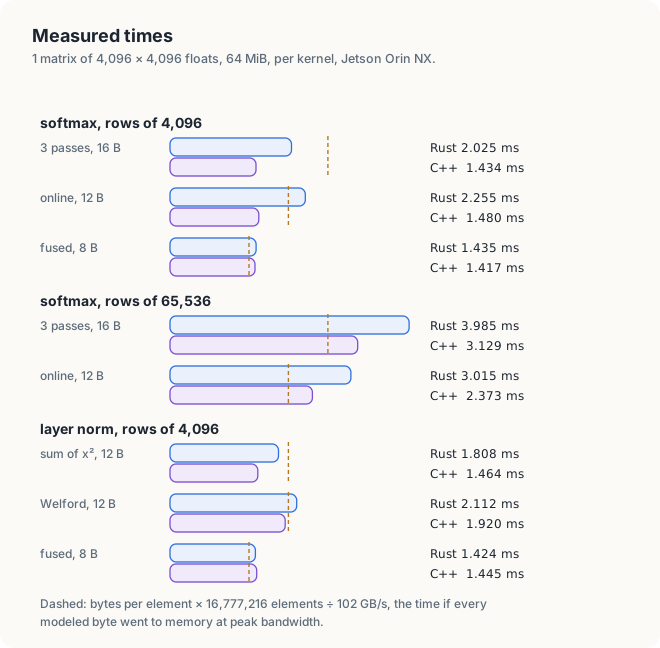
We begin with the fused kernels, which match the model. They move 134 MB in 1.42 to 1.45 ms, that is, at 93 to 95 GB/s, which is 91 to 93% of the 102 GB/s of the memory. This is the fraction that a well-behaved streaming kernel reaches on this GPU. The other numbers need explanations, which we give in the next 4 sections.
23.7.3 Why 3 passes cost no more than 1 on rows of 4,096
The C++ 3-pass softmax takes 1.434 ms, the same time as the fused kernel, although it reads each value 3 times. Its modeled rate, 187.2 GB/s, is 1.8 times the bandwidth of the memory, which would be impossible if every read reached the memory. We conclude that most of its second and third reads were served by the L2 cache.
A simple count confirms this conclusion. An SM of this GPU holds at most 1,536 threads, that is, 6 blocks of 256, so at most \(8 \cdot 6 = 48\) rows are being processed at any moment on the 8 SMs. Each row occupies 16 KiB, so all the rows in progress fit in \(48 \cdot 16 = 768\) KiB, which is less than the 2 MiB of the L2 cache. A row read in pass 1 is therefore still in the cache when passes 2 and 3 read it, and the traffic to the memory is 8 bytes per element, as for the fused kernel. For the same reason, the online kernel saves nothing here, 1.480 ms against 1.434 ms in C++, because the read that it removes was a cache hit.
23.7.4 Rows of 65,536
With rows of 65,536 values, which occupy 256 KiB each, the 48 rows in progress would occupy \(48 \cdot 256\) KiB = 12 MiB, 6 times the size of the L2 cache. A row is then no longer in the cache when the next pass reads it, and every pass reaches the memory. The model of Section 23.4.5 therefore holds. The C++ 3-pass kernel takes 3.129 ms for 268 MB, which is 85.8 GB/s, and the online kernel takes 2.373 ms for 201 MB, which is 84.8 GB/s. The ratio of the 2 times, \(3.129 / 2.373 = 1.32\), is the ratio of their traffic, \(16 / 12 = 1.33\). For long rows, such as those of the output layer of a language model, the online softmax thus saves a quarter of the time. For short rows, the cache had already removed the extra pass.
23.7.5 Bounds checks in the Rust loops
On rows of 4,096 values, the Rust 3-pass and online kernels are 41% and 52% slower than the C++
kernels (2.025 against 1.434 ms, and 2.255 against 1.480 ms), while the fused kernels run at the
same speed in both languages. The difference lies in how the kernels read the row. A Rust kernel
reads input[base + j] from a slice, and every such read compares the index with the slice length
and branches to a trap when the index is out of range. In the fused kernels, the 16 reads are
unrolled and independent of each other, and the checks cost nothing measurable. In the other
kernels, the reads sit in loops whose trip count is known only at run time, and there the checks
are not free.
cuda-oxide can remove the checks. Built with cargo oxide run --unchecked-indexing, the same
program runs the online kernel in 1.545 ms, the long-row kernels in 3.088 and 2.453 ms, and the sum
of squares in 1.433 ms, all within 5% of C++. The 3-pass kernel on short rows improves from 2.025
to 1.684 ms, but it remains 17% slower than C++. The flag makes every out-of-range index
undefined behavior, exactly like get_unchecked, in every kernel of the program. The kernels of
this chapter read only indices \(b \cdot C + j\) with \(b < R\) and \(j < C\), so they stay in
range, but the compiler no longer checks this claim. A per-kernel form,
#[kernel(unchecked_indexing)], limits the trust to the kernels that need the speed.
23.7.6 Welford’s division, and the accuracy
The Welford kernel moves the same 12 bytes per element as the sum of squares, but it takes \(1.920 - 1.464 = 0.456\) ms longer in C++. Since the traffic is the same, the difference must come from computation. Per value, the sum of squares performs 2 additions, 1 of them combined with a multiplication. Welford’s update performs 3 subtractions or additions, 1 combined multiplication and addition, and a division, which a GPU computes with a sequence of several instructions. The kernel is close enough to the memory limit that this extra arithmetic shows in the time. The fused layer normalization avoids both costs, because it moves only 8 bytes per element and computes the variance from registers in 2 inexpensive passes.
The error column shows the cancellation of Section 23.2.5 on the GPU. The sum of squares reaches an
error of 2.97 on outputs whose typical size is 1, so its results are useless, although it runs at
the same speed as the correct kernels. Welford’s method and the fused kernel stay within
\(1.9 \times 10^{-4}\) of the f64 reference. This remaining error has a definite source. The
values lie near 1,000, where f32 numbers are \(6.1 \times 10^{-5}\) apart, so the mean is exact
only to a few times this spacing. Dividing by the standard deviation, \(\sqrt{0.33} = 0.58\),
multiplies the error by 1.7. The softmax errors, about \(10^{-9}\) on probabilities near
\(2.4 \times 10^{-4}\), are at the level of f32 rounding.
Exercises
23.18 With 4 bytes per value and 102 GB/s, how long must the fused layer normalization take at
least for 16,384 rows of 1,024 values? Would the 3-pass softmax be served by the L2 cache at that
row length?
23.19 Estimate the times of the 3-pass and online softmax for 64 rows of 128,000 values on a GPU
with 3.35 TB/s of memory bandwidth and 50 MB of L2 cache.
23.8 The complete programs
//! Chapter 23: softmax and layer normalization of the rows of a matrix, in cuda-oxide.
//!
//! cargo oxide run
use std::sync::Arc;
use std::time::Instant;
use cuda_core::{CudaContext, CudaStream, DeviceBuffer, LaunchConfig1D};
use cuda_device::{DisjointSlice, SharedArray, cuda_module, device, kernel, launch_contract};
use cuda_device::{thread, warp};
const BLOCK: u32 = 256;
const WARPS: usize = BLOCK as usize / 32;
const ROWS: usize = 4096;
const COLS: usize = 4096;
const PER_THREAD: usize = COLS / BLOCK as usize;
const EPS: f32 = 1e-5;
type Error = Box<dyn std::error::Error>;
#[cuda_module]
mod kernels {
use super::*;
#[device]
fn warp_max(mut value: f32) -> f32 {
let mut mask = 16;
while mask > 0 {
value = value.max(warp::shuffle_xor_f32(value, mask));
mask /= 2;
}
value
}
#[device]
fn warp_sum(mut value: f32) -> f32 {
let mut mask = 16;
while mask > 0 {
value += warp::shuffle_xor_f32(value, mask);
mask /= 2;
}
value
}
/// The maximum over the block, returned to every thread. `slots` holds 8 floats.
#[device]
fn block_max(value: f32, slots: *mut f32) -> f32 {
let value = warp_max(value);
let warp = thread::threadIdx_x() as usize / 32;
if warp::lane_id() == 0 {
// SAFETY: lane 0 of each warp writes its own slot, before the barrier.
unsafe { *slots.add(warp) = value };
}
thread::sync_threads();
// SAFETY: between the 2 barriers the slots are only read.
let mut largest = unsafe { *slots };
let mut other = 1;
while other < WARPS {
largest = largest.max(unsafe { *slots.add(other) });
other += 1;
}
thread::sync_threads();
largest
}
/// The sum over the block, returned to every thread. `slots` holds 8 floats.
#[device]
fn block_sum(value: f32, slots: *mut f32) -> f32 {
let value = warp_sum(value);
let warp = thread::threadIdx_x() as usize / 32;
if warp::lane_id() == 0 {
// SAFETY: lane 0 of each warp writes its own slot, before the barrier.
unsafe { *slots.add(warp) = value };
}
thread::sync_threads();
// SAFETY: between the 2 barriers the slots are only read.
let mut sum = 0.0;
let mut other = 0;
while other < WARPS {
sum += unsafe { *slots.add(other) };
other += 1;
}
thread::sync_threads();
sum
}
/// Merges 2 softmax states (maximum m, sum of exp(x - m)); (-inf, 0) is empty.
#[device]
fn merge_softmax(
largest: f32,
sum: f32,
other_largest: f32,
other_sum: f32,
) -> (f32, f32) {
let top = largest.max(other_largest);
if top == f32::NEG_INFINITY {
return (top, 0.0);
}
let first_part = sum * (largest - top).exp();
let second_part = other_sum * (other_largest - top).exp();
(top, first_part + second_part)
}
/// Merges 2 Welford states (count n, mean, sum of squared deviations q).
#[device]
fn merge_welford(first: (f32, f32, f32), second: (f32, f32, f32)) -> (f32, f32, f32) {
let count = first.0 + second.0;
if count == 0.0 {
return first;
}
let delta = second.1 - first.1;
let mean = first.1 + delta * second.0 / count;
let between = delta * delta * first.0 * second.0 / count;
(count, mean, first.2 + second.2 + between)
}
/// Softmax without the maximum: exp(x) / sum of exp(x). Overflows for large x.
#[kernel]
#[launch_contract(domain = 1, block = (256, 1, 1))]
pub fn softmax_naive(input: &[f32], mut out: DisjointSlice<f32>, cols: u32) {
static mut SLOTS: SharedArray<f32, 8> = SharedArray::UNINIT;
// SAFETY: the pointer is only used by the block helpers, between barriers.
let slots = unsafe { (*&raw mut SLOTS).as_mut_ptr() };
let base = thread::blockIdx_x() as usize * cols as usize;
let tid = thread::threadIdx_x() as usize;
let mut sum = 0.0;
let mut column = tid;
while column < cols as usize {
sum += input[base + column].exp();
column += BLOCK as usize;
}
let total = block_sum(sum, slots);
let mut column = tid;
while column < cols as usize {
let probability = input[base + column].exp() / total;
// SAFETY: each block writes only its own row, and each thread only its own
// columns threadIdx.x, threadIdx.x + 256, ...
unsafe { *out.get_unchecked_mut(base + column) = probability };
column += BLOCK as usize;
}
}
/// 3 passes over the row: the maximum, the sum of exp(x - max), the outputs.
#[kernel]
#[launch_contract(domain = 1, block = (256, 1, 1))]
pub fn softmax_three_pass(input: &[f32], mut out: DisjointSlice<f32>, cols: u32) {
static mut SLOTS: SharedArray<f32, 8> = SharedArray::UNINIT;
// SAFETY: the pointer is only used by the block helpers, between barriers.
let slots = unsafe { (*&raw mut SLOTS).as_mut_ptr() };
let base = thread::blockIdx_x() as usize * cols as usize;
let tid = thread::threadIdx_x() as usize;
let mut largest = f32::NEG_INFINITY;
let mut column = tid;
while column < cols as usize {
largest = largest.max(input[base + column]);
column += BLOCK as usize;
}
let top = block_max(largest, slots);
let mut sum = 0.0;
let mut column = tid;
while column < cols as usize {
sum += (input[base + column] - top).exp();
column += BLOCK as usize;
}
let total = block_sum(sum, slots);
let mut column = tid;
while column < cols as usize {
let probability = (input[base + column] - top).exp() / total;
// SAFETY: each block writes only its own row, and each thread only its own
// columns threadIdx.x, threadIdx.x + 256, ...
unsafe { *out.get_unchecked_mut(base + column) = probability };
column += BLOCK as usize;
}
}
/// 2 passes: a running maximum and a rescaled running sum, then the outputs.
#[kernel]
#[launch_contract(domain = 1, block = (256, 1, 1))]
pub fn softmax_online(input: &[f32], mut out: DisjointSlice<f32>, cols: u32) {
static mut MAXES: SharedArray<f32, 8> = SharedArray::UNINIT;
static mut SUMS: SharedArray<f32, 8> = SharedArray::UNINIT;
let base = thread::blockIdx_x() as usize * cols as usize;
let tid = thread::threadIdx_x() as usize;
let mut largest = f32::NEG_INFINITY;
let mut sum = 0.0;
let mut column = tid;
while column < cols as usize {
let value = input[base + column];
if value > largest {
sum = sum * (largest - value).exp() + 1.0;
largest = value;
} else {
sum += (value - largest).exp();
}
column += BLOCK as usize;
}
let mut mask = 16;
while mask > 0 {
let m2 = warp::shuffle_xor_f32(largest, mask);
let s2 = warp::shuffle_xor_f32(sum, mask);
(largest, sum) = merge_softmax(largest, sum, m2, s2);
mask /= 2;
}
let warp = tid / 32;
if warp::lane_id() == 0 {
// SAFETY: lane 0 of each warp writes its own slots, before the barrier.
unsafe {
MAXES[warp] = largest;
SUMS[warp] = sum;
}
}
thread::sync_threads();
// SAFETY: after the barrier the slots are only read.
let (mut top, mut total) = unsafe { (MAXES[0], SUMS[0]) };
let mut other = 1;
while other < WARPS {
(top, total) = unsafe { merge_softmax(top, total, MAXES[other], SUMS[other]) };
other += 1;
}
let mut column = tid;
while column < cols as usize {
let probability = (input[base + column] - top).exp() / total;
// SAFETY: each block writes only its own row, and each thread only its own
// columns threadIdx.x, threadIdx.x + 256, ...
unsafe { *out.get_unchecked_mut(base + column) = probability };
column += BLOCK as usize;
}
}
/// 1 read: each thread keeps its 16 values of the row in registers.
#[kernel]
#[launch_contract(domain = 1, block = (256, 1, 1))]
pub fn softmax_fused(input: &[f32], mut out: DisjointSlice<f32>) {
static mut SLOTS: SharedArray<f32, 8> = SharedArray::UNINIT;
// SAFETY: the pointer is only used by the block helpers, between barriers.
let slots = unsafe { (*&raw mut SLOTS).as_mut_ptr() };
let base = thread::blockIdx_x() as usize * COLS;
let tid = thread::threadIdx_x() as usize;
let mut kept = [0.0f32; PER_THREAD];
let mut largest = f32::NEG_INFINITY;
let mut index = 0;
#[unroll]
while index < PER_THREAD {
kept[index] = input[base + index * BLOCK as usize + tid];
largest = largest.max(kept[index]);
index += 1;
}
let top = block_max(largest, slots);
let mut sum = 0.0;
let mut index = 0;
#[unroll]
while index < PER_THREAD {
kept[index] = (kept[index] - top).exp();
sum += kept[index];
index += 1;
}
let scale = 1.0 / block_sum(sum, slots);
let mut index = 0;
#[unroll]
while index < PER_THREAD {
let column = index * BLOCK as usize + tid;
// SAFETY: each block writes only its own row, and each thread only its own
// columns threadIdx.x, threadIdx.x + 256, ...
unsafe { *out.get_unchecked_mut(base + column) = kept[index] * scale };
index += 1;
}
}
/// Layer norm with variance = mean of squares - square of mean, in 1 pass of sums.
#[kernel]
#[launch_contract(domain = 1, block = (256, 1, 1))]
pub fn layernorm_naive(
input: &[f32],
gamma: &[f32],
beta: &[f32],
mut out: DisjointSlice<f32>,
cols: u32,
) {
static mut SLOTS: SharedArray<f32, 8> = SharedArray::UNINIT;
// SAFETY: the pointer is only used by the block helpers, between barriers.
let slots = unsafe { (*&raw mut SLOTS).as_mut_ptr() };
let base = thread::blockIdx_x() as usize * cols as usize;
let tid = thread::threadIdx_x() as usize;
let mut sum = 0.0;
let mut squares = 0.0;
let mut column = tid;
while column < cols as usize {
let value = input[base + column];
sum += value;
squares += value * value;
column += BLOCK as usize;
}
let mean = block_sum(sum, slots) / cols as f32;
let var = block_sum(squares, slots) / cols as f32 - mean * mean;
let inverse_std = 1.0 / (var + EPS).sqrt();
let mut column = tid;
while column < cols as usize {
let scaled = (input[base + column] - mean) * inverse_std;
let normalized = scaled * gamma[column] + beta[column];
// SAFETY: each block writes only its own row, and each thread only its own
// columns threadIdx.x, threadIdx.x + 256, ...
unsafe { *out.get_unchecked_mut(base + column) = normalized };
column += BLOCK as usize;
}
}
/// Layer norm with Welford's running mean and squared deviations, merged per block.
#[kernel]
#[launch_contract(domain = 1, block = (256, 1, 1))]
pub fn layernorm_welford(
input: &[f32],
gamma: &[f32],
beta: &[f32],
mut out: DisjointSlice<f32>,
cols: u32,
) {
static mut STATE: SharedArray<f32, 24> = SharedArray::UNINIT;
let base = thread::blockIdx_x() as usize * cols as usize;
let tid = thread::threadIdx_x() as usize;
let mut state = (0.0f32, 0.0f32, 0.0f32);
let mut column = tid;
while column < cols as usize {
let value = input[base + column];
let count = state.0 + 1.0;
let delta = value - state.1;
let mean = state.1 + delta / count;
state = (count, mean, state.2 + delta * (value - mean));
column += BLOCK as usize;
}
let mut mask = 16;
while mask > 0 {
let other = (
warp::shuffle_xor_f32(state.0, mask),
warp::shuffle_xor_f32(state.1, mask),
warp::shuffle_xor_f32(state.2, mask),
);
state = merge_welford(state, other);
mask /= 2;
}
let warp = tid / 32;
if warp::lane_id() == 0 {
// SAFETY: lane 0 of each warp writes its own 3 slots, before the barrier.
unsafe {
STATE[3 * warp] = state.0;
STATE[3 * warp + 1] = state.1;
STATE[3 * warp + 2] = state.2;
}
}
thread::sync_threads();
// SAFETY: after the barrier the slots are only read.
let mut all = unsafe { (STATE[0], STATE[1], STATE[2]) };
let mut other = 1;
while other < WARPS {
let slot = 3 * other;
let next = unsafe { (STATE[slot], STATE[slot + 1], STATE[slot + 2]) };
all = merge_welford(all, next);
other += 1;
}
let mean = all.1;
let inverse_std = 1.0 / (all.2 / cols as f32 + EPS).sqrt();
let mut column = tid;
while column < cols as usize {
let scaled = (input[base + column] - mean) * inverse_std;
let normalized = scaled * gamma[column] + beta[column];
// SAFETY: each block writes only its own row, and each thread only its own
// columns threadIdx.x, threadIdx.x + 256, ...
unsafe { *out.get_unchecked_mut(base + column) = normalized };
column += BLOCK as usize;
}
}
/// 1 read: the row stays in registers; the mean first, then the squared deviations.
#[kernel]
#[launch_contract(domain = 1, block = (256, 1, 1))]
pub fn layernorm_fused(
input: &[f32],
gamma: &[f32],
beta: &[f32],
mut out: DisjointSlice<f32>,
) {
static mut SLOTS: SharedArray<f32, 8> = SharedArray::UNINIT;
// SAFETY: the pointer is only used by the block helpers, between barriers.
let slots = unsafe { (*&raw mut SLOTS).as_mut_ptr() };
let base = thread::blockIdx_x() as usize * COLS;
let tid = thread::threadIdx_x() as usize;
let mut kept = [0.0f32; PER_THREAD];
let mut sum = 0.0;
let mut index = 0;
#[unroll]
while index < PER_THREAD {
kept[index] = input[base + index * BLOCK as usize + tid];
sum += kept[index];
index += 1;
}
let mean = block_sum(sum, slots) / COLS as f32;
let mut squares = 0.0;
let mut index = 0;
#[unroll]
while index < PER_THREAD {
kept[index] -= mean;
squares += kept[index] * kept[index];
index += 1;
}
let inverse_std = 1.0 / (block_sum(squares, slots) / COLS as f32 + EPS).sqrt();
let mut index = 0;
#[unroll]
while index < PER_THREAD {
let column = index * BLOCK as usize + tid;
let normalized = kept[index] * inverse_std * gamma[column] + beta[column];
// SAFETY: each block writes only its own row, and each thread only its own
// columns threadIdx.x, threadIdx.x + 256, ...
unsafe { *out.get_unchecked_mut(base + column) = normalized };
index += 1;
}
}
}
/// Time of 1 run of `launch`, in milliseconds: the median of 7 batches of 20 runs,
/// after 100 warm-up runs.
fn time_ms(
stream: &Arc<CudaStream>,
mut launch: impl FnMut() -> Result<(), Error>,
) -> Result<f64, Error> {
for _ in 0..100 {
launch()?;
}
stream.synchronize()?;
let mut batches = Vec::new();
for _ in 0..7 {
let start = Instant::now();
for _ in 0..20 {
launch()?;
}
stream.synchronize()?;
batches.push(start.elapsed().as_secs_f64() * 1e3 / 20.0);
}
batches.sort_by(f64::total_cmp);
Ok(batches[3])
}
/// Uniform numbers in [low, high) from a small linear congruential generator.
fn uniform(n: usize, low: f32, high: f32, seed: u32) -> Vec<f32> {
let mut state = seed;
(0..n)
.map(|_| {
state = state.wrapping_mul(1_664_525).wrapping_add(1_013_904_223);
low + (high - low) * ((state >> 8) as f32 / 16_777_216.0)
})
.collect()
}
/// The softmax of each row, computed in f64.
fn softmax_reference(input: &[f32], cols: usize) -> Vec<f64> {
let mut out = Vec::with_capacity(input.len());
for row in input.chunks(cols) {
let top = row.iter().fold(f64::NEG_INFINITY, |m, &v| m.max(v as f64));
let total: f64 = row.iter().map(|&v| (v as f64 - top).exp()).sum();
out.extend(row.iter().map(|&v| (v as f64 - top).exp() / total));
}
out
}
/// The layer norm of each row, computed in f64.
fn layernorm_reference(input: &[f32], gamma: &[f32], beta: &[f32]) -> Vec<f64> {
let cols = gamma.len();
let mut out = Vec::with_capacity(input.len());
for row in input.chunks(cols) {
let mean = row.iter().map(|&v| v as f64).sum::<f64>() / cols as f64;
let var = row.iter().map(|&v| (v as f64 - mean).powi(2)).sum::<f64>() / cols as f64;
let rstd = 1.0 / (var + EPS as f64).sqrt();
for (j, &v) in row.iter().enumerate() {
out.push((v as f64 - mean) * rstd * gamma[j] as f64 + beta[j] as f64);
}
}
out
}
/// The largest difference between `gpu` and `exact`; NaN if any GPU value is NaN.
fn max_error(gpu: &[f32], exact: &[f64]) -> f64 {
let mut worst = 0.0f64;
for (&g, &e) in gpu.iter().zip(exact) {
let diff = (g as f64 - e).abs();
if diff.is_nan() {
return f64::NAN;
}
worst = worst.max(diff);
}
worst
}
/// Prints a matrix of `cols` columns, 1 row per line.
fn print_matrix(name: &str, values: &[f32], cols: usize) {
println!(" {name}");
for row in values.chunks(cols) {
let shown: Vec<String> = row.iter().map(|v| format!("{v:8.4}")).collect();
println!(" {}", shown.join(" "));
}
}
/// Prints 1 line of a results table: bytes per element, time, bandwidth and error.
fn report(name: &str, bytes: usize, ms: f64, error: f64) {
let gb = (ROWS * COLS * bytes) as f64 / 1e9 / (ms / 1e3);
println!(" {name:<11} {bytes:>10} {ms:7.3} {gb:7.1} {error:11.2e}");
}
fn main() -> Result<(), Error> {
let ctx = CudaContext::new(0)?;
let stream = ctx.default_stream();
// SAFETY: the loaded code was compiled from the `kernels` module above.
let module = unsafe { kernels::load(&ctx)? };
let all_rows = LaunchConfig1D::new(ROWS as u32, BLOCK, 0);
let header = " kernel bytes/elem ms GB/s max error";
// 1. The 2 x 4 example X, and X shifted by 100 and by 10,000.
let x = [1.0f32, 2.0, 3.0, 4.0, 2.0, 4.0, 4.0, 5.0];
let x100: Vec<f32> = x.iter().map(|v| v + 100.0).collect();
let x10k: Vec<f32> = x.iter().map(|v| v + 10_000.0).collect();
let ones = DeviceBuffer::from_host(&stream, &[1.0f32; 4])?;
let zeros = DeviceBuffer::from_host(&stream, &[0.0f32; 4])?;
let small = DeviceBuffer::from_host(&stream, &x)?;
let shifted = DeviceBuffer::from_host(&stream, &x100)?;
let far = DeviceBuffer::from_host(&stream, &x10k)?;
let mut out = DeviceBuffer::<f32>::zeroed(&stream, 8)?;
let two_rows = LaunchConfig1D::new(2, BLOCK, 0);
let naive_two = module.prepare_softmax_naive(two_rows)?;
let three_two = module.prepare_softmax_three_pass(two_rows)?;
let online_two = module.prepare_softmax_online(two_rows)?;
let sq_two = module.prepare_layernorm_naive(two_rows)?;
let welford_two = module.prepare_layernorm_welford(two_rows)?;
println!("the 2 x 4 example X = [1 2 3 4; 2 4 4 5]");
module.softmax_naive(&stream, &naive_two, &small, &mut out, 4)?;
print_matrix("softmax without the maximum, X", &out.to_host_vec(&stream)?, 4);
module.softmax_naive(&stream, &naive_two, &shifted, &mut out, 4)?;
let naive_big = out.to_host_vec(&stream)?;
print_matrix("softmax without the maximum, X + 100", &naive_big, 4);
module.softmax_three_pass(&stream, &three_two, &small, &mut out, 4)?;
let three_x = out.to_host_vec(&stream)?;
print_matrix("softmax, 3 passes, X", &three_x, 4);
module.softmax_three_pass(&stream, &three_two, &shifted, &mut out, 4)?;
let three_big = out.to_host_vec(&stream)?;
print_matrix("softmax, 3 passes, X + 100", &three_big, 4);
module.softmax_online(&stream, &online_two, &small, &mut out, 4)?;
let online_x = out.to_host_vec(&stream)?;
print_matrix("softmax, online, X", &online_x, 4);
module.layernorm_naive(&stream, &sq_two, &small, &ones, &zeros, &mut out, 4)?;
let sq_x = out.to_host_vec(&stream)?;
print_matrix("layer norm, sum of squares, X", &sq_x, 4);
module.layernorm_naive(&stream, &sq_two, &far, &ones, &zeros, &mut out, 4)?;
let sq_far = out.to_host_vec(&stream)?;
print_matrix("layer norm, sum of squares, X + 10000", &sq_far, 4);
module.layernorm_welford(&stream, &welford_two, &far, &ones, &zeros, &mut out, 4)?;
let welford_far = out.to_host_vec(&stream)?;
print_matrix("layer norm, Welford, X + 10000", &welford_far, 4);
let p = softmax_reference(&x, 4);
let y = layernorm_reference(&x, &[1.0; 4], &[0.0; 4]);
let example_ok = max_error(&three_x, &p) < 1e-6
&& max_error(&three_big, &p) < 1e-6
&& max_error(&online_x, &p) < 1e-6
&& max_error(&sq_x, &y) < 1e-4
&& max_error(&welford_far, &y) < 1e-4
&& naive_big.iter().all(|v| v.is_nan())
&& sq_far.iter().all(|v| v.is_nan());
// 2. Softmax of 4,096 rows of 4,096 logits in [-10, 10): 16 KiB per row.
let n = ROWS * COLS;
let cols = COLS as u32;
let logits = uniform(n, -10.0, 10.0, 1);
let input = DeviceBuffer::from_host(&stream, &logits)?;
let mut out = DeviceBuffer::<f32>::zeroed(&stream, n)?;
let exact = softmax_reference(&logits, COLS);
let three = module.prepare_softmax_three_pass(all_rows)?;
let online = module.prepare_softmax_online(all_rows)?;
let fused = module.prepare_softmax_fused(all_rows)?;
println!("softmax of {ROWS} rows x {COLS} columns, median of 7 x 20 runs");
println!("{header}");
let ms = time_ms(&stream, || {
Ok(module.softmax_three_pass(&stream, &three, &input, &mut out, cols)?)
})?;
let three_error = max_error(&out.to_host_vec(&stream)?, &exact);
report("3 passes", 16, ms, three_error);
let ms = time_ms(&stream, || {
Ok(module.softmax_online(&stream, &online, &input, &mut out, cols)?)
})?;
let online_error = max_error(&out.to_host_vec(&stream)?, &exact);
report("online", 12, ms, online_error);
let ms = time_ms(&stream, || {
Ok(module.softmax_fused(&stream, &fused, &input, &mut out)?)
})?;
let fused_error = max_error(&out.to_host_vec(&stream)?, &exact);
report("fused", 8, ms, fused_error);
// 3. The same logits as 256 rows of 65,536: 256 KiB per row.
let long = 65_536;
let long_rows = LaunchConfig1D::new((n / long) as u32, BLOCK, 0);
let three_long = module.prepare_softmax_three_pass(long_rows)?;
let online_long = module.prepare_softmax_online(long_rows)?;
let wide = long as u32;
let exact = softmax_reference(&logits, long);
println!("softmax of {} rows x {long} columns, median of 7 x 20 runs", n / long);
println!("{header}");
let ms = time_ms(&stream, || {
Ok(module.softmax_three_pass(&stream, &three_long, &input, &mut out, wide)?)
})?;
let three_long_error = max_error(&out.to_host_vec(&stream)?, &exact);
report("3 passes", 16, ms, three_long_error);
let ms = time_ms(&stream, || {
Ok(module.softmax_online(&stream, &online_long, &input, &mut out, wide)?)
})?;
let online_long_error = max_error(&out.to_host_vec(&stream)?, &exact);
report("online", 12, ms, online_long_error);
// 4. Layer norm of 4,096 rows of values 1,000 + [-1, 1).
let values = uniform(n, 999.0, 1001.0, 2);
let gamma: Vec<f32> = (0..COLS).map(|j| 0.5 + 0.25 * (j % 3) as f32).collect();
let beta: Vec<f32> = (0..COLS).map(|j| 0.1 * (j % 5) as f32 - 0.2).collect();
let input = DeviceBuffer::from_host(&stream, &values)?;
let g = DeviceBuffer::from_host(&stream, &gamma)?;
let b = DeviceBuffer::from_host(&stream, &beta)?;
let exact = layernorm_reference(&values, &gamma, &beta);
let naive = module.prepare_layernorm_naive(all_rows)?;
let welford = module.prepare_layernorm_welford(all_rows)?;
let fused = module.prepare_layernorm_fused(all_rows)?;
println!("layer norm of {ROWS} rows x {COLS} columns, values 1,000 + [-1, 1)");
println!("{header}");
let ms = time_ms(&stream, || {
Ok(module.layernorm_naive(&stream, &naive, &input, &g, &b, &mut out, cols)?)
})?;
let naive_error = max_error(&out.to_host_vec(&stream)?, &exact);
report("sum, sum x2", 12, ms, naive_error);
let ms = time_ms(&stream, || {
Ok(module.layernorm_welford(&stream, &welford, &input, &g, &b, &mut out, cols)?)
})?;
let welford_error = max_error(&out.to_host_vec(&stream)?, &exact);
report("Welford", 12, ms, welford_error);
let ms = time_ms(&stream, || {
Ok(module.layernorm_fused(&stream, &fused, &input, &g, &b, &mut out)?)
})?;
let norm_error = max_error(&out.to_host_vec(&stream)?, &exact);
report("fused", 8, ms, norm_error);
// 5. Softmax within 1e-6, layer norm within 1e-3; the sum of squares must be off.
let short = [three_error, online_error, fused_error];
let long = [three_long_error, online_long_error];
let softmax_ok = short.iter().chain(&long).all(|&e| e < 1e-6);
let layernorm_ok = welford_error < 1e-3 && norm_error < 1e-3 && naive_error > 0.1;
let ok = example_ok && softmax_ok && layernorm_ok;
println!("{}", if ok { "PASSED" } else { "FAILED" });
Ok(())
}// Chapter 23: softmax and layer normalization of the rows of a matrix, in CUDA C++.
// Build: nvcc -O3 -arch=native softmax_layernorm.cu -o softmax_layernorm
#include <algorithm>
#include <chrono>
#include <cmath>
#include <cstdio>
#include <cstdlib>
#include <vector>
#include <cuda_runtime.h>
const int BLOCK = 256;
const int WARPS = BLOCK / 32;
const int ROWS = 4096;
const int COLS = 4096;
const int PER_THREAD = COLS / BLOCK;
const float EPS = 1e-5f;
void check(cudaError_t err)
{
if (err != cudaSuccess) {
std::fprintf(stderr, "CUDA error: %s\n", cudaGetErrorString(err));
std::exit(1);
}
}
__device__ float warpMax(float value)
{
    for (int mask = 16; mask > 0; mask /= 2) {
        value = fmaxf(value, __shfl_xor_sync(0xffffffff, value, mask));
    }
    return value;
}

__device__ float warpSum(float value)
{
    for (int mask = 16; mask > 0; mask /= 2) {
        value += __shfl_xor_sync(0xffffffff, value, mask);
    }
    return value;
}
// The maximum over the block, returned to every thread. `slots` holds 8 floats.
__device__ float blockMax(float value, float* slots)
{
    value = warpMax(value);
    int warp = threadIdx.x / 32;
    if (threadIdx.x % 32 == 0) {
        slots[warp] = value;
    }
    __syncthreads();

    float largest = slots[0];
    for (int other = 1; other < WARPS; ++other) {
        largest = fmaxf(largest, slots[other]);
    }
    __syncthreads();
    return largest;
}
// The sum over the block, returned to every thread. `slots` holds 8 floats.
__device__ float blockSum(float value, float* slots)
{
value = warpSum(value);
int warp = threadIdx.x / 32;
if (threadIdx.x % 32 == 0) {
slots[warp] = value;
}
__syncthreads();
float sum = 0.0f;
for (int other = 0; other < WARPS; ++other) {
sum += slots[other];
}
__syncthreads();
return sum;
}
// A softmax state: the maximum m and the sum s of exp(x - m). (-inf, 0) is the empty state.
struct SoftmaxState {
float largest; // m
float sum; // s
};
__device__ SoftmaxState mergeSoftmax(SoftmaxState first, SoftmaxState second)
{
float top = fmaxf(first.largest, second.largest);
if (top == -INFINITY) {
return {top, 0.0f};
}
float firstPart = first.sum * expf(first.largest - top);
float secondPart = second.sum * expf(second.largest - top);
return {top, firstPart + secondPart};
}
// A Welford state: the count n, the mean, and the sum q of squared deviations.
struct WelfordState {
float count; // n
float mean;
float squares; // q
};
__device__ WelfordState mergeWelford(WelfordState first, WelfordState second)
{
float count = first.count + second.count;
if (count == 0.0f) {
return first;
}
float delta = second.mean - first.mean;
float mean = first.mean + delta * second.count / count;
float between = delta * delta * first.count * second.count / count;
return {count, mean, first.squares + second.squares + between};
}
// Softmax without the maximum: exp(x) / sum of exp(x). Overflows for large x.
__global__ void softmaxNaive(const float* in, float* out, int cols)
{
__shared__ float slots[WARPS];
const float* row = in + (size_t)blockIdx.x * cols;
float* result = out + (size_t)blockIdx.x * cols;
float sum = 0.0f;
for (int column = threadIdx.x; column < cols; column += BLOCK) {
sum += expf(row[column]);
}
float total = blockSum(sum, slots);
for (int column = threadIdx.x; column < cols; column += BLOCK) {
result[column] = expf(row[column]) / total;
}
}
// 3 passes over the row: the maximum, the sum of exp(x - max), the outputs.
__global__ void softmaxThreePass(const float* in, float* out, int cols)
{
    __shared__ float slots[WARPS];
    const float* row = in + (size_t)blockIdx.x * cols;
    float* result = out + (size_t)blockIdx.x * cols;

    float largest = -INFINITY;
    for (int column = threadIdx.x; column < cols; column += BLOCK) {
        largest = fmaxf(largest, row[column]);
    }
    float top = blockMax(largest, slots);

    float sum = 0.0f;
    for (int column = threadIdx.x; column < cols; column += BLOCK) {
        sum += expf(row[column] - top);
    }
    float total = blockSum(sum, slots);

    for (int column = threadIdx.x; column < cols; column += BLOCK) {
        result[column] = expf(row[column] - top) / total;
    }
}
// 2 passes: a running maximum and a rescaled running sum, then the outputs.
__global__ void softmaxOnline(const float* in, float* out, int cols)
{
__shared__ SoftmaxState slots[WARPS];
const float* row = in + (size_t)blockIdx.x * cols;
float* result = out + (size_t)blockIdx.x * cols;
SoftmaxState state = {-INFINITY, 0.0f};
for (int column = threadIdx.x; column < cols; column += BLOCK) {
float value = row[column];
if (value > state.largest) {
state.sum = state.sum * expf(state.largest - value) + 1.0f;
state.largest = value;
} else {
state.sum += expf(value - state.largest);
}
}
for (int mask = 16; mask > 0; mask /= 2) {
SoftmaxState other;
other.largest = __shfl_xor_sync(0xffffffff, state.largest, mask);
other.sum = __shfl_xor_sync(0xffffffff, state.sum, mask);
state = mergeSoftmax(state, other);
}
if (threadIdx.x % 32 == 0) {
slots[threadIdx.x / 32] = state;
}
__syncthreads();
SoftmaxState all = slots[0];
for (int other = 1; other < WARPS; ++other) {
all = mergeSoftmax(all, slots[other]);
}
for (int column = threadIdx.x; column < cols; column += BLOCK) {
result[column] = expf(row[column] - all.largest) / all.sum;
}
}
// 1 read: each thread keeps its 16 values of the row in registers.
__global__ void softmaxFused(const float* in, float* out)
{
    __shared__ float slots[WARPS];
    const float* row = in + (size_t)blockIdx.x * COLS;
    float* result = out + (size_t)blockIdx.x * COLS;

    float kept[PER_THREAD];
    float largest = -INFINITY;
#pragma unroll
    for (int index = 0; index < PER_THREAD; ++index) {
        kept[index] = row[index * BLOCK + threadIdx.x];
        largest = fmaxf(largest, kept[index]);
    }
    float top = blockMax(largest, slots);

    float sum = 0.0f;
#pragma unroll
    for (int index = 0; index < PER_THREAD; ++index) {
        kept[index] = expf(kept[index] - top);
        sum += kept[index];
    }
    float scale = 1.0f / blockSum(sum, slots);

#pragma unroll
    for (int index = 0; index < PER_THREAD; ++index) {
        result[index * BLOCK + threadIdx.x] = kept[index] * scale;
    }
}
// Layer norm with variance = mean of squares - square of mean, in 1 pass of sums.
__global__ void layernormNaive(const float* in, const float* gamma, const float* beta,
float* out, int cols)
{
__shared__ float slots[WARPS];
const float* row = in + (size_t)blockIdx.x * cols;
float* result = out + (size_t)blockIdx.x * cols;
float sum = 0.0f;
float squares = 0.0f;
for (int column = threadIdx.x; column < cols; column += BLOCK) {
float value = row[column];
sum += value;
squares += value * value;
}
float mean = blockSum(sum, slots) / cols;
float variance = blockSum(squares, slots) / cols - mean * mean;
float inverseStd = 1.0f / sqrtf(variance + EPS);
for (int column = threadIdx.x; column < cols; column += BLOCK) {
result[column] = (row[column] - mean) * inverseStd * gamma[column] + beta[column];
}
}
// Layer norm with Welford's running mean and squared deviations, merged per block.
__global__ void layernormWelford(const float* in, const float* gamma, const float* beta,
float* out, int cols)
{
__shared__ WelfordState slots[WARPS];
const float* row = in + (size_t)blockIdx.x * cols;
float* result = out + (size_t)blockIdx.x * cols;
WelfordState state = {0.0f, 0.0f, 0.0f};
for (int column = threadIdx.x; column < cols; column += BLOCK) {
float value = row[column];
state.count += 1.0f;
float delta = value - state.mean;
state.mean += delta / state.count;
state.squares += delta * (value - state.mean);
}
for (int mask = 16; mask > 0; mask /= 2) {
WelfordState other;
other.count = __shfl_xor_sync(0xffffffff, state.count, mask);
other.mean = __shfl_xor_sync(0xffffffff, state.mean, mask);
other.squares = __shfl_xor_sync(0xffffffff, state.squares, mask);
state = mergeWelford(state, other);
}
if (threadIdx.x % 32 == 0) {
slots[threadIdx.x / 32] = state;
}
__syncthreads();
WelfordState all = slots[0];
for (int other = 1; other < WARPS; ++other) {
all = mergeWelford(all, slots[other]);
}
float inverseStd = 1.0f / sqrtf(all.squares / cols + EPS);
for (int column = threadIdx.x; column < cols; column += BLOCK) {
float normalized = (row[column] - all.mean) * inverseStd;
result[column] = normalized * gamma[column] + beta[column];
}
}
// 1 read: the row stays in registers; the mean first, then the squared deviations.
__global__ void layernormFused(const float* in, const float* gamma, const float* beta,
float* out)
{
__shared__ float slots[WARPS];
const float* row = in + (size_t)blockIdx.x * COLS;
float* result = out + (size_t)blockIdx.x * COLS;
float kept[PER_THREAD];
float sum = 0.0f;
#pragma unroll
for (int index = 0; index < PER_THREAD; ++index) {
kept[index] = row[index * BLOCK + threadIdx.x];
sum += kept[index];
}
float mean = blockSum(sum, slots) / COLS;
float squares = 0.0f;
#pragma unroll
for (int index = 0; index < PER_THREAD; ++index) {
kept[index] -= mean;
squares += kept[index] * kept[index];
}
float inverseStd = 1.0f / sqrtf(blockSum(squares, slots) / COLS + EPS);
#pragma unroll
for (int index = 0; index < PER_THREAD; ++index) {
int column = index * BLOCK + threadIdx.x;
result[column] = kept[index] * inverseStd * gamma[column] + beta[column];
}
}
double nowMs()
{
using namespace std::chrono;
return duration<double, std::milli>(steady_clock::now().time_since_epoch()).count();
}
// Time of 1 run of `launch`, in milliseconds: the median of 7 batches of 20 runs,
// after 100 warm-up runs.
template <typename F>
double timeMs(F launch)
{
    for (int warmup = 0; warmup < 100; ++warmup) {
        launch();
    }
    check(cudaDeviceSynchronize());

    std::vector<double> batches;
    for (int batch = 0; batch < 7; ++batch) {
        double start = nowMs();
        for (int timed = 0; timed < 20; ++timed) {
            launch();
        }
        check(cudaGetLastError());
        check(cudaDeviceSynchronize());
        batches.push_back((nowMs() - start) / 20);
    }

    std::sort(batches.begin(), batches.end());
    return batches[3];
}
// Uniform numbers in [low, high) from a small linear congruential generator.
std::vector<float> uniform(size_t n, float low, float high, unsigned seed)
{
std::vector<float> v(n);
unsigned state = seed;
for (size_t i = 0; i < n; ++i) {
state = state * 1664525u + 1013904223u;
v[i] = low + (high - low) * ((state >> 8) / 16777216.0f);
}
return v;
}
// The softmax of each row, computed in double.
std::vector<double> softmaxReference(const std::vector<float>& in, int cols)
{
std::vector<double> out(in.size());
for (size_t rowIndex = 0; rowIndex < in.size() / cols; ++rowIndex) {
const float* row = in.data() + rowIndex * cols;
double top = -INFINITY;
for (int column = 0; column < cols; ++column) {
top = std::max(top, (double)row[column]);
}
double total = 0.0;
for (int column = 0; column < cols; ++column) {
total += std::exp(row[column] - top);
}
for (int column = 0; column < cols; ++column) {
out[rowIndex * cols + column] = std::exp(row[column] - top) / total;
}
}
return out;
}
// The layer norm of each row, computed in double.
std::vector<double> layernormReference(const std::vector<float>& in,
const std::vector<float>& gamma,
const std::vector<float>& beta)
{
int cols = gamma.size();
std::vector<double> out(in.size());
for (size_t rowIndex = 0; rowIndex < in.size() / cols; ++rowIndex) {
const float* row = in.data() + rowIndex * cols;
double mean = 0.0;
for (int column = 0; column < cols; ++column) {
mean += row[column];
}
mean /= cols;
double variance = 0.0;
for (int column = 0; column < cols; ++column) {
variance += (row[column] - mean) * (row[column] - mean);
}
double inverseStd = 1.0 / std::sqrt(variance / cols + EPS);
for (int column = 0; column < cols; ++column) {
double normalized = (row[column] - mean) * inverseStd;
out[rowIndex * cols + column] = normalized * gamma[column] + beta[column];
}
}
return out;
}
// The largest difference between `gpu` and `exact`; NaN if any GPU value is NaN.
double maxError(const std::vector<float>& gpu, const std::vector<double>& exact)
{
double worst = 0.0;
for (size_t i = 0; i < gpu.size(); ++i) {
double diff = std::fabs(gpu[i] - exact[i]);
if (std::isnan(diff)) {
return NAN;
}
worst = std::max(worst, diff);
}
return worst;
}
bool allNan(const std::vector<float>& v)
{
return std::all_of(v.begin(), v.end(), [](float x) { return std::isnan(x); });
}
std::vector<float> toHost(const float* d, size_t n)
{
std::vector<float> h(n);
check(cudaMemcpy(h.data(), d, n * sizeof(float), cudaMemcpyDeviceToHost));
return h;
}
float* toDevice(const std::vector<float>& h)
{
float* d;
check(cudaMalloc(&d, h.size() * sizeof(float)));
check(cudaMemcpy(d, h.data(), h.size() * sizeof(float), cudaMemcpyHostToDevice));
return d;
}
// Prints a matrix of `cols` columns, 1 row per line.
void printMatrix(const char* name, const std::vector<float>& v, int cols)
{
std::printf(" %s\n", name);
for (size_t i = 0; i < v.size(); ++i) {
std::printf(i % cols == 0 ? " " : " ");
if (std::isnan(v[i])) {
std::printf("%8s", "NaN");
} else {
std::printf("%8.4f", v[i]);
}
if (i % cols == cols - 1) {
std::printf("\n");
}
}
}
// Prints 1 line of a results table: bytes per element, time, bandwidth and error.
void report(const char* name, int bytes, double ms, double error)
{
double gb = (double)ROWS * COLS * bytes / 1e9 / (ms / 1e3);
std::printf(" %-11s %10d %7.3f %7.1f %11.2e\n", name, bytes, ms, gb, error);
}
int main()
{
const char* header = " kernel bytes/elem ms GB/s max error";
// 1. The 2 x 4 example X, and X shifted by 100 and by 10,000.
std::vector<float> x = {1, 2, 3, 4, 2, 4, 4, 5};
std::vector<float> x100(8);
std::vector<float> x10k(8);
for (int i = 0; i < 8; ++i) {
x100[i] = x[i] + 100.0f;
x10k[i] = x[i] + 10000.0f;
}
float* ones = toDevice(std::vector<float>(4, 1.0f));
float* zeros = toDevice(std::vector<float>(4, 0.0f));
float* small = toDevice(x);
float* shifted = toDevice(x100);
float* far = toDevice(x10k);
float* o;
check(cudaMalloc(&o, 8 * sizeof(float)));
std::printf("the 2 x 4 example X = [1 2 3 4; 2 4 4 5]\n");
softmaxNaive<<<2, BLOCK>>>(small, o, 4);
printMatrix("softmax without the maximum, X", toHost(o, 8), 4);
softmaxNaive<<<2, BLOCK>>>(shifted, o, 4);
std::vector<float> naiveBig = toHost(o, 8);
printMatrix("softmax without the maximum, X + 100", naiveBig, 4);
softmaxThreePass<<<2, BLOCK>>>(small, o, 4);
std::vector<float> threeX = toHost(o, 8);
printMatrix("softmax, 3 passes, X", threeX, 4);
softmaxThreePass<<<2, BLOCK>>>(shifted, o, 4);
std::vector<float> threeBig = toHost(o, 8);
printMatrix("softmax, 3 passes, X + 100", threeBig, 4);
softmaxOnline<<<2, BLOCK>>>(small, o, 4);
std::vector<float> onlineX = toHost(o, 8);
printMatrix("softmax, online, X", onlineX, 4);
layernormNaive<<<2, BLOCK>>>(small, ones, zeros, o, 4);
std::vector<float> sqX = toHost(o, 8);
printMatrix("layer norm, sum of squares, X", sqX, 4);
layernormNaive<<<2, BLOCK>>>(far, ones, zeros, o, 4);
std::vector<float> sqFar = toHost(o, 8);
printMatrix("layer norm, sum of squares, X + 10000", sqFar, 4);
layernormWelford<<<2, BLOCK>>>(far, ones, zeros, o, 4);
std::vector<float> welfordFar = toHost(o, 8);
printMatrix("layer norm, Welford, X + 10000", welfordFar, 4);
std::vector<double> p = softmaxReference(x, 4);
std::vector<double> y = layernormReference(x, std::vector<float>(4, 1.0f),
std::vector<float>(4, 0.0f));
bool exampleOk = maxError(threeX, p) < 1e-6 && maxError(threeBig, p) < 1e-6;
exampleOk = exampleOk && maxError(onlineX, p) < 1e-6 && maxError(sqX, y) < 1e-4;
exampleOk = exampleOk && maxError(welfordFar, y) < 1e-4;
exampleOk = exampleOk && allNan(naiveBig) && allNan(sqFar);
// 2. Softmax of 4,096 rows of 4,096 logits in [-10, 10): 16 KiB per row.
size_t n = (size_t)ROWS * COLS;
std::vector<float> logits = uniform(n, -10.0f, 10.0f, 1);
float* in = toDevice(logits);
float* out;
check(cudaMalloc(&out, n * sizeof(float)));
std::vector<double> exact = softmaxReference(logits, COLS);
std::printf("softmax of %d rows x %d columns, median of 7 x 20 runs\n", ROWS, COLS);
std::printf("%s\n", header);
double ms = timeMs([&] { softmaxThreePass<<<ROWS, BLOCK>>>(in, out, COLS); });
double threeError = maxError(toHost(out, n), exact);
report("3 passes", 16, ms, threeError);
ms = timeMs([&] { softmaxOnline<<<ROWS, BLOCK>>>(in, out, COLS); });
double onlineError = maxError(toHost(out, n), exact);
report("online", 12, ms, onlineError);
ms = timeMs([&] { softmaxFused<<<ROWS, BLOCK>>>(in, out); });
double fusedError = maxError(toHost(out, n), exact);
report("fused", 8, ms, fusedError);
// 3. The same logits as 256 rows of 65,536: 256 KiB per row.
int wide = 65536;
int longRows = n / wide;
exact = softmaxReference(logits, wide);
std::printf("softmax of %d rows x %d columns, median of 7 x 20 runs\n", longRows, wide);
std::printf("%s\n", header);
ms = timeMs([&] { softmaxThreePass<<<longRows, BLOCK>>>(in, out, wide); });
double threeLongError = maxError(toHost(out, n), exact);
report("3 passes", 16, ms, threeLongError);
ms = timeMs([&] { softmaxOnline<<<longRows, BLOCK>>>(in, out, wide); });
double onlineLongError = maxError(toHost(out, n), exact);
report("online", 12, ms, onlineLongError);
// 4. Layer norm of 4,096 rows of values 1,000 + [-1, 1).
std::vector<float> values = uniform(n, 999.0f, 1001.0f, 2);
std::vector<float> gamma(COLS);
std::vector<float> beta(COLS);
for (int j = 0; j < COLS; ++j) {
gamma[j] = 0.5f + 0.25f * (j % 3);
beta[j] = 0.1f * (j % 5) - 0.2f;
}
check(cudaMemcpy(in, values.data(), n * sizeof(float), cudaMemcpyHostToDevice));
float* g = toDevice(gamma);
float* b = toDevice(beta);
exact = layernormReference(values, gamma, beta);
std::printf("layer norm of %d rows x %d columns, values 1,000 + [-1, 1)\n", ROWS, COLS);
std::printf("%s\n", header);
ms = timeMs([&] { layernormNaive<<<ROWS, BLOCK>>>(in, g, b, out, COLS); });
double naiveError = maxError(toHost(out, n), exact);
report("sum, sum x2", 12, ms, naiveError);
ms = timeMs([&] { layernormWelford<<<ROWS, BLOCK>>>(in, g, b, out, COLS); });
double welfordError = maxError(toHost(out, n), exact);
report("Welford", 12, ms, welfordError);
ms = timeMs([&] { layernormFused<<<ROWS, BLOCK>>>(in, g, b, out); });
double normError = maxError(toHost(out, n), exact);
report("fused", 8, ms, normError);
// 5. Softmax within 1e-6, layer norm within 1e-3; the sum of squares must be off.
bool softmaxOk = threeError < 1e-6 && onlineError < 1e-6 && fusedError < 1e-6;
softmaxOk = softmaxOk && threeLongError < 1e-6 && onlineLongError < 1e-6;
bool layernormOk = welfordError < 1e-3 && normError < 1e-3 && naiveError > 0.1;
bool ok = exampleOk && softmaxOk && layernormOk;
std::printf("%s\n", ok ? "PASSED" : "FAILED");
cudaFree(ones);
cudaFree(zeros);
cudaFree(small);
cudaFree(shifted);
cudaFree(far);
cudaFree(o);
cudaFree(in);
cudaFree(out);
cudaFree(g);
cudaFree(b);
return ok ? 0 : 1;
}
Common mistakes
- Computing the exponential before subtracting the maximum. Inputs above 88.72 overflow
f32, and the softmax of the row becomes NaN. - Computing the variance as the mean of the squares minus the square of the mean. The result loses all its digits when the mean is large compared with the spread, and can be negative, which makes the square root NaN.
- Merging 2 empty states without a test. \(-\infty - (-\infty)\) is NaN for the softmax merge, and \(0 / 0\) is NaN for the Welford merge. Threads without values hold empty states whenever a row is shorter than the block.
- Leaving out the second barrier of a block reduction. A warp that finishes early overwrites a slot that another warp still reads when 2 reductions use the same slots. The result is wrong on a few launches in a hundred.
- Counting bytes without asking where they come from. A model that sends every read to main memory overestimates repeated reads of a short row, which the L2 cache serves.
- Leaving out \(\varepsilon\). A row of equal values has variance 0, and the division gives NaN.
Summary
- Softmax divides the exponential of each value by the sum of the exponentials of its row. Layer normalization subtracts the row mean and divides by the standard deviation, with a small \(\varepsilon\) under the square root, and then applies a scale and a shift per column.
- Subtracting the row maximum leaves softmax unchanged (Theorem 23.1) and keeps every exponential in
\((0, 1]\). The variance computed as \(\overline{x^2} - \mu^2\), the mean of
the squares minus the square of the mean, suffers from cancellation. It gives \(-8\) instead of
1.25 for 10,001 to 10,004 in
f32. - A sum of exponentials relative to 1 maximum is moved to a larger one by 1 multiplication. The online softmax uses this to find the maximum and the sum in 1 pass, and Welford’s method applies the same idea to the mean and the sum of squared deviations.
- Partial states of disjoint parts of a row merge into the state of their union. The merges are associative, which allows a tree of merges, and they must treat 2 empty states separately.
- With one block per row, the threads read coalesced columns, merge within each warp by an xor butterfly, and merge across warps through 8 shared slots and 2 barriers. Removing the second barrier produced NaN rows in 11 of 100 launches.
- Fused kernels keep the row in registers, read it once, and reached 91 to 93% of the 102 GB/s of the measured GPU. On rows of 4,096 values, the L2 cache served the extra passes of the other kernels. On rows of 65,536 values, it could not, and the online softmax was 1.32 times as fast as 3 passes, which is the ratio of their traffic.
Exercises
- Compute by hand the softmax of the row 0, 0, 0, 10, with and without subtracting the maximum. What fraction of the total does the last value receive?
- Apply Welford’s update by hand to 1,000.5, 999.5, 1,000.5, 999.5. Then compute the mean of the squares minus the square of the mean, rounding each square to the nearest 0.0625. Compare both variances with the exact value, 0.25.
- Prove that Merge-Softmax is commutative: merging \(a\) with \(b\) gives the same state as merging \(b\) with \(a\).
- Write Online-Softmax for a row that arrives in pieces of 4 values, using Merge-Softmax once per piece. How many exponentials does it compute per value?
- Write a softmax kernel that assigns 1 warp of 32 threads to each row, with no shared memory and no barrier, and measure it against the fused kernel on rows of 1,024.
- The online kernel computes 1 exponential per value in its first loop and 1 in its second. Count the exponentials of the 3-pass kernel. What does the online kernel save, if not arithmetic?
- Replace the division in Welford-Update by a multiplication with a reciprocal computed once per count. Is the result still exact on Figure 23.10? Measure the effect on the kernel.
- Build the Rust program with
--unchecked-indexingand run it on your GPU. Which kernels change, and by how much?
Sources and further reading
- M. Milakov and N. Gimelshein, Online normalizer calculation for softmax, arXiv:1805.02867, 2018. The online softmax of Section 23.3.2.
- B. P. Welford, Note on a method for calculating corrected sums of squares and products, Technometrics 4(3), 1962. The update of Section 23.3.4.
- T. F. Chan, G. H. Golub and R. J. LeVeque, Updating formulae and a pairwise algorithm for computing sample variances, Stanford technical report STAN-CS-79-773, 1979. The merge of Section 23.3.5.
- J. L. Ba, J. R. Kiros and G. E. Hinton, Layer normalization, arXiv:1607.06450, 2016.
- N. J. Higham, Accuracy and Stability of Numerical Algorithms, 2nd ed., SIAM, 2002. Chapter 1 on cancellation, and chapter 4 on the accuracy of summation.
- T. Dao et al., FlashAttention: fast and memory-efficient exact attention with IO-awareness, NeurIPS 2022. The online softmax applied inside attention.
- T. H. Cormen, C. E. Leiserson, R. L. Rivest and C. Stein, Introduction to Algorithms, 4th ed., MIT Press, 2022. Loop invariants and the pseudocode conventions of this chapter.
- A. Pathak, An Introduction to Tiled Parallel Programming, Simplified, 2026. The worked-example method of this chapter, applied to the matrix product.