Chapter 24: Capstone: An Image Pipeline
In Chapters 14 to 23, we derived 1 parallel algorithm at a time: a map, a reduction, a matrix product, a stencil, a scan, a histogram and a normalization. A real program, however, chains several of them. Each kernel reads what the previous kernel wrote, the data travel from host memory to the device and back, and the slowest stage sets the rate of the whole program. Image processing illustrates this well, because its common operations fall into the patterns of Part V. Some of them compute each output pixel from 1 input pixel, some from a small window around it, and some from every pixel of the image.
In this chapter, we build a pipeline of 4 stages that turns a color image into a map of its edges. The stages are conversion to gray, histogram equalization, a Gaussian blur and the Sobel edge detector. We carry an image of 8 × 8 pixels through every stage by hand, derive each kernel from the chapter of Part V in which we developed its pattern, and prove that a blur in 2 passes of 5 weights equals the blur with 25 weights. We then run the pipeline in Rust and in CUDA C++ on images of 1,920 × 1,080 pixels, check every pixel against the CPU, and find which stage takes the most time and why. Finally, we process a batch of images on several streams, so that copies overlap with computation.
This chapter covers
- An 8 × 8 image carried by hand through gray conversion, equalization, blur and edge detection
- The pattern behind each stage: a map, a histogram with a scan, and 2 stencils
- The proof that 2 passes of 5 weights equal 1 pass of 25 weights, and the work it saves
- A shared tile with a halo, and the wrong pixels a missing halo produces
- One easy mistake for each stage, with the wrong value it gives on the example
- The host program: buffers, streams, and an exact comparison with the CPU
- The time of each stage, and copies overlapped with kernels on 2 and 3 streams
The programs are in
code/oxide/ch24_capstone/
(Rust, cargo oxide run) and
code/cuda/ch24_capstone/capstone.cu
(C++, with its build command in its first lines). Both programs compute the same images from the
same input, and both print the same report.
24.1 The problem
24.1.1 Images in memory
An image is a rectangle of pixels, whereas memory is a single line of numbered bytes. Before we can write any kernel, we must therefore fix how the rectangle is laid out along the line.
Definition 24.1 Pixel and image. A pixel is the smallest element of an image. A pixel of a gray image is 1 byte, a level from 0 (black) to 255 (white). A pixel of a color image is 3 bytes, the levels of red, green and blue. An image of width \(W\) and height \(H\) stores its pixels row by row: pixel \((x, y)\), in column \(x\) of row \(y\), is byte \(yW + x\) of a gray image, and its 3 bytes start at byte \(3(yW + x)\) of a color image.
Example. In an image of width 8, pixel \((3, 0)\) is byte 3 of the gray image, and its color bytes are bytes 9, 10 and 11.
The formula \(yW + x\) counts the pixels that come before pixel \((x, y)\): the \(y\) whole rows above it, of \(W\) pixels each, and the \(x\) pixels to its left in its own row. For example, in an image of width 8, pixel \((2, 3)\) is byte \(3 \cdot 8 + 2 = 26\) of the gray image, and its color bytes start at byte \(3 \cdot 26 = 78\). We always write a pixel position as \((x, y)\), column first, as in the figures of this chapter, whose column numbers run across the top and whose row numbers run down the left side.
24.1.2 The worked example
We use 1 image throughout the chapter, shown in Figure 24.1. It has 8 × 8 pixels of 4 colors, 16 pixels of each color. There are 2 rows of sky at the top and 2 rows of ground at the bottom, and between them, a house of 4 × 4 pixels with hill on both sides. The test image of the programs, described in Section 24.8, is the same kind of scene at 1,920 × 1,080 pixels.
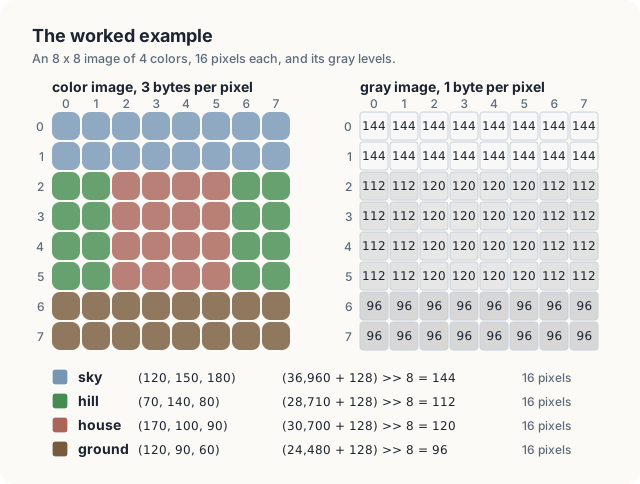
The 4 gray levels, 96, 112, 120 and 144, lie within 48 of each other, on a scale that runs from 0 to 255. The image therefore has low contrast. Its darkest pixel is a dark gray, its brightest pixel is a light gray, and the hill and the house differ by only 8 levels. The pipeline improves the image in 4 stages.
- Gray conversion replaces each color pixel by 1 level (Figure 24.1, right).
- Histogram equalization spreads the levels in use over the whole scale. The 4 levels move to 0, 85, 170 and 255.
- A Gaussian blur replaces each pixel by a weighted average of the 5 × 5 pixels around it, which removes noise and softens the steps between regions.
- Sobel edges measure how fast the level changes at each pixel. The result is bright where 2 regions meet and dark inside a region.
Each stage reads the image that the previous stage wrote. What distinguishes the stages, from the point of view of a parallel program, is the number of input pixels on which 1 output pixel depends. We name the three cases that occur.
Definition 24.2 Point, neighborhood and global operations. An image operation is a point operation if each output pixel depends only on the input pixel at the same position. It is a neighborhood operation if each output pixel depends on a small window of input pixels around its position. It is a global operation if its result depends on every pixel of the image.
Example. Gray conversion is a point operation; the blur, with a window of 5 × 5, and the Sobel detector, with a window of 3 × 3, are neighborhood operations; equalization contains a global operation, the histogram of all 64 levels.
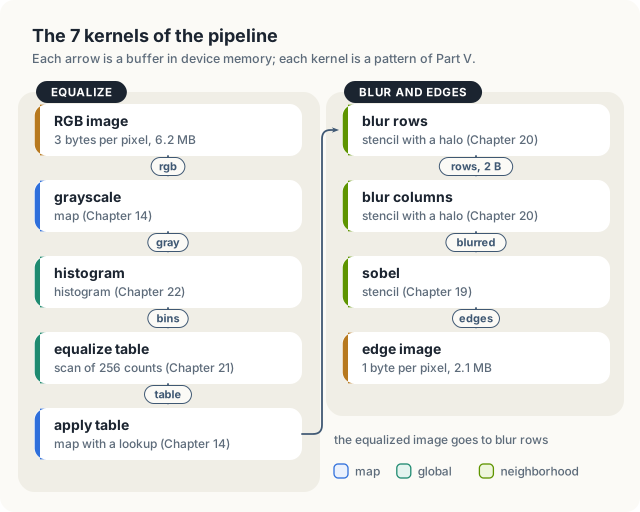
Figure 24.2 shows the pipeline as the 7 kernels of our programs, together with the buffers between them. The equalization takes three kernels and the blur takes 2, for reasons that we explain in Sections 24.4 and 24.5. Figure 24.3 shows what the programs produce for their test image of 1,920 × 1,080 pixels.
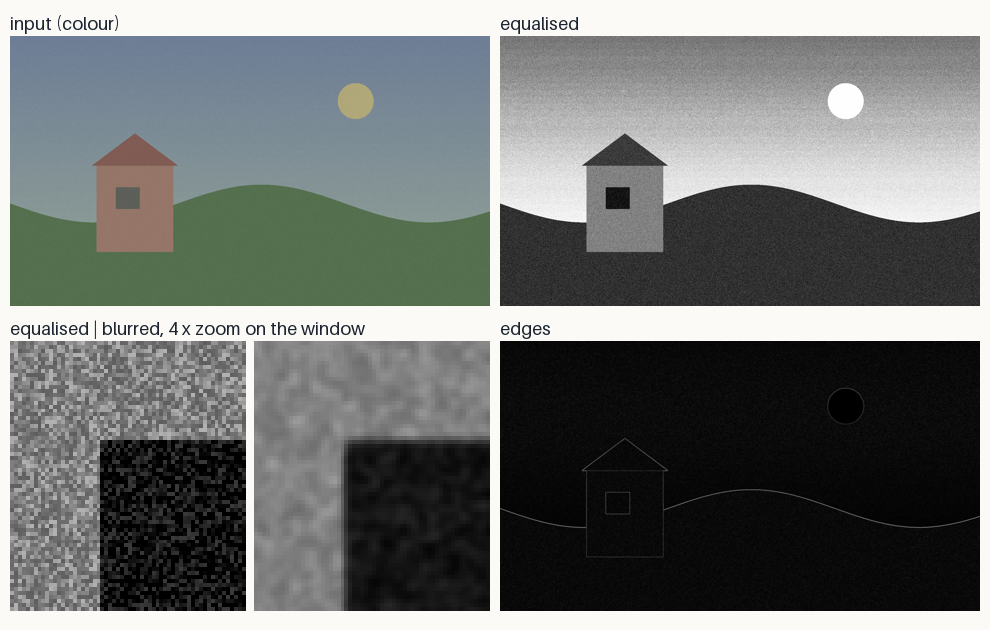
Note that equalization strengthens the grain of the test image together with the scene, because it stretches every difference between levels, including the small random ones. The blur removes most of the grain before the edge detector runs, so the edge image shows the outlines of the objects and only a faint texture elsewhere.
Exercises
24.1 At which byte of a gray image of width 1,920 is pixel \((10, 2)\) stored? At which bytes are
its 3 color bytes?
24.2 In the example, which pixels does the blur of pixel \((0, 0)\) depend on, if positions
outside the image are not counted? Which pixels does the equalized level of pixel \((0, 0)\)
depend on?
24.3 Classify as point, neighborhood or global: inverting an image (\(255 - v\)); finding its
brightest level; replacing each pixel by the median of its 3 × 3 window.
24.2 The sequential pipeline
24.2.1 The algorithm
On a CPU, the 4 stages become a sequence of loops. One detail must be settled first. A blur window near the border of the image reaches past the border, so we need a level for positions outside the image. We let such a position take the level of the nearest pixel inside the image, and we write
\[ \mathrm{clamp}(i, n) = \min(\max(i, 0), n - 1) \]
for this rule. Here \(i\) is a column or row number that may lie outside the image, and \(n\) is the width or the height. For example, with \(n = 8\), \(\mathrm{clamp}(-2, 8) = 0\), \(\mathrm{clamp}(5, 8) = 5\) and \(\mathrm{clamp}(9, 8) = 7\). The 5 weights of the blur are \(w = (1, 4, 6, 4, 1)\), and we explain them in Section 24.5.
Image-Pipeline(\(\mathsf{rgb}, W, H\))
- for \(\mathsf{pixel} \in [0, W \cdot H)\) {
- \(\mathsf{byte} = 3 \cdot \mathsf{pixel}\) // the first of its 3 bytes
- \(\mathsf{gray}[\mathsf{pixel}] = (77\, \mathsf{rgb}[\mathsf{byte}] + 150\, \mathsf{rgb}[\mathsf{byte}+1] + 29\, \mathsf{rgb}[\mathsf{byte}+2] + 128) \gg 8\)
- }
- \(\mathsf{bins}[\mathsf{level}] = 0\) for every \(\mathsf{level} \in [0, 256)\)
- for \(\mathsf{pixel} \in [0, W \cdot H)\) {
- \(\mathsf{bins}[\mathsf{gray}[\mathsf{pixel}]] = \mathsf{bins}[\mathsf{gray}[\mathsf{pixel}]] + 1\) // histogram
- }
- \(\mathsf{total} = 0\)
- for \(\mathsf{level} \in [0, 256)\) {
- \(\mathsf{total} = \mathsf{total} + \mathsf{bins}[\mathsf{level}]\), \(\;\mathsf{cdf}[\mathsf{level}] = \mathsf{total}\) // scan
- }
- \(\mathsf{first} = \mathsf{cdf}[\mathsf{level}]\) for the lowest \(\mathsf{level}\) with \(\mathsf{bins}[\mathsf{level}] > 0\), \(\;\mathsf{span} = W \cdot H - \mathsf{first}\)
- for \(\mathsf{level} \in [0, 256)\) {
- \(\mathsf{table}[\mathsf{level}] = \lfloor (\max(\mathsf{cdf}[\mathsf{level}] - \mathsf{first}, 0) \cdot 255 + \lfloor \mathsf{span}/2 \rfloor) / \mathsf{span} \rfloor\)
- }
- for \(\mathsf{pixel} \in [0, W \cdot H)\) {
- \(\mathsf{equal}[\mathsf{pixel}] = \mathsf{table}[\mathsf{gray}[\mathsf{pixel}]]\)
- }
- for \(y \in [0, H)\), \(x \in [0, W)\) {
- \(\mathsf{rows}[y][x] = \sum_{j \in [0,5)} w_j \cdot \mathsf{equal}[y][\mathrm{clamp}(x + j - 2, W)]\)
- }
- for \(y \in [0, H)\), \(x \in [0, W)\) {
- \(\mathsf{blurred}[y][x] = (\sum_{i \in [0,5)} w_i \cdot \mathsf{rows}[\mathrm{clamp}(y + i - 2, H)][x] + 128) \gg 8\)
- }
- for \(y \in [0, H)\), \(x \in [0, W)\) {
- \((g_x, g_y) = \) Sobel\((\mathsf{blurred}, x, y)\)
- \(\mathsf{edges}[y][x] = \min(\lfloor \sqrt{g_x^2 + g_y^2}\,/\,4 + 1/2 \rfloor, 255)\)
- }
Lines 1 to 4 convert to gray, lines 5 to 19 equalize, lines 20 to 25 blur in 2 passes, and lines 26 to 29 compute the edges. The symbol \(\gg 8\) is a shift right by 8 bits, which is a division by 256 that discards the remainder; for example, \(37{,}088 \gg 8 = 144\). In lines 13 and 15, \(\mathsf{first}\) is the cumulative count of the darkest level in use, and \(\mathsf{span}\) is the number of pixels above that level. In the example, \(\mathsf{first} = 16\) and \(\mathsf{span} = 64 - 16 = 48\). In Sections 24.3 to 24.6, we explain each group of lines on the example. In this section, we count the work and examine what each line depends on.
24.2.2 Counting the work
Lines 2 and 3 run once for each pixel, 64 times in our example, with 3 multiplications each time. Lines 7 and 18 also run 64 times. Lines 11 and 15 run 256 times, once for each possible level, whatever the size of the image. Lines 21 and 24 each run 64 times with 5 multiply-adds, which makes 320 multiply-adds per pass. Line 27 reads the 8 neighbors of each of the 64 outputs and adds 12 weighted terms. The example therefore needs 192 multiplications for the gray levels, 640 multiply-adds for the blur and 768 weighted terms for the edges, and the CPU performs them one after another.
In general, with \(N = W \cdot H\) pixels, every line except lines 11 and 15 runs \(N\) times. For an image of 1,920 × 1,080 pixels, \(N = 2{,}073{,}600\), and the 2 blur passes alone perform \(2 \cdot 5N = 20{,}736{,}000\) multiply-adds. In Section 24.10, we measure the whole sequence on 8 CPU cores at 38 to 51 images per second.
24.2.3 What each line depends on
The sequential order of the loops hides how little most lines need. Lines 2 and 3 compute \(\mathsf{gray}[\mathsf{pixel}]\) from the 3 bytes of pixel \(\mathsf{pixel}\) and from nothing else. Line 18 reads \(\mathsf{gray}[\mathsf{pixel}]\) and 1 entry of a table of 256 bytes. Line 21 reads 5 pixels of 1 row, line 24 reads 5 row sums of 1 column, and line 27 reads the 3 × 3 pixels around \((x, y)\). For each of these lines, every output could be computed at the same time as every other output, as soon as its few inputs exist.
Lines 5 to 15 are different. The table entry of line 15 needs \(\mathsf{cdf}[\mathsf{level}]\), which counts every pixel of the image with a level of at most \(\mathsf{level}\). For example, \(\mathsf{cdf}[112] = 32\) counts the 16 pixels of level 96 and the 16 pixels of level 112, wherever they lie in the image. No entry of the table, and therefore no pixel of the equalized image, can be computed until the histogram of the whole image is complete.
Key observation Each stage of the pipeline is a pattern of Part V, decided by how many input pixels 1 output pixel depends on: 1 pixel (a map), a small window (a stencil), or all pixels (a histogram followed by a scan). The patterns give the kernels; the pipeline connects them, in an order that only the histogram constrains.
Exercises
24.4 How many times does line 21 read each pixel of the equalized image, away from the border? How
many times does line 27 read each pixel of the blurred image?
24.5 Lines 11 and 15 run 256 times for an image of any size. What fraction of the work of
Image-Pipeline do they represent for the image of 1,920 × 1,080 pixels?
24.6 Which lines of Image-Pipeline could start on pixel \(\mathsf{pixel}\) before lines 2 and 3 have finished every
pixel? Which could not, and why?
24.3 Conversion to gray
24.3.1 The weights
A gray image needs 1 level per pixel, so we must combine the 3 levels of a color pixel into 1. The plain average would be the simplest choice, but it does not match what a viewer sees, because the eye is most sensitive to green and least sensitive to blue. A pure green pixel therefore looks brighter than a pure blue pixel of the same level. The ITU-R BT.601 standard weighs the 3 levels accordingly: \[ Y = 0.299\,R + 0.587\,G + 0.114\,B. \]
| Symbol | Meaning | For the sky of the example |
|---|---|---|
| \(R, G, B\) | levels of red, green and blue of the pixel | 120, 150, 180 |
| 0.299, 0.587, 0.114 | weights of the 3 colors, summing to 1 | |
| \(Y\) | perceived brightness, the gray level | 144.45 |
For the sky, \(Y = 0.299 \cdot 120 + 0.587 \cdot 150 + 0.114 \cdot 180 = 35.88 + 88.05 + 20.52 = 144.45\).
Our programs compute with the same weights in integers. Each weight is multiplied by 256 and rounded to the nearest integer: \(0.299 \cdot 256 = 76.5\) becomes 77, \(0.587 \cdot 256 = 150.3\) becomes 150, and \(0.114 \cdot 256 = 29.2\) becomes 29. The 3 integers sum to exactly 256, so a white pixel (255, 255, 255) gives \(255 \cdot 256\) and keeps level 255 after the division by 256. The division is a shift right by 8 bits. Adding 128, half of 256, before the shift makes the division round to the nearest level instead of down. For the sky, we obtain \[ 77 \cdot 120 + 150 \cdot 150 + 29 \cdot 180 = 9{,}240 + 22{,}500 + 5{,}220 = 36{,}960, \qquad (36{,}960 + 128) \gg 8 = 144, \] which is the floating-point value 144.45, rounded. Figure 24.1 lists the same computation for the other 3 colors.
We use integers for a reason that we make precise in Section 24.8. The programs compare every pixel of the GPU’s output with the CPU’s output, and they can demand exact equality only if both processors perform exactly the same operations. Integer additions and multiplications give the same result on every processor. Floating-point expressions do not always do so, because the GPU compiler may fuse a multiplication and an addition into 1 instruction that rounds once instead of twice. In Chapter 10, we measured such differences on 585,903 of 2,097,152 values.
24.3.2 The kernel
Gray conversion is a map, the pattern of Chapter 14, and its kernel therefore gives each pixel its own thread. We first restate the terms that we need.
Definition 24.3 Kernel, thread, block and grid. A kernel is a function that the GPU runs many times at once, and each run is a thread. Threads are grouped into blocks of up to 1,024 threads; the threads of a block run on the same processor of the GPU, a streaming multiprocessor (SM), and can share a small fast memory and wait for one another. The grid is the set of all blocks of 1 launch. Each thread reads its position from the built-in values \(\mathsf{blockIdx}\), \(\mathsf{blockDim}\) and \(\mathsf{threadIdx}\).
Example. The gray kernel for the 8 × 8 example could run as 1 block of 64 threads; thread 3 converts pixel \((3, 0)\).
Gray-Kernel(\(\mathsf{rgb}, \mathsf{gray}, W, H\))
- \(\mathsf{pixel} = \mathsf{blockIdx{.}x} \cdot \mathsf{blockDim{.}x} + \mathsf{threadIdx{.}x}\)
- if \(\mathsf{pixel} \in [0, W \cdot H)\) {
- \(\mathsf{red} = \mathsf{rgb}[3 \cdot \mathsf{pixel}]\), \(\;\mathsf{green} = \mathsf{rgb}[3 \cdot \mathsf{pixel} + 1]\), \(\;\mathsf{blue} = \mathsf{rgb}[3 \cdot \mathsf{pixel} + 2]\) // 3 reads
- \(\mathsf{gray}[\mathsf{pixel}] = (77 \cdot \mathsf{red} + 150 \cdot \mathsf{green} + 29 \cdot \mathsf{blue} + 128) \gg 8\) // 1 write
- }
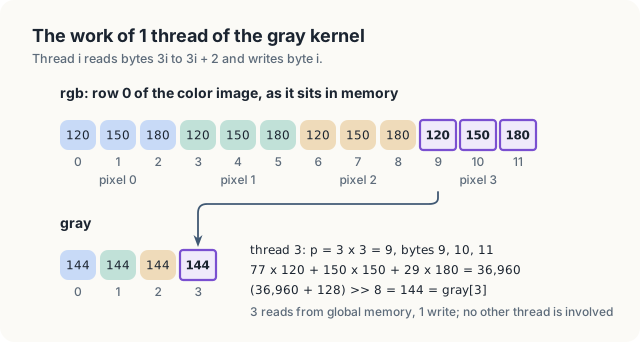
Line 1 gives each thread a pixel number \(\mathsf{pixel}\). Line 2 skips the threads of the last block whose number lies past the end of the image, since such threads have no pixel to convert. Figure 24.4 follows thread 3 of the example. It reads bytes 9, 10 and 11, computes 144, and writes byte 3 of the gray image. This makes 3 reads from global memory and 1 write, and no other thread is involved.
The GPU runs the threads of a block in groups of 32, and the order of the bytes in memory decides how fast the reads of such a group are served.
Definition 24.4 Warp and coalesced access. A warp is a group of 32 consecutive threads of a block that execute the same instruction together; its threads are its lanes 0 to 31. An access of a warp to global memory is coalesced when its 32 addresses fall into as few aligned segments of 32 bytes as the data allow, so that the memory system serves the whole warp with a few transfers.
Example. The 32 threads of a warp of the gray kernel read pixels \(\mathsf{pixel}\) to \(\mathsf{pixel} + 31\), which are 96 consecutive bytes of the color image, and the memory system serves each of the 3 read instructions from the same 3 segments of 32 bytes.
For the image of 1,920 × 1,080 pixels, the programs launch 8,100 blocks of 256 threads, and since \(8{,}100 \cdot 256 = 2{,}073{,}600\), this is exactly one thread per pixel. The following kernels implement lines 1 to 5 of Gray-Kernel.
mod kernels {
    // ...
    /// 1 thread per pixel. BT.601 weights in 8-bit fixed point: 77 + 150 + 29 = 256.
    #[kernel]
    #[launch_contract(domain = 1, block = (256, 1, 1))]
    pub fn grayscale(rgb: &[u8], mut gray: DisjointSlice<u8>) {
        let idx = thread::index_1d();
        let byte = 3 * idx.get();

        if let Some(gray_pixel) = gray.get_mut(idx) {
            let (red, green) = (rgb[byte] as u32, rgb[byte + 1] as u32);
            let blue = rgb[byte + 2] as u32;
            *gray_pixel = ((77 * red + 150 * green + 29 * blue + 128) >> 8) as u8;
        }
    }
    // ...
}
// 1 thread per pixel. BT.601 weights in 8-bit fixed point: 77 + 150 + 29 = 256.
__global__ void grayscale(const uint8_t* rgb, uint8_t* gray)
{
int pixel = blockIdx.x * blockDim.x + threadIdx.x;
if (pixel < PIXELS) {
unsigned red = rgb[3 * pixel];
unsigned green = rgb[3 * pixel + 1];
unsigned blue = rgb[3 * pixel + 2];
gray[pixel] = (77 * red + 150 * green + 29 * blue + 128) >> 8;
}
}
In Rust, thread::index_1d() is line 1, and the test of line 2 is the call gray.get_mut(idx). The
output is a DisjointSlice, a slice that hands each thread only the element of its own index, and
get_mut returns None for a thread whose index lies past the end, so the write needs no unsafe
block. The attribute #[launch_contract(domain = 1, block = (256, 1, 1))] records the block shape.
The host must prepare every launch against it, and a launch with another shape is refused on the
host before it reaches the GPU. The C++ kernel tests the index itself and writes through a raw
pointer. In both languages, the levels are widened to 32-bit integers before the multiplication,
because \(77 \cdot 255 = 19{,}635\) does not fit in a byte.
24.3.3 Weights that do not sum to 256
A common mistake is to truncate the 3 weights instead of rounding them. Since \(0.299 \cdot 256 = 76.54\), truncation gives 76, and the 3 weights 76, 150 and 29 then sum to 255 instead of 256. Every level then comes out slightly too dark, and the error grows with the level. The sky keeps level 144, since \((76 \cdot 120 + 22{,}500 + 5{,}220 + 128) \gg 8 = 36{,}968 \gg 8 = 144\), but a white pixel gives \((255 \cdot 255 + 128) \gg 8 = 65{,}153 \gg 8 = 254\) instead of 255. A test image with no white pixel does not reveal the mistake, whereas a test that converts (255, 255, 255) does.
Exercises
24.7 Convert the pixels (255, 0, 0), (0, 255, 0) and (0, 0, 255) with the integer weights. Explain
why the 3 results differ.
24.8 A warp of the gray kernel reads 96 bytes with 3 load instructions. How many bytes would each
load instruction move if each thread converted 4 pixels and read its 12 bytes as 3 words of 4
bytes?
24.9 Without the 128 in line 4, which of the 4 colors of the example changes its gray level?
24.4 Histogram equalization
24.4.1 The method on the example
The image of the example uses only 4 levels, which lie between 96 and 144, while the scale offers 256 levels between 0 and 255. We would like the levels in use to spread over the whole scale, with the darkest level in use becoming black and the brightest becoming white. Equalization achieves this by moving each level to a new level in proportion to the number of pixels at or below it. It needs 2 quantities, which we now define.
Definition 24.5 Histogram and cumulative count. The histogram of a gray image counts, for each level \(v \in [0, 256)\), the pixels whose level is \(v\); we call the counts \(\mathsf{bins}[v]\). The cumulative count \(c(v)\) is the number of pixels whose level is at most \(v\), \(c(v) = \sum_{u \le v} \mathsf{bins}[u]\). The sequence \(c\) is the inclusive scan of the histogram (Chapter 21).
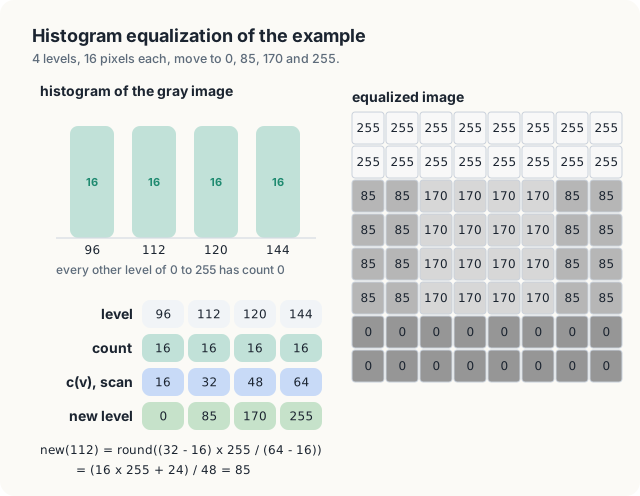
Example. The gray image of Figure 24.1 has \(\mathsf{bins}[96] = \mathsf{bins}[112] = \mathsf{bins}[120] = \mathsf{bins}[144] = 16\) and every other count 0. Its cumulative counts are \(c(96) = 16\), \(c(112) = 32\), \(c(120) = 48\) and \(c(144) = 64\).
The cumulative count tells us what fraction of the pixels is at least as dark as a given level. If 50% of the pixels have a level of at most \(v\), equalization moves \(v\) to about 50% of 255. Since the darkest level in use should become 0 and the brightest should become 255, we subtract the cumulative count \(c_{\min}\) of the darkest level in use, and we divide by what remains.
Definition 24.6 Equalization table. For an image of \(N\) pixels, let \(c_{\min}\) be the cumulative count at the lowest level in use. The equalization table maps level \(v\) to \[ \mathrm{new}(v) = \mathrm{round}\left(\frac{\max(c(v) - c_{\min}, 0)}{N - c_{\min}} \cdot 255\right), \] and the equalized image replaces each level \(v\) by \(\mathrm{new}(v)\).
Example. With \(N = 64\) and \(c_{\min} = c(96) = 16\), \(\mathrm{new}(112) = \mathrm{round}(16 \cdot 255 / 48) = 85\).
| Symbol | Meaning | For level 112 of the example |
|---|---|---|
| \(N\) | number of pixels in the image | 64 |
| \(c(v)\) | number of pixels with a level of at most \(v\) | \(c(112) = 32\) |
| \(c_{\min}\) | cumulative count at the darkest level in use | \(c(96) = 16\) |
| \(c(v) - c_{\min}\) | pixels above the darkest level and at most \(v\) | 16 |
| \(N - c_{\min}\) | pixels above the darkest level | 48 |
| \(\mathrm{new}(v)\) | equalized level | \(\mathrm{round}(16 / 48 \cdot 255) = 85\) |
The fraction in the formula runs from 0 at the darkest level in use to 1 at the brightest level in use, and the factor 255 stretches it over the whole scale. Figure 24.5 works the whole table. Level 96 moves to \(\mathrm{round}(0 \cdot 255 / 48) = 0\), level 120 to \(\mathrm{round}(32 \cdot 255 / 48) = 170\), and level 144 to \(\mathrm{round}(48 \cdot 255 / 48) = 255\). The 4 levels, which were within 48 of each other, now cover the whole scale in equal steps of 85, because each of them holds a quarter of the pixels. In the programs, line 15 of Image-Pipeline performs the rounding in integers. For a numerator \(a\) and a denominator \(s\), the expression \(\lfloor (a + \lfloor s/2 \rfloor) / s \rfloor\) is \(a / s\) rounded to the nearest integer, and for level 112, it gives \(\lfloor (4{,}080 + 24) / 48 \rfloor = 85\).
The cumulative count never decreases as \(v\) grows, and therefore neither does \(\mathrm{new}(v)\). Hence 2 pixels that were in a given order of brightness keep that order. Equalization changes the contrast of an image, not its arrangement of light and dark.
The method splits into 3 steps with different patterns: the histogram, which is a global operation, the table of 256 entries, which is a scan, and the replacement of each level, which is a map. Each step needs the previous one to be complete, so the programs use 1 kernel for each step.
24.4.2 The histogram kernel
In a histogram kernel, many threads add to the same few counters, and their additions must not interfere with each other. Recall that in Chapter 22, we solved this problem with atomic operations and with private counters for each block. We restate the terms here.
Definition 24.7 Shared memory, barrier and atomic operation. Shared memory is a small memory on each SM that the threads of 1 block share; it answers in a few cycles, and its contents last as long as the block. A barrier is a point in a kernel that no thread of a block passes until every thread of the block has reached it. An atomic operation reads a memory word, changes it and writes it back as 1 step, so that no other thread can access the word in between.
Example. 2 threads that add 1 to the same counter with an atomic addition always leave it 2 higher.
Each block of the histogram kernel counts into its own 256 counters in shared memory, and it adds them to the global counters only once, at the end. The following procedure gives the details.
Histogram-Kernel(\(\mathsf{gray}, \mathsf{bins}, N\))
- \(\mathsf{stride} = \mathsf{gridDim{.}x} \cdot 256\) // threads in the grid
- \(\mathsf{local}[\mathsf{threadIdx{.}x}] = 0\) // 256 threads clear 256 counters
- Barrier()
- for \(\mathsf{pixel} = \mathsf{blockIdx{.}x} \cdot 256 + \mathsf{threadIdx{.}x}\); \(\mathsf{pixel} < N\); \(\mathsf{pixel} = \mathsf{pixel} + \mathsf{stride}\) {
- Atomic-Add\((\mathsf{local}[\mathsf{gray}[\mathsf{pixel}]], 1)\) // shared memory
- }
- Barrier()
- if \(\mathsf{local}[\mathsf{threadIdx{.}x}] > 0\) {
- Atomic-Add\((\mathsf{bins}[\mathsf{threadIdx{.}x}], \mathsf{local}[\mathsf{threadIdx{.}x}])\) // global memory
- }
Line 1 computes the number of threads in the grid, and line 2 clears the counters, 1 per thread. The loop of lines 4 to 6 walks through the image with a stride of the whole grid, that is, a thread advances by the total number of threads, \(\mathsf{gridDim{.}x} \cdot 256\), from 1 pixel to its next. Line 5 counts each pixel in the block’s own counter for its level. The barrier of line 3 ensures that no count starts before every counter is 0, and the barrier of line 7 ensures that no block total is read before every count of the block is done. Lines 8 to 10 add the block’s 256 totals to the global histogram, skipping the counters that stayed at 0.
For the image of 1,920 × 1,080 pixels, the programs launch 64 blocks of 256 threads, 16,384 threads in all, so each thread counts 2,073,600 / 16,384 = 126.6 pixels, that is, 126 or 127. The global counters therefore receive at most \(64 \cdot 256 = 16{,}384\) atomic additions instead of 2,073,600. For the 8 × 8 example, 1 block would suffice. Threads 0 to 63 would each count 1 pixel, and threads 96, 112, 120 and 144 would each add 16 to the global counter of their level.
mod kernels {
// ...
/// Counts gray levels in shared bins, then adds each block's bins to the global ones.
#[kernel]
#[launch_contract(domain = 1, block = (256, 1, 1))]
pub fn histogram(gray: &[u8], bins: &[DeviceAtomicU32]) {
static mut LOCAL: SharedArray<u32, 256> = SharedArray::UNINIT;
let tid = thread::threadIdx_x() as usize;
// SAFETY: each thread zeroes only its own bin, before the barrier.
unsafe { LOCAL[tid] = 0 };
thread::sync_threads();
let stride = (thread::gridDim_x() * 256) as usize;
let mut pixel = thread::index_1d().get();
while pixel < gray.len() {
// SAFETY: between the 2 barriers every access to LOCAL is atomic.
let bin = unsafe {
let base = (*&raw mut LOCAL).as_mut_ptr();
BlockAtomicU32::from_ptr(base.add(gray[pixel] as usize))
};
bin.fetch_add(1, AtomicOrdering::Relaxed);
pixel += stride;
}
thread::sync_threads();
// SAFETY: after the barrier no thread writes LOCAL again.
let local = unsafe { LOCAL[tid] };
if local > 0 {
bins[tid].fetch_add(local, AtomicOrdering::Relaxed);
}
}
// ...
}// Counts gray levels in shared bins, then adds each block's bins to the global ones.
__global__ void histogram(const uint8_t* gray, unsigned* bins)
{
__shared__ unsigned local[256];
local[threadIdx.x] = 0;
__syncthreads();
int stride = gridDim.x * 256;
for (int pixel = blockIdx.x * 256 + threadIdx.x; pixel < PIXELS; pixel += stride) {
atomicAdd(&local[gray[pixel]], 1u);
}
__syncthreads();
if (local[threadIdx.x] > 0) {
atomicAdd(&bins[threadIdx.x], local[threadIdx.x]);
}
}
The two kernels follow Histogram-Kernel line by line, and they differ only in how they reach shared
memory. C++ declares __shared__ unsigned local[256] and calls atomicAdd on an element. Rust
declares static mut LOCAL: SharedArray<u32, 256> and turns the address of an element into a
BlockAtomicU32, an integer whose operations are atomic among the threads of 1 block, which is all
that shared memory needs. The global counters are a slice of DeviceAtomicU32, whose operations are
atomic among all threads of the device. Every direct access to LOCAL is unsafe, because the
compiler cannot check how concurrent threads use shared memory. Each // SAFETY: comment states
the argument instead, which rests on the 2 barriers of the pseudocode.
24.4.3 The table kernel
The table needs the scan of the 256 counts and the value \(\mathsf{cumulative}_{\min}\). A scan of 256 values is small, so a single block of 256 threads computes it, with thread \(\mathsf{level}\) responsible for level \(\mathsf{level}\). As in the block scan of Chapter 21, the block first scans each warp with register shuffles and then scans the 8 warp totals.
Table-Kernel(\(\mathsf{bins}, \mathsf{table}\))
- \(\mathsf{level} = \mathsf{threadIdx{.}x}\), \(\;\mathsf{lane} = \mathsf{level} \bmod 32\), \(\;\mathsf{warp} = \lfloor \mathsf{level} / 32 \rfloor\)
- \(\mathsf{count} = \) Atomic-Exchange\((\mathsf{bins}[\mathsf{level}], 0)\) // read and clear
- \(\mathsf{partial} = \) Warp-Scan\((\mathsf{count})\) // inclusive, within the warp
- if \(\mathsf{lane} = 31\) { \(\mathsf{warps}[\mathsf{warp}] = \mathsf{partial}\) }
- if \(\mathsf{level} = 0\) { \(\mathsf{first} = \infty\) }
- Barrier()
- if \(\mathsf{warp} = 0\) and \(\mathsf{lane} < 8\) { \(\mathsf{warps}[\mathsf{lane}] = \) Warp-Scan\((\mathsf{warps}[\mathsf{lane}])\) }
- Barrier()
- \(\mathsf{cumulative} = \mathsf{partial} + \mathsf{warps}[\mathsf{warp} - 1]\) if \(\mathsf{warp} > 0\), else \(\mathsf{cumulative} = \mathsf{partial}\) // cumulative = c(level)
- if \(\mathsf{count} > 0\) { Atomic-Min\((\mathsf{first}, \mathsf{cumulative})\) }
- Barrier()
- \(\mathsf{span} = \mathsf{warps}[7] - \mathsf{first}\)
- \(\mathsf{table}[\mathsf{level}] = \lfloor (\max(\mathsf{cumulative} - \mathsf{first}, 0) \cdot 255 + \lfloor \mathsf{span}/2 \rfloor) / \mathsf{span} \rfloor\)
In the procedure, \(\mathsf{lane}\) is the position of thread \(\mathsf{level}\) in its warp and \(\mathsf{warp}\) the number of its warp; for thread 112, for example, \(\mathsf{lane} = 16\) and \(\mathsf{warp} = 3\). The array \(\mathsf{warps}\) in shared memory holds the 8 warp totals, and \(\mathsf{first}\) receives the smallest cumulative count of a level in use, which is \(\mathsf{cumulative}_{\min}\).
Let us follow the example. The 4 levels in use belong to 2 warps. Warp 3 holds threads 96 to 127, and its scan gives 16 at lane 0 (level 96), 32 at lane 16 (level 112), and 48 from lane 24 (level 120) to lane 31, so \(\mathsf{warps}[3] = 48\). Warp 4 holds level 144 at lane 16, so \(\mathsf{warps}[4] = 16\). After line 7, the scanned warp totals are 0, 0, 0, 48, 64, 64, 64 and 64, and line 9 gives thread 144 the count \(\mathsf{cumulative} = 16 + 48 = 64\). Line 10 leaves \(\mathsf{first} = 16\), the smallest cumulative count among the 4 levels in use, which is \(\mathsf{cumulative}_{\min}\). The total number of pixels is the last warp total, \(\mathsf{warps}[7] = 64\), so the kernel needs no parameter for \(N\).
Line 2 reads each count with an atomic exchange, which returns the old value and stores 0. The kernel therefore leaves the global histogram cleared for the next image, and the pipeline needs no separate launch to clear it. In the programs, line 13 works in 64-bit integers, because \(\max(\mathsf{cumulative} - \mathsf{first}, 0) \cdot 255\) reaches \(2{,}073{,}600 \cdot 255 = 528{,}768{,}000\) for the large image, which is close to the limit of a 32-bit integer. Line 12 gives a span of 0 for an image of a single level, and in that case, the programs keep every level unchanged.
mod kernels {
// ...
/// 1 block of 256 threads, 1 thread per gray level: the cumulative count of the level,
/// then its new level. Each bin is read and reset to 0 for the next image.
#[kernel]
#[launch_contract(domain = 1, block = (256, 1, 1))]
pub fn equalise_table(bins: &[DeviceAtomicU32], mut table: DisjointSlice<u8>) {
static mut WARPS: SharedArray<u32, 8> = SharedArray::UNINIT;
static mut FIRST: SharedArray<u32, 1> = SharedArray::UNINIT;
let level = thread::threadIdx_x() as usize;
let lane = warp::lane_id() as usize;
let warp = level / 32;
let count = bins[level].swap(0, AtomicOrdering::Relaxed);
let inclusive = warp_scan(count);
if lane == 31 {
// SAFETY: lane 31 of each warp writes its own slot, before the barrier.
unsafe { WARPS[warp] = inclusive };
}
if level == 0 {
// SAFETY: only thread 0 writes FIRST before the barrier.
unsafe { FIRST[0] = u32::MAX };
}
thread::sync_threads();
if warp == 0 {
// SAFETY: only warp 0 touches WARPS between the 2 barriers.
let warp_total = if lane < 8 { unsafe { WARPS[lane] } } else { 0 };
let scanned_total = warp_scan(warp_total);
if lane < 8 {
unsafe { WARPS[lane] = scanned_total };
}
}
thread::sync_threads();
// SAFETY: WARPS is only read from here on; FIRST is changed only atomically.
let cdf = inclusive + if warp > 0 { unsafe { WARPS[warp - 1] } } else { 0 };
let first = unsafe { BlockAtomicU32::from_ptr((*&raw mut FIRST).as_mut_ptr()) };
if count > 0 {
first.fetch_min(cdf, AtomicOrdering::Relaxed);
}
thread::sync_threads();
let min = first.load(AtomicOrdering::Relaxed);
let span = (unsafe { WARPS[7] } - min) as u64;
let above = cdf.saturating_sub(min) as u64;
let new_level = if span == 0 {
level as u64
} else {
(above * 255 + span / 2) / span
};
if let Some(entry) = table.get_mut(thread::index_1d()) {
*entry = new_level as u8;
}
}
// ...
}// 1 block of 256 threads, 1 thread per gray level: the cumulative count of the level,
// then its new level. Each bin is read and reset to 0 for the next image.
__global__ void equaliseTable(unsigned* bins, uint8_t* table)
{
__shared__ unsigned warps[8];
__shared__ unsigned first;
int level = threadIdx.x;
int lane = level % 32;
int warp = level / 32;
unsigned count = atomicExch(&bins[level], 0u);
unsigned inclusive = warpScan(count);
if (lane == 31) {
warps[warp] = inclusive;
}
if (level == 0) {
first = 0xffffffffu;
}
__syncthreads();
if (warp == 0) {
unsigned scannedTotal = warpScan(lane < 8 ? warps[lane] : 0);
if (lane < 8) {
warps[lane] = scannedTotal;
}
}
__syncthreads();
unsigned cdf = inclusive + (warp > 0 ? warps[warp - 1] : 0);
if (count > 0) {
atomicMin(&first, cdf);
}
__syncthreads();
uint64_t span = warps[7] - first;
uint64_t above = cdf > first ? cdf - first : 0;
uint64_t newLevel = span == 0 ? level : (above * 255 + span / 2) / span;
table[level] = newLevel;
}
The 3 barriers of Table-Kernel are the 3 calls to sync_threads() and __syncthreads(). All of
them lie outside every if, so every thread of the block reaches them. Line 13 writes the table
through table.get_mut(...) in Rust, which is again a DisjointSlice, and through a plain store in
C++. The scan inside a warp is the device function warp_scan (warpScan in C++), which adds the
value of the lane 1, 2, 4, 8 and 16 places lower with shuffle_up_sync (__shfl_up_sync). We
derived this function in Chapter 21.
24.4.4 Applying the table
The last step of the equalization is a map. In the following kernels, each thread reads 1 gray level and writes the entry of the table for that level.
mod kernels {
// ...
/// 1 thread per pixel: the new level of each pixel, looked up in the table.
#[kernel]
#[launch_contract(domain = 1, block = (256, 1, 1))]
pub fn apply_table(gray: &[u8], table: &[u8], mut out: DisjointSlice<u8>) {
let idx = thread::index_1d();
let pixel = idx.get();
if let Some(cell) = out.get_mut(idx) {
*cell = table[gray[pixel] as usize];
}
}
// ...
}// 1 thread per pixel: the new level of each pixel, looked up in the table.
__global__ void applyTable(const uint8_t* gray, const uint8_t* table, uint8_t* out)
{
int pixel = blockIdx.x * blockDim.x + threadIdx.x;
if (pixel < PIXELS) {
out[pixel] = table[gray[pixel]];
}
}
The read table[gray[i]] is a gather, a read whose address depends on data. The 32 threads of a
warp read 32 entries of the table at unpredictable positions, which is the opposite of a coalesced
access. The table holds only 256 bytes, however, so after the first accesses, it stays in the L1
cache of each SM, and the gathers cost little.
24.4.5 A histogram without atomic additions
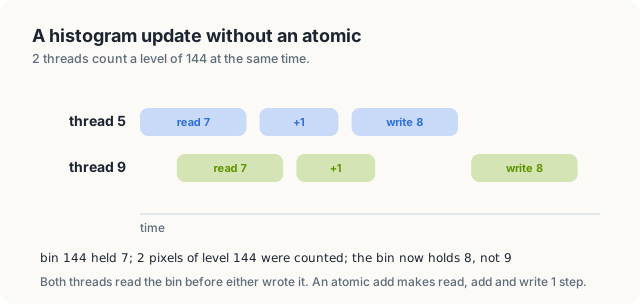
A common mistake in the histogram is to count with a plain addition, local[gray[i]] += 1. Such an
addition takes 3 steps, a read, an add and a write, and 2 threads that count the same level can
interleave these steps, as shown in Figure 24.6. Both threads read the old count 7, both write 8,
and 1 of the 2 pixels is lost.
On the example, 16 threads of 1 block count the 16 sky pixels, all of them of level 144. If they lose any of their additions, \(\mathsf{bins}[144]\) ends below 16, the total \(\mathsf{warps}[7]\) ends below 64, and the table changes. We ran the C++ program with this 1 change, and it printed the following report.
$ ./capstone # local[gray[i]] += 1, no atomicAdd
...
image pixels that differ from the CPU
gray 0
equalised 1961635 first at (0, 0): GPU 104, CPU 97
blurred 1988211 first at (0, 0): GPU 112, CPU 106
edges 1302442 first at (0, 0): GPU 9, CPU 10
...
FAILED
The gray image is still right, but 1,961,635 of the 2,073,600 equalized pixels, 95%, are wrong. A lost count lowers the cumulative count of its level and of every level above it, and with it, the table entry of almost every level. For example, pixel \((0, 0)\) became 104 instead of 97. The error then passes through the blur and the edges. Note also that the histogram stage of this broken program ran in 0.050 ms instead of about 0.12 ms, because plain additions do not wait for one another. A faster kernel is therefore no evidence of a correct one.
Exercises
24.10 Compute the equalization table for an image of 10 pixels with the levels 4, 4, 4, 5, 5, 6, 6,
6, 6, 7, on a scale of 8 levels (replace 255 by 7).
24.11 In Table-Kernel, why must line 10 run after the barrier of line 8 and not before it?
24.12 Histogram-Kernel is launched with 64 blocks. How many atomic additions reach global memory
for the 8 × 8 example with 1 block, and for the large image with 64 blocks?
24.5 A separable Gaussian blur
24.5.1 The weights
A blur replaces each pixel by a weighted average of the pixels around it. Averaging removes small random differences between neighboring pixels, such as the grain of the test image, at the cost of softening the edges between regions. A Gaussian blur uses weights that fall off with the distance from the center in the shape of the normal distribution, so that near pixels count more than far ones. We use the 5 weights \(w = (1, 4, 6, 4, 1)\) in each direction. They are the binomial coefficients of order 4, which approximate a normal distribution with a standard deviation of 1 pixel, since the binomial distribution of order 4 with probability 1/2 has variance \(4 \cdot \tfrac12 \cdot \tfrac12 = 1\). The 5 weights sum to 16.
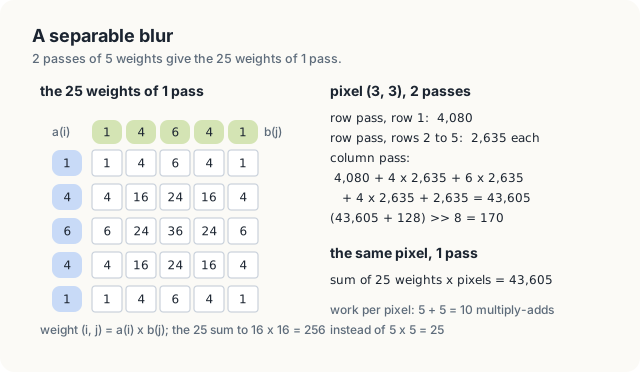
The 2-dimensional blur over a window of 5 × 5 pixels gives the pixel in row \(i\) and column \(j\) of the window the weight \(w_i w_j\), as shown on the left of Figure 24.7. For example, the pixel in row 0 and column 2 of the window has the weight \(w_0 w_2 = 1 \cdot 6 = 6\). The 25 weights run from 1 at the corners to 36 at the center, and they sum to \(16 \cdot 16 = 256\), so a region of constant level keeps its level after the division by 256.
Definition 24.8 Separable filter. A filter on a window of \(k \times k\) pixels is separable if its weight at row \(i\) and column \(j\) of the window is a product \(a_i b_j\) of a column weight and a row weight. Its row pass replaces each pixel by the sum of its \(k\) row neighbors weighted by \(b\), and its column pass does the same along the columns with the weights \(a\).
Example. The blur is separable with \(a = b = (1, 4, 6, 4, 1)\); the weight 36 at the center is \(6 \cdot 6\), and the weight 4 at row 0 and column 1 is \(1 \cdot 4\).
24.5.2 Separability
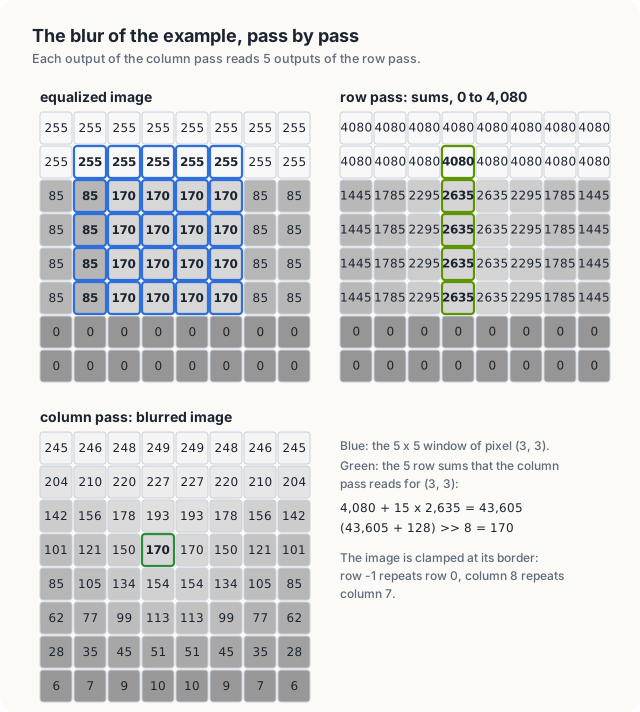
A direct blur multiplies 25 pixels by 25 weights for every output. Since each weight is a product of a weight for its row and a weight for its column, we may hope to apply the 2 factors one after the other, first along the rows and then along the columns. Let us blur pixel \((3, 3)\) of the equalized image by hand in this way, in 2 passes, as shown in Figure 24.8.
The row pass at \((3, y)\) reads pixels 1 to 5 of row \(y\), the window of width 5 centered on column 3. In rows 2 to 5, these pixels are 85, 170, 170, 170 and 170, so the row sum is \(85 + 4 \cdot 170 + 6 \cdot 170 + 4 \cdot 170 + 170 = 2{,}635\). In row 1, all 5 pixels are 255, and the sum is \(16 \cdot 255 = 4{,}080\). The column pass at \((3, 3)\) then reads the row sums of rows 1 to 5 and weighs them in the same way: \[ 4{,}080 + 4 \cdot 2{,}635 + 6 \cdot 2{,}635 + 4 \cdot 2{,}635 + 2{,}635 = 4{,}080 + 15 \cdot 2{,}635 = 43{,}605. \] The first term is the row sum of row 1 with weight 1, and the next 4 terms are the row sums of rows 2 to 5 with the weights 4, 6, 4 and 1. Finally, \((43{,}605 + 128) \gg 8 = 170\). Adding the 25 products of the 5 × 5 window with the weights of Figure 24.7 gives the same 43,605. This agreement is not a coincidence of the example, as the following theorem shows.
Theorem 24.1 Let \(e\) be an image of \(W \times H\) levels, let \(R(x, y) = \sum_{j \in [0,5)} w_j\, e(\mathrm{clamp}(x + j - 2, W), y)\) be its row sums, and let \(B(x, y) = (\sum_{i \in [0,5)} w_i\, R(x, \mathrm{clamp}(y + i - 2, H)) + 128) \gg 8\). Then for every pixel, \[ B(x, y) = \Big(\sum_{i \in [0,5)} \sum_{j \in [0,5)} w_i w_j\, e(\mathrm{clamp}(x + j - 2, W), \mathrm{clamp}(y + i - 2, H)) + 128\Big) \gg 8, \] the 2-dimensional blur with the 25 weights \(w_i w_j\).
| Symbol | Meaning | For pixel \((3, 3)\) of the example |
|---|---|---|
| \(e(x, y)\) | level of pixel \((x, y)\) of the equalized image | \(e(1, 2) = 85\) |
| \(w_j\) | weight \(j\) of the 5 weights \((1, 4, 6, 4, 1)\) | \(w_2 = 6\) |
| \(x + j - 2\) | column \(j\) of the window, which starts 2 columns left of \(x\) | columns 1 to 5 |
| \(R(x, y)\) | row sum, the result of the row pass | \(R(3, 2) = 2{,}635\) |
| \(B(x, y)\) | blurred level, the result of the column pass | 170 |
Proof. Fix \((x, y)\) and write \(y_i = \mathrm{clamp}(y + i - 2, H)\) and \(x_j = \mathrm{clamp}(x + j - 2, W)\). By the definition of \(R\), \(R(x, y_i) = \sum_j w_j\, e(x_j, y_i)\): the clamp acts on each coordinate separately, so the columns \(x_j\) that the row pass reads in row \(y_i\) do not depend on \(i\). Hence \[ \sum_i w_i\, R(x, y_i) = \sum_i w_i \sum_j w_j\, e(x_j, y_i) = \sum_i \sum_j w_i w_j\, e(x_j, y_i), \] since multiplication distributes over the inner sum. Every quantity is a non-negative integer: a row sum is at most \(16 \cdot 255 = 4{,}080\), and a column sum at most \(16 \cdot 4{,}080 = 65{,}280\), far below \(2^{32}\). Every addition and multiplication is therefore exact, the two sides are the same integer before the shift, and the shift gives the same result.
The proof needs the row pass to keep its sums whole. A program that divides by 16 with rounding after each pass, instead of by 256 once at the end, computes a different image. On the example, the row sum 2,635 becomes 165, 4,080 becomes 255, and pixel \((3, 3)\) becomes \((255 + 15 \cdot 165 + 8) \gg 4 = 171\) instead of 170. In this way, 16 of the 64 pixels of the example change. Our programs therefore store the row sums unscaled, in 2 bytes per pixel.
24.5.3 Counting the savings
The 2-dimensional blur performs 25 multiply-adds per pixel, whereas the 2 passes perform \(5 + 5 = 10\). For a window of \(k \times k\) pixels, the counts are \(k^2\) and \(2k\), so the saving grows with the window. It is 2.5 times for \(k = 5\), and 7.5 times for \(k = 15\), with 225 multiply-adds against 30. For the image of 1,920 × 1,080 pixels, the 2 passes save \(15 \cdot 2{,}073{,}600 = 31{,}104{,}000\) multiply-adds per image.
The 2 passes cost memory traffic instead. The row pass writes its sums to an intermediate image of 2 bytes per pixel, 4.1 MB for the large image, and the column pass reads this image back. In Section 24.9, we show that the time of the blur is set by this traffic, not by the multiply-adds.
24.5.4 The tile and its halo
Each output of the row pass reads 5 pixels, and each pixel is read by 5 outputs. A kernel that reads its inputs from global memory therefore fetches every pixel 5 times. Recall from Chapter 20 that tiling removes this repetition. The threads of a block first copy the pixels that the block needs into shared memory, once, and every thread then reads its 5 inputs from the copy.
Definition 24.9 Tile and halo. A tile is the piece of the input that a block copies into shared memory. For a block of \(\mathsf{blockDim{.}x}\) outputs of a filter that reads \(r\) positions on each side, the tile holds \(\mathsf{blockDim{.}x} + 2r\) inputs: the \(\mathsf{blockDim{.}x}\) positions of the block’s own outputs and \(r\) more on each side. The \(2r\) extra positions are the halo.
Example. A block of 8 outputs of the row pass, with \(r = 2\), needs a tile of 12 pixels; its halo is 2 pixels on the left and 2 on the right.
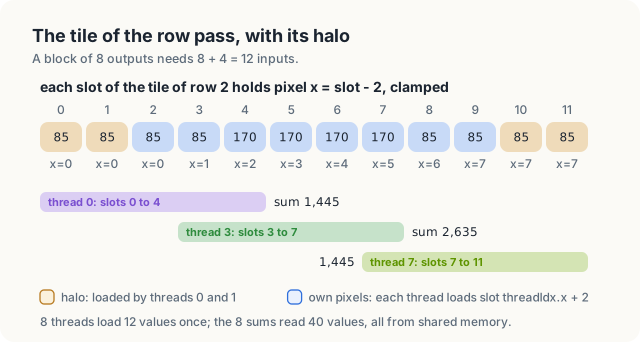
Figure 24.9 shows the tile of row 2 of the example for a block of 8 threads. The slot with number \(\mathsf{slot}\) holds pixel \(\mathsf{left} + \mathsf{slot} - 2\) of the row, clamped, where \(\mathsf{left}\) is the column of the first output of the block. The shift by 2 makes room for the 2 halo pixels on the left. In the example, \(\mathsf{left} = 0\), so slot 2 holds pixel 0, and slots 0 and 1 hold the clamped pixels \(-2\) and \(-1\), which are both pixel 0. Thread \(\mathsf{threadIdx{.}x}\) copies its own pixel into slot \(\mathsf{threadIdx{.}x} + 2\), and threads 0 and 1 also copy the 4 halo slots. After a barrier, thread \(\mathsf{threadIdx{.}x}\) reads slots \(\mathsf{threadIdx{.}x}\) to \(\mathsf{threadIdx{.}x} + 4\), which hold pixels \(\mathsf{left} + \mathsf{threadIdx{.}x} - 2\) to \(\mathsf{left} + \mathsf{threadIdx{.}x} + 2\). For example, thread 3 reads slots 3 to 7, which hold pixels 1 to 5.
Blur-Rows(\(\mathsf{src}, \mathsf{rows}, W\))
- \(\mathsf{left} = \mathsf{blockIdx{.}x} \cdot \mathsf{blockDim{.}x}\), \(\;y = \mathsf{blockIdx{.}y}\)
- \(\mathsf{tile}[\mathsf{threadIdx{.}x} + 2] = \mathsf{src}[y][\mathrm{clamp}(\mathsf{left} + \mathsf{threadIdx{.}x}, W)]\) // own pixel
- if \(\mathsf{threadIdx{.}x} < 2\) {
- \(\mathsf{tile}[\mathsf{threadIdx{.}x}] = \mathsf{src}[y][\mathrm{clamp}(\mathsf{left} + \mathsf{threadIdx{.}x} - 2, W)]\) // left halo
- \(\mathsf{tile}[\mathsf{blockDim{.}x} + 2 + \mathsf{threadIdx{.}x}] = \mathsf{src}[y][\mathrm{clamp}(\mathsf{left} + \mathsf{blockDim{.}x} + \mathsf{threadIdx{.}x}, W)]\) // right halo
- }
- Barrier()
- \(\mathsf{rows}[y][\mathsf{left} + \mathsf{threadIdx{.}x}] = \sum_{\mathsf{tap} \in [0,5)} w_{\mathsf{tap}} \cdot \mathsf{tile}[\mathsf{threadIdx{.}x} + \mathsf{tap}]\)
Lines 2 to 6 are the joint copy, line 7 separates the copy from the reads, and line 8 is line 21 of Image-Pipeline with every read taken from the tile. A block now fetches \(\mathsf{blockDim{.}x} + 4\) pixels from global memory for \(\mathsf{blockDim{.}x}\) outputs, instead of \(5 \cdot \mathsf{blockDim{.}x}\). The programs use \(\mathsf{blockDim{.}x} = 128\), which gives 132 fetches instead of 640 per block, and 15 blocks cover a row of 1,920 pixels exactly.
The column pass works in the same way along the columns. A block of 32 × 8 threads computes 8 rows of 32 columns, and its tile holds the 8 + 4 = 12 rows of 32 row sums that these outputs read. The block is 32 threads wide, so that a warp reads 32 consecutive row sums of 1 row, which are 64 consecutive bytes. The column pass finishes with the rounding of line 24 of Image-Pipeline, \((sum + 128) \gg 8\). The following code shows both passes.
mod kernels {
// ...
/// Row pass, weights 1 4 6 4 1. Slot `slot` of the tile holds pixel left + slot - 2,
/// clamped: 2 halo slots on the left, 128 own pixels, 2 halo slots on the right.
#[kernel]
#[launch_contract(domain = 2, coordinates = u32, block = (128, 1, 1))]
pub fn blur_rows(src: &[u8], mut out: DisjointSlice<u16, Index2D<W>>) {
static mut TILE: SharedArray<u32, { ROW_T + 4 }> = SharedArray::UNINIT;
let thread_idx = thread::threadIdx_x() as usize;
let left = thread::blockIdx_x() as usize * ROW_T;
let row = thread::blockIdx_y() as usize * W;
let pixel = |slot: usize| src[row + tap(left + slot, W)] as u32;
// SAFETY: each slot is written by exactly 1 thread, before the barrier.
unsafe { TILE[thread_idx + 2] = pixel(thread_idx + 2) };
if thread_idx < 2 {
unsafe { TILE[thread_idx] = pixel(thread_idx) };
unsafe { TILE[ROW_T + 2 + thread_idx] = pixel(ROW_T + 2 + thread_idx) };
}
thread::sync_threads();
// SAFETY: after the barrier the tile is only read.
let window = |offset: usize| unsafe { TILE[thread_idx + offset] };
let sum = window(0) + 4 * window(1) + 6 * window(2) + 4 * window(3) + window(4);
if let Some(idx) = thread::index_2d::<W>()
&& let Some(cell) = out.get_mut(idx)
{
*cell = sum as u16;
}
}
/// Column pass on a tile of 32 columns and 8 + 4 rows. The 2 passes weigh by
/// 16 x 16 = 256, so the result is the rounded sum shifted right by 8.
#[kernel]
#[launch_contract(domain = 2, coordinates = u32, block = (32, 8, 1))]
pub fn blur_cols(src: &[u16], mut out: DisjointSlice<u8, Index2D<W>>) {
static mut TILE: SharedArray<u32, { (COL_H + 4) * COL_W }> = SharedArray::UNINIT;
let tile_col = thread::threadIdx_x() as usize;
let tile_row = thread::threadIdx_y() as usize;
let x = thread::blockIdx_x() as usize * COL_W + tile_col;
let top = thread::blockIdx_y() as usize * COL_H;
let value = |slot: usize| src[tap(top + slot, H) * W + x] as u32;
// SAFETY: each slot is written by exactly 1 thread, before the barrier.
unsafe { TILE[(tile_row + 2) * COL_W + tile_col] = value(tile_row + 2) };
if tile_row < 2 {
unsafe { TILE[tile_row * COL_W + tile_col] = value(tile_row) };
let below = COL_H + 2 + tile_row;
unsafe { TILE[below * COL_W + tile_col] = value(below) };
}
thread::sync_threads();
// SAFETY: after the barrier the tile is only read.
let window = |offset: usize| {
let slot = (tile_row + offset) * COL_W + tile_col;
unsafe { TILE[slot] }
};
let sum = window(0) + 4 * window(1) + 6 * window(2) + 4 * window(3) + window(4);
if let Some(idx) = thread::index_2d::<W>()
&& let Some(cell) = out.get_mut(idx)
{
*cell = ((sum + 128) >> 8) as u8;
}
}
// ...
}// Row pass, weights 1 4 6 4 1. Slot `slot` of the tile holds pixel left + slot - 2,
// clamped: 2 halo slots on the left, 128 own pixels, 2 halo slots on the right.
__global__ void blurRows(const uint8_t* src, uint16_t* out)
{
__shared__ unsigned tile[ROW_T + 4];
int left = blockIdx.x * ROW_T;
const uint8_t* row = src + blockIdx.y * W;
tile[threadIdx.x + 2] = row[tap(left + threadIdx.x + 2, W)];
if (threadIdx.x < 2) {
tile[threadIdx.x] = row[tap(left + threadIdx.x, W)];
tile[ROW_T + 2 + threadIdx.x] = row[tap(left + ROW_T + 2 + threadIdx.x, W)];
}
__syncthreads();
const unsigned* window = tile + threadIdx.x;
unsigned sum = window[0] + 4 * window[1] + 6 * window[2] + 4 * window[3] + window[4];
out[blockIdx.y * W + left + threadIdx.x] = sum;
}
// Column pass on a tile of 32 columns and 8 + 4 rows. The 2 passes weigh by
// 16 x 16 = 256, so the result is the rounded sum shifted right by 8.
__global__ void blurCols(const uint16_t* src, uint8_t* out)
{
__shared__ unsigned tile[COL_H + 4][COL_W];
int tileRow = threadIdx.y;
int tileCol = threadIdx.x;
int x = blockIdx.x * COL_W + tileCol;
int top = blockIdx.y * COL_H;
tile[tileRow + 2][tileCol] = src[tap(top + tileRow + 2, H) * W + x];
if (tileRow < 2) {
tile[tileRow][tileCol] = src[tap(top + tileRow, H) * W + x];
tile[COL_H + 2 + tileRow][tileCol] = src[tap(top + COL_H + 2 + tileRow, H) * W + x];
}
__syncthreads();
unsigned sum = tile[tileRow][tileCol] + 4 * tile[tileRow + 1][tileCol];
sum += 6 * tile[tileRow + 2][tileCol] + 4 * tile[tileRow + 3][tileCol];
sum += tile[tileRow + 4][tileCol];
out[(top + tileRow) * W + x] = (sum + 128) >> 8;
}
In the row pass, the line that writes TILE[tx + 2] (C++: tile[tx + 2]) is line 2 of Blur-Rows,
the if tx < 2 block is lines 3 to 6, and the barrier is line 7. The device function tap(i, n)
computes \(\mathrm{clamp}(i - 2, n)\), so tap(x0 + s, W) is the pixel that belongs in slot
\(\mathsf{slot}\). The two languages declare the tile differently. C++ writes __shared__ unsigned tile[ROW_T + 4]. Rust writes static mut TILE: SharedArray<u32, { ROW_T + 4 }>, a type whose length is part of
the type and must be a constant, and this is why the tile widths are the constants ROW_T, COL_W
and COL_H. Every access to the tile is unsafe in Rust, and the 2 // SAFETY: comments state the
argument that we prove in the next section. The output is a DisjointSlice<u16, Index2D<W>>,
addressed by the thread’s 2-dimensional index thread::index_2d::<W>(), so the write needs no
unsafe block.
24.5.5 Correctness of the tile
The tiled row pass is correct if every slot holds the right pixel at the moment when it is read. We now prove that this is the case.
Theorem 24.2 After the barrier of line 7 of Blur-Rows, every slot \(\mathsf{slot} \in [0, \mathsf{blockDim{.}x} + 4)\) of the tile holds \(\mathsf{src}[y][\mathrm{clamp}(\mathsf{left} + \mathsf{slot} - 2, W)]\), and line 8 computes the row sum \(R(\mathsf{left} + \mathsf{threadIdx{.}x}, y)\) of Theorem 24.1.
Proof. Line 2 writes slot \(\mathsf{threadIdx{.}x} + 2\) for \(\mathsf{threadIdx{.}x} \in [0, \mathsf{blockDim{.}x})\), that is, the slots \([2, \mathsf{blockDim{.}x} + 2)\). Lines 4 and 5 write slots \(\mathsf{threadIdx{.}x}\) and \(\mathsf{blockDim{.}x} + 2 + \mathsf{threadIdx{.}x}\) for \(\mathsf{threadIdx{.}x} \in [0, 2)\), that is, the slots \([0, 2)\) and \([\mathsf{blockDim{.}x} + 2, \mathsf{blockDim{.}x} + 4)\). The 3 ranges are disjoint and together cover \([0, \mathsf{blockDim{.}x} + 4)\), so every slot is written exactly once, and each write into a slot \(\mathsf{slot}\) stores the pixel \(\mathsf{left} + \mathsf{slot} - 2\), clamped. No thread passes the barrier of line 7 before every thread has finished lines 2 to 6, so every slot holds its value before any thread reads. After the barrier, the tile is only read. Thread \(\mathsf{threadIdx{.}x}\) reads slots \(\mathsf{threadIdx{.}x} + \mathsf{tap}\) for \(\mathsf{tap} \in [0, 5)\), which hold \(\mathsf{src}[y][\mathrm{clamp}(\mathsf{left} + \mathsf{threadIdx{.}x} + \mathsf{tap} - 2, W)]\), and line 8 adds them with the weights \(w_{\mathsf{tap}}\), which is \(R(\mathsf{left} + \mathsf{threadIdx{.}x}, y)\).
The same argument, with rows in place of columns, proves the column pass.
24.5.6 A missing halo
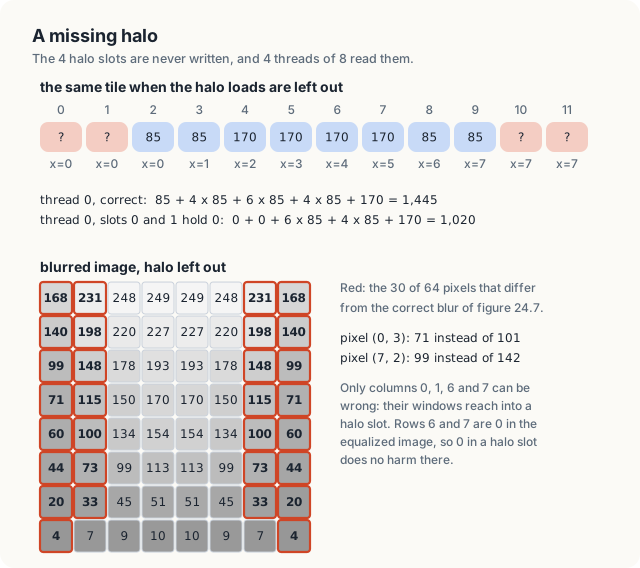
The halo is easy to forget, because the block has \(\mathsf{blockDim{.}x}\) threads, and it seems natural to copy \(\mathsf{blockDim{.}x}\) values. Suppose that lines 3 to 6 of Blur-Rows are left out. Slots 0, 1, \(\mathsf{blockDim{.}x} + 2\) and \(\mathsf{blockDim{.}x} + 3\) are then never written, and the proof of Theorem 24.2 fails at its first step. The threads whose windows reach into those slots read whatever the memory held before. These are threads 0 and 1 on the left, and threads \(\mathsf{blockDim{.}x} - 2\) and \(\mathsf{blockDim{.}x} - 1\) on the right.
Figure 24.10 shows the effect on the example, with a block of 8 threads per row and with 0 in the 4 slots that are never written. Thread 0 of row 2 should add \(85 + 4 \cdot 85 + 6 \cdot 85 + 4 \cdot 85 + 170 = 1{,}445\), but it adds \(0 + 0 + 6 \cdot 85 + 4 \cdot 85 + 170 = 1{,}020\) instead. The column pass spreads the error down the column, and pixel \((0, 3)\) of the blurred image becomes 71 instead of 101. In all, 30 of the 64 blurred pixels are wrong, all of them in columns 0, 1, 6 and 7.
In the programs, the block has 128 threads, so threads 0, 1, 126 and 127 of each block read an
unwritten slot. A row has 15 blocks, so 60 columns of the image are at risk, which is
\(60 \cdot 1{,}080 = 64{,}800\) blurred pixels. We removed the if tx < 2 block from the Rust
kernel and ran the program, which printed the following report.
$ cargo oxide run # blur_rows without the `if tx < 2` block
...
image pixels that differ from the CPU
gray 0
equalised 0
blurred 56548 first at (0, 0): GPU 164, CPU 106
edges 81436 first at (0, 0): GPU 84, CPU 10
...
FAILED
The program compiled without a warning. The reads of the tile are inside unsafe blocks,
and the compiler accepts the argument of their // SAFETY: comments without checking it. Of the
64,800 blurred pixels at risk, 56,548, or 87%, are wrong; in the others, the old contents of shared
memory happened to give the right sum. Pixel \((0, 0)\) is 164 instead of 106. The edge image has
more wrong pixels, 81,436, because the Sobel operator reads a 3 × 3 window, and every wrong blurred
pixel spoils the edges of its neighbors. The 60 columns at risk thus become 90 columns of edges at
risk, 97,200 pixels. The C++ program with the same change gave 56,646 wrong blurred pixels and
81,212 wrong edge pixels. In the picture, the errors form thin vertical stripes, 1 every 128
columns, which are hard to see by looking at the image, whereas the comparison with the CPU finds
them at once.
Rule A tile for \(\mathsf{blockDim{.}x}\) outputs of a filter that reads \(r\) positions on each side holds \(\mathsf{blockDim{.}x} + 2r\) inputs, and every one of them must be written before the barrier. Count the slots, not the threads.
Exercises
24.13 Compute the row sum and the blurred level of pixel \((1, 2)\) of the example by hand, and
check them against Figure 24.8.
24.14 A block of the row pass has 256 threads instead of 128. How many pixels does it fetch, and
what fraction of its fetches are halo? How many columns of the image would a missing halo put at
risk?
24.15 Prove that rounding after each pass, \((sum + 8) \gg 4\) twice, can differ from rounding once
at the end, using pixel \((3, 3)\) of the example.
24.6 Sobel edges
24.6.1 The gradient
An edge in an image is a place where the level changes quickly from 1 pixel to the next. Inside a region of the example, such as the sky, neighboring pixels have almost the same level, while at the border between the sky and the house, the level drops by about 70 within 2 rows. To find edges, we therefore estimate how fast the level changes at each pixel. The Sobel operator makes this estimate in two directions from the 3 × 3 neighborhood of the pixel. Its horizontal component \(g_x\) is the weighted sum of the column to the right of the pixel minus the weighted sum of the column to its left, with the weights 1, 2 and 1 from top to bottom. Its vertical component \(g_y\) is the weighted sum of the row below the pixel minus that of the row above, with the same weights from left to right. The middle pixel of each column or row receives the weight 2 because it is closest to the center.
Definition 24.10 Gradient magnitude. The gradient magnitude at a pixel is the length \(\sqrt{g_x^2 + g_y^2}\) of the vector \((g_x, g_y)\). Our edge image stores it divided by 4, rounded to the nearest integer and limited to 255: \[ \mathrm{edge}(x, y) = \min\big(\lfloor \sqrt{g_x^2 + g_y^2} / 4 + 1/2 \rfloor, 255\big). \]
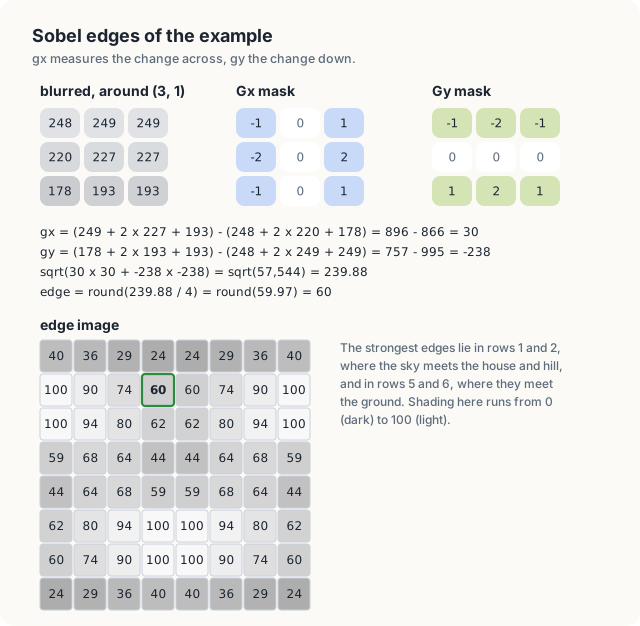
Example. At pixel \((3, 1)\) of the blurred example, \(g_x = 30\) and \(g_y = -238\), and the edge level is 60 (Figure 24.11).
| Symbol | Meaning | At pixel \((3, 1)\) |
|---|---|---|
| \(g_x\) | rate of change from left to right | 30 |
| \(g_y\) | rate of change from top to bottom | \(-238\) |
| \(\sqrt{g_x^2 + g_y^2}\) | gradient magnitude, the length of \((g_x, g_y)\) | 239.88 |
| \(\lfloor z / 4 + 1/2 \rfloor\) | \(z / 4\) rounded to the nearest integer | \(\lfloor 59.97 + 0.5 \rfloor = 60\) |
| \(\min(\ldots, 255)\) | limit to the largest level of a byte | 60 |
The division by 4 scales the result to the range of a byte. A sharp step from level 0 to level 255 gives \(g_x = (1 + 2 + 1) \cdot 255 = 1{,}020\), and \(1{,}020 / 4 = 255\), the brightest level. Figure 24.11 works pixel \((3, 1)\), which lies where the sky meets the house. Its neighborhood in the blurred image has the rows 248, 249, 249; 220, 227, 227; and 178, 193, 193. Therefore, \[ g_x = (249 + 2 \cdot 227 + 193) - (248 + 2 \cdot 220 + 178) = 896 - 866 = 30, \] \[ g_y = (178 + 2 \cdot 193 + 193) - (248 + 2 \cdot 249 + 249) = 757 - 995 = -238. \] In \(g_x\), the first bracket is the right column of the neighborhood, from top to bottom, and the second bracket is the left column. In \(g_y\), the first bracket is the row below, from left to right, and the second bracket is the row above. The level falls by about 70 from the row above to the row below, and it barely changes from left to right. The magnitude is \(\sqrt{900 + 56{,}644} = \sqrt{57{,}544} = 239.88\), and \(239.88 / 4 = 59.97\) rounds to 60.
24.6.2 The kernel
The Sobel operator is a stencil of radius 1, the pattern of Chapter 19, and its kernel therefore gives each output pixel a thread. In the following procedure, \(\mathsf{at}(\mathsf{row}, \mathsf{col})\) is the level of the blurred image in row \(\mathsf{row}\) and column \(\mathsf{col}\), with both coordinates clamped to the image.
Sobel-Kernel(\(\mathsf{src}, \mathsf{edges}, W, H\))
- \(x = \mathsf{blockIdx{.}x} \cdot \mathsf{blockDim{.}x} + \mathsf{threadIdx{.}x}\), \(\;y = \mathsf{blockIdx{.}y} \cdot \mathsf{blockDim{.}y} + \mathsf{threadIdx{.}y}\)
- \(\mathsf{at}(\mathsf{row}, \mathsf{col}) = \mathsf{src}[\mathrm{clamp}(\mathsf{row}, H)][\mathrm{clamp}(\mathsf{col}, W)]\)
- \(g_x = (\mathsf{at}(y{-}1, x{+}1) + 2 \cdot \mathsf{at}(y, x{+}1) + \mathsf{at}(y{+}1, x{+}1)) - (\mathsf{at}(y{-}1, x{-}1) + 2 \cdot \mathsf{at}(y, x{-}1) + \mathsf{at}(y{+}1, x{-}1))\)
- \(g_y = (\mathsf{at}(y{+}1, x{-}1) + 2 \cdot \mathsf{at}(y{+}1, x) + \mathsf{at}(y{+}1, x{+}1)) - (\mathsf{at}(y{-}1, x{-}1) + 2 \cdot \mathsf{at}(y{-}1, x) + \mathsf{at}(y{-}1, x{+}1))\)
- \(\mathsf{edges}[y][x] = \min(\lfloor \sqrt{g_x^2 + g_y^2}\,/\,4 + 1/2 \rfloor, 255)\)
We let each thread use the 8 pixels around its own, since the center has weight 0 in both masks, and it writes 1 byte. The kernel reads the 8 pixels from global memory without a shared tile. A pixel is read by up to 9 threads, but those threads belong to the same block or to neighboring blocks, and most of the repeated reads are served by the L1 cache of the SM. Exercise 24.18 asks whether a tile would help. The following kernels implement the procedure.
mod kernels {
// ...
/// Sobel gradient magnitude divided by 4, rounded and clamped to 255. The 8 neighbors
/// come from global memory; neighboring threads share them through the L1 cache.
#[kernel]
#[launch_contract(domain = 2, coordinates = u32, block = (32, 8, 1))]
pub fn sobel(src: &[u8], mut out: DisjointSlice<u8, Index2D<W>>) {
let (x, y) = (thread::index_2d_col(), thread::index_2d_row());
let (x_left, x_right) = (x.saturating_sub(1), (x + 1).min(W - 1));
let (y_above, y_below) = (y.saturating_sub(1), (y + 1).min(H - 1));
let at = |row: usize, col: usize| src[row * W + col] as i32;
if let Some(idx) = thread::index_2d::<W>()
&& let Some(cell) = out.get_mut(idx)
{
let right = at(y_above, x_right) + 2 * at(y, x_right) + at(y_below, x_right);
let left = at(y_above, x_left) + 2 * at(y, x_left) + at(y_below, x_left);
let below = at(y_below, x_left) + 2 * at(y_below, x) + at(y_below, x_right);
let above = at(y_above, x_left) + 2 * at(y_above, x) + at(y_above, x_right);
let (gx, gy) = (right - left, below - above);
let magnitude = sqrt_rn_f32((gx * gx + gy * gy) as f32);
*cell = (magnitude * 0.25 + 0.5).min(255.0) as u8;
}
}
}// Sobel gradient magnitude divided by 4, rounded and clamped to 255. The 8 neighbors
// come from global memory; neighboring threads share them through the L1 cache.
__global__ void sobel(const uint8_t* src, uint8_t* out)
{
int x = blockIdx.x * blockDim.x + threadIdx.x;
int y = blockIdx.y * blockDim.y + threadIdx.y;
int xLeft = max(x - 1, 0);
int xRight = min(x + 1, W - 1);
int yAbove = max(y - 1, 0);
int yBelow = min(y + 1, H - 1);
const uint8_t* upper = src + yAbove * W;
const uint8_t* middle = src + y * W;
const uint8_t* lower = src + yBelow * W;
int right = upper[xRight] + 2 * middle[xRight] + lower[xRight];
int left = upper[xLeft] + 2 * middle[xLeft] + lower[xLeft];
int below = lower[xLeft] + 2 * lower[x] + lower[xRight];
int above = upper[xLeft] + 2 * upper[x] + upper[xRight];
int gx = right - left;
int gy = below - above;
float magnitude = sqrtf(float(gx * gx + gy * gy));
out[y * W + x] = fminf(magnitude * 0.25f + 0.5f, 255.0f);
}
The kernels compute the 4 weighted sums of lines 3 and 4 as right, left, below and above,
and the clamped neighbor positions xLeft, xRight, yAbove and yBelow (x_left and so on in
Rust) of line 2. The largest possible component is
\(4 \cdot 255 = 1{,}020\), so the sum of squares is at most \(2 \cdot 1{,}020^2 = 2{,}080{,}800\).
This is an integer below \(2^{24} = 16{,}777{,}216\), and its conversion to a 32-bit float is
therefore exact. The square root is sqrt_rn_f32 in Rust and sqrtf in C++. Both round to the
nearest float, as the IEEE 754 standard requires of a square root, and so do the CPU’s f32::sqrt
and std::sqrt. The multiplication by 0.25 is exact, because 0.25 is a power of 2.
We also compiled the C++ program with --use_fast_math, which replaces sqrtf by an approximate
square root. The edge image still agreed with the CPU’s edge image in every pixel, with the same
checksum. The rounding of line 5 depends on the exact root only at the sums of squares
\((4k + 2)^2\), where \(k\) is any non-negative integer. For example, for \(g_x = 10\) and
\(g_y = 0\), with \(k = 2\), we have \(\sqrt{100} = 10\) and \(10 / 4 + 1/2 = 3\) exactly,
and a root slightly below 10 would give 2. The approximate root of the measured GPU returned these
integer roots exactly. The programs nevertheless keep the correctly rounded root, because it agrees
with the CPU by its definition, not by a test on 1 GPU and 1 image.
24.6.3 Neighbors outside the image
A common mistake in a stencil is to forget the clamp of line 2 of Sobel-Kernel. At pixel \((3, 0)\), the kernel then reads row \(-1\), which does not exist. In a buffer stored row by row, row \(-1\) lies before the start of the image, and column \(-1\) of row \(y\) is the last pixel of row \(y - 1\). If the memory before the image holds 0, pixel \((3, 0)\) of the example gets \(g_y = (220 + 2 \cdot 227 + 227) - 0 = 901\) and the edge level 225 instead of 24, and 27 of the 28 border pixels of the example change. We removed the 4 clamps from the C++ kernel and ran the program, which printed the following report.
$ ./capstone # sobel with xl = x - 1, xr = x + 1, ...
...
image pixels that differ from the CPU
gray 0
equalised 0
blurred 0
edges 5852 first at (0, 0): GPU 129, CPU 10
...
FAILED
The image has \(2 \cdot 1{,}920 + 2 \cdot 1{,}078 = 5{,}996\) border pixels, and 5,852 of them are wrong, while every interior pixel is right. Pixel \((0, 0)\) became 129 instead of 10. Note that the kernel did not stop. The reads before the first row and after the last one landed in other memory of the program, and the device reported no error. In Rust, the same reads would be caught, because cuda-oxide checks every slice index against the length of the slice and stops the kernel when the index lies outside. The column wrap of \(x - 1\) at \(x = 0\), however, stays inside the slice, and it would not be caught.
Exercises
24.16 Compute the edge level of pixel \((0, 1)\) of the example from the blurred image of Figure
24.8.
24.17 Which levels of a blurred image of constant level give an edge level other than 0?
24.18 Write a Sobel kernel that copies a tile of \((8 + 2) \times (32 + 2)\) pixels into shared
memory, and compare its time with the kernel above. Explain the result with the role of the L1
cache.
24.7 The host pipeline
24.7.1 Buffers
Recall that the host is the CPU and its memory, and the device is the GPU and its memory. The host program keeps the device buffers of 1 image in a structure, so that it can process several images at once with 1 set of buffers for each image. The following table lists the buffers of a set.
| Buffer | Element | Elements | Size |
|---|---|---|---|
rgb | byte | 3 per pixel | 6.2 MB |
gray, equal, blurred, edges | byte | 1 per pixel | 2.1 MB each |
rows | 16-bit integer | 1 per pixel | 4.1 MB |
bins | 32-bit atomic integer | 256 | 1,024 bytes |
table | byte | 256 | 256 bytes |
A set occupies \(6.2 + 4 \cdot 2.1 + 4.1 = 18.7\) MB. In Rust, each buffer is a DeviceBuffer,
which frees its memory when the structure is dropped. In C++, the function freeBuffers calls
cudaFree for each buffer.
24.7.2 Streams
The 7 kernels of 1 image must run in order, the copy of the input must finish before the first kernel, and the copy of the output must wait for the last kernel. A stream provides this order.
Definition 24.11 Stream. A stream is a queue of device work, copies and kernel launches, that the device executes in the order in which the host issued it. Work in 1 stream starts only after the previous work in the same stream has finished. Work in different streams has no order and may run at the same time.
Example. The 7 kernels of 1 image, issued on stream 0, run one after the other; the kernels of a second image, on stream 1, may run while the first image is copied.
The host functions stage and process, shown below, issue the 7 launches of 1 image on 1 stream.
A launch returns to the host as soon as the work is queued, so the host issues all 7 launches without
waiting, and the stream keeps them in order.
/// Launches stage `index` of the pipeline on `stream`.
fn stage(
module: &kernels::LoadedModule,
stream: &Arc<CudaStream>,
buffers: &mut Buffers,
index: usize,
) -> Result<(), Error> {
let line = LaunchConfig1D::new((PIXELS / 256) as u32, 256, 0);
let rows = LaunchConfig2D::new(((W / ROW_T) as u32, H as u32), (ROW_T as u32, 1), 0);
let grid = ((W / COL_W) as u32, (H / COL_H) as u32);
let tiles = LaunchConfig2D::new(grid, (COL_W as u32, COL_H as u32), 0);
match index {
0 => {
let launch = module.prepare_grayscale(line)?;
module.grayscale(stream, &launch, &buffers.rgb, &mut buffers.gray)?;
}
1 => {
let launch = module.prepare_histogram(LaunchConfig1D::new(64, 256, 0))?;
module.histogram(stream, &launch, &buffers.gray, &buffers.bins)?;
}
2 => {
let launch = module.prepare_equalise_table(LaunchConfig1D::new(1, 256, 0))?;
module.equalise_table(stream, &launch, &buffers.bins, &mut buffers.table)?;
}
3 => {
let launch = module.prepare_apply_table(line)?;
let (gray, table) = (&buffers.gray, &buffers.table);
module.apply_table(stream, &launch, gray, table, &mut buffers.equal)?;
}
4 => {
let launch = module.prepare_blur_rows(rows)?;
module.blur_rows(stream, &launch, &buffers.equal, &mut buffers.rows)?;
}
5 => {
let launch = module.prepare_blur_cols(tiles)?;
module.blur_cols(stream, &launch, &buffers.rows, &mut buffers.blurred)?;
}
_ => {
let launch = module.prepare_sobel(tiles)?;
module.sobel(stream, &launch, &buffers.blurred, &mut buffers.edges)?;
}
}
Ok(())
}
/// All 7 stages of 1 image, in order, on `stream`.
fn process(
module: &kernels::LoadedModule,
stream: &Arc<CudaStream>,
buffers: &mut Buffers,
) -> Result<(), Error> {
for index in 0..STAGES.len() {
stage(module, stream, buffers, index)?;
}
Ok(())
}// Launches stage `index` of the pipeline on `stream`.
void stage(cudaStream_t stream, Buffers& buffers, int index)
{
int line = PIXELS / 256;
dim3 rows(W / ROW_T, H);
dim3 tiles(W / COL_W, H / COL_H);
dim3 tile(COL_W, COL_H);
switch (index) {
case 0:
grayscale<<<line, 256, 0, stream>>>(buffers.rgb, buffers.gray);
break;
case 1:
histogram<<<64, 256, 0, stream>>>(buffers.gray, buffers.bins);
break;
case 2:
equaliseTable<<<1, 256, 0, stream>>>(buffers.bins, buffers.table);
break;
case 3:
applyTable<<<line, 256, 0, stream>>>(buffers.gray, buffers.table, buffers.equal);
break;
case 4:
blurRows<<<rows, ROW_T, 0, stream>>>(buffers.equal, buffers.rows);
break;
case 5:
blurCols<<<tiles, tile, 0, stream>>>(buffers.rows, buffers.blurred);
break;
default:
sobel<<<tiles, tile, 0, stream>>>(buffers.blurred, buffers.edges);
}
}
// All 7 stages of 1 image, in order, on `stream`.
void process(cudaStream_t stream, Buffers& buffers)
{
for (int index = 0; index < 7; ++index) {
stage(stream, buffers, index);
}
}
The launch configurations match the 3 shapes of kernel. The configuration line covers the image
with 8,100 blocks of 256 threads for the 2 maps. The configuration rows gives each of the 1,080
image rows 15 blocks of 128 threads. The column pass and the Sobel kernel use 60 × 135 blocks of
32 × 8 threads, because \(60 \cdot 32 = 1{,}920\) and \(135 \cdot 8 = 1{,}080\). The histogram uses
a fixed grid of 64 blocks, and the table kernel uses 1 block. In Rust, each prepare_ call checks a
configuration against the launch contract of its kernel and returns an error if the block shape
differs, and the launch itself takes the prepared value. In C++, the triple-angle-bracket launch
takes any configuration.
24.8 Checking against the CPU
As we saw in Section 24.5.6, a GPU program can produce an image that looks right and is wrong in a few thousand pixels. Both programs therefore compute the whole pipeline a second time on the CPU and compare the 2 results pixel by pixel. The CPU version uses the same integer formulas, the same clamping and a correctly rounded square root, so every pixel must agree exactly, and no tolerance is needed.
The CPU version is also the baseline for the speed of the GPU, so it uses every core. The function
par_rows (parRows in C++), shown below, divides the rows of an output image into 1 band per core
and processes the bands on separate threads. In Rust, chunks_mut hands each thread its own band as
a separate mutable slice, so the compiler verifies that no 2 threads write the same row.
/// Runs `f(y, row)` for every row of `out`, the rows split into 1 band per CPU core.
fn par_rows<T: Send>(out: &mut [T], f: impl Fn(usize, &mut [T]) + Sync) {
let cores = std::thread::available_parallelism().map_or(1, |n| n.get());
let band = H.div_ceil(cores);
std::thread::scope(|s| {
for (k, chunk) in out.chunks_mut(band * W).enumerate() {
let f = &f;
s.spawn(move || {
for (r, row) in chunk.chunks_mut(W).enumerate() {
f(k * band + r, row);
}
});
}
});
}// Runs f(y, row) for every row y, the rows split into 1 band per CPU core.
template <typename F>
void parRows(F f)
{
int cores = std::max(1u, std::thread::hardware_concurrency());
int band = (H + cores - 1) / cores;
std::vector<std::thread> threads;
for (int k = 0; k < cores; ++k) {
threads.emplace_back([=] {
for (int y = k * band; y < std::min(H, (k + 1) * band); ++y) {
f(y);
}
});
}
for (std::thread& t : threads) {
t.join();
}
}
The programs generate the test image themselves. It shows a house below a hill, a sky that brightens toward the horizon, and a sun, with random grain of up to 8 levels on every pixel. Its colors lie in a narrow range of levels, so the image has low contrast, and equalization has a visible effect (Figure 24.3). For each of the 4 images, both programs print the number of pixels in which the GPU differs from the CPU, as follows.
$ ./capstone # C++, Jetson Orin NX
GPU: Orin, 8 SMs image 1920 x 1080 = 2073600 pixels
...
image pixels that differ from the CPU
gray 0
equalised 0
blurred 0
edges 0
edge image checksum: 166b66c2
All 4 images agree in all 2,073,600 pixels. The last line is a checksum of the GPU’s edge image, and the Rust and the C++ programs print the same value, 166b66c2. The two languages therefore produce the same edge image, byte for byte. The batch of Section 24.10 checks the output once more, by comparing the last edge image that each stream copies back with the CPU’s edge image of the same input.
24.9 Time per stage
24.9.1 Measurements
The measurements come from an integrated GPU, a Jetson Orin NX with 8 SMs and 102 GB/s of memory bandwidth. Each stage is timed alone, as the mean of 100 launches, after the GPU has run the pipeline for 0.4 s to raise its clock. The programs report the time and the effective bandwidth, which is the number of bytes that the stage must read and write divided by its time. Times drift by about 10% between runs.
| Stage | Bytes per pixel | Rust | C++ | C++, effective |
|---|---|---|---|---|
| grayscale | 4 | 0.200 ms | 0.183 ms | 45.4 GB/s |
| histogram | 1 | 0.056 ms | 0.055 ms | 38.0 GB/s |
| equalize table | 0 | 0.007 ms | 0.007 ms | |
| apply table | 2 | 0.185 ms | 0.192 ms | 21.6 GB/s |
| blur rows | 3 | 0.301 ms | 0.208 ms | 29.9 GB/s |
| blur columns | 3 | 0.280 ms | 0.210 ms | 29.7 GB/s |
| sobel | 2 | 0.350 ms | 0.225 ms | 18.4 GB/s |
| sum of the 7 stages | 15 | 1.380 ms | 1.079 ms | 28.8 GB/s |
| the 7 stages in turn | 1.489 ms | 1.165 ms |
The bytes per pixel are those that a stage must move. For example, the gray kernel reads 3 bytes and writes 1, and the row pass reads 1 byte and writes a 2-byte row sum. For the gray kernel in C++, the effective bandwidth is therefore \(4 \cdot 2{,}073{,}600\) bytes in 0.183 ms, about 45 GB/s. The histogram was the only stage whose time changed by much more than 10% between runs, from 0.054 to 0.117 ms in both languages, and the table quotes the more frequent value. The 7 stages issued 1 after the other take 1.165 ms in C++, slightly more than the sum of their separate times.
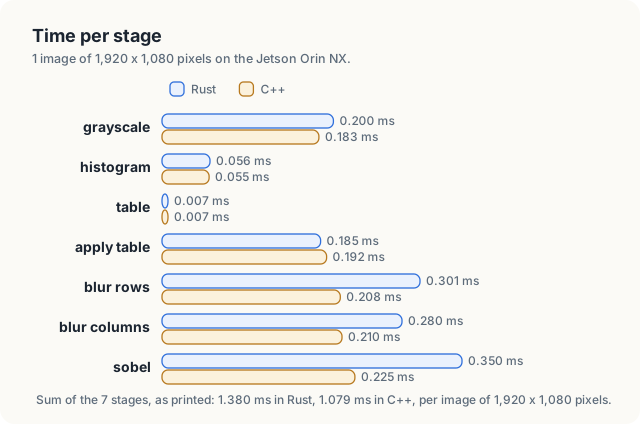
The table kernel, a single block of 256 threads, takes 0.007 ms, which is about the cost of launching any kernel. A kernel with almost no parallelism thus costs nothing noticeable when it handles 256 values between two kernels that handle 2 million.
24.9.2 Which stage dominates, and why
The blur dominates. Its 2 passes take \(0.208 + 0.210 = 0.418\) ms in C++, 39% of the 1.079 ms of the 7 stages. The Sobel kernel follows with 21%, the apply-table kernel with 18% and the gray kernel with 17%, while the histogram and the table together take 6%.
The arithmetic does not explain this order. The 2 blur passes perform 10 multiply-adds per pixel, 20.7 million per image. The measured GPU has 1,024 lanes (8 SMs of 128) at up to 1.17 GHz, which gives about \(1.2 \cdot 10^{12}\) simple integer operations per second. The multiply-adds therefore account for about 0.02 ms of the 0.418 ms. Likewise, the square roots of the Sobel kernel are a small part of its time.
What the stages have in common is memory traffic. Together, they must read and write 15 bytes per pixel, which is \(15 \cdot 2{,}073{,}600 = 31.1\) MB per image. At the 102 GB/s of the memory, this would take 0.305 ms, but the stages take 1.079 ms, an effective 28.8 GB/s, or 28% of the peak. The blur takes the largest share because it moves the most bytes, 6 per pixel. The row pass reads the equalized image and writes 2-byte row sums, and the column pass reads them back and writes the blurred image. The intermediate image of 4.1 MB is the price of the separable form. Theorem 24.1 saves 15 multiply-adds per pixel, which cost little here, while the 2 passes add 4 bytes of traffic per pixel, which cost more. A 1-pass blur with a tile of \((8 + 4) \times (32 + 4)\) inputs would move about 2 bytes per pixel and perform 25 multiply-adds. Exercise 7 at the end of the chapter asks for such a kernel.
The effective rates stay far below 102 GB/s because every access is narrow. Each thread of these kernels reads and writes 1 or 2 bytes, so 1 load instruction of a warp moves only 32 or 64 bytes. In Chapter 8, we measured the same effect with a histogram: 13.7 GB/s with 1-byte loads and 82.9 GB/s with 16-byte loads. The Sobel kernel has the lowest rate, 18.4 GB/s, because it issues the most load instructions per byte. For each byte that it writes, its code reads 12 bytes, most of them answered by the L1 cache, and it takes a square root. The apply-table kernel, at 21.6 GB/s, adds a gather to its 2 bytes. Moreover, each kernel runs for only a fraction of a millisecond, so its start-up and its last, partly filled wave of blocks are a visible part of its time.
24.9.3 Rust and C++
The Rust kernels take 1.380 ms against 1.079 ms in C++, which is 28% more. The difference lies in 3
kernels: the row pass (0.301 against 0.208 ms), the column pass (0.280 against 0.210 ms) and the
Sobel kernel (0.350 against 0.225 ms). The 2 maps and the histogram are within 10% of each other in
the two languages. The 3 slower kernels are those that index slices most. In cuda-oxide, every index
into a slice, such as src[r * W + c], compiles to a comparison with the length of the slice and a
branch that stops the kernel if the index lies outside. The Sobel kernel performs 12 such reads per
pixel. We ran the Rust program with #[kernel(unchecked_indexing)] on every kernel, which removes
the checks. It gave 0.228 ms for each blur pass, 0.268 ms for the Sobel kernel and 1.175 ms for the
7 stages, with the same edge image. The checks therefore account for about 2/3 of the difference.
The flag makes an index out of range undefined behavior, as it is in C++, and so the programs keep
the checks.
24.10 A batch of images on streams
24.10.1 Copies and kernels
A program that processes a sequence of video frames must also copy each frame to the device and each result back. Per image, the copy in moves 6.2 MB, and the copy out moves 2.1 MB. On 1 stream, the 2 copies and the 7 kernels run one after the other, and the SMs wait during the copies. The copies, however, are not performed by the SMs, so in principle they could run while the SMs work on another image.
Definition 24.12 Copy engine and pinned memory. A copy engine is a unit of the GPU that moves data between host memory and device memory while the SMs run kernels. Pinned memory is host memory that the operating system keeps at a fixed physical address, so that a copy engine can read and write it without the CPU. An asynchronous copy, one that returns to the host before it is done, requires pinned memory.
Example. While the SMs blur image 0, a copy engine can copy image 1 from pinned host memory into the buffers of a second stream.
The batch therefore gives image \(\mathsf{image}\) to stream \(\mathsf{image} \bmod S\), with 1 set of buffers for each of the \(S\) streams, as in Chapter 6. Here \(S\) is the number of streams, and \(\mathsf{image} \bmod S\) is the remainder of \(\mathsf{image}\) on division by \(S\); with \(S = 3\), for example, images 0, 3 and 6 go to stream 0, and image 4 goes to stream 1. The programs call such a set of buffers a lane, a name that has nothing to do with the lanes of a warp.
Batch(\(\mathsf{images}, n, S\))
- for \(\mathsf{image} \in [0, n)\) {
- \(\mathsf{slot} = \mathsf{image} \bmod S\)
- on stream \(\mathsf{slot}\): copy \(\mathsf{images}[\mathsf{image}]\) into \(\mathsf{lanes}[\mathsf{slot}].\mathsf{rgb}\) // host to device
- on stream \(\mathsf{slot}\): the 7 kernels on \(\mathsf{lanes}[\mathsf{slot}]\)
- on stream \(\mathsf{slot}\): copy \(\mathsf{lanes}[\mathsf{slot}].\mathsf{edges}\) into \(\mathsf{out}[\mathsf{slot}]\) // device to host
- }
- wait for every stream
The kernels of images \(\mathsf{image}\) and \(\mathsf{image} + S\) use the same lane on the same stream, so they run in order and cannot overwrite each other’s buffers. The host loop issues all the work at once and then waits in line 7. The following code implements the procedure.
/// Uploads, processes and downloads `count` images, image `image` on stream
/// image % streams.len().
/// Returns images per second.
fn batch(
module: &kernels::LoadedModule,
streams: &[Arc<CudaStream>],
lanes: &mut [Buffers],
inputs: &[PinnedHostBuffer<u8>],
outputs: &mut [PinnedHostBuffer<u8>],
count: usize,
) -> Result<f64, Error> {
let start = Instant::now();
for image in 0..count {
let slot = image % streams.len();
let (stream, buffers) = (&streams[slot], &mut lanes[slot]);
let input = &inputs[image % inputs.len()];
// SAFETY: no host buffer is read, written or dropped until every stream is
// synchronized below, after all copies have completed.
unsafe { buffers.rgb.copy_from_pinned_host_async(stream, input)? };
process(module, stream, buffers)?;
unsafe { buffers.edges.copy_to_pinned_host_async(stream, &mut outputs[slot])? };
}
for stream in streams {
stream.synchronize()?;
}
Ok(count as f64 / start.elapsed().as_secs_f64())
}// Uploads, processes and downloads `count` images, image `image` on stream image % n.
// Returns images per second.
double batch(cudaStream_t* streams, Buffers* lanes, int n, uint8_t** inputs,
uint8_t** outputs, int count)
{
double t0 = nowMs();
for (int image = 0; image < count; ++image) {
int slot = image % n;
cudaStream_t stream = streams[slot];
Buffers& buffers = lanes[slot];
const uint8_t* input = inputs[image % 4];
uint8_t* output = outputs[slot];
size_t bytes = 3 * PIXELS;
check(cudaMemcpyAsync(buffers.rgb, input, bytes, cudaMemcpyHostToDevice, stream));
process(stream, buffers);
uint8_t* edges = buffers.edges;
check(cudaMemcpyAsync(output, edges, PIXELS, cudaMemcpyDeviceToHost, stream));
}
for (int slot = 0; slot < n; ++slot) {
check(cudaStreamSynchronize(streams[slot]));
}
return count / ((nowMs() - t0) / 1e3);
}
In Rust, the 2 asynchronous copies are unsafe, because the device reads and writes the host buffers
after the call has returned, and the compiler cannot see when the device is done. The // SAFETY:
comment states the condition that makes the copies correct, namely that no host buffer is read,
written or dropped until every stream has been synchronized. The C++ calls to cudaMemcpyAsync
carry the same condition without a marker.
24.10.2 Measured overlap
The programs first time the 2 copies alone, and then process a batch of 128 images on 1, 2 and 3 streams, after 1 batch to warm up. The C++ program printed the following results.
copy in 0.201 ms 30.9 GB/s
copy out 0.070 ms 29.8 GB/s
batch of 128 images: copy in, 7 stages, copy out
1 stream(s) 695.3 images/s
2 stream(s) 835.3 images/s
3 stream(s) 859.5 images/s
CPU, 8 threads 37.7 images/s
batch outputs match the CPU: yes
PASSED
The Rust program measured 573.4, 686.7 and 689.9 images/s on 1, 2 and 3 streams, and 51.0 images/s for its CPU version. The CPU rates varied between runs, from 37.7 to 51.0 images/s.
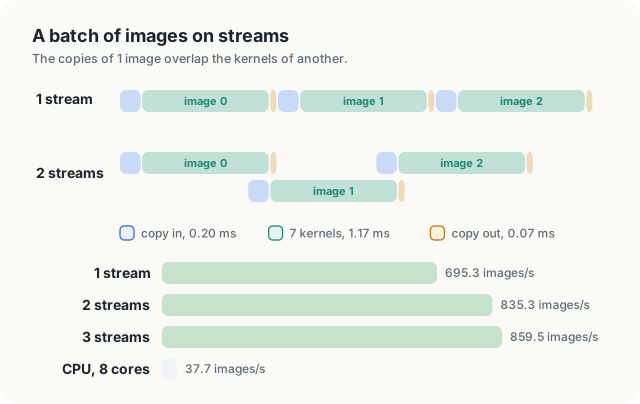
The rates follow from the measured times. On 1 stream, an image costs its copy in, its 7 kernels and its copy out in turn, that is, \(0.201 + 1.165 + 0.070 = 1.436\) ms, or 696 images/s, and the measured 695.3 images/s agrees. The copies take 0.271 ms of the 1.436 ms, or 19%. If they were hidden completely, the kernels alone would set the rate, at 1 image per 1.165 ms, or 858 images/s.
With 2 streams, the program reaches 835.3 images/s, which is 1.197 ms per image. Of the 0.271 ms of copies per image, 0.239 ms, or 88%, now run while kernels run. With 3 streams, it reaches 859.5 images/s, which is 1.163 ms per image, so the copies are hidden completely, and the kernels of consecutive images run back to back (Figure 24.13). More streams cannot help, because the SMs are then busy all the time. On this integrated GPU, the copies and the kernels share the same memory, and they still overlap well. The copy engine moves about 31 GB/s and the kernels about 29 GB/s, together well under the 102 GB/s of the memory.
The Rust program follows the same account. Its times, \(0.203 + 1.489 + 0.072 = 1.764\) ms, predict 567 images/s on 1 stream, against 573.4 measured. On 3 streams, its 689.9 images/s, or 1.450 ms per image, are again the rate of its kernels alone. On 3 streams, the GPU processes images 22.8 times as fast as the CPU version in the C++ run, 859.5 against 37.7 images/s. In the Rust run, the factor is 13.5, 689.9 against 51.0 images/s. Both programs produce exactly the same output as the CPU.
Exercises
24.19 Use the measured times of the copies and of the 7 kernels to predict the rate on 1 stream and
the best possible rate on many streams. Compare with the measurements.
24.20 Run the batch with 4 and 6 streams. Explain why the rate stops growing.
24.21 The Rust program spends more time per image in its kernels than the C++ program. Does the
benefit of a second stream, as a fraction, grow or shrink when the kernels are slower?
24.11 The complete programs
The following listings give the whole Rust program, src/main.rs, and the whole C++ program,
capstone.cu.
//! Chapter 24: an image pipeline. Gray conversion, histogram equalization, a separable
//! Gaussian blur and Sobel edges, checked pixel by pixel against the CPU, then a batch of
//! images on 1, 2 and 3 streams.
//!
//! cargo oxide run
use std::fs::File;
use std::io::{BufWriter, Write};
use std::sync::Arc;
use std::time::Instant;
use cuda_core::{CudaContext, CudaStream, DeviceBuffer, LaunchConfig1D, LaunchConfig2D};
use cuda_core::PinnedHostBuffer;
use cuda_device::atomic::{AtomicOrdering, BlockAtomicU32, DeviceAtomicU32};
use cuda_device::float::sqrt_rn_f32;
use cuda_device::thread::Index2D;
use cuda_device::{DisjointSlice, SharedArray, cuda_module, device, kernel, launch_contract};
use cuda_device::{thread, warp};
const W: usize = 1920;
const H: usize = 1080;
const PIXELS: usize = W * H; // 2,073,600
const BATCH: usize = 128;
const ROW_T: usize = 128; // outputs per block of the row pass
const COL_W: usize = 32; // columns per block of the column pass
const COL_H: usize = 8; // rows per block of the column pass
type Error = Box<dyn std::error::Error>;
#[cuda_module]
mod kernels {
use super::*;
/// Position `i - 2` clamped to [0, n): slot `i` of a window that starts 2 before.
#[device]
fn tap(slot: usize, size: usize) -> usize {
if slot < 2 { 0 } else { (slot - 2).min(size - 1) }
}
#[device]
fn warp_scan(mut value: u32) -> u32 {
let lane = warp::lane_id();
let mut step = 0;
#[unroll]
while step < 5 {
let offset = 1 << step;
let left = warp::shuffle_up_sync(u32::MAX, value, offset);
if lane >= offset {
value += left;
}
step += 1;
}
value
}
/// 1 thread per pixel. BT.601 weights in 8-bit fixed point: 77 + 150 + 29 = 256.
#[kernel]
#[launch_contract(domain = 1, block = (256, 1, 1))]
pub fn grayscale(rgb: &[u8], mut gray: DisjointSlice<u8>) {
let idx = thread::index_1d();
let byte = 3 * idx.get();
if let Some(gray_pixel) = gray.get_mut(idx) {
let (red, green) = (rgb[byte] as u32, rgb[byte + 1] as u32);
let blue = rgb[byte + 2] as u32;
*gray_pixel = ((77 * red + 150 * green + 29 * blue + 128) >> 8) as u8;
}
}
/// Counts gray levels in shared bins, then adds each block's bins to the global ones.
#[kernel]
#[launch_contract(domain = 1, block = (256, 1, 1))]
pub fn histogram(gray: &[u8], bins: &[DeviceAtomicU32]) {
static mut LOCAL: SharedArray<u32, 256> = SharedArray::UNINIT;
let tid = thread::threadIdx_x() as usize;
// SAFETY: each thread zeroes only its own bin, before the barrier.
unsafe { LOCAL[tid] = 0 };
thread::sync_threads();
let stride = (thread::gridDim_x() * 256) as usize;
let mut pixel = thread::index_1d().get();
while pixel < gray.len() {
// SAFETY: between the 2 barriers every access to LOCAL is atomic.
let bin = unsafe {
let base = (*&raw mut LOCAL).as_mut_ptr();
BlockAtomicU32::from_ptr(base.add(gray[pixel] as usize))
};
bin.fetch_add(1, AtomicOrdering::Relaxed);
pixel += stride;
}
thread::sync_threads();
// SAFETY: after the barrier no thread writes LOCAL again.
let local = unsafe { LOCAL[tid] };
if local > 0 {
bins[tid].fetch_add(local, AtomicOrdering::Relaxed);
}
}
/// 1 block of 256 threads, 1 thread per gray level: the cumulative count of the level,
/// then its new level. Each bin is read and reset to 0 for the next image.
#[kernel]
#[launch_contract(domain = 1, block = (256, 1, 1))]
pub fn equalise_table(bins: &[DeviceAtomicU32], mut table: DisjointSlice<u8>) {
static mut WARPS: SharedArray<u32, 8> = SharedArray::UNINIT;
static mut FIRST: SharedArray<u32, 1> = SharedArray::UNINIT;
let level = thread::threadIdx_x() as usize;
let lane = warp::lane_id() as usize;
let warp = level / 32;
let count = bins[level].swap(0, AtomicOrdering::Relaxed);
let inclusive = warp_scan(count);
if lane == 31 {
// SAFETY: lane 31 of each warp writes its own slot, before the barrier.
unsafe { WARPS[warp] = inclusive };
}
if level == 0 {
// SAFETY: only thread 0 writes FIRST before the barrier.
unsafe { FIRST[0] = u32::MAX };
}
thread::sync_threads();
if warp == 0 {
// SAFETY: only warp 0 touches WARPS between the 2 barriers.
let warp_total = if lane < 8 { unsafe { WARPS[lane] } } else { 0 };
let scanned_total = warp_scan(warp_total);
if lane < 8 {
unsafe { WARPS[lane] = scanned_total };
}
}
thread::sync_threads();
// SAFETY: WARPS is only read from here on; FIRST is changed only atomically.
let cdf = inclusive + if warp > 0 { unsafe { WARPS[warp - 1] } } else { 0 };
let first = unsafe { BlockAtomicU32::from_ptr((*&raw mut FIRST).as_mut_ptr()) };
if count > 0 {
first.fetch_min(cdf, AtomicOrdering::Relaxed);
}
thread::sync_threads();
let min = first.load(AtomicOrdering::Relaxed);
let span = (unsafe { WARPS[7] } - min) as u64;
let above = cdf.saturating_sub(min) as u64;
let new_level = if span == 0 {
level as u64
} else {
(above * 255 + span / 2) / span
};
if let Some(entry) = table.get_mut(thread::index_1d()) {
*entry = new_level as u8;
}
}
/// 1 thread per pixel: the new level of each pixel, looked up in the table.
#[kernel]
#[launch_contract(domain = 1, block = (256, 1, 1))]
pub fn apply_table(gray: &[u8], table: &[u8], mut out: DisjointSlice<u8>) {
let idx = thread::index_1d();
let pixel = idx.get();
if let Some(cell) = out.get_mut(idx) {
*cell = table[gray[pixel] as usize];
}
}
/// Row pass, weights 1 4 6 4 1. Slot `slot` of the tile holds pixel left + slot - 2,
/// clamped: 2 halo slots on the left, 128 own pixels, 2 halo slots on the right.
#[kernel]
#[launch_contract(domain = 2, coordinates = u32, block = (128, 1, 1))]
pub fn blur_rows(src: &[u8], mut out: DisjointSlice<u16, Index2D<W>>) {
static mut TILE: SharedArray<u32, { ROW_T + 4 }> = SharedArray::UNINIT;
let thread_idx = thread::threadIdx_x() as usize;
let left = thread::blockIdx_x() as usize * ROW_T;
let row = thread::blockIdx_y() as usize * W;
let pixel = |slot: usize| src[row + tap(left + slot, W)] as u32;
// SAFETY: each slot is written by exactly 1 thread, before the barrier.
unsafe { TILE[thread_idx + 2] = pixel(thread_idx + 2) };
if thread_idx < 2 {
unsafe { TILE[thread_idx] = pixel(thread_idx) };
unsafe { TILE[ROW_T + 2 + thread_idx] = pixel(ROW_T + 2 + thread_idx) };
}
thread::sync_threads();
// SAFETY: after the barrier the tile is only read.
let window = |offset: usize| unsafe { TILE[thread_idx + offset] };
let sum = window(0) + 4 * window(1) + 6 * window(2) + 4 * window(3) + window(4);
if let Some(idx) = thread::index_2d::<W>()
&& let Some(cell) = out.get_mut(idx)
{
*cell = sum as u16;
}
}
/// Column pass on a tile of 32 columns and 8 + 4 rows. The 2 passes weigh by
/// 16 x 16 = 256, so the result is the rounded sum shifted right by 8.
#[kernel]
#[launch_contract(domain = 2, coordinates = u32, block = (32, 8, 1))]
pub fn blur_cols(src: &[u16], mut out: DisjointSlice<u8, Index2D<W>>) {
static mut TILE: SharedArray<u32, { (COL_H + 4) * COL_W }> = SharedArray::UNINIT;
let tile_col = thread::threadIdx_x() as usize;
let tile_row = thread::threadIdx_y() as usize;
let x = thread::blockIdx_x() as usize * COL_W + tile_col;
let top = thread::blockIdx_y() as usize * COL_H;
let value = |slot: usize| src[tap(top + slot, H) * W + x] as u32;
// SAFETY: each slot is written by exactly 1 thread, before the barrier.
unsafe { TILE[(tile_row + 2) * COL_W + tile_col] = value(tile_row + 2) };
if tile_row < 2 {
unsafe { TILE[tile_row * COL_W + tile_col] = value(tile_row) };
let below = COL_H + 2 + tile_row;
unsafe { TILE[below * COL_W + tile_col] = value(below) };
}
thread::sync_threads();
// SAFETY: after the barrier the tile is only read.
let window = |offset: usize| {
let slot = (tile_row + offset) * COL_W + tile_col;
unsafe { TILE[slot] }
};
let sum = window(0) + 4 * window(1) + 6 * window(2) + 4 * window(3) + window(4);
if let Some(idx) = thread::index_2d::<W>()
&& let Some(cell) = out.get_mut(idx)
{
*cell = ((sum + 128) >> 8) as u8;
}
}
/// Sobel gradient magnitude divided by 4, rounded and clamped to 255. The 8 neighbors
/// come from global memory; neighboring threads share them through the L1 cache.
#[kernel]
#[launch_contract(domain = 2, coordinates = u32, block = (32, 8, 1))]
pub fn sobel(src: &[u8], mut out: DisjointSlice<u8, Index2D<W>>) {
let (x, y) = (thread::index_2d_col(), thread::index_2d_row());
let (x_left, x_right) = (x.saturating_sub(1), (x + 1).min(W - 1));
let (y_above, y_below) = (y.saturating_sub(1), (y + 1).min(H - 1));
let at = |row: usize, col: usize| src[row * W + col] as i32;
if let Some(idx) = thread::index_2d::<W>()
&& let Some(cell) = out.get_mut(idx)
{
let right = at(y_above, x_right) + 2 * at(y, x_right) + at(y_below, x_right);
let left = at(y_above, x_left) + 2 * at(y, x_left) + at(y_below, x_left);
let below = at(y_below, x_left) + 2 * at(y_below, x) + at(y_below, x_right);
let above = at(y_above, x_left) + 2 * at(y_above, x) + at(y_above, x_right);
let (gx, gy) = (right - left, below - above);
let magnitude = sqrt_rn_f32((gx * gx + gy * gy) as f32);
*cell = (magnitude * 0.25 + 0.5).min(255.0) as u8;
}
}
}
/// The device buffers of 1 image in flight.
struct Buffers {
rgb: DeviceBuffer<u8>,
gray: DeviceBuffer<u8>,
bins: DeviceBuffer<DeviceAtomicU32>,
table: DeviceBuffer<u8>,
equal: DeviceBuffer<u8>,
rows: DeviceBuffer<u16>,
blurred: DeviceBuffer<u8>,
edges: DeviceBuffer<u8>,
}
impl Buffers {
fn new(stream: &Arc<CudaStream>) -> Result<Self, Error> {
Ok(Buffers {
rgb: DeviceBuffer::zeroed(stream, 3 * PIXELS)?,
gray: DeviceBuffer::zeroed(stream, PIXELS)?,
bins: DeviceBuffer::<u32>::zeroed(stream, 256)?.cast_elem(),
table: DeviceBuffer::zeroed(stream, 256)?,
equal: DeviceBuffer::zeroed(stream, PIXELS)?,
rows: DeviceBuffer::zeroed(stream, PIXELS)?,
blurred: DeviceBuffer::zeroed(stream, PIXELS)?,
edges: DeviceBuffer::zeroed(stream, PIXELS)?,
})
}
}
/// Name of each stage, and the bytes it must read and write per pixel.
const STAGES: [(&str, usize); 7] = [
("grayscale", 4),
("histogram", 1),
("table", 0),
("apply table", 2),
("blur rows", 3),
("blur columns", 3),
("sobel", 2),
];
/// Launches stage `index` of the pipeline on `stream`.
fn stage(
module: &kernels::LoadedModule,
stream: &Arc<CudaStream>,
buffers: &mut Buffers,
index: usize,
) -> Result<(), Error> {
let line = LaunchConfig1D::new((PIXELS / 256) as u32, 256, 0);
let rows = LaunchConfig2D::new(((W / ROW_T) as u32, H as u32), (ROW_T as u32, 1), 0);
let grid = ((W / COL_W) as u32, (H / COL_H) as u32);
let tiles = LaunchConfig2D::new(grid, (COL_W as u32, COL_H as u32), 0);
match index {
0 => {
let launch = module.prepare_grayscale(line)?;
module.grayscale(stream, &launch, &buffers.rgb, &mut buffers.gray)?;
}
1 => {
let launch = module.prepare_histogram(LaunchConfig1D::new(64, 256, 0))?;
module.histogram(stream, &launch, &buffers.gray, &buffers.bins)?;
}
2 => {
let launch = module.prepare_equalise_table(LaunchConfig1D::new(1, 256, 0))?;
module.equalise_table(stream, &launch, &buffers.bins, &mut buffers.table)?;
}
3 => {
let launch = module.prepare_apply_table(line)?;
let (gray, table) = (&buffers.gray, &buffers.table);
module.apply_table(stream, &launch, gray, table, &mut buffers.equal)?;
}
4 => {
let launch = module.prepare_blur_rows(rows)?;
module.blur_rows(stream, &launch, &buffers.equal, &mut buffers.rows)?;
}
5 => {
let launch = module.prepare_blur_cols(tiles)?;
module.blur_cols(stream, &launch, &buffers.rows, &mut buffers.blurred)?;
}
_ => {
let launch = module.prepare_sobel(tiles)?;
module.sobel(stream, &launch, &buffers.blurred, &mut buffers.edges)?;
}
}
Ok(())
}
/// All 7 stages of 1 image, in order, on `stream`.
fn process(
module: &kernels::LoadedModule,
stream: &Arc<CudaStream>,
buffers: &mut Buffers,
) -> Result<(), Error> {
for index in 0..STAGES.len() {
stage(module, stream, buffers, index)?;
}
Ok(())
}
/// Average time of 100 runs of `launch`, in milliseconds, after 1 warm-up run.
fn time_ms(
stream: &Arc<CudaStream>,
mut launch: impl FnMut() -> Result<(), Error>,
) -> Result<f64, Error> {
launch()?;
stream.synchronize()?;
let start = Instant::now();
for _ in 0..100 {
launch()?;
}
stream.synchronize()?;
Ok(start.elapsed().as_secs_f64() * 1e3 / 100.0)
}
/// Uploads, processes and downloads `count` images, image `image` on stream
/// image % streams.len().
/// Returns images per second.
fn batch(
module: &kernels::LoadedModule,
streams: &[Arc<CudaStream>],
lanes: &mut [Buffers],
inputs: &[PinnedHostBuffer<u8>],
outputs: &mut [PinnedHostBuffer<u8>],
count: usize,
) -> Result<f64, Error> {
let start = Instant::now();
for image in 0..count {
let slot = image % streams.len();
let (stream, buffers) = (&streams[slot], &mut lanes[slot]);
let input = &inputs[image % inputs.len()];
// SAFETY: no host buffer is read, written or dropped until every stream is
// synchronized below, after all copies have completed.
unsafe { buffers.rgb.copy_from_pinned_host_async(stream, input)? };
process(module, stream, buffers)?;
unsafe { buffers.edges.copy_to_pinned_host_async(stream, &mut outputs[slot])? };
}
for stream in streams {
stream.synchronize()?;
}
Ok(count as f64 / start.elapsed().as_secs_f64())
}
/// The 4 images of the pipeline that are kept: gray, equalized, blurred and edges.
struct Images {
gray: Vec<u8>,
equal: Vec<u8>,
blurred: Vec<u8>,
edges: Vec<u8>,
}
/// Runs `f(y, row)` for every row of `out`, the rows split into 1 band per CPU core.
fn par_rows<T: Send>(out: &mut [T], f: impl Fn(usize, &mut [T]) + Sync) {
let cores = std::thread::available_parallelism().map_or(1, |n| n.get());
let band = H.div_ceil(cores);
std::thread::scope(|s| {
for (k, chunk) in out.chunks_mut(band * W).enumerate() {
let f = &f;
s.spawn(move || {
for (r, row) in chunk.chunks_mut(W).enumerate() {
f(k * band + r, row);
}
});
}
});
}
/// The CPU version of `tap`.
fn tap(slot: usize, size: usize) -> usize {
if slot < 2 { 0 } else { (slot - 2).min(size - 1) }
}
/// The same 7 stages on the CPU, with the same integer arithmetic, rows on every core.
fn cpu_pipeline(rgb: &[u8]) -> Images {
let mut gray = vec![0u8; PIXELS];
par_rows(&mut gray, |y, row| {
for (x, gray_pixel) in row.iter_mut().enumerate() {
let byte = 3 * (y * W + x);
let (red, green) = (rgb[byte] as u32, rgb[byte + 1] as u32);
let blue = rgb[byte + 2] as u32;
*gray_pixel = ((77 * red + 150 * green + 29 * blue + 128) >> 8) as u8;
}
});
let mut bins = [0u32; 256];
for &level in &gray {
bins[level as usize] += 1;
}
let min = bins.iter().copied().find(|&count| count > 0).unwrap_or(0);
let span = (PIXELS as u32 - min) as u64;
let mut table = [0u8; 256];
let mut cdf = 0u32;
for level in 0..256 {
cdf += bins[level];
let above = cdf.saturating_sub(min) as u64;
let new_level = if span == 0 {
level as u64
} else {
(above * 255 + span / 2) / span
};
table[level] = new_level as u8;
}
let mut equal = vec![0u8; PIXELS];
par_rows(&mut equal, |y, row| {
for (x, equal_pixel) in row.iter_mut().enumerate() {
*equal_pixel = table[gray[y * W + x] as usize];
}
});
let mut rows = vec![0u32; PIXELS];
par_rows(&mut rows, |y, row| {
let window = |slot: usize| equal[y * W + tap(slot, W)] as u32;
for (x, row_sum) in row.iter_mut().enumerate() {
let near = window(x) + 4 * window(x + 1) + 6 * window(x + 2);
*row_sum = near + 4 * window(x + 3) + window(x + 4);
}
});
let mut blurred = vec![0u8; PIXELS];
par_rows(&mut blurred, |y, row| {
for (x, blurred_pixel) in row.iter_mut().enumerate() {
let window = |offset: usize| rows[tap(y + offset, H) * W + x];
let sum = window(0) + 4 * window(1) + 6 * window(2) + 4 * window(3) + window(4);
*blurred_pixel = ((sum + 128) >> 8) as u8;
}
});
let mut edges = vec![0u8; PIXELS];
par_rows(&mut edges, |y, row| {
let at = |row: usize, col: usize| blurred[row * W + col] as i32;
let (y_above, y_below) = (y.saturating_sub(1), (y + 1).min(H - 1));
for (x, edge) in row.iter_mut().enumerate() {
let (x_left, x_right) = (x.saturating_sub(1), (x + 1).min(W - 1));
let right = at(y_above, x_right) + 2 * at(y, x_right) + at(y_below, x_right);
let left = at(y_above, x_left) + 2 * at(y, x_left) + at(y_below, x_left);
let below = at(y_below, x_left) + 2 * at(y_below, x) + at(y_below, x_right);
let above = at(y_above, x_left) + 2 * at(y_above, x) + at(y_above, x_right);
let (gx, gy) = (right - left, below - above);
let magnitude = ((gx * gx + gy * gy) as f32).sqrt();
*edge = (magnitude * 0.25 + 0.5).min(255.0) as u8;
}
});
Images { gray, equal, blurred, edges }
}
/// A synthetic 1920 x 1080 scene with low contrast: sky, sun, hills, a house, grain.
fn scene(seed: u32) -> Vec<u8> {
let mut state = seed;
let mut rgb = vec![0u8; 3 * PIXELS];
let shift = seed as f32 * 0.05;
for y in 0..H {
for x in 0..W {
let (u, v) = (x as f32 / W as f32, y as f32 / H as f32);
let hill = 0.62 + 0.07 * (u * 9.0 + shift * 20.0).sin();
let sun = (x as f32 - (0.72 + shift) * W as f32).hypot(y as f32 - 260.0);
let house = (0.18..0.34).contains(&u) && (0.48..0.80).contains(&v);
let window = (0.22..0.27).contains(&u) && (0.56..0.64).contains(&v);
let roof = v < 0.48 && v > 0.36 && (u - 0.26).abs() < (v - 0.36) * 0.75;
let base = if window {
[92, 96, 88]
} else if house {
[150, 118, 104]
} else if roof {
[128, 92, 84]
} else if sun < 72.0 {
[176, 168, 120]
} else if v > hill {
[84, 112, 78]
} else {
let sky = (v * 40.0) as i32;
[110 + sky, 126 + sky, 150]
};
state = state.wrapping_mul(1_664_525).wrapping_add(1_013_904_223);
let grain = (state >> 28) as i32 - 8;
let p = 3 * (y * W + x);
for c in 0..3 {
rgb[p + c] = (base[c] + grain).clamp(0, 255) as u8;
}
}
}
rgb
}
/// Writes a binary PGM (gray) or PPM (RGB) file.
fn write_image(path: &str, data: &[u8], channels: usize) -> Result<(), Error> {
let mut file = BufWriter::new(File::create(path)?);
let magic = if channels == 3 { "P6" } else { "P5" };
write!(file, "{magic}\n{W} {H}\n255\n")?;
file.write_all(data)?;
Ok(())
}
/// Prints how many pixels of 2 images differ, and the first one that does.
fn report(label: &str, gpu: &[u8], cpu: &[u8]) -> usize {
let wrong = gpu.iter().zip(cpu).filter(|(a, b)| a != b).count();
print!(" {label:<10} {wrong:8}");
if let Some(i) = (0..PIXELS).find(|&i| gpu[i] != cpu[i]) {
let (x, y) = (i % W, i / W);
print!(" first at ({x}, {y}): GPU {}, CPU {}", gpu[i], cpu[i]);
}
println!();
wrong
}
/// FNV-1a hash of an image, to compare the outputs of 2 programs.
fn checksum(data: &[u8]) -> u32 {
let mut h = 2_166_136_261u32;
for &byte in data {
h = (h ^ byte as u32).wrapping_mul(16_777_619);
}
h
}
fn main() -> Result<(), Error> {
let ctx = CudaContext::new(0)?;
let streams = [ctx.new_stream()?, ctx.new_stream()?, ctx.new_stream()?];
let stream = &streams[0];
// SAFETY: the loaded code was compiled from the `kernels` module above.
let module = unsafe { kernels::load(&ctx)? };
let name = ctx.device_name()?;
let sms = ctx.multiprocessor_count()?;
println!("GPU: {name}, {sms} SMs image {W} x {H} = {PIXELS} pixels");
let scenes: Vec<Vec<u8>> = (0..4).map(scene).collect();
let reference: Vec<Images> = scenes.iter().map(|rgb| cpu_pipeline(rgb)).collect();
// 1. Each stage of 1 image, timed alone.
let mut b = Buffers::new(stream)?;
b.rgb = DeviceBuffer::from_host(stream, &scenes[0])?;
let warm = Instant::now();
while warm.elapsed().as_secs_f64() < 0.4 {
time_ms(stream, || process(&module, stream, &mut b))?; // raise the GPU clock
}
println!("stage ms GB/s");
let mut total = 0.0;
for (k, (label, bytes)) in STAGES.iter().enumerate() {
let ms = time_ms(stream, || stage(&module, stream, &mut b, k))?;
let gb = (bytes * PIXELS) as f64 / 1e9 / (ms / 1e3);
println!(" {label:<13} {ms:7.3} {gb:7.1}");
total += ms;
}
let all = time_ms(stream, || process(&module, stream, &mut b))?;
println!(" sum of stages {total:7.3}");
println!(" all 7 in turn {all:7.3}");
// 2. The GPU's images against the CPU's, pixel by pixel.
let gpu = Images {
gray: b.gray.to_host_vec(stream)?,
equal: b.equal.to_host_vec(stream)?,
blurred: b.blurred.to_host_vec(stream)?,
edges: b.edges.to_host_vec(stream)?,
};
let cpu = &reference[0];
println!("image pixels that differ from the CPU");
let mut wrong = report("gray", &gpu.gray, &cpu.gray);
wrong += report("equalised", &gpu.equal, &cpu.equal);
wrong += report("blurred", &gpu.blurred, &cpu.blurred);
wrong += report("edges", &gpu.edges, &cpu.edges);
println!("edge image checksum: {:08x}", checksum(&gpu.edges));
std::fs::create_dir_all("target/images")?;
write_image("target/images/input.ppm", &scenes[0], 3)?;
write_image("target/images/gray.pgm", &gpu.gray, 1)?;
write_image("target/images/equalised.pgm", &gpu.equal, 1)?;
write_image("target/images/blurred.pgm", &gpu.blurred, 1)?;
write_image("target/images/edges.pgm", &gpu.edges, 1)?;
// 3. The CPU on every core, 4 images.
let start = Instant::now();
for rgb in &scenes {
cpu_pipeline(rgb);
}
let cpu_rate = scenes.len() as f64 / start.elapsed().as_secs_f64();
let cores = std::thread::available_parallelism().map_or(1, |n| n.get());
// 4. The copies alone, then a batch: copy in, 7 stages, copy out, on 1 to 3 streams.
let mut inputs = Vec::new();
for rgb in &scenes {
inputs.push(PinnedHostBuffer::from_slice(&ctx, rgb)?);
}
let mut outputs = Vec::new();
for _ in 0..3 {
outputs.push(PinnedHostBuffer::from_slice(&ctx, &vec![0u8; PIXELS])?);
}
let mut lanes = vec![b, Buffers::new(stream)?, Buffers::new(stream)?];
stream.synchronize()?;
let lane = &mut lanes[0];
let copy_in = time_ms(stream, || {
// SAFETY: time_ms synchronizes the stream before the host buffers are used again.
unsafe { lane.rgb.copy_from_pinned_host_async(stream, &inputs[0])? };
Ok(())
})?;
let copy_out = time_ms(stream, || {
// SAFETY: as above.
unsafe { lane.edges.copy_to_pinned_host_async(stream, &mut outputs[0])? };
Ok(())
})?;
let rate_in = (3 * PIXELS) as f64 / 1e9 / (copy_in / 1e3);
let rate_out = PIXELS as f64 / 1e9 / (copy_out / 1e3);
println!("copy in {copy_in:6.3} ms {rate_in:5.1} GB/s");
println!("copy out {copy_out:6.3} ms {rate_out:5.1} GB/s");
batch(&module, &streams, &mut lanes, &inputs, &mut outputs, BATCH)?; // warm up
println!("batch of {BATCH} images: copy in, 7 stages, copy out");
let mut correct = true;
for n in 1..=3 {
let (some, used, out) = (&streams[..n], &mut lanes[..n], &mut outputs[..n]);
let rate = batch(&module, some, used, &inputs, out, BATCH)?;
println!(" {n} stream(s) {rate:6.1} images/s");
for k in 0..n {
let last = (BATCH - 1 - (BATCH - 1 - k) % n) % inputs.len();
correct &= outputs[k].as_slice() == reference[last].edges.as_slice();
}
}
println!(" CPU, {cores} threads {cpu_rate:6.1} images/s");
let verdict = if wrong == 0 && correct { "PASSED" } else { "FAILED" };
println!("batch outputs match the CPU: {}", if correct { "yes" } else { "no" });
println!("{verdict}");
Ok(())
}// Chapter 24: an image pipeline. Gray conversion, histogram equalization, a separable
// Gaussian blur and Sobel edges, checked pixel by pixel against the CPU, then a batch of
// images on 1, 2 and 3 streams.
// Build: nvcc -O3 -arch=native -Xcompiler -ffp-contract=off capstone.cu -o capstone
#include <algorithm>
#include <chrono>
#include <cmath>
#include <cstdint>
#include <cstdio>
#include <cstdlib>
#include <cstring>
#include <thread>
#include <vector>
#include <cuda_runtime.h>
const int W = 1920;
const int H = 1080;
const int PIXELS = W * H; // 2,073,600
const int BATCH = 128;
const int ROW_T = 128; // outputs per block of the row pass
const int COL_W = 32; // columns per block of the column pass
const int COL_H = 8; // rows per block of the column pass
void check(cudaError_t err)
{
if (err != cudaSuccess) {
std::fprintf(stderr, "CUDA error: %s\n", cudaGetErrorString(err));
std::exit(1);
}
}
double nowMs()
{
using namespace std::chrono;
return duration<double, std::milli>(steady_clock::now().time_since_epoch()).count();
}
// Position slot - 2 clamped to [0, size): slot `slot` of a window that starts 2 before.
__host__ __device__ int tap(int slot, int size)
{
int position = slot < 2 ? 0 : slot - 2;
return position < size ? position : size - 1;
}
__device__ unsigned warpScan(unsigned value)
{
int lane = threadIdx.x % 32;
#pragma unroll
for (int offset = 1; offset < 32; offset *= 2) {
unsigned left = __shfl_up_sync(0xffffffffu, value, offset);
if (lane >= offset) {
value += left;
}
}
return value;
}
// 1 thread per pixel. BT.601 weights in 8-bit fixed point: 77 + 150 + 29 = 256.
__global__ void grayscale(const uint8_t* rgb, uint8_t* gray)
{
    int pixel = blockIdx.x * blockDim.x + threadIdx.x;
    if (pixel < PIXELS) {
        unsigned red = rgb[3 * pixel];
        unsigned green = rgb[3 * pixel + 1];
        unsigned blue = rgb[3 * pixel + 2];
        gray[pixel] = (77 * red + 150 * green + 29 * blue + 128) >> 8;
    }
}
// Counts gray levels in shared bins, then adds each block's bins to the global ones.
__global__ void histogram(const uint8_t* gray, unsigned* bins)
{
    __shared__ unsigned local[256];

    local[threadIdx.x] = 0;
    __syncthreads();

    int stride = gridDim.x * 256;
    for (int pixel = blockIdx.x * 256 + threadIdx.x; pixel < PIXELS; pixel += stride) {
        atomicAdd(&local[gray[pixel]], 1u);
    }
    __syncthreads();

    if (local[threadIdx.x] > 0) {
        atomicAdd(&bins[threadIdx.x], local[threadIdx.x]);
    }
}
// 1 block of 256 threads, 1 thread per gray level: the cumulative count of the level,
// then its new level. Each bin is read and reset to 0 for the next image.
__global__ void equaliseTable(unsigned* bins, uint8_t* table)
{
    __shared__ unsigned warps[8];
    __shared__ unsigned first;
    int level = threadIdx.x;
    int lane = level % 32;
    int warp = level / 32;

    unsigned count = atomicExch(&bins[level], 0u);
    unsigned inclusive = warpScan(count);
    if (lane == 31) {
        warps[warp] = inclusive;
    }
    if (level == 0) {
        first = 0xffffffffu;
    }
    __syncthreads();

    if (warp == 0) {
        unsigned scannedTotal = warpScan(lane < 8 ? warps[lane] : 0);
        if (lane < 8) {
            warps[lane] = scannedTotal;
        }
    }
    __syncthreads();

    unsigned cdf = inclusive + (warp > 0 ? warps[warp - 1] : 0);
    if (count > 0) {
        atomicMin(&first, cdf);
    }
    __syncthreads();

    uint64_t span = warps[7] - first;
    uint64_t above = cdf > first ? cdf - first : 0;
    uint64_t newLevel = span == 0 ? level : (above * 255 + span / 2) / span;
    table[level] = newLevel;
}
// 1 thread per pixel: the new level of each pixel, looked up in the table.
__global__ void applyTable(const uint8_t* gray, const uint8_t* table, uint8_t* out)
{
    int pixel = blockIdx.x * blockDim.x + threadIdx.x;
    if (pixel < PIXELS) {
        out[pixel] = table[gray[pixel]];
    }
}
// Row pass, weights 1 4 6 4 1. Slot `slot` of the tile holds pixel left + slot - 2,
// clamped: 2 halo slots on the left, 128 own pixels, 2 halo slots on the right.
__global__ void blurRows(const uint8_t* src, uint16_t* out)
{
    __shared__ unsigned tile[ROW_T + 4];
    int left = blockIdx.x * ROW_T;
    const uint8_t* row = src + blockIdx.y * W;

    tile[threadIdx.x + 2] = row[tap(left + threadIdx.x + 2, W)];
    if (threadIdx.x < 2) {
        tile[threadIdx.x] = row[tap(left + threadIdx.x, W)];
        tile[ROW_T + 2 + threadIdx.x] = row[tap(left + ROW_T + 2 + threadIdx.x, W)];
    }
    __syncthreads();

    const unsigned* window = tile + threadIdx.x;
    unsigned sum = window[0] + 4 * window[1] + 6 * window[2] + 4 * window[3] + window[4];
    out[blockIdx.y * W + left + threadIdx.x] = sum;
}

// Column pass on a tile of 32 columns and 8 + 4 rows. The 2 passes weigh by
// 16 x 16 = 256, so the result is the rounded sum shifted right by 8.
__global__ void blurCols(const uint16_t* src, uint8_t* out)
{
    __shared__ unsigned tile[COL_H + 4][COL_W];
    int tileRow = threadIdx.y;
    int tileCol = threadIdx.x;
    int x = blockIdx.x * COL_W + tileCol;
    int top = blockIdx.y * COL_H;

    tile[tileRow + 2][tileCol] = src[tap(top + tileRow + 2, H) * W + x];
    if (tileRow < 2) {
        tile[tileRow][tileCol] = src[tap(top + tileRow, H) * W + x];
        tile[COL_H + 2 + tileRow][tileCol] = src[tap(top + COL_H + 2 + tileRow, H) * W + x];
    }
    __syncthreads();

    unsigned sum = tile[tileRow][tileCol] + 4 * tile[tileRow + 1][tileCol];
    sum += 6 * tile[tileRow + 2][tileCol] + 4 * tile[tileRow + 3][tileCol];
    sum += tile[tileRow + 4][tileCol];
    out[(top + tileRow) * W + x] = (sum + 128) >> 8;
}
// Sobel gradient magnitude divided by 4, rounded and clamped to 255. The 8 neighbors
// come from global memory; neighboring threads share them through the L1 cache.
__global__ void sobel(const uint8_t* src, uint8_t* out)
{
    int x = blockIdx.x * blockDim.x + threadIdx.x;
    int y = blockIdx.y * blockDim.y + threadIdx.y;
    int xLeft = max(x - 1, 0);
    int xRight = min(x + 1, W - 1);
    int yAbove = max(y - 1, 0);
    int yBelow = min(y + 1, H - 1);

    const uint8_t* upper = src + yAbove * W;
    const uint8_t* middle = src + y * W;
    const uint8_t* lower = src + yBelow * W;

    int right = upper[xRight] + 2 * middle[xRight] + lower[xRight];
    int left = upper[xLeft] + 2 * middle[xLeft] + lower[xLeft];
    int below = lower[xLeft] + 2 * lower[x] + lower[xRight];
    int above = upper[xLeft] + 2 * upper[x] + upper[xRight];
    int gx = right - left;
    int gy = below - above;

    float magnitude = sqrtf(float(gx * gx + gy * gy));
    out[y * W + x] = fminf(magnitude * 0.25f + 0.5f, 255.0f);
}
// The device buffers of 1 image in flight.
struct Buffers {
uint8_t* rgb;
uint8_t* gray;
unsigned* bins;
uint8_t* table;
uint8_t* equal;
uint16_t* rows;
uint8_t* blurred;
uint8_t* edges;
};
Buffers allocBuffers()
{
Buffers b;
check(cudaMalloc(&b.rgb, 3 * PIXELS));
check(cudaMalloc(&b.gray, PIXELS));
check(cudaMalloc(&b.bins, 256 * sizeof(unsigned)));
check(cudaMalloc(&b.table, 256));
check(cudaMalloc(&b.equal, PIXELS));
check(cudaMalloc(&b.rows, PIXELS * sizeof(uint16_t)));
check(cudaMalloc(&b.blurred, PIXELS));
check(cudaMalloc(&b.edges, PIXELS));
check(cudaMemset(b.bins, 0, 256 * sizeof(unsigned)));
return b;
}
void freeBuffers(Buffers& b)
{
cudaFree(b.rgb);
cudaFree(b.gray);
cudaFree(b.bins);
cudaFree(b.table);
cudaFree(b.equal);
cudaFree(b.rows);
cudaFree(b.blurred);
cudaFree(b.edges);
}
// Name of each stage, and the bytes it must read and write per pixel.
struct Stage {
const char* name;
int bytes;
};
const Stage STAGES[7] = {
{"grayscale", 4},
{"histogram", 1},
{"table", 0},
{"apply table", 2},
{"blur rows", 3},
{"blur columns", 3},
{"sobel", 2},
};
// Launches stage `index` of the pipeline on `stream`.
void stage(cudaStream_t stream, Buffers& buffers, int index)
{
    int line = PIXELS / 256;
    dim3 rows(W / ROW_T, H);
    dim3 tiles(W / COL_W, H / COL_H);
    dim3 tile(COL_W, COL_H);

    switch (index) {
    case 0:
        grayscale<<<line, 256, 0, stream>>>(buffers.rgb, buffers.gray);
        break;
    case 1:
        histogram<<<64, 256, 0, stream>>>(buffers.gray, buffers.bins);
        break;
    case 2:
        equaliseTable<<<1, 256, 0, stream>>>(buffers.bins, buffers.table);
        break;
    case 3:
        applyTable<<<line, 256, 0, stream>>>(buffers.gray, buffers.table, buffers.equal);
        break;
    case 4:
        blurRows<<<rows, ROW_T, 0, stream>>>(buffers.equal, buffers.rows);
        break;
    case 5:
        blurCols<<<tiles, tile, 0, stream>>>(buffers.rows, buffers.blurred);
        break;
    default:
        sobel<<<tiles, tile, 0, stream>>>(buffers.blurred, buffers.edges);
    }
}

// All 7 stages of 1 image, in order, on `stream`.
void process(cudaStream_t stream, Buffers& buffers)
{
    for (int index = 0; index < 7; ++index) {
        stage(stream, buffers, index);
    }
}
// Average time of 100 runs of `launch`, in milliseconds, after 1 warm-up run.
template <typename F>
double timeMs(cudaStream_t stream, F launch)
{
launch();
check(cudaStreamSynchronize(stream));
double t0 = nowMs();
for (int timed = 0; timed < 100; ++timed) {
launch();
}
check(cudaGetLastError());
check(cudaStreamSynchronize(stream));
return (nowMs() - t0) / 100;
}
// Uploads, processes and downloads `count` images, image `image` on stream image % n.
// Returns images per second.
double batch(cudaStream_t* streams, Buffers* lanes, int n, uint8_t** inputs,
uint8_t** outputs, int count)
{
double t0 = nowMs();
for (int image = 0; image < count; ++image) {
int slot = image % n;
cudaStream_t stream = streams[slot];
Buffers& buffers = lanes[slot];
const uint8_t* input = inputs[image % 4];
uint8_t* output = outputs[slot];
size_t bytes = 3 * PIXELS;
check(cudaMemcpyAsync(buffers.rgb, input, bytes, cudaMemcpyHostToDevice, stream));
process(stream, buffers);
uint8_t* edges = buffers.edges;
check(cudaMemcpyAsync(output, edges, PIXELS, cudaMemcpyDeviceToHost, stream));
}
for (int slot = 0; slot < n; ++slot) {
check(cudaStreamSynchronize(streams[slot]));
}
return count / ((nowMs() - t0) / 1e3);
}
// The 4 images of the pipeline that are kept: gray, equalized, blurred and edges.
struct Images {
std::vector<uint8_t> gray, equal, blurred, edges;
};
// Runs f(y, row) for every row y, the rows split into 1 band per CPU core.
template <typename F>
void parRows(F f)
{
    int cores = std::max(1u, std::thread::hardware_concurrency());
    int band = (H + cores - 1) / cores;
    std::vector<std::thread> threads;

    for (int k = 0; k < cores; ++k) {
        threads.emplace_back([=] {
            for (int y = k * band; y < std::min(H, (k + 1) * band); ++y) {
                f(y);
            }
        });
    }
    for (std::thread& t : threads) {
        t.join();
    }
}
// The same 7 stages on the CPU, with the same integer arithmetic, rows on every core.
Images cpuPipeline(const std::vector<uint8_t>& rgb)
{
Images img;
img.gray.resize(PIXELS);
parRows([&](int y) {
for (int x = 0; x < W; ++x) {
int byte = 3 * (y * W + x);
unsigned red = rgb[byte];
unsigned green = rgb[byte + 1];
unsigned blue = rgb[byte + 2];
img.gray[y * W + x] = (77 * red + 150 * green + 29 * blue + 128) >> 8;
}
});
unsigned bins[256] = {};
for (uint8_t level : img.gray) {
bins[level] += 1;
}
unsigned first = 0;
unsigned cdf = 0;
for (int level = 0; level < 256 && first == 0; ++level) {
first = bins[level];
}
uint64_t span = PIXELS - first;
uint8_t table[256];
for (int level = 0; level < 256; ++level) {
cdf += bins[level];
uint64_t above = cdf > first ? cdf - first : 0;
table[level] = span == 0 ? level : (above * 255 + span / 2) / span;
}
img.equal.resize(PIXELS);
parRows([&](int y) {
for (int x = 0; x < W; ++x) {
img.equal[y * W + x] = table[img.gray[y * W + x]];
}
});
std::vector<unsigned> rows(PIXELS);
parRows([&](int y) {
const uint8_t* equal = &img.equal[y * W];
for (int x = 0; x < W; ++x) {
unsigned sum = equal[tap(x, W)] + 4 * equal[tap(x + 1, W)];
sum += 6 * equal[tap(x + 2, W)] + 4 * equal[tap(x + 3, W)];
rows[y * W + x] = sum + equal[tap(x + 4, W)];
}
});
img.blurred.resize(PIXELS);
parRows([&](int y) {
for (int x = 0; x < W; ++x) {
unsigned sum = rows[tap(y, H) * W + x] + 4 * rows[tap(y + 1, H) * W + x];
sum += 6 * rows[tap(y + 2, H) * W + x] + 4 * rows[tap(y + 3, H) * W + x];
sum += rows[tap(y + 4, H) * W + x];
img.blurred[y * W + x] = (sum + 128) >> 8;
}
});
img.edges.resize(PIXELS);
parRows([&](int y) {
const uint8_t* src = img.blurred.data();
const uint8_t* upper = src + std::max(y - 1, 0) * W;
const uint8_t* middle = src + y * W;
const uint8_t* lower = src + std::min(y + 1, H - 1) * W;
for (int x = 0; x < W; ++x) {
int xLeft = std::max(x - 1, 0);
int xRight = std::min(x + 1, W - 1);
int right = upper[xRight] + 2 * middle[xRight] + lower[xRight];
int left = upper[xLeft] + 2 * middle[xLeft] + lower[xLeft];
int below = lower[xLeft] + 2 * lower[x] + lower[xRight];
int above = upper[xLeft] + 2 * upper[x] + upper[xRight];
int gx = right - left;
int gy = below - above;
float magnitude = std::sqrt(float(gx * gx + gy * gy));
img.edges[y * W + x] = std::min(magnitude * 0.25f + 0.5f, 255.0f);
}
});
return img;
}
// A synthetic 1920 x 1080 scene with low contrast: sky, sun, hills, a house, grain.
std::vector<uint8_t> scene(unsigned seed)
{
unsigned state = seed;
std::vector<uint8_t> rgb(3 * PIXELS);
float shift = seed * 0.05f;
for (int y = 0; y < H; ++y) {
for (int x = 0; x < W; ++x) {
float u = float(x) / W;
float v = float(y) / H;
float hill = 0.62f + 0.07f * std::sin(u * 9.0f + shift * 20.0f);
float sunX = float(x) - (0.72f + shift) * W;
float sun = std::hypot(sunX, float(y) - 260.0f);
bool house = u >= 0.18f && u < 0.34f && v >= 0.48f && v < 0.80f;
bool window = u >= 0.22f && u < 0.27f && v >= 0.56f && v < 0.64f;
bool roof = v < 0.48f && v > 0.36f;
roof = roof && std::fabs(u - 0.26f) < (v - 0.36f) * 0.75f;
int base[3];
if (window) {
base[0] = 92, base[1] = 96, base[2] = 88;
} else if (house) {
base[0] = 150, base[1] = 118, base[2] = 104;
} else if (roof) {
base[0] = 128, base[1] = 92, base[2] = 84;
} else if (sun < 72.0f) {
base[0] = 176, base[1] = 168, base[2] = 120;
} else if (v > hill) {
base[0] = 84, base[1] = 112, base[2] = 78;
} else {
int sky = int(v * 40.0f);
base[0] = 110 + sky, base[1] = 126 + sky, base[2] = 150;
}
state = state * 1664525u + 1013904223u;
int grain = int(state >> 28) - 8;
int p = 3 * (y * W + x);
for (int c = 0; c < 3; ++c) {
rgb[p + c] = std::clamp(base[c] + grain, 0, 255);
}
}
}
return rgb;
}
// Prints how many pixels of 2 images differ, and the first one that does.
using Image = std::vector<uint8_t>;
int report(const char* label, const Image& gpu, const Image& cpu)
{
int wrong = 0;
int firstWrong = -1;
for (int i = 0; i < PIXELS; ++i) {
if (gpu[i] != cpu[i]) {
wrong += 1;
firstWrong = firstWrong < 0 ? i : firstWrong;
}
}
std::printf(" %-10s %8d", label, wrong);
if (firstWrong >= 0) {
int x = firstWrong % W;
int y = firstWrong / W;
int g = gpu[firstWrong];
int c = cpu[firstWrong];
std::printf(" first at (%d, %d): GPU %d, CPU %d", x, y, g, c);
}
std::printf("\n");
return wrong;
}
// FNV-1a hash of an image, to compare the outputs of 2 programs.
unsigned checksum(const std::vector<uint8_t>& data)
{
unsigned h = 2166136261u;
for (uint8_t byte : data) {
h = (h ^ byte) * 16777619u;
}
return h;
}
std::vector<uint8_t> download(const uint8_t* device)
{
std::vector<uint8_t> host(PIXELS);
check(cudaMemcpy(host.data(), device, PIXELS, cudaMemcpyDeviceToHost));
return host;
}
int main()
{
cudaDeviceProp prop;
check(cudaGetDeviceProperties(&prop, 0));
int sms = prop.multiProcessorCount;
std::printf("GPU: %s, %d SMs ", prop.name, sms);
std::printf("image %d x %d = %d pixels\n", W, H, PIXELS);
cudaStream_t streams[3];
for (cudaStream_t& s : streams) {
check(cudaStreamCreate(&s));
}
cudaStream_t s = streams[0];
std::vector<std::vector<uint8_t>> scenes;
std::vector<Images> reference;
for (unsigned seed = 0; seed < 4; ++seed) {
scenes.push_back(scene(seed));
reference.push_back(cpuPipeline(scenes.back()));
}
// 1. Each stage of 1 image, timed alone.
Buffers lanes[3] = {allocBuffers(), allocBuffers(), allocBuffers()};
Buffers& b = lanes[0];
check(cudaMemcpy(b.rgb, scenes[0].data(), 3 * PIXELS, cudaMemcpyHostToDevice));
double warm = nowMs();
while (nowMs() - warm < 400) {
timeMs(s, [&] { process(s, b); }); // raise the GPU clock
}
std::printf("stage ms GB/s\n");
double total = 0;
for (int k = 0; k < 7; ++k) {
double ms = timeMs(s, [&] { stage(s, b, k); });
double gb = double(STAGES[k].bytes) * PIXELS / 1e9 / (ms / 1e3);
std::printf(" %-13s %7.3f %7.1f\n", STAGES[k].name, ms, gb);
total += ms;
}
double all = timeMs(s, [&] { process(s, b); });
std::printf(" sum of stages %7.3f\n", total);
std::printf(" all 7 in turn %7.3f\n", all);
// 2. The GPU's images against the CPU's, pixel by pixel.
Images gpu;
gpu.gray = download(b.gray);
gpu.equal = download(b.equal);
gpu.blurred = download(b.blurred);
gpu.edges = download(b.edges);
const Images& cpu = reference[0];
std::printf("image pixels that differ from the CPU\n");
int wrong = report("gray", gpu.gray, cpu.gray);
wrong += report("equalised", gpu.equal, cpu.equal);
wrong += report("blurred", gpu.blurred, cpu.blurred);
wrong += report("edges", gpu.edges, cpu.edges);
std::printf("edge image checksum: %08x\n", checksum(gpu.edges));
// 3. The CPU on every core, 4 images.
double t0 = nowMs();
for (const std::vector<uint8_t>& rgb : scenes) {
cpuPipeline(rgb);
}
double cpuRate = scenes.size() / ((nowMs() - t0) / 1e3);
unsigned cores = std::thread::hardware_concurrency();
// 4. The copies alone, then a batch: copy in, 7 stages, copy out, on 1 to 3 streams.
uint8_t* inputs[4];
uint8_t* outputs[3];
for (int k = 0; k < 4; ++k) {
check(cudaMallocHost(&inputs[k], 3 * PIXELS));
std::memcpy(inputs[k], scenes[k].data(), 3 * PIXELS);
}
for (int k = 0; k < 3; ++k) {
check(cudaMallocHost(&outputs[k], PIXELS));
}
auto copyIn = [&] {
check(cudaMemcpyAsync(b.rgb, inputs[0], 3 * PIXELS, cudaMemcpyHostToDevice, s));
};
auto copyOut = [&] {
check(cudaMemcpyAsync(outputs[0], b.edges, PIXELS, cudaMemcpyDeviceToHost, s));
};
double inMs = timeMs(s, copyIn);
double outMs = timeMs(s, copyOut);
double inRate = 3.0 * PIXELS / 1e9 / (inMs / 1e3);
double outRate = 1.0 * PIXELS / 1e9 / (outMs / 1e3);
std::printf("copy in %6.3f ms %5.1f GB/s\n", inMs, inRate);
std::printf("copy out %6.3f ms %5.1f GB/s\n", outMs, outRate);
batch(streams, lanes, 3, inputs, outputs, BATCH);
std::printf("batch of %d images: copy in, 7 stages, copy out\n", BATCH);
bool correct = true;
for (int n = 1; n <= 3; ++n) {
double rate = batch(streams, lanes, n, inputs, outputs, BATCH);
std::printf(" %d stream(s) %6.1f images/s\n", n, rate);
for (int k = 0; k < n; ++k) {
int last = (BATCH - 1 - (BATCH - 1 - k) % n) % 4;
const uint8_t* expect = reference[last].edges.data();
correct = correct && std::memcmp(outputs[k], expect, PIXELS) == 0;
}
}
std::printf(" CPU, %u threads %6.1f images/s\n", cores, cpuRate);
bool passed = wrong == 0 && correct;
std::printf("batch outputs match the CPU: %s\n", correct ? "yes" : "no");
std::printf("%s\n", passed ? "PASSED" : "FAILED");
for (int k = 0; k < 4; ++k) {
cudaFreeHost(inputs[k]);
}
for (int k = 0; k < 3; ++k) {
cudaFreeHost(outputs[k]);
freeBuffers(lanes[k]);
}
for (cudaStream_t& st : streams) {
cudaStreamDestroy(st);
}
return passed ? 0 : 1;
}
Common mistakes
- Computing in floating point and comparing exactly. A floating-point expression may be evaluated differently on the GPU, for example with a fused multiply-add. Use integer arithmetic where the result must match exactly, or compare with a tolerance.
- Fixed-point weights that do not sum to the scale. Weights of 76, 150 and 29 sum to 255, and white becomes 254 (Section 24.3.3).
- Counting with a plain addition. 2 threads that count the same level can lose 1 of the 2 counts. Count with an atomic addition instead (Section 24.4.5).
- Rounding each pass of a separable filter. Theorem 24.1 holds only if the row pass keeps its sums whole and the rounding happens once at the end.
- Forgetting the halo of a tile. A tile of \(T\) outputs of a filter of radius \(r\) needs \(T + 2r\) inputs. The missing slots hold whatever the memory held before, and the result is wrong in a few columns only (Section 24.5.6).
- Leaving a global histogram uncleared. A histogram kernel adds to its counts. Here, the table kernel clears each count as it reads it.
- Reusing a pinned output buffer on 2 streams. 2 streams that copy into the same host buffer can do so in either order. Give each stream its own buffer, or synchronize before reusing it.
Summary
- The 4 stages of the pipeline are patterns of Part V: gray conversion and the table lookup are maps, equalization needs a histogram and a scan of 256 counts, and the blur and the Sobel detector are stencils.
- The worked example of 8 × 8 pixels goes from levels 96, 112, 120 and 144 to 0, 85, 170 and 255, to a blurred image in which pixel (3, 3) is 170, and to an edge image in which pixel (3, 1) is 60.
- Integer arithmetic, a correctly rounded square root and 1 rounding at the end of the blur make the GPU’s images equal to the CPU’s in every pixel, and the Rust and C++ programs equal to each other.
- A separable filter of \(k \times k\) weights costs \(2k\) multiply-adds instead of \(k^2\), and Theorem 24.1 proves the 2 passes exact.
- A tile for \(T\) outputs of radius \(r\) holds \(T + 2r\) inputs. Without the halo, 4 threads of each block read unwritten slots.
- On the measured GPU, the 7 kernels take 1.079 ms per image of 1,920 × 1,080 pixels in C++ and 1.380 ms in Rust. The blur takes the largest share, 39%, because it moves the most bytes, and every stage runs at 18 to 45 GB/s because its accesses are 1 or 2 bytes wide.
- On 3 streams, the copies hide completely behind the kernels: 859.5 images/s in C++ and 689.9 in Rust, against 37.7 to 51.0 images/s for the CPU version on 8 cores.
Exercises
- Carry an 8 × 8 image whose top 4 rows have level 100 and bottom 4 rows level 140 through the whole pipeline by hand: the equalized levels, the row sums, the blurred column 0, and the edge level of pixel \((0, 3)\).
- The grayscale and apply-table kernels cannot be fused into 1, because equalization needs the whole histogram first. Which other pairs of consecutive kernels could be fused, and how many bytes per pixel would each fusion save?
- Fuse the column pass of the blur and the Sobel kernel. What halo does the fused kernel need, and how many rows of row sums must its tile hold for a block of 8 output rows?
- Change the gray kernel to convert 4 pixels per thread, reading its 12 color bytes as 3 words of 4 bytes. Measure the effective bandwidth, and compare it with the 1-byte and 16-byte loads of Section 8.8.
- Replace the tiled row pass by a kernel that reads its 5 inputs directly from global memory, and measure the difference. Explain it with the L1 cache.
- Add
#[kernel(unchecked_indexing)]to 1 Rust kernel at a time and find which kernels gain most. - Write a 1-pass blur that copies a tile of \((8 + 4) \times (32 + 4)\) equalized pixels into shared memory and applies the 25 weights of Figure 24.7 directly. Count the bytes it moves per pixel and the multiply-adds it performs, measure it against the 2 passes, and explain the result with Section 24.9.2.
- Make the equalization table kernel work for images of 16-bit levels (65,536 bins). Which parts of Table-Kernel no longer fit in 1 block?
Sources and further reading
- ITU-R Recommendation BT.601, Studio encoding parameters of digital television for standard 4:3 and wide-screen 16:9 aspect ratios: the luma weights 0.299, 0.587 and 0.114.
- R. C. Gonzalez and R. E. Woods, Digital Image Processing, 4th ed., Pearson, 2018: histogram equalization, smoothing filters, separable filters and the Sobel operator (chapter 3).
- I. Sobel and G. Feldman, “A 3 × 3 isotropic gradient operator for image processing”, 1968, presented at the Stanford Artificial Intelligence Project.
- T. H. Cormen, C. E. Leiserson, R. L. Rivest and C. Stein, Introduction to Algorithms, 4th ed., MIT Press, 2022: the style of the pseudocode, and loop-invariant proofs.
- A. Pathak, An Introduction to Tiled Parallel Programming, Simplified, 2026: tiles, barriers and their proof on a worked example.
- IEEE 754-2019, Standard for Floating-Point Arithmetic: the correctly rounded square root.
- NVIDIA, CUDA C++ Programming Guide: shared memory, atomic functions, streams and asynchronous
copies, and
--use_fast_math. - cuda-oxide source, rev b7fe543:
SharedArray,DisjointSlicewithIndex2D,BlockAtomicU32,DeviceAtomicU32::swap,sqrt_rn_f32and#[kernel(unchecked_indexing)].